PART 1
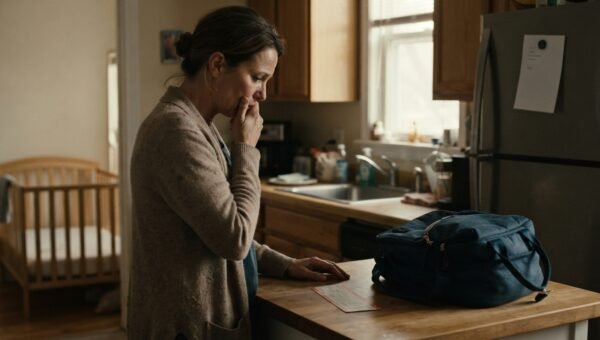
The silence from my boys started on a Tuesday in mid-October.
I called Mark on my way home from the grocery store to see if he and Sarah wanted to come over for Sunday pot roast. It went straight to voicemail, which was unusual for him at five in the afternoon, but I did not think much of it. Then I tried David after dinner to ask about his little girl’s preschool pageant.
He answered, but his tone was like ice water down my neck.
“David? Is everything okay?” I asked, setting down the dish towel.
“I can’t talk to you right now, Mom,” he said. His voice was shaking with anger. “I really just cannot believe you did this to Dad. Don’t call the house until you’re ready to be honest.”
He hung up before I could even draw breath.
When I called back, it went straight to voicemail. Mark never returned my message. For three days, I lived in this fog of panic, wondering if there had been some awful family misunderstanding or an accident nobody told me about. My husband, Robert, just sat in his recliner every night, watching the evening news and sighing heavily whenever I tried to show him my phone.
“Give them space, Brenda,” he said softly, looking down at his hands. “They’re just upset.”
“Upset about what, Robert? What could I have possibly done?”
He wouldn’t look me in the eye. That was the first warning bell.
We had been married for thirty-one years, and Robert had a tell whenever he was hiding something small, like a dent in the bumper or a late water bill: he stared hard at the carpet and swallowed repeatedly.
On Friday morning, I drove over to Mark’s house. I sat in his driveway until he walked out to get his mail in his work boots. When he saw my car, he turned around to walk back inside, but I got out and slammed the door.
“Mark Alan, you look at me right now,” I said, my voice cracking in the cold air. “What is going on? Why are you treating me like a criminal?”
Mark turned, his face tight and miserable. “You really want to play dumb out here on the lawn, Mom? Dad came over last weekend in tears. He showed us the empty IRA statements. Forty-two thousand dollars. Drained completely dry over the last eighteen months. He told us about the online casino accounts on your tablet.”
I stood on the sidewalk, my purse clutched in both hands, completely paralyzed.
“I don’t gamble,” I whispered. “Mark, I don’t even know how to download an app on that tablet. You set it up for my crossword puzzles.”
“Dad showed us the transaction logs, Mom. He covered for you until he couldn’t pay the property taxes. He asked us not to yell at you, but we can’t just pretend you didn’t blow your whole safety net.”
He walked inside and locked the deadbolt.
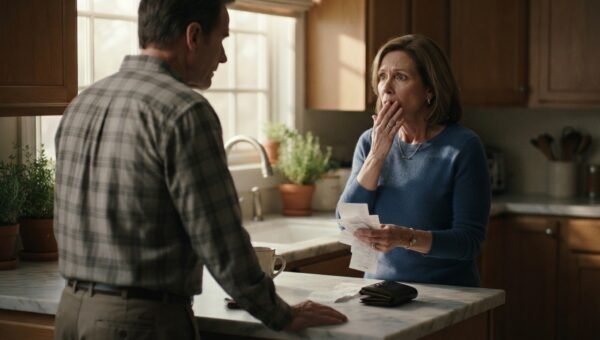
I drove home so fast my hands shook on the steering wheel. Robert was sitting at the kitchen table, an open bag of chips in front of him. I threw my keys onto the counter with enough force to crack the ceramic bowl.
“You told our boys I’m a gambler?” I demanded, the blood pounding in my ears. “You told Mark and David I blew forty-two thousand dollars from our retirement?”
Robert went pale. He stood up slowly, backing toward the refrigerator.
“Brenda, listen to me,” he stammered, putting his hands up. “I panicked.
I had to tell them something. The money was gone, and David was asking questions about why we couldn’t help with his down payment. I just needed time to fix it.”
“Fix what? Where did forty-two thousand dollars go?”
“I made bad investments,” he said quickly, his voice rising in that weak, frantic way it always did when he backed himself into a corner. “Penny stocks. High-risk trades. I lost it, okay? I was ashamed. I was going to put it back before you noticed.”
I looked at this man I had shared a bed with since 1993, and for the first time in my life, I didn’t believe a single word coming out of his mouth.
I spent that entire night at the desktop computer in the small back den. I pulled up our joint retirement account through the bank portal. The forty-two thousand had indeed been withdrawn in steady increments: two thousand dollars here, twenty-five hundred there, like clockwork over a year and a half.
Robert had told the boys the withdrawals went to digital poker sites, but the routing trails on the bank statements did not say DraftKings or Bovada.
They were wire transfers and direct ACH debits to an LLC called Riverbend Vault Holdings, located in an industrial park outside St. Louis, Missouri. Two hours south of our house.
I printed every single transaction. Then I printed the bank authorization forms Robert had used to move the funds, noting that he had forged my initials on three separate withdrawal confirmations.
At seven o’clock Saturday morning, without saying a word to Robert, who was still asleep in the master bedroom, I put the paperwork in a manila folder, got into my Buick, and took the highway south.
PART 2
The drive south on Interstate 55 was gray and cold. My mind kept trying to build a sensible explanation to keep from falling apart. Maybe Robert had rented a commercial bay for vintage cars or old farm machinery he thought he could flip. He had always talked about restoring a 1968 Chevelle. If he had squandered our life savings on rusted car parts and lied out of pure masculine pride, I would be furious, but we could survive it.
I pulled into Riverbend Vault Holdings around nine-thirty. It was a sprawling facility surrounded by chain-link fence topped with razor wire, tucked between a gravel quarry and an abandoned rail spur. Rows of corrugated metal buildings stretched out under the overcast sky.
The front office smelled like stale coffee and floor wax. A woman in her fifties with bifocals on a beaded chain sat behind a laminate counter, clicking away on an old keyboard.
“Good morning,” she said, barely glancing up. “Deliveries around back, pickups need a gate pass.”
I set my driver’s license and the printed bank transfer sheets down on the counter. “My name is Brenda Miller. My husband, Robert Miller, has been paying this facility twelve to fifteen hundred dollars a month for the past year and a half. I need to know what he is renting.”
The woman adjusted her glasses and looked at the papers, then pulled up her system. She typed for a moment, her brow furrowing.
“Robert Miller,” she muttered. “Yes, ma’am. He’s leasing unit one-eighteen. It’s one of our climate-controlled interior suites with dedicated electrical.”
“Dedicated electrical for what?”
“Well, the contract doesn’t specify what tenants keep inside, as long as it isn’t hazardous materials or living animals,” she said. She glanced at the screen again, then looked at me with a softer expression. “You’re listed right here as the secondary contact and emergency beneficiary on the primary agreement, Mrs. Miller. But you don’t have a key with you?”
“No,” I said, my voice steady only through pure willpower. “I don’t. But forty-two thousand dollars of our joint retirement paid for that door. I want to see inside.”
She hesitated for a long minute. Then she reached into a steel lockbox behind the counter, grabbed a master ring, and stood up. “Come with me.”
We walked through a heavy security door into a long, brightly lit corridor that smelled faintly of pine cleaner and dehumidifiers. We stopped in front of a gray metal door marked 118.
The clerk slid her key into the cylinder and turned it. The latch clicked open.
“I’ll give you a few minutes,” she murmured, taking a step back down the hallway.
I pushed the door open, reached to the wall, and flipped the switch.
Fluorescent lights buzzed to life overhead.
I stood frozen in the doorway. It was not a storage room. It was not filled with car parts, tools, or boxes of old business files.
It was a fully furnished bedroom.
Against the far wall sat a twin-sized bed made with pastel yellow sheets and a quilt covered in embroidered daisies. Next to the bed was a white wooden nightstand with a working lamp shaped like a sleeping fawn. On the nightstand sat an open storybook and a pair of small, pink-rimmed children’s glasses.
Along the right wall stood a low bookshelf filled with picture books, coloring pads, and boxes of twenty-four-count crayons. A small wooden wardrobe sat in the corner. When my trembling hand pulled the wardrobe door open, I found rows of little girls’ dresses, neatly pressed on child-sized hangers, sized from roughly 4T to 7.
Every single item was arranged with obsessive, terrifying precision. There was no dust anywhere. Robert had even brought in an air purifier, which was humming quietly in the corner, plugged into the dedicated wall outlet.
On the dresser beside the bed sat a silver-framed photograph.
I walked over, my legs feeling like lead pipes, and picked it up.
The photograph showed a little girl with light brown hair in pigtails, wearing a yellow sundress, sitting on the shoulders of a younger, laughing Robert. The picture was thirty-five years old.
I knew that picture because it used to sit on our mantel until Robert told me he had lost it during our move in 1996.
The little girl was Claire.
Claire was Robert’s daughter from his first marriage, before he and I ever met. She had died of leukemia at five years old, two years before Robert and I were introduced through mutual friends at our church. Robert had rarely spoken of her. Whenever her name came up in the early years of our marriage, he would shut down completely, change the subject, or leave the room. I had respected his grief, believing he had packed it away in the quiet corners of his heart the best he could.
Instead, he had built a shrine.
PART 3
I did not scream. I did not cry. A cold, heavy stillness settled over me as I walked around that concrete room.
On a small folding desk near the back, Robert had three thick ledger books. I opened the first one. It was filled with receipts dating back three years.
He hadn’t just put old belongings in this locker. Claire’s actual childhood belongings had been destroyed or given away by her mother decades ago; Robert had admitted that to me when we were engaged.
What was in this room was recreated.
The receipts showed he had spent thousands of dollars on vintage auctions, estate sales, and antique toy dealers online, hunting down exact duplicates of Claire’s childhood clothes, the exact edition of the storybooks she loved, and the exact model of the fawn nightlight.
He was buying back a ghost.
And because the monthly rental on an interior, high-security, climate-controlled vault in that facility was steep, combined with his obsessive spending on out-of-print 1980s toys and furniture, he had blown through his own savings and then systematically stripped our joint accounts to keep the lease current.
He had let our sons believe their mother was an untrustworthy addict rather than admit to the world, and to himself, that he had completely lost his grip on reality.
I took out my phone. I took wide photographs of the room from every angle. I took close-ups of the framed photo, the neatly made bed, the clothes in the wardrobe, and the ledger with the receipts taped inside.
I walked back out, nodded to the clerk who locked the heavy metal door, got into my car, and called David.
He answered on the third ring, his voice still tense. “Mom, I told you—”
“Be quiet, David,” I said, my voice so flat and authoritative that he stopped instantly. “I am sending you and your brother five photographs right now. Open your messages. Look at them. Then get in your car and meet me at our house in two hours.”
I hung up and sent the pictures to a group chat with both boys.
The drive home felt entirely different from the drive down. The panic was gone, replaced by a deep, sharp clarity. Robert had not made a financial mistake. He had executed a deliberate, cowardly trade: he sacrificed my reputation, my dignity, and my relationship with our children so he could keep visiting a dead child in a concrete box.
When I pulled into our driveway, Mark’s truck was already there. David’s car pulled in three minutes later.
Both boys got out of their vehicles. They were standing on the lawn, staring at their phones, looking pale and thoroughly confused.
“Mom,” Mark stammered as I walked up the walkway, key in hand. “What are these pictures? What is this place?”
“Come inside,” I told them. “Your father is in the living room.”
We walked through the front door together. Robert was sitting in his usual chair with a mug of coffee. When he saw me walk in flanked by our sons, his face drained of all color. He set the mug down so quickly it sloshed onto the side table.
“Brenda? Boys? What’s going on?” Robert asked, trying to force a lighthearted smile that failed completely.
I walked to the coffee table and dropped the manila folder right in the center.
“Unit one-eighteen at Riverbend Vaults,” I said clearly.
Robert stopped breathing. He looked at the folder, then up at me, his eyes widening with pure terror.
“I was there this morning, Robert. I saw the yellow quilt. I saw the fawn lamp. I saw the receipts where you spent eighteen hundred dollars for a vintage Sears dresser from 1988.”
Mark stepped forward, his jaw tight. “Dad, what is she talking about?”
“Robert,” I said, cutting him off before he could invent another lie. “Tell your sons why our retirement is gone. Tell them why you told them I was playing online roulette.”
Robert dropped his face into his hands. His shoulders began to heave, not with theatrical grief, but with the pathetic, shuddering sobs of a man who knows the walls have finally collapsed around him.
“I couldn’t lose her again,” Robert whispered into his palms. “They were going to tear down the old house where she lived with her mother. I started remembering… I couldn’t stop. I just wanted a place where she was still safe. Where nothing changed.”
David stared at his father, utterly bewildered. “Who? Who are you talking about?”
“Claire,” I said. “Your half-sister. Who died before you were born.”
David looked from Robert to me, and then the full weight of the deception hit him. He stepped back toward the foyer, looking at his father with an expression of disgust that cut deeper than any shouting match ever could.
“You let us treat Mom like dirt,” David said, his voice cracking with rage. “You looked me in the eye on my porch and told me Mom was a liar and a thief. You made us abandon her for a week so you could pay for a storage room?”
Robert looked up, tears streaming down his wrinkled cheeks. “I was going to tell her, David! I just needed time to get ahead of it—”
“You forged my initials, Robert,” I said, keeping my voice down to a level that made him flinch. “You committed financial fraud. You stole forty-two thousand dollars from our future, and then you tried to destroy my relationship with our sons to cover your own shame.”
“Brenda, please,” he begged, reaching out across the coffee table. “I’m sick. I need help. You know how hard it was when Claire died. We can get past this. We’ll downsize the house. We’ll pay it back.”
I looked down at his outstretched hand and didn’t feel an ounce of sympathy. Grief is a tragedy, but weaponizing it to ruin your wife and poison your children’s minds is a choice.
“Pack two bags, Robert,” I said. “You have thirty minutes before I call the sheriff.”
ENDING
Robert did not fight me on leaving. He could barely look at Mark or David as he stuffed clothes into an old duffel bag. When he walked out the door that afternoon, Mark didn’t even offer him a ride; Robert had to call his younger brother in Peoria to come pick him up from a diner down the road.
The following Monday, I sat in a divorce attorney’s office in town.
I handed her the complete paper trail: the bank statements, the forged initials, the rental agreement from Riverbend Vaults, the photographs of the unit, and the ledgers detailing his spending.
Because the money was indisputably dissipated from marital assets without my consent, my attorney went straight for the throat. In our settlement negotiations, Robert had no ground to stand on. The evidence of intentional financial fraud was overwhelming, and he was terrified that pushing back would lead to formal criminal charges for forgery.
We sold the family home six months later.
Under the terms of the settlement, I received the full forty-two thousand dollars taken off the top of the house proceeds before the remaining equity was split. Robert had to surrender all claim to my state teacher’s pension, and he was required to assume total legal and financial liability for the lease at Riverbend Vaults.
Mark and David spent the first few weeks after that awful day trying to apologize to me over and over. They felt sickeningly guilty for turning their backs on me so quickly, but I sat them both down at my kitchen table and told them the truth.
“He was your father,” I said. “You trusted him to tell the truth, just like I did for thirty years. He used your love against you. Do not let his sickness make you feel guilty for being human.”
It took time, but our family healed. They come over every Sunday now. Mark brings his wife, and David brings my granddaughter, Lily, who is six now and loves to help me roll out pie crusts on the counter.
About three months after the divorce was finalized, Robert’s brother called me. He told me Robert had finally let the lease go on unit 118 because he couldn’t afford the payments on his own in a small one-bedroom rental. Robert had donated the clothes and the furniture to a local children’s charity and moved into grief counseling.
His brother asked if I wanted to see Robert, just once, so he could apologize properly.
“No,” I told him gently. “Tell him I hope he finds peace with Claire. But he chose to live with a memory instead of the family that was standing right in front of him. I have living people to care for.”
I bought myself a small, sunny townhouse near the park with the proceeds from our home sale. The living room has big bay windows that let the morning light pour across the hardwood floor.
On my mantel, I don’t have secrets, and I don’t have locked boxes. I have pictures of my sons, their wives, and my granddaughter laughing in the sunshine.
Robert spent thousands of dollars trying to preserve the past in a dark, air-conditioned room. I chose to spend what I have left on the present, and for the first time in thirty years, the air in my home is completely clean.