Thirty-one years is a long time to look at the same face across a kitchen table. You learn the exact way the morning light hits the coffee pot at 6:15, and you learn how a silence can stretch across four rooms without needing a single word to prop it up. Or at least you think you do.
I found the gold band resting right on the porcelain rim of the bathroom sink.
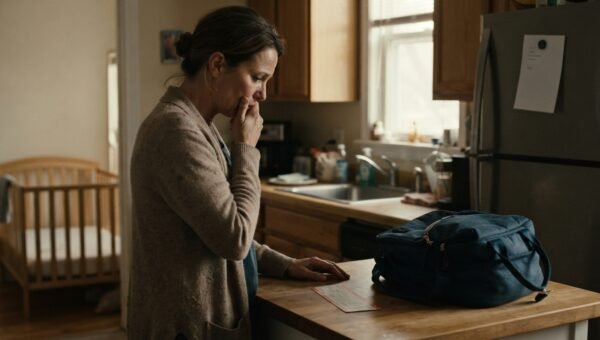
It was Tuesday morning, our anniversary, and the house had that terrible, hollow draft it gets when the front door has just clicked shut. There was no note taped to the refrigerator. There were no folded shirts left in the hamper. Just that little circle of polished yellow gold sitting next to the soap dish, cold to the touch.
Underneath it, she had left one small piece of hotel stationery with six words written in her neat, upright cursive. Please don’t follow me. That was all. No signature. No explanation about where she was heading or why thirty-one years of quiet mornings had suddenly ended before the sun was even fully up over the treeline.
I sat down on the edge of the bed and stared at the carpet for an hour. My brain wouldn’t lock onto anything solid. I went through our closets in my head, looking for missing luggage, missing coats, missing anything that would tell me if she had been planning this for months.
Her heavy winter coat was still hanging by the back door. Her sensible brown walking shoes were lined up under the bench. But her suitcase, the navy nylon one we bought in Bangor back in ninety-eight, was gone from the top shelf of the hall closet.
By Wednesday afternoon, the silence in the house felt physical, like a wet blanket pressing down on my chest. I called her sister in Portland, thinking maybe Clara had gone to stay with family to clear her head. Clara picked up on the third ring, her voice sharp and distracted.
“I haven’t seen her, Gene,” Clara said, and I could hear papers rustling on the other end of the line. “Is everything all right?”
“She left,” I told her, and my voice sounded thin even to me. “This morning. Well, Tuesday morning. She left her ring on the sink.”
Clara was quiet for a long second. Then she sighed, a heavy, tired sound. “I’m busy right now, Gene.
I’m sure she just needed some air. Call me later.” And she hung up before I could ask another thing.
That was my first mistake, trusting that tone of voice. I spent Thursday pacing from the living room to the kitchen, burning through a fresh pot of coffee every few hours, convincing myself of the one thing a man in his fifties doesn’t want to admit out loud. I thought about the man who lived down the road, the one who retired from the mill two years ago and whose wife had packed up and moved south after thirty years of what everyone thought was a solid marriage. I figured that was us. I figured Clara knew all about it and was covering for her.
The house smelled like stale coffee and old upholstery. I didn’t turn on the television. I just watched the shadows lengthen across the hardwood floor, moving from the south window to the baseboard heater, tracking the hours like a slow sentence.
My chest felt tight, the same dull ache I carried around for three years after we buried my mother back when I was forty. Caregiving leaves a mark on you. It makes you paranoid. It makes you assume the worst is always waiting just around the corner, ready to drop.
By Friday morning, I had worked myself into a blind, stubborn fury. The note said not to follow her, but the note didn’t own me. Thirty-one years doesn’t just get thrown away like a crumpled grocery receipt. I grabbed my keys off the hook, locked the front door behind me without packing a single spare shirt, and got into the truck.
It was a four-hour drive down to Portland, mostly interstate with long stretches of pine trees blurring past the windows. I kept my hands locked at ten and two on the steering wheel, my knuckles white enough to ache. Every time a silver sedan passed me in the fast lane, my foot twitched on the gas pedal. I didn’t have a plan. I didn’t know where I was going to look first. I just knew I couldn’t sit in that kitchen another minute listening to the refrigerator hum.
When I finally pulled into the parking lot of the medical center on the north side of the city, the afternoon sun was turning the glass front doors into blinding sheets of copper. I didn’t belong in a place like that. Hospitals have a specific smell of floor wax and rubbing alcohol that always makes my skin crawl.
I pushed through the heavy glass doors and walked up to the main reception desk, my boots clicking too loud on the linoleum. The woman behind the counter didn’t even look up from her screen right away.
“Can I help you?” she asked.
“My wife,” I said, my voice rough from three days of barely talking. “Her name is Clara. Or… my wife’s name is Martha. Martha Miller. She left home two days ago. I need to know what room she’s in.”
The receptionist tapped her keyboard for a moment, frowning at the monitor. “Are you immediate family?”
“I’m her husband.”
“Hold on one second.” She picked up her desk phone and muttered a few low words into the receiver. After a brief pause, she looked up at me with a strange, careful expression that I didn’t like at all. “Third floor. Room 314. Take the elevators to your left.”
I didn’t take the elevator. I took the stairs, my legs burning as I pushed through the heavy metal fire door onto the third floor. The hallway was quiet, lined with pale green walls and plastic chairs bolted to the floor. A nurse carrying a plastic tray of medicine cups nodded at me as she passed, her shoes squeaking softly against the floor tiles.
Room 314 was near the end of the hall. The door was half-open, a sliver of warm yellow light cutting across the dark hallway floor. I walked up slowly, my boots making no sound on the rubber runner, and pushed the door open just enough to see inside.
Martha was sitting in a low plastic chair right next the bed. Her back was to me, but I knew the slope of her shoulders anywhere. She was leaning forward, holding a very thin, very pale hand between both of hers. And in the bed, propped up against a stack of white pillows with a clear plastic tube taped to the back of her wrist, was my sister Clara.
I froze with my hand still flat against the wood of the door. My brain refused to assemble the pieces. Clara had told me on the phone just forty-eight hours ago that she was fine, that her routine scans were clear, that she was sitting at her kitchen table in Portland dealing with paperwork.
“Gene?”
Martha turned her head around, her eyes red-rimmed and hollow, and looked at me like she had seen a ghost. She didn’t look guilty. She just looked bone-tired, the way she had looked thirty years ago when we sat in the hospice waiting room watching the nurses change my mother’s sheets.
I stepped all the way into the room, my chest feeling like it was caving in. “What is this?” I asked, and the words came out harsher than I meant them to. “Clara told me her scans were clear. Why didn’t anyone call me?”
Clara tried to pull herself up against the pillows, her breath rattling a little in her chest. She looked smaller than she had last month at Thanksgiving, her skin gray and papery under the harsh fluorescent lights overhead.
Martha stood up slowly from the chair, her knees popping in the quiet room. She walked over to me, stopping just an inch short of touching my chest, and looked right up into my eyes.
“She made me promise not to tell you yet,” Martha said, her voice dropping to a low, steady whisper. “She didn’t want you going back under. Not after your mother.”
I looked from Martha to my sister in the bed, my throat tightening up so hard I couldn’t get the air down. “Going under? What are you talking about? She’s my sister.”
Clara reached out a thin hand from the blankets and tapped the small wooden bedside table with her fingernail. “I wasn’t the only one keeping something from you, Gene,” she said. Her voice was weak, but it had that old stubborn edge to it that hadn’t changed since we were kids sharing a bedroom in Augusta. “Look in the drawer.”
I reached out, my hand shaking just a little bit, and pulled open the small drawer of the hospital table. Inside sat a thick brown manila envelope with my name written across the front in Martha’s neat, upright hand.
I pulled it out, my fingers clumsy against the clasp. I didn’t open it right there in front of them. I backed up a step until my shoulders hit the cool wall of the hospital room, and I slid the heavy papers out into the light.
The top sheet was a medical report from the oncology department dated three weeks prior. The words aggressive recurrence stared up at me from the white paper in cold, clean print. Below it was a list of emergency contacts. Martha’s name was written there in Clara’s handwriting, underlined twice in blue ink. And beneath that was a folded sheet of lined notebook paper covered in Clara’s handwriting from top to bottom.
I unfolded the letter, my eyes jumping over the lines until I hit the middle of the page where she explained it all. She had known the cancer was back before our anniversary, but the doctors told her the aggressive treatment would require round-the-clock support. She knew how I broke down when our mother died, how every hospital visit and every stale cup of waiting room coffee sent me spiraling into months of sleepless nights and black panic. She had made Martha swear on her life not to tell me until the initial diagnosis was confirmed and a room was secured, choosing to face the first blow alone rather than drag me back into the dark place she knew I couldn’t survive twice.
“I didn’t want to ruin your anniversary,” Clara whispered from the bed, her eyes shining in the dim light. “Martha didn’t want to leave you either. But I couldn’t do the admission paperwork alone, Gene. And you weren’t strong enough to hear it on a Tuesday morning.”
I stood there in the middle of that sterile room with the papers heavy in my hand, and all the anger I had driven two states with just evaporated, leaving behind a hollow, aching sort of shame. They had protected me. They had taken my weakness as a given, and they had built a wall around me out of pure, stubborn love, even if it meant breaking my heart on our anniversary to do it.
Martha walked back over and put her hand gently on my forearm, her fingers warm through the sleeve of my shirt. She didn’t say I told you so. She didn’t apologize for walking out the door without an argument.
“We’re here now,” Martha said softly. “The doctor is coming back at four to go over the charts. We need to update the proxy forms so your name is on them too.”
I looked down at my wife, at the pale skin around her eyes and the tired set of her jaw where she had carried this awful secret all by herself for forty-eight hours of driving and crying and sitting in hard plastic chairs.
“I’m sorry,” I muttered, and my voice cracked right down the middle.
“Don’t be,” Clara said from the bed, her mouth twisting into a weak, familiar grin. “Just pull up a chair, Gene. You’ve got a lot of catching up to do.”
We stayed in that room until the sun went down behind the brick buildings across the street, turning the Portland skyline into a dark silhouette against a bruised purple sky. When the evening nurse came in to check the IV drips, Martha stepped out into the quiet hallway to talk to the doctor about the morning schedule.
I followed her out into the narrow corridor. The fluorescent lights hummed a low, steady note overhead, and the smell of floor wax was heavy in the air. Martha was standing by the tall wired window at the end of the hall, looking out at the parking lot where our truck sat parked under a flickering streetlamp.
Without a word, I reached into my jacket pocket, pulled out the gold band she had left on the porcelain sink Tuesday morning, and caught her hand before she could turn around.
She looked down as I slid the cool circle of gold back onto her finger, right where it belonged, fitting snug against her knuckle after thirty-one years of holding on. She didn’t pull away. She just leaned her head against my shoulder, and we stood there together in the quiet hall while the hospital settled in for another long night.