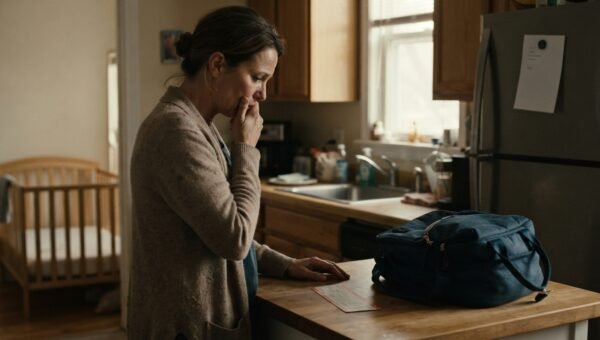
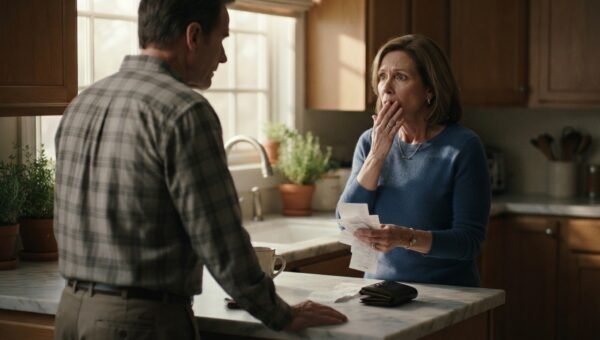
The house had that heavy, hollow smell that lingers after someone dies in a bed they haven’t left for six weeks. It wasn’t a bad smell, just old dust and faint rubbing alcohol and the lavender soap Helen always liked to keep in the little dish by the bathroom sink. I was standing at the kitchen counter trying to scrape dried oatmeal out of a cast iron pot when the front door rattled open and Linda walked right into the middle of my living room without knocking.
She didn’t take off her coat. She didn’t even look at me. She just dropped her leather handbag onto the dining room chair with a loud, deliberate thud and started pulling the cushions off the sofa one by one.
“Where is it?” Linda said. Her voice had that thin, sharp edge it always got when she didn’t get her way at church committee meetings. “I know she had that sapphire ring with the two small diamonds. And the gold locket from her grandmother. You’ve had her here for thirty-two days, Clara. I know how this works.”
I didn’t drop the sponge. I just kept my hands in the warm soapy water because my skin was already dry and cracking from washing Helen’s bedding twice a day for a month. “Linda, take your coat off and sit down. Your mother was buried yesterday afternoon. Can we at least get through the weekend?”
“Don’t play sweet with me,” Linda snapped, marching right up to the kitchen pass-through window and pointing a finger that was shaking just a little bit. “She had a safety deposit box key. I know she did. And since you two were the ones playing nurse while she couldn’t leave that mattress upstairs, you think you can just sweep everything into your own pockets.”
I looked at her face. It wasn’t even grief. It was just pure, pinched panic. Her eyes were darting toward the hallway closet where Helen’s winter coats were still hanging on their wooden hangers.
“Go ahead,” I told her, and my voice sounded flatter than I meant it to. “Look in the closets. Look under the bed. There’s nothing in there except a half-used bottle of lotion and some flannel sheets.”
She didn’t need my permission. She spent the next twenty minutes pulling plastic bins out of the hall closet and dumping them onto the floor.
She went through Helen’s old cedar chest in the spare room. She even checked the pockets of the housecoat hanging behind the bathroom door. When she didn’t find a single ring or loose bill, her face went tight and blotchy. She grabbed her handbag off the chair and jerked the front door open.
“This isn’t over, Clara,” she said, and the screen door slammed hard enough to rattle the cheap brass latch. “Mark my words. You haven’t seen the last of this.”
Then she was gone, and the house dropped back into that heavy, ringing silence. My husband, Arthur, came down the stairs a few minutes later, rubbing the back of his neck where he always got that red knot whenever his sister started in on him. He looked at the pile of winter sweaters Linda had left scattered across the hallway rug, and he just let out a long, slow breath.
“I’m sorry,” Arthur whispered. He didn’t look at me when he said it. He just looked at the floor. “She’s just… she’s been like that since our dad passed. Everything has to be accounted for. Every last nickel.”
“She thinks we stole her inheritance, Arthur,” I said, setting the iron pot down on the counter. “Your mother didn’t even have an inheritance to speak of, unless you count a ten-year-old Buick and a collection of ceramic teacups.”
“I know,” he said. He walked over and put his hand on my shoulder, but his palm felt cold. “Just leave it. We’ll go to the lawyer’s office on Monday and get the reading over with. Vance has the will. It’s all standard stuff.”
We spent the rest of that Saturday in near silence. I didn’t clean up the sweaters in the hall until Sunday morning because every time I looked at them, I could still hear the snap of Linda’s handbag closing. I was halfway through drinking my first cup of lukewarm coffee when the gravel in our driveway crunched under tires that didn’t sound like our neighbors’.
It was a dark grey sedan. A man in a light grey suit stepped out, carrying a heavy manila envelope that looked like it had been stuffed with thick cardboard. He didn’t knock on the screen door. He just laid it right on the center of the welcome mat and walked back to his car before I could even wipe my hands on my apron.
I opened the door and picked it up. It was heavy, thicker than a normal letter. The return address in the corner said Vance & Associates, Probate Law, over in Amarillo.
Arthur came into the kitchen, buttoning his flannel shirt. “What’s that?”
“Mr. Vance’s office,” I said, turning the envelope over in my hands. The paper felt expensive, the kind of heavy bond paper that costs fifty cents a sheet. “The courier just dropped it.”
I slit the top open with a butter knife because I couldn’t find the scissors. Inside wasn’t a packet of legal forms or a schedule for the reading. There was a short note typed on heavy letterhead, and underneath it, wrapped in a square of blue hospital flannel, was a piece of grey plastic tubing.
It was the cheap patient ID bracelet Helen had worn around her wrist during her final weeks at the county hospital down the road. They had cut it off her arm with orange-handled shears the day she came home to our spare room because she hated the feel of the plastic clicking against her skin. I remembered picking it up off the bedside table and tossing it into her wicker basket of keepsakes just so the cleaning staff wouldn’t throw it out with the trash wrappers.
I pulled it out of the flannel. It was just a loop of dull grey PVC with a faded barcode printed near the clasp. I almost dropped it back into the envelope to deal with later when I noticed the white plastic barrel in the middle of the band. It had tiny little ridges around the rim.
“What is that?” Arthur asked, leaning over my shoulder. The smell of his shaving soap was sharp in the small kitchen. “Why would Vance send you a hospital tag?”
“I don’t know,” I said.
My fingers felt clumsy as I tried to twist the white barrel. It was stuck tight, gummed up with old hospital soap or skin oil from the weeks Helen had worn it against her pulse. I had to use the corner of a kitchen towel to get enough grip on the plastic. With a small, dry snap, the barrel unscrewed.
Inside the hollow core wasn’t lint or dust. There was something dark and flat, no bigger than my fingernail. A micro SD card, the kind people put inside digital cameras or smartphones to hold thousands of photographs.
“Arthur,” I whispered, holding it up between my thumb and forefinger. “Look at this.”
He didn’t say anything. He just reached out and took the small black chip, turning it over in the palm of his calloused hand like it might bite him. “She kept a phone in her room the whole time she was here,” he muttered, his brow furrowing deep. “Linda said she didn’t know how to use anything newer than a flip phone, but… Mom had that old tablet her neighbor gave her for Christmas two years ago.”
“The one she said was too complicated,” I said.
“Yeah.” Arthur looked from the chip to the envelope on the table. “Get your laptop. The one from the kitchen desk.”
It took three minutes for the old machine to boot up, the fan rattling inside the plastic housing the way it always did when the battery was low. I plugged the small card adapter into the side port, and the screen flickered twice before a single folder popped up on the desktop. There was only one file inside. It was an MP4 video file named simply: *For_Arthur_and_Clara.mp 4*.
My finger hovered over the trackpad for five seconds. I didn’t want to click it. Part of me was waiting for Linda to walk back through the front door and start tearing through the drawers again.
“Play it,” Arthur said. His voice was lower than usual, almost a gravelly scratch.
I double-clicked the icon. The screen went black for a second, and then the camera shifted. It was shaky, filmed in the dim light of our upstairs guest room. The green plaid curtains were drawn tight against the afternoon sun, and the hum of the small oxygen machine was a steady, low rumble in the background.
Helen was propped up against two pillows. Her face looked small and grey, the way it always did toward the end, but her eyes were bright and hard as river stones. She wasn’t wearing her teeth, and her hair was tied back in a messy knot with a piece of blue yarn.
“If Linda is accusing you right now,” Helen said, and her voice on the laptop speakers sounded rougher and clearer than it had in her final week, “it means she found out I changed the beneficiary.”
I stopped breathing. The kitchen was so quiet I could hear the refrigerator compressor kick on down the hall.
On the screen, Helen shifted her weight against the pillows, wincing slightly as her shoulder hit the headboard. “She’s been coming in here every Tuesday for three months asking about the life insurance policy and the deed to the house down in Vernon. Asking if I’d signed the papers yet. She thinks because she’s the oldest she’s entitled to every cent I managed to salt away after your father passed, Arthur.”
She paused, looking directly into the lens of whatever tablet she had propped up against the water pitcher on her nightstand.
“She thinks I’m too confused to know what I’m doing,” Helen continued, and a dry, humorless little cough rattled in her chest. “She thinks she can bully the lawyer into giving her the whole pot before I’m even cold in the ground. Well, Mr. Vance is a very thorough man. I had him come out here two weeks ago while Linda was down in Dallas visiting her daughter. We signed the new papers right at this kitchen table while you were out at the feed store, Arthur.”
She raised one thin, blue-veined hand and tapped the plastic hospital bracelet resting against her wrist.
“I’m putting this little card right where she’d never look,” Helen said, her lips thinning into a straight, stubborn line. “She’ll tear this whole house apart looking for paper. Let her look. She won’t find a single signed document because Vance has the originals locked in his safe in Amarillo. Everything goes into the secure trust for Arthur and Clara. Not a dime for Linda until she learns how to treat people like family instead of debtors.”
The video didn’t have any background music. It just ended with the sound of Helen reaching out and tapping the lens with her fingernail to stop the recording. The screen went back to the blue desktop background with the rattling fan noise.
Arthur was staring at the screen. His mouth was slightly open, and his eyes didn’t move.
“She knew,” he said. He didn’t sound angry. He just sounded tired, like someone who had been carrying a heavy sack for ten miles and finally realized he didn’t have to hold it anymore. “She knew Linda was going to come here the minute she died and tear the place apart.”
“She planned the whole thing,” I said, looking down at the grey plastic bracelet sitting on the kitchen table beside my empty coffee cup. “She put the card inside the hospital tag on purpose because she knew Linda would search every drawer for paper, but she’d never touch a piece of hospital trash.”
“We have to call Vance,” Arthur said, reaching for his phone on the counter. “We need to make sure those files are actually in his safe before Linda gets to his office tomorrow morning.”
“She’s already going there,” I said, remembering the way Linda had slammed our screen door. “She told me this isn’t over.”
The meeting at Mr. Vance’s office on Monday morning smelled like floor wax and old leather. The blinds were drawn against the bright Texas sun, casting long, dusty stripes across the heavy walnut conference table. Linda was already sitting there when we walked in, her purse clutched in her lap like a shield, her face flushed red from the drive. Mr. Vance sat at the head of the table with a thick manila folder opened in front of him, his glasses perched on the very tip of his nose.
“Arthur. Clara,” Mr. Vance said, nodding once. He didn’t smile. Lawyers in small towns don’t usually smile when they’re dealing with family estates. “Linda has been telling me about some missing jewelry and some alleged irregularities concerning the primary designation on your mother’s estate.”
Linda didn’t wait for us to sit down. She leaned forward over the table, her knuckles white where she gripped the leather strap of her purse. “They took it,” she said, her voice rising two notches above normal conversation. “Mother wasn’t in her right mind during that last month. She didn’t know what she was signing. And now they’ve cleaned out her accounts while she was lying in their spare room.”
Mr. Vance looked at her over his glasses. He didn’t look surprised. He looked like a man who had seen this exact same scene forty times a year for thirty years.
“Mrs. Miller,” Vance said calmly. “Your mother was very clear about her wishes when we updated the file on the fourteenth of last month. She was fully competent. I have the medical clearance form from her physician right here in the file, signed four days before the change was recorded.”
“That’s a lie,” Linda snapped, her voice cracking just a little bit. “She didn’t know anything about trusts! She wanted everything split three ways between me, Arthur, and the church fund. You let them manipulate her!”
I didn’t yell. I didn’t lean across the table the way she did. I just reached into my coat pocket, pulled out the small black micro SD card, and laid it right in the center of the walnut table, right beside Mr. Vance’s legal papers.
“What is that?” Linda said, her eyes dropping to the tiny piece of plastic. “What is that supposed to be? More of your garbage?”
Mr. Vance picked it up with two fingers, looking at it through his glasses with mild curiosity. “Is this what I think it is, Clara?”
“Helen left it in her hospital bracelet,” I said quietly. “She told us to bring it here if Linda started making trouble.”
Arthur reached out and plugged the small USB reader we had brought with us into the side of Mr. Vance’s desktop computer by the corner of the table. It took only a few seconds for the file to load on the office monitor. Mr. Vance turned the screen slightly so Linda could see it.
The video started playing before anyone could say another word.
Helen’s voice filled the small, quiet office, sharp and clear. *“If Linda is accusing you right now, it means she found out I changed the beneficiary…”*
Linda stopped breathing. I could see the exact second the color drained out of her face, leaving her skin looking like old parchment under the fluorescent office lights. She didn’t move. She didn’t reach for her purse. She just stared at the screen as her mother’s voice explained, point by plain point, exactly why she was being cut out of the primary distribution.
When the video ended, the room stayed dead silent for five long seconds. Even the traffic outside on the main street seemed to quiet down.
Mr. Vance closed the manila folder with a slow, deliberate thud. He didn’t look at Linda. He just looked at Arthur and me.
“The documentation is entirely sound,” Vance said, his voice flat and professional. “The trust is registered, the primary beneficiary designation was executed according to all state guidelines, and the video testimony establishes clear intent in the event of any legal challenge.” He slid the folder across the table toward Arthur. “Everything is in order.”
Linda sat there for another moment, her mouth slightly open, before she stood up so fast her chair scraped against the linoleum floor with a sharp, ugly screech. She didn’t say a word. She didn’t look at Arthur, and she didn’t look at me. She grabbed her handbag, turned on her heel, and walked out of the office, the front door swinging wide behind her and letting in a rush of hot, dusty wind from the street.
We didn’t see her for six months after that. We didn’t get cards at Christmas, and she didn’t call when Arthur had his appendix out in the spring. The house was quiet in a way it hadn’t been since before Helen moved into the spare room, but it was a different kind of quiet. It was the sound of a heavy door finally locking from the inside.
That evening, after we got back from Amarillo, I set the empty plastic hospital bracelet down on the kitchen windowsill right beside a fresh cup of coffee. The little white barrel was still unscrewed, showing the dark, hollow center where the truth had been hiding all along. The sun was going down behind the pasture fence, turning the window glass the color of old amber, and the kitchen finally smelled like coffee and nothing else.