PART 1
My sister-in-law Linda stood on my front porch three days after the funeral and told me I was a thief.
She didn’t lower her voice, and she didn’t care that our neighbors across the street were out raking leaves. She had her purse tucked tight under her arm, her car engine was still ticking in my driveway, and she pointed a manicured finger right at my chest.
“You had her in this house for four weeks, Karen,” Linda said. “Mom had her mother’s sapphire ring, the gold rope chain, and two diamond brooches when she moved in here.
Don’t play dumb with me. They weren’t in her dresser at the hospice wing, and they weren’t in her safe-deposit box. You took advantage of a dying woman.”
My husband, David, was still at work. His mother, Evelyn, had passed away on a Tuesday morning holding my hand while David was stuck in traffic on the interstate. For the last month of Evelyn’s life, my spare bedroom had smelled like rubbing alcohol, peppermint tea, and lavender lotion. I had washed her nightgowns every night. I had crushed her pain medication into applesauce. Linda had visited twice, both times for less than fifteen minutes, complaining each time that the house felt stuffy.
“Linda, she didn’t bring jewelry here,” I said, leaning against the doorframe because my lower back still ached from lifting Evelyn in and out of bed. “She came here straight from the hospital with one small suitcase. You packed that suitcase yourself.”
“I packed what she asked for, but she had a black velvet pouch,” Linda snapped. “She wouldn’t leave that behind. I want to look through her room right now. If you have nothing to hide, you won’t stop me.”
A younger version of me would have slammed the door in her face. But I was fifty-eight years old, completely exhausted, and hollowed out from grief. David had been quiet and fragile since the service, and the last thing I wanted was for him to come home to another screaming match between his sister and me. I stepped back and opened the door wider.
“Go ahead,” I told her. “Look wherever you want.”
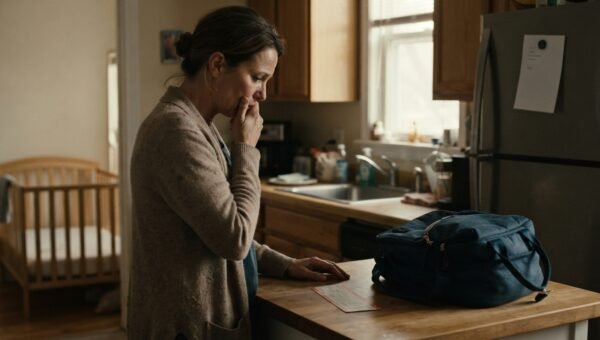
Linda marched past me without wiping her boots on the mat. She went straight back to the guest room. For twenty minutes, I stood in the kitchen with my hands wrapped around a mug of lukewarm coffee, listening to drawers sliding open and closet hangers scraping against the metal rod.
She checked under the mattress. She unzipped the empty duffel bag in the closet. She even went through the bathroom medicine cabinet, rattling prescription bottles.
When she finally walked back into the living room, her face was red and blotchy. She was furious because she hadn’t found a single piece of gold.
“You hid it somewhere else,” she said, her voice shaking with bitter certainty. “You’re slick, Karen. You always acted like the devoted daughter-in-law, but you knew she had assets. Just wait until the probate attorney calls us. If you pawned my mother’s things, I’ll have the sheriff at your door.”
She slammed my front door so hard the glass pane rattled in its frame.
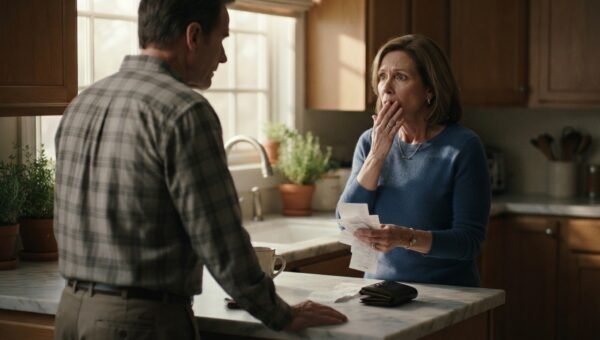
David came home an hour later. When I told him what happened, he sat down at the kitchen table, put his face in his rough hands, and just sighed. He was a good man, but he had spent his entire life avoiding Linda’s tantrums.
Their father had walked out when they were teenagers, and Evelyn had raised them alone by working double shifts at the county billing office. Linda had grown up believing she was owed something for every hardship she ever endured.
“I’m sorry, Karen,” David whispered. “She’s just hurting. She thinks having Mom’s things will make up for… well, everything.”
“She called me a thief in our front yard, David,” I said gently.
He didn’t answer. He just reached across the table and squeezed my fingers.
The next afternoon, a courier pulled into our driveway in a plain white sedan. He brought a padded manila envelope that required my signature. The return label had the printed address of Miller, Vance & Cole, an elder law firm in town that I knew Evelyn had used years ago when she drafted her original will.
Inside the envelope was a folded legal document and a small, clear plastic bag containing a cheap turquoise plastic beaded bracelet.
I recognized that bracelet immediately. Evelyn had worn it on her left wrist during her final two weeks. It was the kind of five-dollar trinket you buy at a beach souvenir stand, strung together with thick elastic cord. One of the hospice aides had offered to cut it off when Evelyn’s hands started swelling, but Evelyn had pulled her arm away and refused to let anyone touch it. I had assumed it was a gift from one of her church friends.
I dumped the contents onto the kitchen counter. The legal note was brief, signed by a paralegal named Sarah, stating that per Evelyn Miller’s written instructions, the enclosed personal effect was to be delivered directly to Karen Miller upon the conclusion of memorial services.
I picked up the bracelet. The plastic beads were scuffed and dull. I held it over the kitchen trash can, ready to toss it. It seemed ridiculous that an attorney had used a paid courier to deliver a piece of junk to my house.
Then my thumb brushed across the largest turquoise bead in the center.
It wasn’t smooth like the others. It had a tiny seam running around the middle. Curious, I held the bead between my fingernails and twisted. It didn’t pop off; it unthreaded like a miniature screw cap.
A tiny black rectangle slid out into the palm of my hand.
It was a micro SD card, no bigger than my fingernail.
My heart thumped against my ribs as I walked over to the desk in the corner of the room, pulled out my laptop, and slipped the card into the adapter. There was only one file stored on the drive. It was an MP4 video file named simply: *For Karen.*
I clicked it.
The screen flickered, and then Evelyn’s face appeared. She was propped up against the pillows in my guest room, wearing the pale blue nightgown I had washed for her a dozen times. The lighting was gray, coming from the window that overlooked our backyard garden. She was holding a tablet computer propped on her knees, looking straight into the lens. Her breathing was shallow, but her eyes were clear and steady.
“Karen,” Evelyn said, her voice thin and dry. “If Linda is accusing you right now, it means she found out I changed the beneficiary.”
PART 2
I stared at the screen, my hands resting frozen on the edge of the keyboard.
Evelyn paused in the recording to take a sip of water from the plastic cup with the bent straw that always sat on her nightstand. I remembered that cup. I remembered filling it with crushed ice the morning she made this.
“Linda thinks she’s clever,” Evelyn continued, her voice gaining a little bit of that old, firm rhythm she used when she worked the billing desk. “Two months ago, right after the doctor told me the treatments weren’t doing any good, Linda took me to the credit union. She told me we needed to put her name on my accounts so she could pay my medical bills. She brought paperwork. She told me David was too soft to handle the money and that you had enough on your plate.”
Evelyn gave a tired, dry chuckle that ended in a soft cough.
“She didn’t know I still had my reading glasses in my purse. I looked at that signature card. She wasn’t asking to be an authorized signer. She was trying to transfer my $84,650 annuity directly into a joint survivorship account under her name only. She wanted to cut David out entirely. When I refused to sign, she stopped taking my calls. That was when she dropped me off at the hospital and told the nurses she couldn’t manage me at home anymore.”
The video shook slightly as Evelyn adjusted the tablet on her lap.
“Linda took my mother’s jewelry four years ago, Karen. She told me she was putting it in her safe for safekeeping because my neighborhood wasn’t safe anymore. She sold the brooches two summers ago to pay off her credit cards. I never told David because I was too ashamed of how I raised her. But you took me in. You didn’t ask for a dime, and you cleaned up after an old woman who couldn’t even walk to the bathroom.”
Evelyn leaned closer to the camera.
“The annuity had Linda listed as the sole beneficiary from years ago, back when David was going through his divorce and didn’t want anything in his name. Linda thought that form was locked in stone. But Mr. Vance came to this room three days after I moved in with you. I changed the beneficiary on the entire $84,650 annuity. Fifty percent to David, and fifty percent to you, Karen. Directly. It bypasses probate. It doesn’t touch the estate.”
Evelyn reached up and touched the plastic turquoise bracelet on her wrist.
“Sarah at the law office helped me put this together. I told her not to mail this until after I was gone, because I knew Linda would show up at your door looking for blood the second the credit union told her she wasn’t on the policy. Don’t let her bully David, Karen. He has a soft heart, just like his father did. You keep him steady.”
The screen went black.
I sat in the quiet living room for ten minutes without moving. All the pieces snapped together in my mind with sudden, cold clarity. Linda hadn’t come to my house looking for sentimental heirlooms. She had come to my house looking for leverage. She had gone to the credit union or called the insurance company right after the funeral, expecting an $84,650 payout, only to be told that her name wasn’t on the file anymore. In her panic and greed, she assumed Evelyn must have hidden cash or jewelry in my house to replace what she lost.
Around five o’clock, David’s truck pulled into the driveway. He walked through the kitchen door carrying his lunch pail, looking worn down by another long day at the warehouse.
“David,” I said, standing up from the desk. “Sit down. There’s something you need to hear.”
He looked at the laptop, then at the manila envelope, and his shoulders tensed up immediately. “Karen, if Linda called you again, I’ll handle it. I promise. I’ll tell her to back off.”
“She didn’t call,” I said. “Your mother left us something.”
I turned the laptop toward him and hit play.
Watching my husband’s face while his mother spoke from the grave was one of the hardest things I’ve ever done. When Evelyn talked about Linda taking the jewelry four years ago, David closed his eyes and leaned his forehead against his fist. But when Evelyn explained how Linda tried to trick her at the credit union into signing over the money, David’s head snapped up.
“She tried to take Mom’s annuity?” he muttered, his voice barely audible. “Mom was paying for her prescriptions on a credit card, and Linda tried to take her savings?”
“Listen to the rest,” I told him.
When the video finished, David didn’t say anything for a long time. The house was dead quiet except for the hum of the refrigerator.
“All these years,” David finally said, looking at the tiny black card on the desk. “I thought Linda was just loud. I thought she was just high-strung. I gave her Mom’s car after the service because she cried and said she couldn’t afford a new transmission. She looked me in the eye at the cemetery, Karen, and told me Mom promised her everything.”
Before I could answer, David’s cell phone began to buzz on the table. The screen lit up with Linda’s name.
PART 3
David looked at the phone. It buzzed three times against the wood. In the past, he would have let it go to voicemail, waited two hours to gather his courage, and then called her back with an apology just to keep the peace.
This time, he reached out and picked it up. He put it on speaker.
“David?” Linda’s voice came through sharp and breathless. “Did you talk to your wife yet? Because I just got off the phone with the annuity administrator at the state board. They’re telling me there was an amendment filed last month. Last month, David! When Mom was out of her mind on morphine! Karen had an attorney sneak into that house, didn’t she? That’s elder abuse. That’s fraud. I am entitled to that policy, and if you two think you’re keeping a single cent of that $84,650, I will drag you through every court in this county!”
David didn’t shout. His voice was lower and steadier than I had ever heard it.
“Mom wasn’t on morphine when she signed it, Linda. She was sitting in the armchair eating oatmeal.”
“Don’t take her side!” Linda yelled. “You don’t know what Karen did behind your back! She manipulated Mom while she was weak!”
“Mom made a video, Linda,” David said plainly.
The line went completely dead for four seconds.
“What?” Linda’s voice dropped an octave, the false confidence cracking instantly.
“Mom made a video before she died,” David repeated. “The law firm sent it to Karen today. Mom told us about the trip you took her on to the credit union two months ago. She told us how you tried to make yourself the sole owner of her accounts while she was sick. She told us about her mother’s sapphire ring and the diamond brooches you took from her four years ago and pawned.”
“That’s a lie,” Linda stammered, but the fury had drained out of her voice, replaced by raw panic. “Mom was confused. She forgot where she put things. I would never—”
“Mom wasn’t confused,” David said. His hand on the table had curled into a tight fist, but his voice stayed level. “She knew exactly who you were. And she knew exactly what you’d do the minute she died. That’s why she had Mr. Vance come to our house with a notary. That’s why the paperwork is airtight.”
“David, please,” Linda said, her tone shifting into a whiny plea. “You know how tight money has been for me since the divorce. Mark hasn’t paid child support in four months. I took care of Mom for years before she got bad! You can’t just cut me out of eighty thousand dollars! We’re brother and sister!”
“You didn’t care about brother and sister when you tried to take that money for yourself, Linda,” David said. “You were going to take the whole $84,650 and leave me with the funeral bill. You didn’t even offer to pay for the flowers.”
“I was going to split it with you later!” she cried. “I was just trying to protect it from taxes!”
“Don’t lie to me anymore,” David said. “It’s over.”
“If you don’t share that check, David, I swear to God you will never see me or my kids again!” she screamed. “You’re choosing her over your own blood!”
David looked up from the phone and looked directly at me. He looked at my tired eyes, the gray hairs I hadn’t had time to dye while caring for his mother, and the cheap plastic bracelet sitting on the desk.
“Karen took care of our mother when you couldn’t be bothered to stay for ten minutes,” David told the phone. “She is my family. Do not come to this house again. If you step on our property, I won’t argue with you. I will call the police.”
David hit the red button on his screen and set the phone face down.
The silence that followed wasn’t heavy; it was clean. It felt like the air in a room after a storm finally breaks a heatwave. David stood up, walked around the table, and pulled me into his arms. He buried his face in my shoulder, and for the first time since his mother died, he let himself cry. Not with the polite, quiet tears he shed at the church, but with deep, ragged sobs that shook his entire body.
I held him tight and let him grieve both of them: the mother he had lost to cancer, and the sister he had lost to greed.
ENDING
Two weeks later, the paperwork arrived from the insurance company.
The total balance of Evelyn’s annuity was $84,650. David and I each received a check for $42,325.
We didn’t buy new cars, and we didn’t go on an extravagant vacation. We paid off the remaining $4,200 from Evelyn’s funeral expenses, which Linda had completely ignored despite taking our mother’s 2014 Buick. We put $20,000 into our home equity balance to knock out the last of our second mortgage, and we placed the rest into a high-yield savings account to serve as our emergency cushion for retirement.
Linda tried calling David twice more from different numbers over the following month. When he didn’t answer, she sent a long, rambling text message accusing us of poisoning the family and claiming she was hiring an attorney to contest the beneficiary change.
David forwarded the text directly to Mr. Vance. The attorney sent Linda a single certified letter stating that the beneficiary designation was legally executed, witnessed, notarized, and accompanied by video evidence establishing Evelyn’s complete mental competency. The letter warned her that any further harassment of David or me would result in immediate legal action, including an inquiry into the conversion of the missing jewelry.
We never heard from Linda again. Her kids, who were already in college, reached out to David around Thanksgiving. They didn’t mention the money, and David didn’t bring it up; he just made sure they knew his door was always open to them.
On a chilly Saturday morning in November, I finally finished cleaning out the guest room. I washed the curtains, stripped the sheets, and packed away the small medical supplies we hadn’t used.
I took the tiny micro SD card and slipped it into an envelope labeled with Evelyn’s name, storing it in our fireproof lockbox alongside our deed and birth certificates.
Then I picked up the plastic turquoise bracelet.
I didn’t throw it away. I washed the scuffed plastic beads with warm water and dish soap, dried it carefully with a paper towel, and set it on the wooden dresser next to Evelyn’s framed photograph.
It wasn’t made of gold, and it didn’t have any sapphires or diamonds. But to me, it was worth far more than anything Linda had ever stolen. It was the proof that in her final days, an old woman had seen through the noise, protected the son who loved her, and left her truth in hands she knew she could trust.