PART 1
My daughter moved back into my spare bedroom six months after her divorce, carrying two suitcases and a box of winter coats. She sat at my kitchen table on that first cold October night and laid her hands flat on the oilcloth. She told me right then that she did not want a dime from me. She said she had let her ex-husband manage every dollar for twelve years, and she was never going to be a burden to anyone again.
I believed her. Within three weeks, Laura had a job answering phones at a dental clinic two miles down the road. Every Friday, she walked into the kitchen with two brown bags of groceries, set a carton of whole milk and my brand of decaf coffee on the counter, and refused to let me hand her cash. When the downstairs toilet started running in November, she went down to the hardware store herself, bought the flapper, and fixed it with an adjustable wrench. Watching her put her life back together was the greatest relief I had felt since my husband, Frank, died six years ago. I thought my home had become a safe place for both of us.
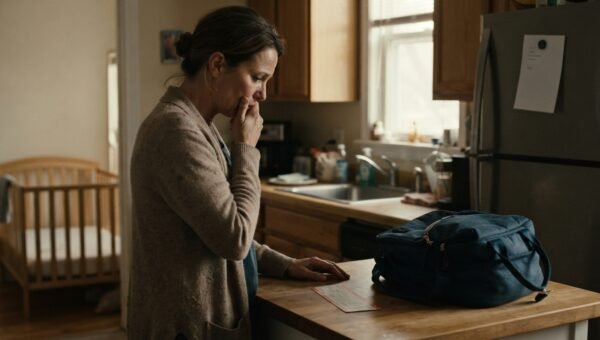
Then, on a Tuesday afternoon in early February, I pulled the heavy white microwave away from the wall to wipe down the grease splatters behind the stove.
Tucked into the tight gap between the microwave feet and the yellow tile backsplash were three thick white envelopes.
They had been bent in half so they would not stick out. Every single one of them was addressed to me, in bold black capital letters, with red warning boxes printed across the front.
My hands began to shake before I even slit the first flap.
The first notice was from a bank I had never stepped foot inside, demanding payment on a credit card balance of $11,200. The second was a final demand notice on a personal installment loan for $8,400. The third was another credit line, past due ninety days, showing an overdue balance of $5,000.
The balances totaled $24,600.
My mouth went completely dry. I had lived on my modest pension, Social Security, and Frank’s small annuity for six years without missing a single payment on anything. I did not carry credit card debt. I paid my gas bill on the second of the month and my water bill on the fifth.
I looked at the counter where Laura set her purse every evening when she walked in the door. I looked at the microwave where she heated her lunch soup every morning before heading to the clinic. She was the only person living in this house with me. She was the one who picked up the mail from the box out on the curb every afternoon before I even got my shoes on.
When her blue sedan pulled into the driveway at twenty past five, I was standing in the middle of the kitchen with all three notices fanned out across the table.
Laura walked through the door with her coat half-unbuttoned, smiling with a small paper bag of bakery rolls in her hand. The smile dropped off her face the second she saw my eyes.
“Mom? What is it?”
“You tell me,” I said, my voice shaking so hard it sounded like someone else speaking. “You told me you didn’t want my money, Laura.
You told me you were going to be independent. And all this time, you were sliding my mail behind the appliances while you ruined me?”
She dropped her purse on the floor. She did not yell back. She stepped toward the table, squinted at the papers, and picked up the top letter with two fingers, as if it might burn her.
“Mom, what are you talking about?” she whispered. “I found these in the mail pile two weeks ago. I slid them back there because I didn’t know how to bring it up. I thought these were Dad’s old debts you were hiding from me.”
“Your father has been dead six years,” I shouted, tears stinging my eyelids. “Frank never took out a personal loan in his life! Look at the dates, Laura! Look at the top right corner!”
She pulled the paper closer to her face. Her eyes scanned the printed lines, and then she stopped breathing.
“May of last year,” she said quietly. “And September.”
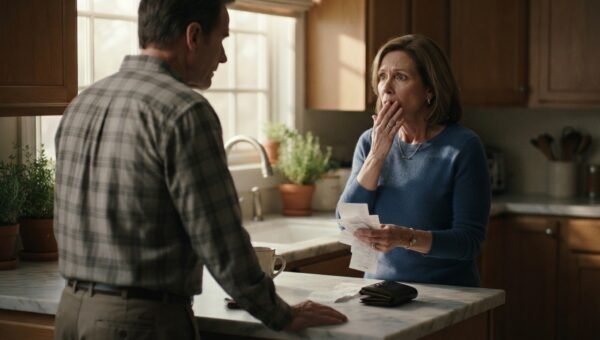
“I never opened them,” I said, leaning against the counter for support. “Somebody used my Social Security number. Somebody took twenty-four thousand dollars in my name, and the mail was hidden in my kitchen.”
Laura did not look defensive anymore. She looked sick. She grabbed her laptop from her work bag, sat down in her winter coat, and opened the browser.
“Sit down, Mom,” she said, her voice dropping into a tight, focused register I had never heard from her before. “We’re pulling your official credit report right now. We’re going to see where the statements were going before they started landing in this mailbox.”
We sat side by side in the glow of the screen for twenty minutes, answering identity questions about old street names and vehicle registrations. When the full report loaded, Laura clicked on the active open accounts.
Under the mailing address for the $11,200 credit card, the screen did not show my little house on Maple Street. It showed an apartment number on Elmwood Avenue, three towns over.
It was the address of my thirty-four-year-old son, Kevin.
PART 2
The room went so quiet that the hum of the refrigerator sounded like a drill.
Laura did not move her hand from the mouse pad. She stared at the address on Elmwood Avenue, her jaw set so tight a tendon stood out in her neck.
“Kevin,” she whispered.
“No,” I said instantly, the word coming out before my brain could process it. “There’s a mistake. The credit bureau has old addresses crossed up. Kevin is working in logistics. He has a salary. He bought a new truck last spring.”
“Mom,” Laura said, turning the laptop screen an inch closer to my face. “Look at the employer line on the loan application.”
Listed under secondary contact and reference was Kevin’s cell phone number. The email address on the personal loan account was a variation of Kevin’s first and middle name, registered through a free email provider. And the start date of the first credit card was May 14 of the previous year, exactly two weeks after Kevin had come to my house alone on a Sunday afternoon to help me clean out Frank’s old metal filing cabinet in the basement.
I remembered that Sunday with terrible clarity. Kevin had brought me a box of blueberry muffins. He had told me to sit upstairs and rest my knees while he carried the heavy tax folders upstairs. He had spent two hours down in that cool basement by himself, sorting through Frank’s folders, laughing whenever he found an old receipt from the hardware store. Before he left that evening, he had hugged me tightly by the front door and told me I was doing great on my own.
My stomach twisted into a hard knot. My son had not been helping me. He had been looking for my Social Security card, my date of birth, and my banking history.
“Why were the bills coming here?” I asked, my voice barely audible. “If the statements went to his apartment, why did these notices end up in our mailbox?”
Laura clicked through the payment history tabs. Her fingers tapped rapidly on the keyboard.
“Because he stopped paying,” she said, pointing a finger at the red payment markers running along the grid. “He made the minimum payments for four months from an online account. Then in November, the payments stopped completely. When an account goes ninety days delinquent, the collection departments run a skip-trace on the primary Social Security number. They found your legal residence. They started mailing the default warnings directly to the house.”
She looked at me, her eyes filled with a mixture of anger and grief.
“I took the mail out of the box three weeks ago,” Laura said softly. “I saw ‘Final Notice’ on bank envelopes addressed to you. My first thought was that Dad had secret debts before he died and you were too proud to ask for help. I was scared to confront you while I was staying here for free. That’s why I shoved them behind the microwave until I could figure out what to say. I swear to you on Dad’s grave, Mom, that’s the only reason.”
I looked at my daughter, who had scrubbed my kitchen floor on her hands and knees two days ago, and then I looked at the three red notices on the table. The shame that rushed through me was so thick I could hardly breathe. I had accused the child who was buying my milk and fixing my plumbing, while my golden son was sitting in an apartment thirty miles away, letting twenty-four thousand dollars of bad debt fall directly onto his widowed mother’s head.
“Call him,” Laura said. Her voice was flat, without an ounce of warmth.
“Not on the phone,” I said, standing up on stiff knees. “We are not doing this over a telephone where he can hang up and make an excuse.”
“Then get your coat,” Laura said.
We drove thirty miles north on the highway in complete silence. The windshield wipers swept a steady crust of road salt across the glass. I kept my purse clutched in my lap, with the credit reports and the three demand letters folded inside a manila folder against my ribs.
Kevin lived in a modern brick complex with manicured bushes and a row of covered carports. His dark grey truck was parked in spot 42, clean and shiny under the amber parking lot lights.
We walked up the outdoor stairs to the second floor. Laura stood right behind my shoulder. I did not knock gently. I hit the hollow wood with the flat of my fist three times.
The lock clicked. The door swung open, and Kevin stood there in sweatpants and a grey t-shirt, holding a half-empty bottle of soda. He had the television playing sports in the background.
“Mom?” he said, blinking in surprise. “Laura? What are you guys doing here? Is everything okay?”
I did not wait for an invitation. I stepped past him into his warm, carpeted hallway, pulled the manila folder from my coat, and dropped the three red envelopes onto his glass dining table.
“You need to explain this to me, Kevin,” I said. “Right now.”
He looked down at the envelopes. For one second, his face went completely blank. Then his posture slouched, his shoulders dropping forward, and he would not look me in the eye.
He didn’t ask what the papers were. He didn’t ask why we had them.
He already knew.
PART 3
“Mom, please,” Kevin said, lowering his voice as if someone else were in the apartment. “Keep your voice down. Let’s just sit down and talk.”
“I am not sitting down in your apartment,” I said. My voice was steady now, cold and clear in a way that surprised even me. “There is twenty-four thousand six hundred dollars in debt in my name. The credit card was opened with your address. The phone number on the file is your cell phone. Did you do this?”
Kevin ran both hands over his face, pressing his palms hard against his temples. He walked over to the kitchen counter, leaned his weight against it, and stared at the floor.
“I was in over my head, Mom,” he said, his voice cracking. “Last winter, the company cut our logistics bonuses. I was behind on the truck payments. I had three maxed-out store cards from when I furnished this place. I thought I was going to lose my vehicle, and if I lost the truck, I couldn’t get to the distribution center for work.”
“So you went into my basement?” I asked. “You ate my food, smiled in my face, and stole my information out of your dead father’s metal box?”
“I was going to pay it back!” he shouted, suddenly defensive, looking up with red-rimmed eyes. “I never intended for you to see a single bill! I paid on it every month all summer! I had a plan to transfer the balance to an LLC once my credit score bumped up, but then the interest rates jumped and the minimums doubled, and I just couldn’t keep up. I was drowning!”
Laura stepped forward from the hallway, her coat still zipped to her chin.
“You were drowning, so you decided to drown Mom instead?” Laura said, her words cutting through the air like a knife. “She’s sixty-eight years old, Kevin. She lives on twenty-one hundred dollars a month. If these accounts go to court, they can put a lien on the house. Did you think about that while you were buying fancy leather seats for your truck?”
“Shut up, Laura!” Kevin snapped, his face flushing dark red. “You moved back home because your own marriage failed! You’re living off her right now! Don’t you stand there and act holy!”
“She buys the groceries!” I yelled, stepping directly between them. “She fixes my pipes! She works forty hours a week and looks me in the eye every single morning! Do not speak to your sister like that in front of me!”
The silence returned, heavy and ugly. Kevin looked away, staring out the sliding glass door toward the dark parking lot.
“What do you want me to do?” he asked, his tone turning sullen, like a teenager caught breaking curfew. “I don’t have twenty-four grand sitting in checking. If you report it to the police as fraud, they’ll arrest me, Mom. You’ll give your own son a felony record. Is that what you want? To put me in jail over money?”
That was his play. I saw it as clearly as if it were written on the wall. He had counted on my maternal instinct. He had gambled that an aging mother would swallow the debt, deplete her emergency fund, or let her credit rot into the ground rather than see her son handcuffed. He had used my love for him as his personal insurance policy.
I looked at him. I saw the little boy who used to skin his knees on the driveway, but standing in front of me was a grown man who had decided his mother’s old age was worth sacrificing for his own comfort.
“No,” I said quietly. “I am not going to jail for you, and I am not going to let you destroy the house your father worked thirty years to pay off.”
I took a pen out of my purse and set it on the glass table next to the demand letters.
“Tomorrow morning at nine o’clock, you will meet Laura and me at the main branch of First National Bank in town,” I told him. “You will bring the title to that truck in your driveway. You will apply for a debt consolidation loan with the truck as collateral, under your name alone, and you will use the proceeds to pay off every single penny of these three balances. If the bank will not give you the full amount on the truck, you will sign a notarized confession of judgment and a repayment agreement drafted by an attorney, and you will sell that vehicle by Friday.”
Kevin stared at me, his mouth open. “I need the truck for work, Mom. I can’t just sell it.”
“Then you can buy a five-hundred-dollar beater car like your sister drives,” I said. “And if you are not standing outside the bank doors at eight-fifty-five tomorrow morning, I will walk straight into the police station across the street, file a full identity theft affidavit with your address and phone number attached, and hand over the credit reports. Do you understand me?”
He looked at my face, searching for the soft mother who always smoothed things over at Thanksgiving. He found nothing.
“I understand,” he muttered, dropping his head.
“We will see you at nine,” Laura said.
We turned around and walked out into the cold night air.
ENDING
The next morning, the temperature was twelve degrees, and the wind off the lake rattled the street signs outside the bank.
Kevin was standing on the sidewalk when Laura and I pulled up at ten minutes to nine. He was wearing his heavy work jacket, his hands shoved deep into his pockets, his eyes swollen from lack of sleep. He had the blue paper title to his truck held in his left hand.
It took three hours inside the bank manager’s office. The bank would not cover the entire $24,600 against the used truck alone, but they approved a personal loan against the equity for $16,000. For the remaining $8,600, the branch notary watched Kevin sign a legally binding confession of judgment and an automatic wage deduction agreement, pledging $450 every month directly to an escrow account set up to clear the remaining balance.
When the manager pushed the final set of papers across the desk, Kevin signed his name with a shaking hand. He didn’t look at Laura, and he barely looked at me.
We walked out into the bright winter glare together.
“Are you happy now?” Kevin asked me on the sidewalk, his voice bitter and thin. “I have to sell the truck anyway to make these payments. You basically ruined me, Mom.”
“You did this to yourself in my basement, Kevin,” I told him gently. “I just refused to carry the weight of it for you.”
He turned and walked toward his vehicle without saying goodbye. He did not call the following Sunday. He did not come over for Easter. His automated payment of $450 arrived in the escrow account on the first of March, and another arrived on the first of April, exact to the cent.
Laura stayed in my spare bedroom for another fourteen months. She paid half the electric bill every month, helped me plant the garden along the back fence in May, and saved enough money from her clinic job to put a deposit on a sunny two-bedroom apartment near her office.
On the morning she moved out, after we carried her last suitcase down the porch steps, we came back inside to drink a final cup of coffee together at the kitchen table. The house felt large and quiet, but it was a peaceful quiet, free of secrets and unspoken fears.
Laura rinsed her mug in the sink, set it on the drying rack, and turned to look at me.
“You know,” she said, leaning against the counter, “we never did paint that yellow tile behind the stove.”
I smiled, picked up my sponge, and wiped down the clean, empty counter where the microwave sat squarely against the wall, hiding nothing.
“Leave it yellow,” I told her. “It reminds me of who is standing in my corner.”