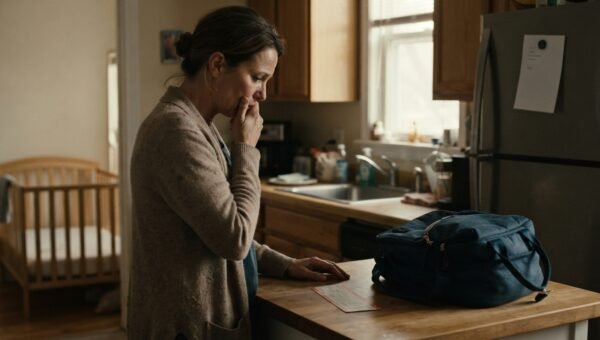
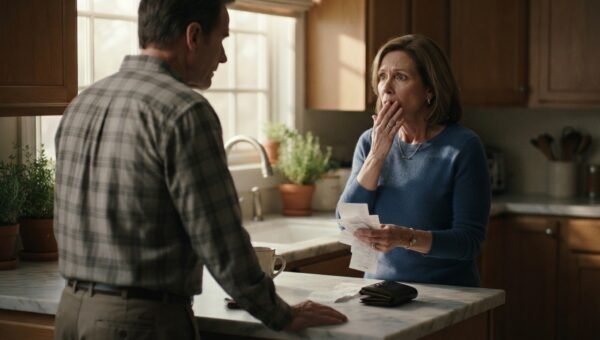
PART 1
My sister Brenda spent thirty years telling anyone who would listen that I was Dad’s favorite. Every holiday dinner, every family picnic, she found a way to work it into the room. If Dad asked me to pass the potatoes, Brenda would smirk and roll her eyes. If he commented on the weather to me first, she would lean across the table and say, “Well, of course Amy gets the first word. Amy’s the golden child.”
The truth was completely the opposite. Dad and I couldn’t sit in the same room for twenty minutes without an argument.
We clashed over everything. He was a retired machinist who believed every dollar had to be pinched until it bled, and I left home at nineteen to work in county administrative offices and raise my daughter on my own. When I bought my first used sedan, he told me I paid six hundred dollars too much. When I took a weekend shift to cover dental bills, he told me I lacked planning. We fought constantly, with sharp, stubborn words that left long silences between us.
Brenda was the daughter he actually spoke to. She lived four miles down the road from his small brick ranch in Canton, Ohio. She called him every single Sunday at six in the evening without fail. Whenever his gutters needed cleaning or his furnace made a rattling sound, Brenda was the one who stopped by with her husband, Greg.
Whenever Dad needed groceries during a snowstorm, it was Brenda’s car in his driveway. I was lucky if Dad picked up the phone once a month when I checked in, and even then, our conversations rarely lasted past five minutes.
So on the Tuesday after his funeral, when his estate attorney called us into his office and read the will, the room went dead silent.
Dad had left the house entirely to me.
Brenda was left nothing. Not a piece of furniture, not a savings bond, not a dime. The house wasn’t a mansion, but it was paid off, solid brick on a half-acre lot, worth roughly two hundred and twenty thousand dollars in our area.
Brenda jumped out of her chair before the attorney, Mr. Henderson, even finished reading the final paragraph. Her face turned dark red.
“You manipulated him,” she screamed at me, pointing a shaking finger directly between my eyes. “You miserable snake!
You stayed away for years, barely showed your face, and somehow you got him to change the paperwork behind my back! I took care of him! I checked on him every week while you lived your own life!”
“Brenda, stop,” I said, holding both hands up. My stomach was churning so hard I thought I was going to throw up on the mahogany desk. “I didn’t know anything about this. Dad never said a single word to me about the will. Not once.”
“Don’t lie to me!” she yelled. Greg tried to put a hand on her shoulder, but she jerked away from him. “He promised this house to us. He promised it to my boys. You stole my mother’s dining table, you stole his garage, and you stole our family home. You make this right, Amy, or I swear to God you are dead to me.”
She stormed out, slamming the heavy office door so hard the glass pane rattled in its frame.
Greg gave me a look that was half pity and half disgust, then hurried down the hallway after his wife.
I sat there alone with Mr. Henderson. I was fifty-four years old, tired down to my bones from two weeks of hospice care and funeral arrangements, and I felt completely sick. I had spent my whole life feeling like the outsider in Dad’s eyes, the daughter who never measured up, the one who constantly disappointed him. Now I had his house, and Brenda had every right to feel furious. As far as the whole family could see, Brenda had been the dutiful, loving daughter, and I was the distant child who somehow walked away with the prize.
“Mr. Henderson,” I said, my voice shaking. “Can I just give it to her? Can I sign a quitclaim deed or whatever it’s called? I don’t want this. I don’t want a family war over real estate. Brenda was the one who called him every Sunday. She was the one who was there.”
I reached for my purse, ready to sign whatever paper would hand the deed straight to my sister and end the nightmare right there.
Mr. Henderson took off his reading glasses and set them down on the desk. He didn’t look surprised by Brenda’s outburst, but his eyes were unusually quiet.
“Amy,” he said carefully. “Before you sign anything or make any legal decisions, you need to wait. Your father left specific instructions regarding his safe-deposit box at First Citizens Bank. He instructed that the box must be opened in your presence, and that no property transfers are to be executed until you review the contents.”
“Is there money in there?” I asked, confused. “Because if there’s money, that should go to Brenda too.”
“I don’t know what’s in the box,” Mr. Henderson said. “Only your father had the key, and the bank holds the duplicate. But he paid my retainer specifically to accompany you there. Meet me at the branch tomorrow morning at ten o’clock. Promise me you won’t sign any transfer documents until then.”
I hesitated, but I agreed.
The next morning, it was raining hard when I pulled into the bank parking lot on Market Avenue. Mr. Henderson was already waiting under the green awning, carrying his leather briefcase. We walked in, signed the visitor logs, and were escorted downstairs by a bank officer into a small, windowless viewing room with gray carpet and fluorescent lights.
The officer set the long, narrow metal box on the laminate table, clicked open the lock with his key and Dad’s key, and left the room, pulling the door shut behind him.
I stared at the metal container. My hands were trembling as I lifted the lid.
There were no savings bonds inside. There was no cash, no jewelry, and no stock certificates.
There was only a single, heavy accordion folder tied shut with a frayed red elastic band. Inside the folder was a thick, neatly organized stack of canceled personal checks, all drawn on Dad’s primary checking account, spanning eighteen years.
Every single check was made out to Brenda.
I began flipping through them, my thumb catching on the dry paper edges. Five hundred dollars. Twelve hundred dollars. Three thousand dollars. Seven hundred and fifty dollars. Two thousand dollars. The dates started in the late 1990s and ran straight through until six months before Dad entered hospice.
I pulled out the very last check in the stack. It was dated November 14th of last year, written in Dad’s uneven, shaky handwriting for four thousand two hundred dollars.
In the bottom left corner, in the little line reserved for notes, Dad had written four words that made the room completely tilt:
“Final payment for what happened to Amy.”
PART 2
I stared at those six words until the blue ink seemed to blur into the paper.
“Final payment for what happened to Amy.”
Amy was my name. I was sitting in that gray basement room with cold hands, staring at my own name written on a check my father gave my sister less than a year ago.
Mr. Henderson leaned over the table, adjusting his reading glasses to look at the slip of paper. He didn’t speak. He pulled a yellow legal pad and a pocket calculator out of his briefcase, and without a word, he began sliding the checks toward himself one by one.
For forty-five minutes, the only sound in the room was the soft rustle of paper and the rhythmic click of calculator keys. I sat frozen, watching the stack on the left shrink and the stack on the right grow.
When he finished, Mr. Henderson drew a double line under his figures on the yellow pad. He turned the pad toward me.
“Two hundred and forty-six thousand, eight hundred dollars,” he said quietly. “Over eighteen years.”
The number hit the table like a lead weight. Two hundred and forty-six thousand dollars. Dad’s entire house, the brick ranch on the half-acre lot that Brenda had screamed I stole from her, was appraised at two hundred and twenty thousand. Brenda hadn’t been left out of Dad’s estate. Over the last eighteen years of his life, she had already collected more than the entire value of his property.
“What happened to me?” I whispered, my voice sounding hollow in the small room. “What is she being paid for?”
“I don’t know, Amy,” Mr. Henderson said honestly. “Your father hired me two years ago to draft his final will. When I asked him why he was excluding Brenda, he told me that Brenda had already received her inheritance in installments. He refused to give me details. He simply told me that the proof would be in the box, and that when the time came, you would understand.”
“I don’t understand,” I said. “I don’t understand any of this.”
I took the folder home in a brown paper grocery bag, holding it tight against my coat as I walked through the rain to my car.
My phone had three missed calls from Brenda and two long, angry text messages from Greg, demanding to know when we could meet at the title company so I could sign over the deed. I didn’t answer them. I drove back to my small duplex, carried the bag into my kitchen, and spread the checks across my dining room table by year.
The pattern was unmistakable. The checks started in the fall of 2005. That was the year my life had fallen apart.
Back in 2005, I was thirty-three years old, working as an administrative assistant at the county courthouse, and raising my ten-year-old daughter, Chloe. I had been saving every spare dollar for five years to put down on a small cottage near the city park. I had twelve thousand dollars in an envelope in my closet, cash I had pulled from paychecks and side cleaning jobs. And then, during a weekend when I was out of town attending my best friend’s wedding in Cincinnati, someone broke into my apartment.
They didn’t touch my television. They didn’t take Chloe’s small stereo. They went straight into my bedroom closet, pulled down the shoebox behind my winter boots, and took the twelve thousand dollars.
When I came home on Sunday evening and found the shoebox empty, I fell to my knees on the floor. I called the police, but there was no forced entry. The deadbolt hadn’t been picked; the back window was cracked open from the inside, but the police officer told me it looked staged. He asked me who had a key.
Only two people had keys to my apartment back then: my father, and my sister Brenda, who occasionally watched Chloe after school.
The next day, Dad came to my apartment. I remembered that afternoon with agonizing clarity. We stood in my small kitchen, and for the first time in my life, I saw real fury in his eyes. But it wasn’t directed at the burglar. It was directed at me.
“You’re careless, Amy,” he had barked at me, his voice rough and harsh. “Keeping cash in a shoebox like an idiot. What kind of mother does that? You probably left the door unlocked. You probably bragged to some stranger about having savings. You threw your own money away, and now you want everyone to feel sorry for you.”
We had a screaming fight right there in front of the empty closet. I accused him of having no heart, of always finding a way to make every tragedy my fault. He told me that if I couldn’t manage twelve thousand dollars, I didn’t deserve to buy a house. He walked out, slammed my door, and from that day on, our relationship became a battlefield of short words, defensive phone calls, and mutual resentment.
Two months later, Brenda bought a newer minivan and put a down payment on the house she still lives in today. At the time, she told everyone that Greg had received a surprise bonus from his machining plant. Nobody questioned it.
Now, sitting at my kitchen table nineteen years later, I looked at the first canceled check in Dad’s folder.
It was dated October 18, 2005. Exactly three weeks after the break-in at my apartment.
It was made out to Brenda for twelve thousand dollars.
In the memo line, Dad had written: “Loan repayment.”
My hands went completely numb. I pulled out a magnifying glass from my junk drawer and began examining the rest of the checks, tracking the dates against the calendar of our family’s life.
After that first check in 2005, the checks didn’t stop. They came every few months. Some were for five hundred dollars, some for two thousand. In 2011, when Brenda’s oldest son started college, there was a check for seven thousand dollars. In 2016, when Greg was laid off for six months, there were four separate checks for fifteen hundred dollars each.
And on the memo line of almost every third check, Dad had written cryptic, jagged notes in his stiff handwriting:
“Keep your word.”
“Per our agreement.”
“This has to be the last one.”
“For silence.”
The story was laying itself out in front of me, check by canceled check, year by year. Dad hadn’t thought I was careless. Dad had known exactly who took my twelve thousand dollars.
He had found out it was Brenda.
To protect Brenda, or to protect the family from the shame of a daughter being arrested for grand theft, Dad had stepped in. He had reimbursed Brenda, or covered for her, or bought her silence. But then something far worse had happened.
The payments hadn’t ended in 2005. Brenda had realized she had leverage over him. She had turned that shameful theft into an eighteen-year shakedown. Every Sunday phone call wasn’t an act of devotion; it was an audit. Every visit to clean his gutters or check his furnace was a reminder of what she held over his head.
My phone rang on the kitchen counter. The screen lit up with Brenda’s name.
This time, I didn’t ignore it. I picked up the phone, pressed talk, and put it to my ear.
“It’s about time you answered,” Brenda snapped, her voice tight and aggressive. “Greg talked to a real estate attorney this morning. He says if you don’t sign a voluntary deed transfer by Friday, we have grounds to contest the will on undue influence. You were alone with Dad in hospice his last three days. People will testify to that.”
“Brenda,” I said, keeping my voice as steady as I could manage. “Come over to Dad’s house tonight at seven. Just you and Greg. I’ll have the paperwork ready.”
“Good,” she said, sounding instantly smug. “I’m glad you finally came to your senses.”
She hung up without saying goodbye.
PART 3
I arrived at Dad’s empty house at six o’clock to turn on the lights.
Walking through the front door felt different this time. The smell of his old Prince Albert pipe tobacco still lingered in the wool curtains, mixed with the faint scent of lemon wax from the side tables. For decades, I had walked into this house feeling like a trespasser, bracing myself for his criticism, wondering why he had loved my sister so easily while treating me like an unpaid bill.
Now, looking at the worn recliner where he used to sit by the window, the truth felt far heavier than anger.
He hadn’t favored Brenda. He had been trapped by her.
He had spent eighteen years paying a quiet, humiliating ransom to his own child, watching his retirement savings drain away five hundred and a thousand dollars at a time, just to keep a family secret from blowing up. And all those Sunday evening calls that I used to envy? Dad wasn’t enjoying a warm chat with his loving daughter. He was waiting for the phone to ring so she could tell him how much she needed to keep the peace.
At ten minutes past seven, Greg’s truck pulled into the gravel driveway.
Brenda marched through the front door carrying a blue folder under her arm, with Greg trailing a step behind her. She didn’t take off her coat. She walked right into the dining room where Dad’s heavy oak table stood under the brass chandelier.
“We brought a standard quitclaim deed,” Brenda said, tossing the blue folder onto the center of the table. “We have a notary who lives two streets over. We can walk down, get it stamped, and be done with this whole ugly mess. You do this, Amy, and we can go back to being a normal family.”
“Sit down, Brenda,” I said.
“I don’t need to sit down. Just sign the paper.”
“Sit down,” I repeated, and something in my voice must have sounded different, because Greg glanced at me, pulled out a chair, and sat. Brenda hesitated, crossed her arms, and dropped into the chair opposite mine.
I didn’t reach for her blue folder. Instead, I reached down to the floor, picked up Dad’s heavy accordion folder, and set it on the table between us. I untied the red elastic band.
“What is that?” Brenda asked, frowning.
“This was Dad’s safe-deposit box,” I said. “Mr. Henderson and I opened it yesterday morning.”
Brenda’s posture stiffened immediately. Her eyes darted from the folder to my face, then down to the table. “There wasn’t supposed to be anything in that box except his old war medals.”
“No medals,” I said. “Just canceled checks. Every single check Dad wrote to you from October 2005 until November of last year.”
Greg looked up, his forehead wrinkling. “What checks?”
Brenda didn’t answer him. Her eyes were fixed on the paper in front of me.
“Two hundred and forty-six thousand, eight hundred dollars, Greg,” I said, looking directly at my brother-in-law. “That’s what’s in this box. Over eighteen years.”
Greg turned his head toward his wife. “Brenda, what is she talking about? Your dad gave you small loans here and there, five hundred bucks for the kids’ band trips. What is two hundred and forty-six thousand dollars?”
“Shut up, Greg,” Brenda whispered, her teeth clenched.
“No, don’t shut up, Greg,” I said. I slid the very first check across the table. It stopped right in front of Greg’s hands. “Take a look at the date on that one. October 18, 2005. Twelve thousand dollars. That was three weeks after someone stole my life savings out of my bedroom closet. That was the down payment on your house, wasn’t it?”
Greg picked up the check. His face went entirely blank as he read the amount, then the date, then Dad’s signature.
“Amy, I swear to you,” Greg stammered, his voice cracking. “Brenda told me her dad gave us an early inheritance gift. She said he wanted us to buy the house on Elm Street so the kids would have a yard. She said he insisted on it.”
“He didn’t insist on it,” I said, looking straight into Brenda’s eyes. “Did he, Brenda?”
Brenda didn’t flinch. The panic that had flashed across her face for three seconds vanished, replaced by a cold, venomous glare.
“You think you’re so smart,” she hissed, leaning across the table. “You always thought you were better than me because you went to community college and got an office job while I stayed home with babies. Dad had money. He had a full pension from the plant, he had savings, and he was sitting on this house completely paid off. You were always preaching about independence and how you didn’t need anybody. Well, I needed help! We had three kids, Greg’s back went out twice, and Dad had more than enough to go around!”
“So you stole twelve thousand dollars from your own sister?” I asked, my voice barely above a whisper. “From Chloe? When we were eating macaroni and cheese three nights a week?”
“I was going to borrow it!” she snapped, not even trying to deny it anymore. “I knew you had the cash sitting in your closet doing nothing. I took it, and when you went completely hysterical and called the cops, I panicked. I went to Dad. I told him what I did, and I told him that if he didn’t cover for me, your precious police officer was going to fingerprint the window and I was going to jail with a toddler in diapers.”
She scoffed, crossing her arms again.
“And Dad did what a father is supposed to do,” she said bitterly. “He protected his family. He paid you back through me, and then he realized that keeping our family together meant helping the child who actually gave a damn about him.”
“Keeping the family together?” I asked. I slid the final check across the table. The one from November.
Greg looked down at it. He read the memo line out loud, his voice trembling: “‘Final payment for what happened to Amy.'”
Greg dropped the check on the table like it burned his fingers. He looked at his wife with pure disgust. “You blackmailed your own father.”
“I didn’t blackmail anybody!” Brenda screamed, slamming her hand on the oak wood. “He offered! He knew how hard things were for us!”
“He didn’t offer, Brenda,” I said quietly. “He kept every single check. For eighteen years, he documented every penny you squeezed out of him. He kept the receipts because he knew that one day, he wouldn’t be here to protect himself from you anymore. He didn’t leave you out of the will to be cruel. He left you the house in cash, eighteen years early. And he gave me the deed so that for once in my life, you couldn’t take the roof from over my head.”
Brenda sat there breathing heavily, the blue folder still untouched between us.
“You can take your deed and your notary and leave,” I told her. “If you file one single paper contesting this will, Mr. Henderson will file this entire folder with the probate court. Every canceled check, every memo line, and an itemized accounting of two hundred and forty-six thousand dollars in undeclared personal transfers. And then we can let the probate judge and the IRS decide whether that was an early inheritance or extortion.”
Brenda stared at the checks on the table. She looked at Greg, waiting for him to defend her, to threaten a lawsuit, to say anything.
Greg didn’t say a word. He stood up from his chair, pushed it neatly under the table, and walked out the front door into the rain. A moment later, his truck engine started.
Brenda grabbed her purse and her blue folder. She didn’t look at me as she reached the hallway.
“You ruined this family,” she spat, her voice shaking with rage.
“No, Brenda,” I said, looking at the empty dining room around me. “You just finally ran out of Dad’s money.”
She slammed the door on her way out, exactly like she had done at the lawyer’s office. But this time, the glass didn’t rattle. The house just went quiet.
ENDING
I stayed in Dad’s house for three hours after they left.
I didn’t pack anything, and I didn’t clean. I just walked through the rooms with a dust rag, wiping down the window sills and the tops of his bookshelves.
In the living room, next to his old recliner, there was a small wooden side table where he kept his reading glasses, a pad of grid paper, and an old brass desk lamp. I opened the small drawer beneath the lamp. Inside was a roll of electrical tape, a box of wooden matches, and a small, worn photograph of me and Dad at the county fair when I was nine years old.
I was holding a blue ribbon from the 4-H sewing competition, and Dad was standing behind me with his hand resting on my shoulder, looking stiff and uncomfortable in front of the camera, but smiling just enough around his pipe.
I sat down in his recliner and held that photograph in my lap until the rain stopped tapping against the window panes.
All those years, I had hated him for his harshness. I had hated the way he snapped at me after the break-in, the way he picked fights over car repairs and grocery bills, the way he seemed to push me away whenever I tried to get close. I thought he was cold. I thought he was disappointed that I wasn’t the sweet, attentive daughter Brenda pretended to be.
Sitting in that quiet house, I finally saw the truth for what it was.
Dad wasn’t mad at me that day in my kitchen nineteen years ago. He was furious at himself. He was ashamed that he had raised a child capable of stealing from her own sister, and he was too proud and too broken to admit that he had failed to fix it. Every harsh word he threw at me over money for two decades wasn’t criticism. It was the bitter, helpless anger of a man who was watching a bully bleed him dry while the daughter he actually respected worked two jobs to pay her own way.
He couldn’t bring himself to confess it to my face. He was an old-fashioned machinist who didn’t know how to say, *I was weak, and I let your sister rob us both.*
So he built an accounting instead. He built a paper trail, check by check, year by year, waiting for the only day he could finally set the ledger straight without having to look me in the eye and watch me see his shame.
The probate process finished four months later without a single objection from Brenda.
Greg moved out of their house in July. From what my cousin told me, they are working through a quiet legal separation, and Brenda has had to put their home up for sale to settle debts Greg refused to carry. She hasn’t called me, and I haven’t called her. Some bridges are burned so clean that there isn’t even ash left to sweep away.
Last week, I moved my furniture into the brick ranch on the half-acre lot.
Chloe, who is twenty-nine now and working as a physical therapist in Cleveland, came down for the weekend to help me paint the kitchen. We chose a warm, light yellow to replace Dad’s faded beige.
On Sunday evening, exactly at six o’clock, the kitchen was quiet. The wall clock above the stove gave its steady, rhythmic tick. For thirty years, that was the hour Dad’s phone would ring, the hour he would pick up the receiver and listen to Brenda’s demands disguised as family affection.
The phone on my counter stayed completely silent.
I poured two mugs of black coffee, handed one to my daughter, and sat down at the oak table. The house was solid, the deed was in my name, and for the first time in eighteen years, nobody owed anyone a single thing.