PART 1
The suitcases were supposed to stay in our guest room for six weeks while my mother-in-law looked for an apartment. Her name is Evelyn. She sold her condo out in Canton back in April, banked the equity, and told my husband, David, that she wanted to downsize near us. She said six weeks was plenty of time to find a nice quiet senior garden unit with low maintenance.
Ten months later, she was still in our hallway bathroom every morning at 6:30, using my towels and leaving the shower curtain pulled back so the floor soaked through.
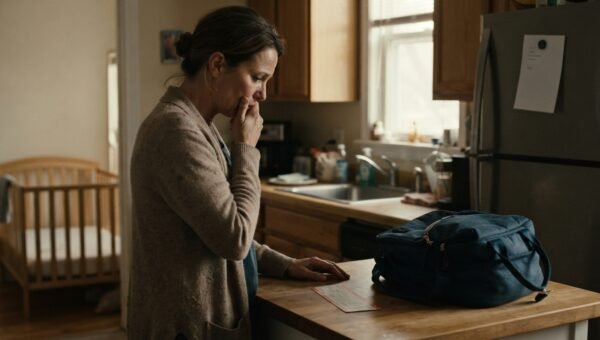
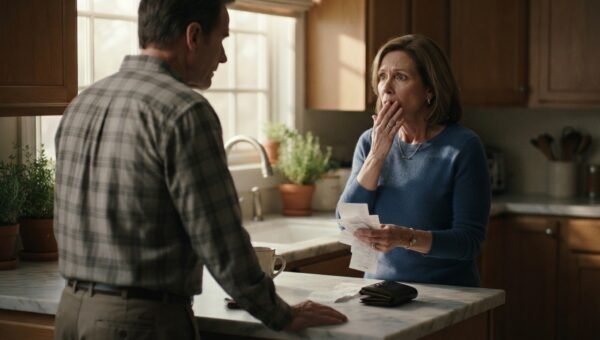
She did not act like a houseguest. By month three, she had moved her extra boxes into our garage, rearranged the pantry so none of the school snacks were where our two daughters could reach them, and started meeting the mail carrier at the curb. I came home from my shift at the clinic one Tuesday and found three of my medical bills and a letter from our mortgage lender already slit open on the kitchen island.
When I asked her why she was cutting open mail addressed to me, she smoothed down her cardigan and said, “I live here, Helen. In a proper household, family does not keep secrets about expenses.”
David never backed me up. If I brought it up after the girls went to sleep, he walked into the kitchen, poured cereal into a bowl, and stared at the kitchen cabinets.
He would tell me that Evelyn was seventy-two, that her knees bothered her when it rained, and that she had sacrificed plenty for him growing up. He made it sound like asking for a move-out date was the same as pushing his mother onto the interstate in the winter.
The break came on a Thursday night in February. I found Evelyn standing in the dining room over my fourteen-year-old daughter, Chloe, telling her that the shorts she wore to volleyball practice made her look cheap. Chloe was crying at the table with her homework pushed aside.
I did not yell. I took Chloe by the arm, walked her up to her bedroom, shut the door, and waited for David to pull into the driveway.
When he walked in, I met him in the laundry room before he could even take off his work boots. I kept my voice low so the girls would not hear.
I told him Evelyn needed to be out by the end of March. I told him seven weeks was more than fair, but ten months was the end of the line.
David dropped his keys onto the washer with a heavy clatter. “She is seventy-two years old, Helen. You want me to throw my own mother out on the street? You want to make an old woman homeless because you cannot stand a little company?”
“She has money from her Canton sale,” I said. “She has good credit. She is not homeless, David. She is running our home.”
He refused to look at me. He slept in the den on the fold-out sofa and did not say a word before he left for the job site at six the next morning.
At 7:30, after the girls caught the bus, I was standing at the stove scraping scrambled eggs into the trash can.
Evelyn walked into the kitchen wearing her coat and purse. She dropped a stapled four-page packet onto the counter right next to the cutting board.
“Fine,” Evelyn said. Her voice was flat and hard. “Since you are throwing me out of my son’s house, you can write the check for the security deposit.”
It was a standard residential lease application for a two-bedroom brick duplex on Elmwood Avenue, about four miles north of our neighborhood. The rent was listed at $1,450 a month, and the security deposit line called for $2,900 in cashier’s check or certified funds.
I looked at her face. She had her chin tilted up, waiting for me to argue or refuse so she could call David at work and tell him I was blocking her from moving. I had $3,200 in my personal checking account from my hospital overtime. For ten seconds, I honestly thought about pulling out my checkbook and writing the whole $2,900 just to buy our peace back. I wanted our house back so badly I could taste it.
I pulled the pen from my purse. I flipped to the second page to check who the check should be made out to.
The landlord line was filled out in blue ink.
The name written there was David Vance.
I stopped with my pen hovering over the signature blank. I knew my husband’s handwriting. The capital D had the same long tail he put on our tax forms every April.
I looked at the address on the first page again: 814 Elmwood Avenue, Unit B.
I took out my phone right in front of Evelyn. She stood by the island watching me with her hands crossed over her handbag. I opened the county property appraisal portal and typed in the parcel number for 814 Elmwood.
The record loaded on my screen. The property was a brick duplex. It had been purchased three years earlier. The buyer listed was David Vance, a married man as his sole and separate property. The deed showed no mortgage. He had paid $185,000 in cash.
Three years ago, David and I were putting replacement tires on a credit card because he told me his contracting business had hit a bad winter slump.
I looked up from my phone at Evelyn.
“David owns this duplex,” I said. “He has owned it for three years.”
Evelyn did not blink. She did not look startled. She simply pulled her leather gloves tighter over her fingers and looked at me like I was the last person in town to figure out an obvious joke.
“Of course he owns it,” she said.
PART 2
“If he owns the building,” I said, “why are you living in our spare bedroom for ten months?”
Evelyn picked up the lease from the counter, tapped the edges straight against the granite, and laid it back down between us.
“Because the other unit isn’t empty,” she said.
She did not explain another word. She walked down the hall, went into the guest room, and shut the door with a sharp click.
I stood in my kitchen with the county records still open on my phone screen. The time stamp at the top showed 7:42 AM. My shift at the outpatient desk was supposed to start at 8:30. I sat down on the stool where Chloe had been crying the night before and called the clinic supervisor to tell her I had a family emergency and would be using a personal day.
Once the call ended, I read every line on the county auditor site.
The duplex sat on an older street off the old state route, an area built in the late 1960s with brick duplexes and chain-link fences. The deed of conveyance was dated October 14, three years back. The previous owner was an estate sale handled by an attorney in Warren. The transfer tax stamp confirmed the sale price was paid in full without a lender lien.
That was the exact autumn David told me we could not afford to replace our furnace. I remembered wearing two sweaters around our house that November while we waited for a tax refund because David insisted his company checking account was down to less than four thousand dollars. I had taken extra Saturday intake shifts at the clinic to cover our propane bills.
I did not call David at his job site. I knew if I called him while he was surrounded by his crew, he would get loud, accuse me of ambushing him, and hang up.
Instead, I went into our home office in the basement.
David kept his business records in a two-drawer metal filing cabinet behind the water softener. It had a cheap key lock on the top drawer that he usually left unlocked. When I pulled the handle, the drawer caught. It was locked.
I walked over to his tool bench along the back wall. In his gray metal organizer, inside a plastic bin labeled dry-wall anchors, I found a small brass key. It turned the lock with one turn.
The top drawer held his usual commercial liability policies and truck titles. Behind the green dividers, right at the back, sat an accordion folder with no label.
Inside that folder was the settlement statement for 814 Elmwood Avenue. The title company receipt showed a wire transfer coming from an account at First State Bank under the name Vance Contracting LLC.
Stapled behind the title papers were twelve months of utility receipts and two lease agreements for Unit A.
Unit B, the half Evelyn had applied for, had been vacant since November. But Unit A had a tenant.
The lease for Unit A was signed by a woman named Clara Vance.
The monthly rent listed for Unit A was zero dollars.
Attached to Clara’s lease was a copy of a state identification card. The woman in the photo had silver hair cropped close, clear dark eyes, and a birthdate that made her seventy-five. She had the exact same square jawline that David saw every time he looked in the mirror.
My stomach went hollow.
David had told me his father walked out on him and his mother when David was six years old. For twenty-one years of marriage, David had maintained that his father, Raymond, took off for Florida and died penniless in a county home fifteen years later. Evelyn had told that same story at every Thanksgiving dinner, reminding our girls how she had worked two jobs at a dry cleaner to keep shoes on David’s feet while his father vanished.
David had never mentioned a sister. He had never mentioned an aunt. He had never mentioned any woman named Clara.
I checked the emergency contact form inside Clara’s file. The emergency contact listed was Raymond Vance. The address listed for Raymond was an assisted living facility on North Park Avenue in Warren, less than twenty miles from our front door.
His father was not dead in Florida.
I took photographs of every single document with my phone. I locked the metal cabinet, put the brass key back in the drywall anchor bin, and walked upstairs.
Evelyn was sitting in our living room with the television on low, watching a morning talk show with her legs crossed.
“I am going to the grocery store,” I said from the foyer.
She did not turn her head. “Pick up the low-sodium rye. David likes it with his roast beef.”
I did not drive to the grocery store. I drove north onto the county road toward Warren.
PART 3
The facility on North Park Avenue was called Shady Pines Manor. It was a single-story brick building with a concrete portico and a small parking lot lined with dead marigolds.
The receptionist at the front desk looked at my clinic badge, which was still clipped to the strap of my purse, and did not question me when I asked which room Raymond Vance was in. She pointed down the west corridor toward Room 114.
The door was propped open with a rubber wedge.
An older man sat in an armchair by the window, his knees covered by a faded navy afghan. He had thin white hair, David’s thick forearms, and a plastic oxygen tube looped over his ears. On the bedside table sat a framed picture of two little girls.
I recognized the girls instantly. It was Chloe and my younger daughter, Maya, when they were six and eight years old, sitting on the tire swing in our backyard.
The man turned his head slowly when my shoes squeaked on the linoleum.
“Are you the nurse with the ten o’clock pills?” he asked. His voice was raspy and thin.
“No, Mr. Vance,” I said. “My name is Helen. I’m David’s wife.”
He stared at me for three long seconds. His hands, spotted with liver spots, gripped the armrests of his chair. He did not look angry. He looked terrified.
“Did something happen to him?” Raymond whispered.
“David is fine,” I said. I sat down in the vinyl chair across from him. “He’s at work. But I need to ask you about Clara.”
Raymond let out a long, trembling breath that made the oxygen cannula hiss. He closed his eyes for a moment, then opened them and looked down at his slippers.
“Clara is my sister,” he said. “David’s aunt. She has Parkinson’s, Helen. She cannot manage stairs anymore.”
Over the next twenty minutes, twenty-one years of stories fell apart in that quiet room.
Raymond had never left the county. In 1982, when David was seven, Evelyn filed for divorce after discovering Raymond had signed over the family’s hardware store deed to cover his sister Clara’s medical bills after an auto wreck. Evelyn told Raymond that if he ever came near David again, she would take every dime he had left in court and make sure David grew up knowing his father picked a sick sister over his own flesh and blood.
Raymond stayed away because he was broke, working maintenance at the county water plant, and terrified of Evelyn’s rage. But when David turned twenty-five and opened his contracting business, Raymond had reached out through a mutual friend.
David had been visiting his father in secret for nineteen years.
“When Clara’s house got taken by the tax office three years ago,” Raymond said, his voice shaking, “David told me he would handle it. He said he had money put away in his business accounts. He said he bought that duplex so Clara would always have a place on the ground floor with a walk-in shower.”
“He told you he bought it for Clara?” I asked.
“He told me his wife agreed to it,” Raymond said. He looked right at me, his eyes wet and clear. “He said you were an angel, Helen. He told me you said family took care of family, even if we had to keep it quiet from Evelyn so she wouldn’t have a fit.”
My hands were shaking so hard I had to press them against my knees.
David had not bought that property out of cruelty. He had bought it out of twenty years of cowardice. He wanted to be the loyal son to his mother, the good husband who never caused trouble, and the secret savior to the father he was supposed to hate.
He used money that belonged to our family, hid it from me, and lied to an old man dying in a nursing home to avoid standing up to his mother.
“And why is Evelyn moving into the other unit now?” I asked.
“Because Evelyn found out,” Raymond said simply. “Two months ago. She followed David one Sunday when he thought he was going to Home Depot. She caught him carrying groceries into Clara’s kitchen.”
Raymond pulled a tissue from his pocket and pressed it to his mouth.
“Evelyn told him right there on the porch that if he didn’t give her the other half of that duplex, she was going to tell you that he had been funneling marital funds into my care and Clara’s rent for a decade. She told him she would make sure you took half his business in a divorce.”
The whole ten months snapped into focus.
Evelyn was not staying in our guest room because she could not find a condo. She was staying in our guest room to punish David every single morning until the tenant in Unit B moved out and David finished remodeling the kitchen to her taste.
And David had let her terrorize me and our daughters because he was terrified that if I found out the truth, I would leave him.
I stood up. I reached out and touched Raymond’s shoulder. His coat felt thin under my fingers.
“Thank you for telling me, Raymond,” I said.
He looked up at me with tears running into the corners of his mouth. “Are you going to take Clara’s home away?”
“No,” I said. “I am not.”
I drove straight to the duplex on Elmwood Avenue.
David’s white work truck was parked in the driveway behind a flatbed loaded with drywall.
I parked my sedan directly behind his truck, blocking the drive. I walked through the side gate into Unit B. The front door was propped open with a paint can. David was standing in the empty living room in his work vest, measuring the baseboards with a yellow tape.
He turned around when the floorboards creaked. When he saw my face, the tape snapped back into the case with a loud crack.
“Helen?” he said, his voice cracking. “What are you doing here?”
I took the lease application out of my coat pocket and dropped it on the floor between his work boots.
“Your father says hello,” I said.
ENDING
David did not speak for a full minute. The color drained out of his cheeks until he looked older than his forty-nine years. He dropped his hands to his sides, the metal tape measure dangling from his fingers.
“Helen, let me explain,” he began.
“There is nothing to explain,” I said. “You bought this building with money that should have fixed our heat and helped put our daughters through school. You let your mother open my mail, call our daughter cheap, and treat me like a maid in my own home because you were scared she would tell me you have a father.”
“She would have destroyed us,” David said, his voice cracking into a whisper. “You don’t know her, Helen. If she knew I helped him…”
“She already knows, David. She has known for months. She has been using it like a whip over your back, and you handed her the whip.”
I did not scream. I did not throw anything. The rage I had felt on the drive over had turned into something cold, steady, and clean.
“You have two choices,” I said. “You pack your mother’s bags tonight. You load them into your truck, and you bring her here. She can live in Unit B with the unfinished kitchen and the paint dust. Or you can pack your own bags, move in here with her, and my lawyer will serve you with separation papers by Friday afternoon.”
“Helen, please,” he said.
“And Clara stays in Unit A,” I added. “We are putting this property into a trust for your aunt and for our girls. You will never charge that woman a nickel, and your mother will never set foot in Unit A. If your mother refuses, you can sell this building, give me half the proceeds, and tell the county judge why you hid a commercial property during our marriage.”
David looked down at the floor, his shoulders slumped like a tired boy. He nodded once.
“Okay,” he whispered. “Okay.”
That evening, I sat on our front porch with a cup of tea while David carried Evelyn’s matching hard-shell suitcases out to the tailgate of his truck.
Evelyn stood at the edge of the driveway, wearing her wool coat, waiting for him to open the passenger door. When she looked up at the porch and saw me sitting there, her lips pressed into a thin, bitter line. She looked like she wanted to spit out one last remark about disrespect, or family duty, or the money she thought she was owed.
I did not look away. I lifted my cup, took a slow sip, and met her eyes until she turned her back and climbed into the truck.
David drove her away at dusk.
It has been six months since that Thursday.
David still lives in our house, but he sleeps in the spare bedroom where his mother used to stay. We go to a marriage counselor every Tuesday afternoon at four o’clock. Sometimes we talk about the future; mostly we sit in the quiet while he tries to explain why he spent thirty years running away from an angry woman instead of protecting the family he chose. I don’t know if we will stay married. We take it one month at a time.
Every other Sunday, I take Chloe and Maya out to Shady Pines to visit Raymond.
They bring their sketchbooks and sit on the vinyl chairs by the window, showing their grandfather drawings of their school track meets and our garden. Raymond shows them old black-and-white pictures of his hardware store from 1974, pointing out the wooden bins where he kept the brass screws.
Last Sunday, as we were walking out through the lobby, Chloe reached into her jacket pocket and pulled out a small copper key Raymond had given her to keep in her jewelry box.
She turned it over in her palm, looking at the worn teeth.
“Grandpa said this used to open the front door of his shop,” Chloe said.
“It did,” I told her, taking her hand as we walked toward the car. “Keep it safe.”