PART 1
I cannot read sheet music, and I have never played a single scale in my life. Yet when my husband’s Aunt Clara died last spring at eighty-one, her lawyer called our house to say she had left her upright mahogany Kohler & Campbell piano directly to me.
Clara had two grown children of her own, Donald and Brenda. They were furious before Clara was even buried. Donald called my husband, David, the very next evening, his voice shaking with pure spite.
He claimed I had flattered an old lady into giving away family property. Brenda sent me three long text messages accusing me of taking an heirloom her daughter deserved.
I did not want the piano. Our living room was already cramped with David’s recliner and our grandchildren’s toy bins. The day after the service, I called Brenda and offered to sign it over to her right then. Brenda told me to talk to the estate attorney. When I did, Mr. Henderson read me the exact line from Clara’s will. Clara had stipulated that the piano could not be sold, gifted, or transferred out of my possession for a mandatory holding period of twelve full months. If I refused it or gave it away before that year was up, the estate had instructions to donate it to the county women’s shelter.
Brenda did not want it going to a shelter, so she backed off, but she never spoke to me again.
David told me Clara was probably just losing her mind toward the end. He helped the movers push the heavy dark wood against our north wall, where it mostly sat collecting dust beneath a crocheted runner.
For ten months, the only person who touched the keys was our six-year-old granddaughter, Chloe, whenever she came over on Sunday afternoons. She would bang on the middle keys with her palms while David watched football.
Then, on the second Tuesday of October, Chloe pressed the third F-sharp above middle C, and nothing happened. The key stayed depressed, stuck tight in its groove.
I didn’t think much of it until the next morning, when I noticed the wooden fallboard felt slightly misaligned. I remembered Clara used to hire an old tuner named Arthur Hayes, who lived two towns over. When I looked him up, Arthur was still working. He drove out to our place on a rainy Thursday afternoon, carrying a worn leather satchel of brass tools.
David was sitting at the kitchen counter behind us, going over our quarterly utility bills.
Arthur set his tuning lever down, ran a thumb across the jammed key, and frowned. He told me the hammer wasn’t broken. Something was blocking the bridge pins down behind the action rail.
He unscrewed the upper front panel and lifted the heavy wooden board away from the frame. The smell of old felt, dry spruce, and forty years of attic dust filled our front room. Arthur reached two fingers into the narrow gap behind the soundboard dampers, right between the iron plate and the wooden ribs.
He pulled out a flat, yellowed envelope.
It had been folded in half lengthwise to slide behind the action bracket, wedged tightly enough that only someone taking the front apart would ever spot it.
On the outside of the envelope, written in Clara’s firm, slanted cursive, was one name: David.
Arthur didn’t say a word. He laid the envelope on the crochet runner, picked up his wrench, and quietly excused himself to his van to fetch a pair of long-nosed pliers.
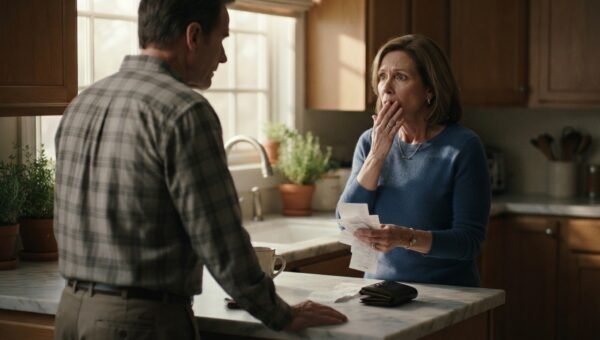
I picked it up. The paper was dry and brittle along the folds. I walked it over to the kitchen island and set it down right on top of our electric bill.
“David,” I said. “This was inside the piano.”
David looked up, irritated by the interruption. He saw his name on the envelope. His brow furrowed. He picked up our butter knife, sliced open the top edge, and pulled out two folded sheets of lined notebook paper.
He started reading silently.
At first, his face showed ordinary confusion. Then his posture stiffened. The color drained out of his cheeks so completely that his lips looked gray. He didn’t blink. He sat there staring at the first page for so long, breathing in shallow, jagged gasps, that I genuinely thought his heart was giving out.
“David, talk to me,” I said, putting my hand on his shoulder. His arm was as hard as iron.
He didn’t speak. He slowly separated the two pages, kept the second one facedown under his palm, and handed me the first page.
His hand was shaking so badly the paper rattled.
The handwriting was Clara’s. The date at the very top was May 14, 1988, three weeks before our wedding day.
The first sentence read:
“I promised your mother I would never tell you who your father was unless you married someone I trusted.”
PART 2
The room felt entirely airless. Through the open front door, I could hear the wet rhythm of the rain outside and Arthur rummaging through the trunk of his car in our driveway.
I looked down at the paper in my hands.
My husband had lived fifty-four years believing his father was a man named Donald Miller Senior, a long-haul truck driver who died in a rollover crash on Interstate 80 when David was barely three years old. There had always been an old, silver-framed photograph on his mother Evelyn’s dresser showing a square-jawed man in a denim jacket standing next to a green pickup truck. That was the ghost David had grown up with. He had Donald Senior’s middle name. He had spent his childhood believing he came from a hardworking family man who just had bad luck on an icy highway.
Evelyn had died seven years ago of colon cancer. She had passed away holding David’s hand, leaving behind boxes of old sewing patterns, a modest house, and that same framed photograph.
Clara’s letter told a completely different story.
“Dear David,” the letter began. “If you are reading this, it means you stayed with Martha long enough for her to prove she is who I thought she was. Your mother made me swear on our father’s Bible in the summer of 1968 that I would take this to the grave. But Evelyn always hid behind convenience. She let you build your whole identity on a dead stranger because the truth would have ruined her standing in the church and cost our family what little peace we had.”
I read the lines twice, trying to make the ink match the woman I had known. Clara had been a quiet, strict woman who wore high-collared blouses and attended Sunday service without fail. Whenever we visited her small brick ranch house on Elm Street, she would watch me wash dishes or fold napkins with an intensity that used to make me nervous. I had spent thirty-four years thinking she disapproved of me.
I looked at David. He hadn’t moved. His thumb was pressed down against the second page on the countertop, holding it so tightly the paper was creased beneath his knuckle.
“David,” I whispered. “What is on the other page?”
He swallowed hard. “Donald Senior wasn’t a stranger,” he said. His voice sounded like it was coming from the bottom of a dry well. “He was a cousin from out in Iowa. He visited for two weeks the year after Evelyn finished secretarial school. When she got pregnant, my grandfather paid Donald five hundred dollars to sign the birth certificate before he moved out to California. Donald never lived in this county. He never raised me. He never sent a dime.”
“Then who was it?” I asked.
Arthur Hayes came back through the front door then, wiping his boots on our rag mat. He held a brass key tool and looked between us, sensing the tension instantly.
“I can finish the action rail and come back Tuesday for the fine tuning, Mrs. Miller,” Arthur said gently, keeping his eyes on the floorboards. “No extra charge.”
“Thank you, Arthur,” I said. My voice was steady, though my hands were cold. I went to my purse, counted out eighty dollars in cash for his travel, and handed it to him. He set the brass tool on the piano bench, took his satchel, and pulled the door shut behind him.
The latch clicked.
David finally lifted his hand off the second page.
“Read it,” he said.
I picked it up. Clara’s handwriting grew looser on the second sheet, as if she had written it in a hurry while someone was waiting in the other room.
“Your father was Thomas Vance,” the letter said. “He owned the lumber yard where your grandfather bought his timber. When Evelyn told him she was carrying his child, Thomas offered to pay for a private doctor in Chicago. Your grandfather refused to let his daughter be hidden away like a shameful secret, but Thomas was married to the mayor’s sister. He made it clear that if Evelyn made a sound in town, he would pull his credit accounts from our family’s mill. We would have lost the business in six months.”
Thomas Vance.
The name hit me with the weight of a stone.
Thomas Vance hadn’t just been a local businessman. For forty years, he had been the richest man on our side of the river. He was the man who funded the municipal park where David had played Little League baseball. He had donated the brick library where David had studied for his mechanic’s license.
And more than that: Thomas Vance had died nine years ago, leaving behind two sons. One of those sons was Donald Vance, the county land commissioner. The other was Robert Vance, who still ran the lumber supplier where David had bought every single piece of cedar and plywood to build our back porch.
David had worked with Robert Vance for twenty years, trading small talk across a dusty sales counter, shaking hands over delivery receipts, completely unaware that he was looking into the eyes of his own brother.
PART 3
“She lied to me,” David said. His voice wasn’t loud. It cracked on the last word. “Every time I asked about Donald Senior, she told me how much I looked like him. She kept that picture on her dresser for forty-eight years.”
“She was terrified, David,” I said, stepping around the island and pulling a kitchen stool next to him. “Think about 1968. Think about what a scandal like that would have done to an unmarried girl working in a town this small.”
“I don’t care about the scandal,” he said, turning to look at me. His eyes were red and wet. “Thomas Vance used to come down to the ballfields on Saturday mornings. He used to hand out ice cream tickets to the kids who hit doubles. I remember him looking at me once, real quiet, and telling me my swing was too flat. He handed me a dollar bill. I kept that dollar in my top dresser drawer until I was fourteen because I thought an important man had noticed me.”
He pressed the heels of his hands into his eye sockets and sat there, breathing hard.
I looked back down at the letter. There was a postscript at the bottom of the second page that I hadn’t seen.
“P.S. Thomas gave your grandfather five thousand dollars in an envelope the day before you were born to cover your hospital stay and your schooling. Your grandfather refused to touch a penny of it. He bought this piano with it on your first birthday, had it delivered to my house, and told me that one day, when you had a wife with good sense who wouldn’t spend her life chasing other people’s money, you would find out where you came from. God forgive us all for keeping quiet so long.”
The piano had never been Clara’s.
It had been David’s birthright, paid for by the father who couldn’t acknowledge him, preserved by the aunt who had guarded the secret through four decades of family dinners, holiday gatherings, and silent compromises.
That was why Clara had put the twelve-month holding clause in her will.
She knew Brenda and Donald would have dragged that piano out to a consignment shop or an auction house within forty-eight hours to split a quick three hundred dollars. She knew they would have sold it to strangers who might never have opened the front board. Clara had trusted me to hold on to it, even when the family turned cold, because she knew I wasn’t the kind of woman who threw things away just because they took up room.
We didn’t sleep that night.
David sat at the kitchen table with Clara’s letter between his hands, looking through the old shoeboxes of his mother’s papers he had stored in the hall closet. In the very bottom, beneath Evelyn’s high school diploma and a stack of old water receipts, he found an old yellowed bank deposit slip from July 1969. It was stamped by the First National Bank in town, showing a cash transfer of five thousand dollars to the Baldwin & Sons Piano Company.
The paper trail was clean. It had been sitting there for more than half a century.
The next morning, David didn’t go to work at the garage. Around ten o’clock, he took Clara’s letter, got into his truck, and drove out to the lumber yard on Route 4.
I stayed home, pacing the floorboards between our kitchen and the upright piano. I was terrified of what would happen if he confronted Robert Vance with forty years of buried shame. I pictured shouting matches, police calls, and the kind of ugly public scene that destroys whatever dignity a family has left.
Two hours later, David’s truck pulled back into the gravel drive.
He walked into the kitchen, hung his keys on the hook by the door, and set an old, scuffed wooden box on the island.
“Did you talk to Robert?” I asked, my chest tight.
“I did,” David said. He looked exhausted, but the gray, hollow look in his face was gone. “I went into his back office. I closed the door, and I handed him Clara’s letter.”
“What did he do?”
“He read it,” David said quietly. “Then he sat back in his chair, took off his glasses, and looked out the window for five minutes without saying a word. Then he opened his bottom file drawer and pulled this out.”
David lifted the lid of the wooden box. Inside were four black-and-white photographs from the late 1960s. One of them showed Evelyn sitting on the hood of a car by the river, laughing, with a young, dark-haired Thomas Vance standing beside her with his arm draped across her shoulders.
“Robert told me their mother found those pictures in his father’s desk the week after Thomas died,” David said. “Robert and his brother knew Thomas had a child in town. Their mother made them burn the rest of the letters, but Robert kept these four in his office safe. He said he had spent the last nine years wondering which of the boys who grew up on the south side was his brother.”
ENDING
There was no lawsuit. There was no demand for an inheritance, no frantic call to estate lawyers, and no dramatic scene on the steps of the county courthouse. Thomas Vance’s money had been divided and spent years ago, and David didn’t want a nickel of it anyway. He had made his own living with his own two hands for thirty-five years, fixing transmissions and doing honest work.
What mattered to David wasn’t the Vance name or the lumber company. It was the simple, undeniable relief of finally knowing the truth about his own blood.
Three weeks later, on a clear Saturday afternoon, Brenda called our house.
Word had traveled, the way it always does in small towns. Robert Vance had been seen standing out by David’s truck behind the repair shop, talking for nearly an hour over the open hood of an old Chevy. Brenda demanded to know why we were suddenly friendly with the Vances, and whether Clara had left any stock certificates hidden in the piano bench.
David took the phone from my hand.
“Clara left Martha the piano, Brenda,” David said, his voice completely level. “And she left me the truth. You don’t have a claim on either one of them. Don’t call this house asking for money again.”
He hung up the receiver before she could answer. That was the last time we heard from her.
A week later, Arthur Hayes came back to finish the job.
He tightened the action screws, leveled the keybed, and tuned all eighty-eight strings until the Kohler & Campbell sounded as clear and bright as the day it was rolled out of the showroom in 1969. When he finished, he played a short, resonant hymn, gathered his tools, and thanked us for the work.
That evening, after dinner, David walked over to the piano.
He didn’t know how to play, but he sat down on the narrow bench anyway. He reached out and rested his thick, calloused fingers across the ivory keys, exactly where his grandfather had placed a five-thousand-dollar burden fifty-seven years ago.
He looked at the framed photograph on top of the instrument. It wasn’t the stranger in the denim jacket anymore. It was a picture of Clara from her younger days, sitting on her front porch with her hair pinned up, looking straight into the camera with that same stubborn, unwavering gaze.
David pressed middle C. The note rang through our quiet house, clear and true, and for the first time in his life, he knew exactly who he was.