PART 1
I was sorting my husband’s clothes for laundry when a folded cream envelope slid out of his charcoal wool jacket and hit the linoleum floor.
I picked it up, expecting a receipt from the hardware store or an estimate from his landscaping clients. Instead, the handwriting on the heavy paper was neat, slanted, and definitely written in purple fountain pen ink.
The note inside read: “Happy anniversary Darling. These 9 years have been the best of my life.
Meet me at Le Jardin on Friday at 7 p.m. Wear red.”
My stomach dropped straight into my shoes. It was not meant for me. David and I had been married for twenty-one years, not nine. We did not eat at Le Jardin, a fancy French place downtown where appetizers cost forty dollars. Our anniversary was in October, four months away.
I stood there by the washing machine with his work shirts smelling like dry cedar and grass clippings. For twenty-one years, David had been the steady man who coached Little League, checked the tire pressure on my station wagon every Sunday, and took care of his widowed sister’s lawn. We had two boys, both grown now, and an eight-year-old girl named Clara whom we had adopted after our late twenties had slipped away. We were comfortable, or so I had told myself.
My first thought was to march down the hall, shove the paper in his face, and scream until my throat burned.
But twenty-one years teaches a woman that screaming gives people time to invent an excuse. He would say it was a joke from a coworker, or that someone slipped it into his pocket at a bar, or that he was holding it for an employee. If I asked him outright, I would get a lie polished to look like the truth, and I would spend the rest of my days second-guessing every time he worked late.
Instead of confronting him, I quietly made a plan.
I folded the paper back into its exact creases, slid it back into the inside breast pocket of his jacket, and hung it back in the hall closet. My hands did not shake until the closet door clicked shut.
That week was the longest five days of my life. I cooked his pork chops, asked him about the retaining wall he was building across town, and listened to him talk about his bad knee.
He kissed my cheek before leaving for work each morning just like he always had. He looked me right in the eye without blinking. That was the part that made my chest ache: how easy it was for him to look completely normal while holding a second life in his pocket.
By Thursday night, I noticed the jacket was gone from the hall hook. It was hanging on the back of our bedroom door, freshly pressed.
On Friday afternoon, I called Mrs. Gable down the street and hired her to watch Clara until ten that night. Clara asked why I was getting dressed up so early. I told her Mommy had an errand downtown.
I went into the back of my closet and pulled out a cherry-red wrap dress I had bought three years ago for a cousin’s wedding and had not worn since. I put on small gold earrings, did my hair in the bathroom mirror with the door locked, and put my wedding ring into my purse.
Looking at my bare ring finger made my throat tight, but I needed to see who this woman was before David knew I was there.
I drove downtown through the five o’clock traffic, parked two blocks away from Le Jardin, and walked in at six-fifteen.
The hostess was young, wearing black silk. I asked for a table for one near the back corner, somewhere quiet where I could read. I slipped her a twenty-dollar bill from my wallet. She took me to a small two-top tucked behind an artificial potted ficus, directly facing the main dining room. From where I sat, I had a clear line of sight to the arched doorway and the center row of booths.
At six-thirty, a woman walked in alone.
She was in her late thirties, slender, wearing a tailored navy coat. When she took off the coat, she was wearing a bright scarlet sheath dress with a gold pendant at her collarbone.
She sat down at table seven, right in the center of the room. She was alone, checking her watch, smoothing her skirt.
I sat at the next table, just six feet away with the potted leaves between us, and watched her. She had delicate features, neat brown hair pinned back, and hands that looked soft, like someone who worked in an office and never dug in garden beds. She checked her phone twice, smiling softly to herself. She ordered sparkling water from the waiter and told him she was waiting for her guest.
At seven on the dot, the front brass door swung open.
David walked in.
He was wearing his charcoal jacket, a crisp white shirt, and no tie. He looked handsome, older than her by fifteen years, but broad-shouldered and clean-shaven. He had a small white jeweler’s box in his left hand.
He stopped at the maître d’ stand, nodded toward table seven, and walked straight toward her. He smiled at her, a warm, familiar smile that I recognized from the summer we bought our first home.
Then, halfway across the polished hardwood floor, his eyes shifted to the corner to look for an extra chair, and his eyes found mine.
The smile fell completely off his face. His skin lost every bit of color, leaving his jaw gray. He stopped dead between two candlelit tables, the jeweler’s box hanging limp in his fingers.
His face changed instantly, and what happened next left me speechless.
The woman in red stood up, beamed at him, and wrapped her arms around his neck. “Happy anniversary, David,” she said loudly enough for three tables around them to turn and smile.
David did not hug her back. His arms stayed pinned to his sides, his eyes locked on mine, wide and terrified, as if he were staring at a ghost that had come to drag him into the dark.
PART 2
The woman stepped back from the hug, laughing a little at how stiff he was.
“What’s wrong?” she asked, reaching for his hand. “You look like you’ve seen an accident.”
David’s mouth opened, but nothing came out. He looked like an engine whose belt had just snapped. He glanced at the front door, then at the floor, and finally back at me. I did not move. I did not cry, and I did not look away. I just sat behind my glass of tap water in my red wrap dress, watching the twenty-one years between us unravel on top of white linen tablecloths.
“David?” the woman repeated, her smile starting to fade into concern. “Are you okay? Is it your back again?”
“No,” he managed, his voice sounding thin and dry. “No. Melissa, wait.”
Her name was Melissa. Hearing him say her name with familiar ease hit harder than finding the note in the pocket. It made her real. She was not a shadow or an idea; she was a woman with a name and a voice who had spent nine years of her life thinking this man belonged to her.
“Let’s sit down,” she said, pulling out a chair. “I made reservations three weeks ago. They gave us the table by the terrace just like I asked.”
“Melissa,” David said again, his voice trembling now. He turned slightly, trying to block her view of my corner, but it was already too late.
I stood up.
The wooden legs of my chair scraped against the floorboards, loud in the quiet room. The waiter paused with a tray of bread basket plates.
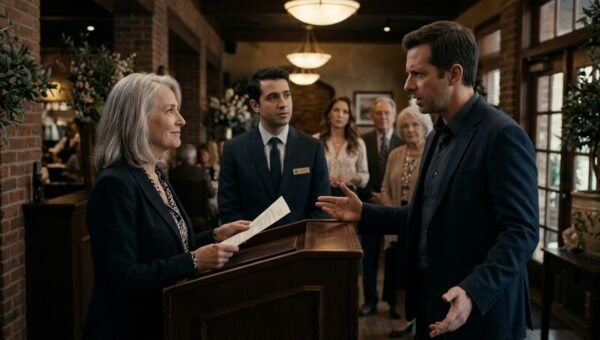
I walked around the potted ficus and stepped directly to the edge of their table.
Melissa looked up at me with mild annoyance, the way someone looks at a stranger who has wandered too close to their personal conversation. “Excuse me?” she said.
David took half a step backward, raising one hand as if he were trying to ward off a blow. “Sarah. Please. Don’t do this here.”
Melissa’s head snapped from me to David. The annoyance on her face vanished, replaced by an uneasy, sharp confusion. “David? Who is this?”
“I’m his wife,” I said. My voice was completely steady, which surprised even me. “We’ve been married twenty-one years. Our daughter Clara is at home doing third-grade math with a babysitter.”
The entire room seemed to hold its breath. A fork clattered against china at a table behind us.
Melissa did not shout. She just stared at me, then looked down at the table, then up at David’s gray face. “Your wife,” she repeated. It was not a question. It was a flat, dull sound. “You told me she died of ovarian cancer seven years ago. You said you couldn’t bear to talk about her.”
I looked at David. The shame on his face was thick and ugly. He looked smaller than I had ever seen him, his shoulders hunched inside the charcoal jacket I had ironed a hundred times.
“Melissa, please let me explain,” he whispered, stepping between us. “It’s complicated. You don’t know the whole situation.”
“Did she die?” Melissa asked him, her voice rising just enough to tremble. “Is she dead, David?”
He did not answer. He stared down at his shoes.
“Nine years,” she whispered, her eyes filling with fast, furious tears. “Nine years you’ve spent three nights a week at my condo. You helped me pick out the cabinets. You went to my sister’s wedding in Savannah. You told me you couldn’t marry again because the memory of her was too painful.”
The math hit me then, clean and cold. Nine years ago was the year David started taking commercial landscaping contracts two counties south. He had told me the commute was too far to drive back every night during the summer rush, that he was sleeping in a cheap motel near the interstate to save gas money. Every Tuesday and Thursday night for nine summers, while I was bathing our toddler and paying the electric bill, he was living in an apartment thirty miles down the highway with another woman.
“Show her the box, David,” I said quietly.
Melissa looked at his hand. He was still gripping the small white jeweler’s box so hard his knuckles were white.
“What is that?” Melissa asked, her voice cracking. “David, what did you bring tonight?”
“It’s nothing,” he muttered, trying to shove it into his coat pocket.
“Open it,” Melissa said.
He hesitated for three seconds, realized everyone within twenty feet was staring at him, and opened the lid with a thumb.
Inside was a simple gold band with three small inset diamonds. It was not an engagement ring. It was an anniversary band. The exact twin of the one he had given me for our tenth anniversary, which was sitting at that moment in the velvet tray on my dresser at home.
“You gave me that same design eleven years ago,” I said to him. “At the Italian place by the lake.”
Melissa stood up so fast her water glass tipped over, splashing across the white cloth. She did not grab her purse or her coat. She looked at David with an expression of pure, gut-level disgust that mirrored my own.
“Don’t you ever come near my house again,” she said to him, her voice shaking with rage. “Don’t you ever call my phone. If I see your truck on my street, I’m calling the police.”
She turned and walked straight out of the restaurant, leaving her navy coat over the back of the chair.
David made an instinctive move to follow her, taking two fast steps toward the foyer, but then he stopped. He turned around and looked at me.
“Sarah,” he pleaded, reaching out a hand. “Let’s go home. Let’s just go home and talk about this.”
“I am going home,” I told him, looking him straight in the eyes. “You are going to a motel. And this time, you can actually pay for the room.”
PART 3
I walked out of Le Jardin before he could answer.
The cool night air hit my face, and for the first time in an hour, I could feel my lungs working. I did not run to my car. I walked with my head up, my heels clicking on the concrete, while David jogged behind me, begging, explaining, and making excuses that sounded weaker with every step.
“It started when things were hard with the business,” he said, out of breath as he followed me down the sidewalk. “I was lonely, Sarah. We were arguing about money every night, Clara was crying constantly with colic, and I met her at a diner near the supply depot. It was just coffee at first. Then it got out of hand. I didn’t know how to stop it without blowing everything up.”
“You told her I was dead,” I said, reaching my station wagon and unlocking the driver’s side door. “You killed me off so you didn’t have to choose.”
“I was trying to protect our family!” he shouted, desperation cracking his voice.
“You were protecting your comfort,” I said. “There is a difference.”
I got into the car, locked the doors, and started the engine. He pounded on the driver’s side window with his fist, his face contorted in the streetlamp glow, but I put the car in reverse and backed out of the space without looking at him again.
When I got back to the house, Mrs. Gable was sitting on the sofa watching an old movie. Clara was asleep in her room with her stuffed rabbit tucked under her chin. I paid Mrs. Gable, thanked her, and waited until her taillights disappeared down the driveway before I went to work.
I did not pack my bags. It was my house. My grandfather had left me the down payment thirty years ago, and my name was first on the deed.
Instead, I dragged three large plastic storage bins from the garage into our bedroom.
I emptied his side of the closet. Every shirt, every pair of work pants, his hunting boots, his golf clubs, and every pair of socks from the dresser went into those bins. I took his bathroom kit, his extra razors, his blood pressure medication, and his spare glasses. I carried the bins out to the front porch, set them beside the steps, and stacked them under the overhang so the morning dew wouldn’t ruin his clothes.
Then I called our bank’s 24-hour automated line from the kitchen phone.
Our joint savings account had $42,300 in it. That was money from twenty years of saving, along with my mother’s small estate payout from two years back. I used the telephone prompts to transfer half, exactly $21,150, into my individual checking account that he could not touch. I left the other half for him. I was hurt, but I was not going to be accused of theft in front of a judge.
Around one in the morning, his truck pulled into the gravel driveway.
I sat at the kitchen table with the lights off, watching through the blinds. The porch light illuminated the three gray bins stacked by the front door.
David got out of the truck slowly. He walked up the porch steps, saw the bins, and stopped. He tried the front door handle. It was locked from the inside with the heavy deadbolt. He knocked twice, soft and hesitant, then waited.
I did not move from the table.
After five minutes, he sat down on the top step with his head in his hands. He sat there for a long time in the dark. Eventually, he stood up, loaded the three bins into the bed of his truck, and drove away.
The house was so quiet I could hear the hum of the refrigerator.
The next morning, I took Clara to school, drove straight to the courthouse, and filed for legal separation. By noon, I had an appointment with a family attorney named Eleanor Vance, an older woman with sharp gray eyes who listened to my story without once pitying me.
“We need to audit his business accounts,” Eleanor said, writing on a legal pad. “If he was maintaining an apartment or paying rent for nine years, that’s marital waste. He will have to account for every dollar drawn from joint funds.”
When the financial disclosures came back three weeks later, the paper trail confirmed it. Over nine years, David had funneled nearly $68,000 through his commercial landscaping account to cover half the mortgage on Melissa’s townhouse, claiming it as equipment storage and travel expenses on his tax schedules. He had run a double ledger, just like he had run a double life.
When his attorney saw the bank records and the statements from Le Jardin’s waitstaff, the fight went out of him. David knew that if we went before a judge, the commercial tax fraud alone would destroy his business.
He agreed to our terms without a trial.
ENDING
We signed the final divorce papers on a Thursday morning in November, nine months after I found the letter in his jacket.
The house stayed with me and Clara. David signed over his equity to offset the $68,000 he had drained from our marital assets over the decade. He kept his truck, his landscaping equipment, and his business, though he had to downsize to two seasonal workers and move into a small rental duplex on the edge of town. He got standard visitation with Clara every other weekend, which he kept reliably. Whatever else he was, he was still her father, and I never used our daughter as a weapon to punish him.
Melissa, I learned through a mutual acquaintance in town, had put her townhouse on the market within a month of that night and moved back home to North Carolina. She had refused to see him, refused his letters, and blocked his number completely. She had lost nine years of her life to a phantom, and she wanted nothing left of the wreckage.
David tried to talk to me several times during the handoffs with Clara. He would stand by the gate, looking thin and older than fifty-six, asking if we could ever sit down for coffee to talk like friends.
“There’s nothing left to say, David,” I told him gently each time. “We had twenty-one years. That’s over now.”
The following spring, I hired a local carpenter to tear down the old wooden fence around the backyard and rebuild it with fresh cedar boards that smelled clean and bright in the sun. I planted hydrangeas and yellow rose bushes along the southern edge where David had always kept his spare bags of gravel and fertilizer.
One Saturday afternoon, I was cleaning out the hall closet to make room for Clara’s winter coats and roller skates. Pushed way back onto the top shelf, behind a box of old tax returns, was a folded paper bag containing the cherry-red dress I had worn that night to the restaurant.
I took it down, thought about throwing it in the trash, and then stopped.
I walked into the laundry room, filled a cardboard box with clothes to donate to the women’s shelter down by the community college, and laid the red dress right on top. It was still a good dress, made of sturdy wool that would keep someone warm through the winter.
I taped the box shut, loaded it into the back of my car, and drove into town with all four windows rolled down.