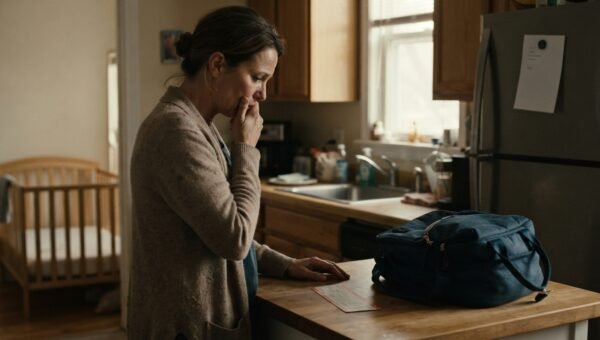
The blue binder on my kitchen table had been sitting there since November, closed tight and ignored, but I kept running my thumb over the corner of it while the rain hit the back porch.
My son, Toby, had made his position crystal clear three months ago when his little boy, Leo, was born.
“We are doing things by the book, Mom,” he had told me over the phone, his voice flat and careful, the way he got whenever he wanted to let me down without an argument. “No drop-sided cribs, no overheating, no old-fashioned advice.
Brenda’s mother is going to handle the daytime hours while we are both at the firm. We need someone modern.”
It stung. It stung in a very particular, quiet way that stayed under your ribs for days. I had raised two boys in a drafty house with zero insulation and a wood stove that ate cordwood faster than we could stack it, and they both had all their fingers and toes. But I kept my mouth shut. I packed away the knitted blankets I had spent three weeks making and told him I understood. Brenda’s mother, Miriam, took over the nursery duties from eight in the morning until five in the evening, driving her little silver sedan up the gravel drive every single day like clockwork.
Then came the call at 11:47 on a Tuesday night.
The phone didn’t just ring; it buzzed against the bedside table with that frantic, stuttering vibration that means someone is pressing buttons in a panic.
I grabbed it before the second ring had even finished echoing off the plaster.
“Mom,” Toby said. His voice wasn’t just tired. It was hollow. “Can you come over right now? Please.”
“Is Leo okay?” I sat straight up, kicking the heavy quilt off my legs.
“Leo is sleeping in his crib. Brenda is upstairs asleep. Just… get in your truck and come. Don’t ask questions. Just come through the side door. I left it unlocked.”
The drive took twelve minutes through the dark, winding roads outside Millinocket where the pines lean over the tarmac like they are trying to block the sky. The engine of my old truck sounded louder than usual in the quiet night, and every mile felt longer than it should have. When I pulled into Toby’s paved driveway, his sedan was there, but Miriam’s silver car was nowhere to be seen. That was the first wrong note.
Miriam always left her car parked right by the side entrance so she could load her canvas bags and Tupperware.
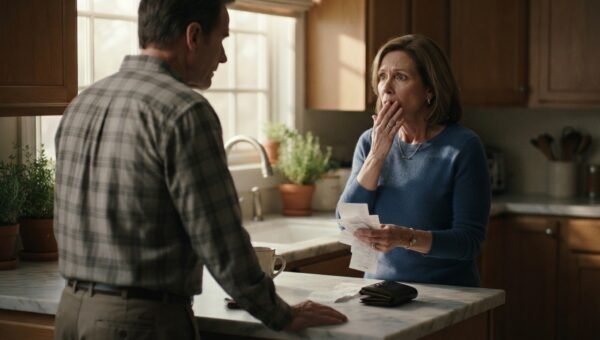
I pushed the side door open and stepped into the kitchen. Toby was sitting at the island under the bright overhead lights, staring at a small white sheet of lined notebook paper pinned down by a coffee mug.
“Toby?” I whispered, closing the door behind me.
He didn’t look up right away. He just lifted his hand and pointed a finger at the paper. “Look at the times, Mom. Just look at the times she wrote down.”
I walked over, my boots clicking softly against the tile, and leaned down. It was a handwritten feeding chart. Neat columns. *9:00 AM – Formula, 2 oz. 11:30 AM – Nap. 1:00 PM – Formula, 3 oz.* It looked professional enough at first glance.
“What am I looking at?” I asked, looking up at his face.
His skin had that greyish, washed-out look people get when they realize their house has been broken into.
“Those are the times Miriam wrote in the logbook every single day for the last month,” Toby said, his voice shaking so hard he could barely get the words out. “Every time Brenda asked how the baby ate, Miriam handed her one of these sheets. Neun o’clock. Twelve-thirty. Two o’clock.”
He reached out and tapped a key on his laptop, waking the screen from sleep. A video window popped up, showing a black-and-white wide-angle view of the nursery crib. The timestamp in the corner read 11:14 AM from three weeks ago.
“I updated the doorbell and the interior cameras last weekend,” Toby said, not looking at me. “I wanted to check the Wi-Fi connection for the nursery monitor. I started scrolling back through the cloud storage just out of curiosity. To see how she interacts with him.”
On the screen, the nursery door swung open. Miriam walked in, but she wasn’t carrying the baby. She wasn’t even looking at the crib. She walked straight to the changing table, picked up her heavy leather handbag, zipped it shut, and walked right out of the room.
The crib remained empty. The little bundle of blue blankets didn’t move.
“Where is Leo?” I asked, my breath catching in my throat.
“Nowhere,” Toby whispered. “She left him in that room alone. Not for two minutes. Look at the timestamp.”
He clicked the mouse again, skipping forward. 11:46 AM. Thirty-two minutes. For thirty-two minutes, my brand-new grandson was lying in that crib with nobody in the house, while Miriam’s written log downstairs claimed she was feeding him every drop of formula on the chart.
“The lying is bad enough,” Toby said, and I could hear the tears catching in his throat. “The lying makes me want to put my fist through this wall. But that wasn’t why I called you at midnight, Mom.”
He pulled up another video clip, this one from the front doorbell camera. The date stamp was from yesterday afternoon at 2:15 PM.
Miriam stepped out the front door, wearing her beige cardigan and carrying her large leather tote bag. But she wasn’t walking to her car. She walked right down the front steps to the edge of the property where the asphalt met the gravel shoulder.
A rusted blue sedan was parked idling by the mailboxes. A man stepped out from the driver’s side. He wasn’t young, maybe sixty or so, with stooped shoulders and a heavy grey jacket zipped up to his chin. Miriam didn’t look surprised to see him. She reached into her tote bag, pulled out a thick, legal-sized manila folder stamped with the logo of Toby’s consulting firm, and handed it straight to him.
The man took the folder, tucked it under his arm, and leaned down to say something to her.
Toby hit the spacebar on the keyboard, pausing the video right as the man’s face turned toward the wide-angle lens of the doorbell camera.
I stopped breathing. The kitchen seemed to tilt sideways for half a second.
“Do you know him, Mom?” Toby asked, his voice dropping to a harsh whisper. “Do you recognize that coat? Because I thought maybe he was a client. I thought maybe she was dropping off an invoice she forgot to mail. But I ran the name of the car owner through the DMV database using my partner’s access, and the name on the registration doesn’t match any client we have.”
I couldn’t look away from the frozen face on the screen. The square jaw, the heavy slope of the nose, the way the left earlobe had a small notch at the bottom just like a tear in an old leaf.
“That’s not a client,” I said, and my own voice sounded like it was coming from inside a well.
“Who is it then?” Toby demanded, turning his chair around to face me fully. “Who the hell is he, and why did she give him the confidential client ledger from my office?”
“That’s not all,” I said, my knees suddenly feeling weak. I pulled out a kitchen chair and sat down without waiting for an invitation. “Did you listen to the audio on that clip? Did you turn the volume up?”
Toby swallowed hard. “The wind was blowing. The audio is mostly road noise.”
“Listen to the last three seconds again,” I told him, pointing a shaky finger at the play button. “Unmute it. Turn it all the way up.”
He reached out, his finger trembling as he dragged the volume slider to maximum, and hit play on the doorbell footage.
On the tiny laptop speaker, the sound of passing traffic hissed like static. Then came Miriam’s voice, clear and sharp through the small microphone mounted by the doorbell frame.
*“I’ll have the rest on Thursday, Arthur,”* she said clearly on the recording. *“Just give me until Thursday.”*
The name hung in the damp kitchen air like woodsmoke.
Toby froze with his hand still hovering over the mouse. He looked at me, then back at the screen, and the color drained completely out of his face until he looked like something carved out of old cedar.
“Arthur?” Toby whispered. “Who the hell is Arthur? Her husband died fifteen years ago. His name was Robert.”
“Arthur isn’t her husband’s name,” I said, and my chest felt tight and heavy, like someone had piled wet sand on top of my ribs. “Arthur was your father’s brother. The one who left for Bangor back in ’84 after the mill fire. The one we never spoke about again because he walked away with forty thousand dollars from the union safe.”
Toby stared at me, his mouth slightly open, trying to bridge the gap between thirty years of family silence and the man standing by the mailboxes on his front porch.
“She’s been stealing your office files for him,” I said, looking down at the falsified feeding chart on the counter. “Every time she was supposed to be watching Leo, she was going through your study while you were at the firm, copying your client lists and your financial audits, and handing them over to a man who knows how to work a lonely grandmother with a gambling problem.”
“A gambling problem?” Toby’s voice cracked. “Miriam? She goes to church three times a week.”
“People who go to church three times a week are the ones who can’t admit they’re drowning in slot machines down at the river hall,” I said bitterly. “I heard whispers about her at the hardware store back in October. I didn’t think it was this bad. I thought she was just playing bingo.”
Toby stood up so fast his chair tipped over backward, hitting the linoleum with a sharp crack that echoed down the hallway. He didn’t even look back at it. He walked straight past the island, headed down the dark hall toward the master bedroom, and pushed the door open before I could even stand up to follow him.
“Brenda!” his voice rang out, sharp and panicked in the dark of the hallway. “Brenda, wake up. Turn the light on right now.”
I stayed sitting at the kitchen island, staring down at the little white piece of paper with the fake feeding times written in Miriam’s careful, looping handwriting. The 9:00 AM formula times. The nap schedules. All of it was just a smoke screen to cover the thirty minutes she spent sliding confidential corporate documents into her leather tote bag while my grandson lay sleeping in a room by himself upstairs.
Footsteps pounded down the hall a minute later. Brenda appeared in the kitchen doorway, her hair twisted up in a messy bun, her eyes wide and confused, wearing an oversized flannel shirt over her pajamas.
“Toby, what is going on?” she asked, her voice shaking as she looked between us. “Why did you wake me up? Is Leo alright?”
Toby didn’t answer her with words. He just grabbed the laptop from the counter, turned the screen toward her, and pressed play on the doorbell video.
We watched it together in silence. The silver car, the rusted sedan, the man with the notched ear, and the folder being passed across the gravel shoulder. And then, clear as church bells in the quiet evening, Miriam’s voice came through the speaker again.
*“I’ll have the rest on Thursday, Arthur.”*
Brenda didn’t scream. She didn’t cry. She reached out and grabbed the edge of the kitchen counter with both hands, her knuckles turning bone-white, and stared at the screen until the video looped back to the beginning.
“My mother,” Brenda whispered, the words coming out flat and broken. “My mother has been bringing her into my house every single day.”
“She was using the baby as an alibi,” Toby said, his voice dropping into that dark, dangerous register I hadn’t heard since he was a teenager standing up to a bully behind the schoolhouse. “She was leaving our son alone in his crib so she could steal my company’s financial records and hand them to a criminal in broad daylight.”
“She’s not coming back here,” Brenda said, and her voice didn’t shake anymore. It sounded cold, like winter ice settling over a pond. “If she calls my phone tonight, if she shows up tomorrow morning at eight o’clock like she always does, I am not opening the door.”
“She won’t have to,” Toby said, reaching for his phone on the counter. “I’m calling the state police right now. And then I’m calling the locksmithed service to change every cylinder on this house before the sun comes up.”
The next few hours were a blur of flashing blue lights in the driveway, two state troopers sitting at our kitchen table drinking cold coffee from paper cups, and Brenda sitting upstairs in the rocking chair with Leo held tight against her chest like she was afraid someone might reach through the window and take him away.
By 4:00 in the morning, the troopers had left with copies of the video files, the falsified feeding charts, and a list of missing corporate documents from Toby’s home office. The house was finally quiet again, save for the low hum of the refrigerator and the wind outside rattling the loose shingle by the chimney.
Toby walked back into the kitchen, looking exhausted, his shoulders slumped forward like he had been carrying a sack of wet feed for a hundred miles. He pulled out the chair next to me and sat down heavily, staring at his empty coffee mug.
“I’m sorry, Mom,” he said quietly, not looking up from the ceramic rim.
“For what?” I asked.
“For telling you you did things the old-fashioned way. For keeping you away because I thought we needed someone with a professional resume and a modern schedule.” He rubbed his face with both hands, his voice dropping to a whisper. “If I had just let you watch him like you offered, none of this would have happened.”
I reached across the table and put my hand over his. His skin was cold, just like mine had been when I saw that face on the screen.
“You wanted what was best for your boy,” I told him, squeezing his fingers. “That doesn’t make you stupid, Toby. It just means you trusted the wrong person.”
He let out a long, ragged breath, leaning his head back against the wall. “What do we do now?”
“We wait for the sun to come up,” I said. “And then we make a new schedule. A real one.”
The sun came up slow over the pines, turning the grey fog above the river into a pale, watery gold. Brenda came down the stairs around six o’clock, her eyes red-rimmed but her chin held high, carrying little Leo in her arms. She walked straight into the kitchen, looked at me across the island, and didn’t say a word before she handed the baby right into my waiting arms.
Leo smelled like warm flannel and baby soap, soft and heavy against my shoulder, breathing slow and easy.
Toby stood up, walked over to the counter where Miriam’s false logbook was still lying, and picked it up by the corner like it was something dirty. He dropped it straight into the kitchen wastebasket, pushing the lid down firmly until it clicked shut.
Then he reached into the drawer, pulled out a clean sheet of lined paper and a black ballpoint pen, and laid them flat on the clean quartz surface right under the warm glow of the counter lamp.
“Can you write down how you used to do it, Mom?” Toby asked, looking at me with something very close to peace in his tired eyes. “The old-fashioned way. I think we need to learn it from scratch.”
I shifted Leo against my shoulder, picked up the pen with my right hand, and started writing at the very top of the clean white page.