The phone went under the pillow sometime around his sixty-second birthday. It was a stupid little habit, but after thirty-six years of living with the same man, you notice when a routine shifts by even an inch. Arthur used to leave his phone right on the bedside table face up next to the alarm clock. Then he started sliding it under the goose-down pillow every single night before he turned off the reading lamp.
The peppermint gum started around the same time. Arthur hasn’t chewed gum since we gave up smoking in nineteen-ninety-four, but suddenly there was a yellow pack of Winterfresh tucked into the driver-side door pocket of his Ford pickup. He would unwrap a stick right before he pulled into the gravel drive on Wednesday afternoons. He didn’t even chew it long enough to lose the flavor before he spit it out into a paper coffee cup in the console.
I told myself I was being ridiculous. I told myself that men at sixty-two get weird about their tech or their breath or their joints aching. I told myself a lot of things while I sat at the kitchen island folding dish towels three times over just to keep my hands busy.
The first real crack came on a Wednesday in late October. The sky was that flat, pewter gray that usually means snow is hiding behind the ridge.
Arthur kissed the top of my head while I was standing at the stove stirring a pot of navy bean soup and said he had to run down to hardware to pick up a new shear pin for the mower deck.
The mower has been parked in the shed with a broken deck since September because Arthur bought a new zero-turn in August.
I didn’t say a word out loud. I just watched him walk out to the truck through the wavy old glass of our kitchen window. I waited forty-two seconds by the wall clock, grabbed my keys off the brass hook by the back door, and backed my sedan out without turning on the headlights until I hit the blacktop.
He didn’t go toward town. He took the old county road that leads past the quarry and toward the medical park behind the strip mall.
My chest felt tight, the way it does when you drink too much black coffee on an empty stomach.
I kept three car lengths back behind his silver tailgate, my foot heavy on the brake every time his lights flickered. He didn’t pull into the hardware store. He turned right into the parking lot of a low-slung red brick building with a sign out front that said Regional Diagnostic and Outpatient Labs.
It wasn’t a motel. It wasn’t a diner with a dark booth in the back. It was a place where people went to get blood drawn or MRIs done when the hospital in Knoxville was too far to drive.
I pulled my car into an empty spot four rows away and killed the engine. I sat there with my hands welded to ten and two on the steering wheel, watching his truck door swing open. Arthur climbed out wearing his brown corduroy jacket, the one I bought him for our anniversary three years ago. He looked around once, his shoulders pulled up high against the chill, and walked through the heavy glass double doors.
Twenty-two minutes passed. I counted them on the digital clock of my dashboard because my watch battery died two weeks ago and I hadn’t gotten around to replacing it.
When the doors opened again, Arthur wasn’t alone.
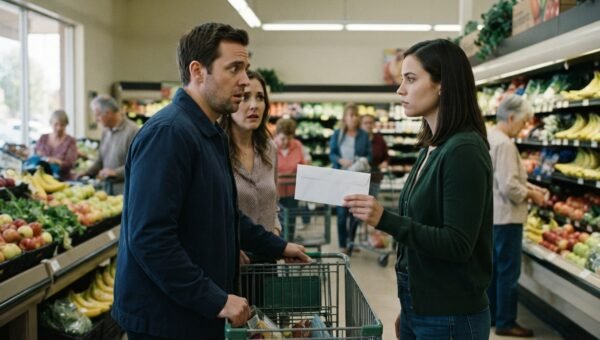
A woman walked out beside him. She looked to be around forty, wearing a sensible navy puffer coat and a knitted green scarf wrapped around her neck. She had dark hair pulled back into a messy clip, and as they reached the edge of the asphalt, she stopped and turned to face him. Arthur didn’t back away. He reached out and touched her cheek with the back of his hand, a slow, heavy gesture that looked entirely too natural for a stranger. Then she leaned in and pressed her forehead against his shoulder for three or four seconds before pulling back to wipe her nose with a tissue.
My phone was sitting on the passenger seat. My hands were shaking so hard I dropped it twice before I finally got the camera app open. The shutter click sounded uncomfortably loud in the quiet cab of my car, even though the windows were rolled up tight.
I didn’t follow him home. I drove out to the state park overlook, sat on a wooden bench that smelled of old creosote, and stared at the grey water of the lake until my fingers went numb.
By the time I got back to the house, the sun had dropped behind the ridge and the kitchen was dark. Arthur’s truck was parked in its usual spot by the pump house. The kitchen smelled faintly of the navy bean soup I’d left simmering on the back burner, though the burner had clicked off hours ago when the gas timer ran out.
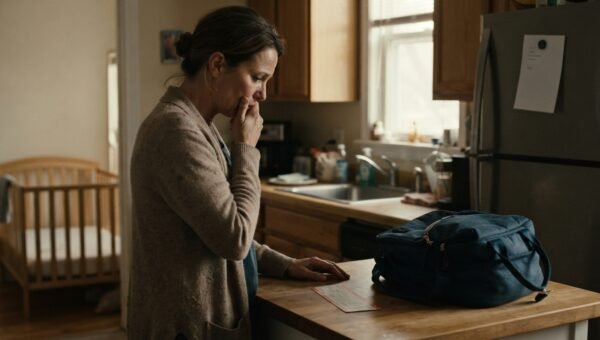
I didn’t turn on the overhead light. I walked straight to the table, pulled the small square printout of the photograph out of my coat pocket, and laid it face up right in the center of the oak tabletop where we’ve eaten three meals a day for three decades.
Arthur came in from the garage a minute later carrying a bundle of kindling. He stopped dead when he saw the paper on the wood.
He didn’t run. He didn’t ask me what I was doing. He just set the wood down by the scuttle box with a dry thud, walked over to the table, and pulled out the Windsor chair across from me. He sat down very slowly, his knees making that dull cracking sound they’ve been making since he fell off the hay wagon back in ninety-six.
He looked at the picture for a long time. The light from the refrigerator was the only thing illuminating his face, casting a pale blue glow over his chin and the deep lines around his eyes.
“I was going to tell you after the test,” he said.
His voice didn’t sound like a man who had been caught. It sounded like a man who had been holding his breath underwater for twenty minutes and had finally let the air out.
“The test,” I said. My voice was thinner than I wanted it to be.
Arthur didn’t answer right away. He reached into the pocket of his flannel shirt, pulled out his phone, and tapped the screen twice. He laid it flat on the table right next to the photograph of him touching that woman’s cheek.
“Look at the screen,” he said.
I didn’t want to touch his phone. It felt dirty, like it belonged to someone else entirely. But I leaned forward until my glasses slipped down the bridge of my nose and looked at the glowing display.
It was an ancestry app. I’d seen him playing with it once around Thanksgiving when our youngest niece got him one of those mail-in spit kits for a joke. I remember him laughing about it, saying he already knew his people came out of North Carolina and that was enough history for any man.
The screen showed a family tree. At the top were our names, Arthur and Martha, with our two boys branching off below us like old apple boughs. But over on the left side, tucked away behind a dotted line I had never laid eyes on before, there was a new branch. A red line connected Arthur’s name to a profile box that had a woman’s name inside it.
Clara Vance. Age 41.
“Who is she?” I asked.
Arthur rubbed his palms against his thighs, leaving dark crescents of dry skin on his denim trousers. “She’s mine, Mart. Before we met. Back when I was working the lumber mill in Bristol before the draft.”
The kitchen seemed to get very small. I could hear the old refrigerator compressor humming in the corner, a steady, low-frequency rattle that sounded like a tractor idling down the road. Thirty-six years. We had buried my mother together. We had sat on the edge of our eldest boy’s hospital bed when he broke his femur playing JV football. We had signed the mortgage release on this very house three years before the turn of the century.
“Thirty-six years, Arthur,” I said.
“I didn’t know,” he said, and his voice cracked just a little bit, the way it did when his own father died and he tried to fix the fence posts instead of crying. “I swear to God, Mart, I didn’t know she existed until four months ago. Her mother never told me. They moved out to Oregon right after the mill shut down in seventy-nine. She passed away last winter, and Clara found my name through some DNA database online because she was putting together her medical history for her doctor.”
He picked up his phone, tapped another icon, and slid a folded piece of white printer paper across the table toward my hand.
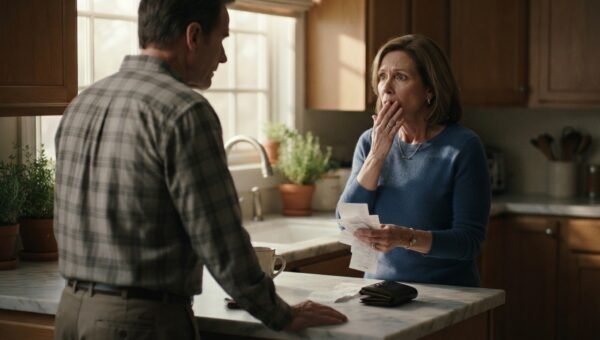
I unfolded it. It was a lab requisition form from the University Medical Center. Under the heading of genetic marker compatibility and tissue typing, there were words I didn’t entirely understand, but I saw the diagnosis near the bottom in bold type: acute myeloid leukemia, second recurrence.
“She needs a donor,” I whispered.
“She’s my daughter,” Arthur said simply. “And I’m the only full match she’s got within five hundred miles because her brother doesn’t have the right markers. That’s why I was going to those appointments on Wednesdays. We were doing the blood work and the clearance physicals. I didn’t want to tell you until I knew if I could actually help her, because if I couldn’t, what was the point of bringing a ghost into this house?”
I looked at the photograph on the table again. The woman in the puffer coat. Clara. I looked at the shape of her jaw in the little thumbnail on the screen. It was the same jaw Arthur has, slightly square at the corners, the kind of bone structure that doesn’t soften much with age.
“You put the phone under your pillow,” I said, and even to my own ears, it sounded like a ridiculous thing to fixate on when there was leukemia and a forty-year-old secret sitting between us.
“I didn’t want the notification dings waking you up at five in the morning when she sent me lab results or text messages,” he said, looking straight at me for the first time since he came through the door. “Every time that thing buzzed, I felt like I was stealing something from you. I was scared to death you’d see a name pop up before I had my feet under me.”
We sat there in the dark kitchen for a long time. The navy bean soup on the back burner had gone completely cold. I could feel the anger I’d driven around with for three hours slowly turning into something heavier and much more complicated, like wet clay settling at the bottom of a bucket.
“Why didn’t you just tell me the first day?” I asked.
“Because I was a coward,” he said. He didn’t look away this time. “I was scared you’d look at me and think I had another life behind your back all these years, even though I didn’t. I was terrified of losing what we built.”
“You think a blood test was going to make me pack a bag?”
“I didn’t know what you’d do,” he said quietly. “When you’ve been with someone thirty-six years, you get fragile about the foundation. You start thinking any little crack is going to bring the whole barn down.”
I reached out and touched the corner of the lab form with my fingernail. The paper was crisp and cheap, the kind they print off office machines that are running low on toner.
“When is the next one?” I asked.
Arthur blinked. “The marrow harvest? Next Tuesday at eight in the morning.”
I stood up from the table, my joints popping in the quiet room, and walked over to the coffee pot to see if there was any left from the morning. There wasn’t, just a dark ring of sludge at the bottom of the glass carafe.
“Well,” I said, turning back to face him while I reached for the dish towel to wipe down the counter. “You’re going to need someone to drive you home afterward. You always get woozy when they give you that sedative stuff, Arthur. You know you can’t drive with those eyes.”
Arthur let out a long breath that sounded almost like a laugh, though there wasn’t much humor in it. He stood up from his chair and walked around the table until he was standing right beside me near the sink. He didn’t touch me, but his shoulder brushed mine, warm through his flannel shirt.
“We can go together on Tuesday,” he said. “And maybe… maybe we can invite her over for Sunday dinner after she’s out of recovery. If you’re up for it.”
I looked down at the phone still glowing on the oak table, showing that strange, unexpected branch reaching out into the empty space of our lives.
“I’ll make a pot of roast beef,” I said. “And you can tell her where you get those stubborn cowlicks from.”
We sat side by side at the kitchen table as the evening light faded completely from the window, scrolling through the rest of the digital family tree together while the house settled around us.