PART 1
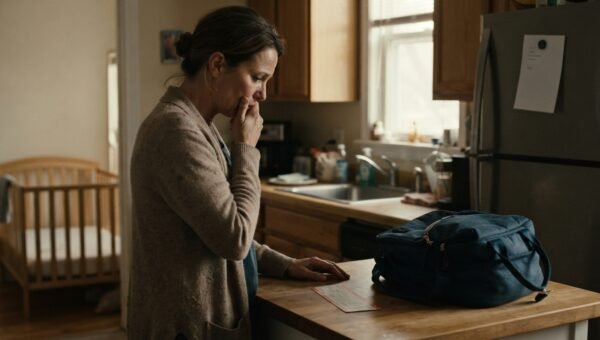
My mother stopped wearing her wedding ring two months before my parents’ 50th anniversary. Dad noticed right away at Sunday dinner. He kept staring at her bare left hand while she passed the roast beef, until he finally reached out and touched her knuckle. She pulled her hand back smoothly, laughing it off, and told him her arthritis was acting up and her fingers were just too swollen.
Dad swallowed the explanation because he loved her, and because at seventy-four, you want to believe your wife of nearly fifty years isn’t keeping secrets. I believed her too. Mom had always been practical, and she had complained about her stiff joints all winter.
Then came the weekend Mom stayed over at my house while Dad was up at the cabin fixing the roof gutters. She spent two nights in my guest room, drank coffee on the back porch with me every morning, and talked about the golden anniversary party we were planning. She seemed completely normal, if a little distracted whenever Dad called to check in.
Two days after she went home, I stripped the guest bed and cleaned the room. When I opened the small nightstand drawer to wipe out some lint, I noticed a tiny piece of clear Scotch tape sticking out from underneath the bottom of the wood drawer above it.
I pulled the drawer all the way out of its tracks and flipped it over.
Taped flat against the raw plywood underside was her plain yellow-gold wedding band.
She hadn’t left it by accident on top of the nightstand. She hadn’t dropped it into the jewelry dish. She had physically taped it to the bottom of the drawer where nobody would ever look.
My stomach gave a sick, heavy drop. I stood there holding the wooden drawer in my bedroom, staring at the thin gold band. I called her immediately.
“Mom,” I said, trying to keep my voice light and steady. “I was cleaning the guest room, and I found your wedding ring. Did you forget it?”
The other end of the line went entirely dead. Not a disconnected click, just the heavy, frozen silence of someone who had stopped breathing.
“Mom?” I repeated.
“Where was it, Carol?” she asked. Her voice was barely a whisper, flat and strained.
“Taped under the bottom of the nightstand drawer,” I said honestly. “Why was it taped there?”
She took a long, shaky breath. “Please,” she said, her voice cracking slightly at the edge. “Please don’t tell your father yet.”
That word, yet, stayed with me like an open sore. It wasn’t a denial. It wasn’t a reasonable explanation. It was an admission that something was coming, and she was simply waiting for the right moment to let it blow up our lives.
I promised her I wouldn’t say anything, mostly because I was terrified of what would happen if I did. Dad’s heart wasn’t great. He had taken blood pressure pills for a decade, and he worshipped my mother. The idea of dropping a grenade into their golden anniversary made my hands shake.
A week later, Dad called me himself. His voice sounded bright, full of boyish excitement.
“Carol, honey, could you come over on Saturday?” he asked. “I dragged the old photo albums down from the attic.
I want to build a slideshow for Mom for the banquet hall. You’re the computer genius around here. Can you help me scan them onto a flash drive?”
Mom was at her weekly book club luncheon on Saturday afternoon, which gave Dad and me the living room to ourselves. He had laid out four heavy velvet-bound albums across the dining room table, along with a stack of loose prints and a magnifying glass. He made a pot of black coffee and brought out a plate of lemon cookies.
“Look at this one,” Dad smiled, pointing his thumb at a faded square photo from 1974. “We were so young we didn’t have sense enough to come in out of the rain.”
We spent two hours working our way through the albums. We scanned their camping trips, my first bike ride, my eighth birthday party in the backyard. Then we reached the brown leather album marked 1978.
Dad turned the heavy page. In the corner was a glossy color picture of my mother standing in front of the county courthouse in a tailored light blue wool coat, holding a small bouquet of white carnations. She looked stunning, her dark hair pinned up, smiling straight into the camera.
“I remember that coat,” Dad said, frowning slightly in mild confusion. “She bought that with her own secret savings. But I don’t remember this picture. Where was I?”
He reached out to gently slip the photograph from its plastic sleeve so he could place it on the flatbed scanner.
As the photograph slid out, a stiff piece of cream-colored paper folded in thirds came with it. It had been tucked tightly behind the print, hidden inside the black paper backing of the album page.
“What’s that?” Dad asked.
He unfolded it carefully, smoothing the heavy creases with his thumbs. It was an official state document, stamped with a golden county seal. A certificate of marriage.
Dad started reading it silently. His eyes traced the calligraphic script across the top line, down to the middle, and then froze.
The groom’s name wasn’t my father’s.
It was a man named Arthur James Vance.
Dad read the name twice. Then he pushed his reading glasses further up his nose and looked at the date stamped at the bottom.
November 14, 1978.
I was born in October of 1975.
Dad stared at the date, his face completely draining of color until his skin looked like wet chalk. He looked at the legal seal, then down at the picture of my mother smiling in her blue coat, and then slowly turned his head to look at me.
PART 2
“That doesn’t make any sense,” Dad said. His voice was completely hollow, like all the air had been sucked out of the room. “Your mother and I were married in June of 1974. We had the ceremony at St. Mark’s. Everyone was there. Uncle Frank drove the getaway car.”
He reached into his pocket, pulled out his worn leather wallet, and slipped out the faded black-and-white picture of them on the church steps that he had carried behind his driver’s license for fifty years. In that picture, Mom was wearing white lace, and Dad was in a rented tuxedo, grinning like he had won the lottery.
“We were married,” he whispered again, looking from the wallet photo to the official document on the table. “Who the hell is Arthur Vance?”
I sat there, frozen, the weight of the gold ring I had found hidden under the drawer suddenly burning in the back of my mind. “Please don’t tell your father yet.” That had been her plea. She wasn’t hiding a temporary spat. She was hiding a secret that predated my earliest childhood memories.
“Dad,” I said gently, touching his forearm. His arm was trembling. “Let’s not jump to conclusions until we ask her.”
“I was at work that day,” Dad murmured, not hearing me. His finger traced the November 1978 date. “I was running the freight line down in Toledo that whole week. She told me she took the bus to visit her sister in Cleveland. She took a bus to get married.”
The front door unlocked with a sharp click.
Mom walked into the foyer carrying a cardboard flat of pansies from the nursery. She was humming softly to herself, her keys jingling in her hand.
“Arthur? Carol?” she called out cheerily. “You wouldn’t believe the sale they had at Miller’s—”
She stopped dead in the dining room archway.
Dad was sitting rigid in his chair, the unfolded certificate lying flat between his hands. The photograph of her in the blue coat sat next to it, under the glare of the dining room chandelier.
Mom’s eyes dropped to the paper. The color drained from her face so fast I thought she might faint. The flat of purple pansies tilted in her grip, dirt spilling onto the hardwood floor, before she caught herself and set the flowers down on the entryway bench.
“Arthur,” she said quietly.
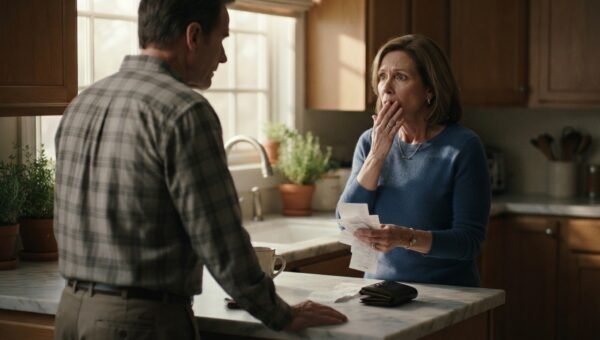
“Who is Arthur James Vance, Ruth?” Dad asked. He didn’t yell. That was the terrifying part. His voice was dead, stripped bare of any emotion. “And why did you marry him three years after Carol was born?”
Mom closed her eyes for three long seconds. When she opened them, she looked straight at me, and I saw the betrayal in her gaze. She thought I had told him. She thought I had set this up.
“Carol didn’t tell me anything,” Dad said, catching the look. “We were scanning pictures for our party. The party for our fifty years of marriage. Only now I’m looking at a piece of paper that says you married another man during our fifth year.”
Mom walked slowly into the room, but she didn’t sit down. She gripped the back of an empty dining chair until her knuckles turned ivory.
“Arthur, please sit back. Let me get you a glass of water first. Your blood pressure—”
“Stop it, Ruth!” Dad’s voice finally cracked, a sharp, ragged bark that made the china rattle in the cabinet. “Do not treat me like an invalid! Who is this man? And whose daughter is Carol?”
That was the question that had been hanging in the air like poison. The room went dead silent.
I looked up at my mother. Every certainty I had ever held about my own life—my blood, my name, the man who taught me how to drive and held my hand through chickenpox—hung on what she was about to say.
Mom began to cry, silent tears tracking down the deep lines beside her nose. “Carol is yours, Arthur. On my soul, Carol is your daughter. You are her father. That has never been a lie.”
“Then what is this?” Dad demanded, slapping the flat of his hand against the certificate. “Tell me right now, or I swear to God I am walking out that front door and I am not coming back.”
Mom pulled a trembling hand across her mouth. “You couldn’t marry me in 1974, Arthur,” she said, her voice shaking violently. “Because I was already married to him.”
PART 3
The story came out in jagged, painful pieces over the next two hours, while the coffee went stone cold and the afternoon light faded out of the living room windows.
In 1971, three years before she ever met my father, Mom was twenty-one years old and living in a small industrial town two counties south. She met Arthur Vance at a bowling alley. He was older, charismatic, and had a job running delivery routes. Within six months, they went to a justice of the peace and signed their names to a registry.
It lasted less than ninety days. Arthur Vance was a reckless gambler who ran up debts with men you didn’t borrow money from. One night in early 1972, he packed a duffle bag, took every dollar out of their joint bank account, and vanished into thin air.
Mom moved away. She changed towns, got a job as a bookkeeper at a lumber yard, and tried to forget the humiliation. Two years later, she met my dad at a company picnic. Dad was steady, kind, and hardworking. He treated her like she was made of gold.
“I was terrified,” Mom sobbed, sitting at the edge of the table, her head bowed in her hands. “I went to a legal aid lawyer in 1973. He told me it would cost three hundred dollars to file for an abandonment divorce and run notices in the newspaper, money I didn’t have. Then Arthur, you asked me to marry you. You were so happy. Your family was so proud. Everyone was talking about the big church wedding.”
“So you lied to me,” Dad said. He was staring straight ahead at the wall, his hands resting motionless on his knees.
“I convinced myself the first marriage didn’t count,” Mom whispered. “We had only lived together for two months. There was no property, no children. I thought Arthur Vance was dead or gone forever. I wanted a clean life with you so badly that I just… pretended my real life started the day I met you. We had the church ceremony. The priest signed the church register, but I never filed the civil marriage license downtown. I told you the county clerk lost the paperwork in the mail.”
Dad blinked slowly, a memory surfacing. “You said you’d take care of re-filing it.”
“I couldn’t,” Mom wept. “Because filing it would have been a felony. I was already legally married to another man.”
I sat across from her, my mind spinning. “Mom… if you were already married to Arthur Vance in 1971, why does this certificate say you married him in November of 1978?”
Mom looked up, her eyes rimmed in red, wiping her cheeks with a paper napkin.
“In the summer of 1978, Arthur Vance tracked me down,” she said.
A cold chill went through my chest.
“He found out where my parents lived, and he showed up on my sister’s doorstep,” Mom continued. “He was sick. He had severe liver damage and debts he couldn’t pay. But he knew I had a new life, a respectable husband with a steady union job, and a three-year-old baby girl.”
She looked at Dad, her voice desperate. “He told me if I didn’t pay him five thousand dollars, he would walk into your dispatch office in Toledo and introduce himself as my legal husband. He threatened to file bigamy charges against me. He said he would take Carol away because our home was built on fraud.”
“Why didn’t you come to me?” Dad asked. His voice wasn’t angry anymore; it was broken. “Five thousand dollars was everything we had in savings back then, Ruth. But I would have given you my right arm. Why didn’t you trust me?”
“Because you would have gone to jail,” she cried. “You would have found him and beaten him half to death, Arthur! You were hot-tempered back then, and he was a snake. And worse, you would have known I deceived you from the very first day we stood at that altar.”
So Mom went to see a lawyer in secret. The lawyer told her that because Vance had abandoned her for years, she had clear grounds for an absolute divorce, but Vance refused to sign the waiver unless he got his cash. He demanded cash, and he demanded that they settle everything quietly without his creditors finding him.
“The lawyer arranged an uncontested, expedited divorce hearing,” Mom explained, pointing at the document. “This paper isn’t a marriage certificate, Arthur. Look at the title at the very top. It’s a certified copy of the final decree of dissolution and the original 1971 registry entry, bound together for the court record. The clerk filed the final decree on November 14, 1978. That was the day Arthur Vance signed the release, took the cashier’s check, and vanished for good.”
Dad picked up the paper again. His hands were steadier now. He turned it over and looked at the embossed seal on the reverse side. The fine print in the clerk’s docket read: In Re the Marriage of Ruth Anne Miller and Arthur James Vance: Final Decree of Dissolution.
The front page was the old 1971 marriage record that the court had attached to verify the dissolution. To anyone glancing at the top sheet, it looked like a wedding certificate dated the day of the final filing.
“He died three years later in Nevada,” Mom whispered. “A cousin sent me the obituary clipping. That was the end of him.”
Dad sat in silence for a long time, the clock on the mantle ticking loudly in the quiet room. Then he looked at the gold ring on the table—the ring I had found taped under the drawer.
“And this?” Dad asked softly. “Why did you take off your ring two months ago, Ruth? Why did you tape it under Carol’s drawer?”
Mom looked at the gold band, and fresh tears spilled down her face.
“Because two months ago, the banquet hall asked for a copy of our marriage license to verify our anniversary package discount,” Mom said. “I went down to the county records office to pull a certified copy of our 1974 marriage, intending to finally put it in the family bible.”
She covered her mouth, a sob tearing through her throat.
“The clerk searched the state archives for two hours, Arthur. There is no record. After Arthur Vance was out of my life in 1978, I was so ashamed of what I had done that I never told you we needed to go to the courthouse and make our marriage legal. Every anniversary we celebrated, every tax return we filed, every year we spent together… we were never legally married. I was living in a house of cards.”
ENDING
The truth sat in the center of the dining room table like an unexploded shell.
Fifty years of Sunday dinners, church attendance, shared bank accounts, and mortgage payments. A whole life built on solid ground, only the foundation had never been filed with the county clerk.
“When I realized what I had done,” Mom said, her shoulders shaking, “I couldn’t look at that ring anymore. Every time I washed the dishes, every time you held my hand in church, I felt like a fraud. I felt like I was wearing a lie on my finger. When I stayed at Carol’s house, I couldn’t bear to wear it to bed. I took it off and taped it away so I wouldn’t have to look at it, but I couldn’t bring myself to throw it away. I was planning to tell you after the anniversary. I was going to pack my bags and move into an apartment.”
Dad didn’t speak for five full minutes. He just sat there, looking down at his own wedding band, worn thin and scratched from forty years of turning wrenches and hauling timber.
Then, slowly, he pushed his chair back and stood up.
He didn’t yell. He didn’t walk out the front door. He walked around the table until he was standing right behind my mother. He placed both of his large, calloused hands on her shoulders.
Mom flinched, expecting him to push away, but he didn’t. He leaned down and rested his cheek against the crown of her gray hair.
“Ruth,” Dad said softly, his voice thick with unshed tears. “You carried that by yourself for fifty years?”
Mom broke down completely, burying her face against Dad’s forearm, sobbing so hard she could barely draw breath.
“I was so afraid,” she wept. “I was so afraid you wouldn’t want me if you knew.”
“You foolish woman,” Dad whispered, pulling her up from the chair and wrapping his arms tightly around her. “I took a vow before God on those church steps in 1974. Father O’Malley blessed us. The state of Ohio didn’t build this family. You and I did. We raised Carol. We buried your parents. We worked three jobs between us to pay off this house. A clerk’s signature didn’t make you my wife. You’ve been my wife every single day of my life.”
I sat in my chair and let my own tears fall, the knot of terror in my chest finally unraveling into pure, aching relief.
The next morning, Monday at nine o’clock, Dad put on his Sunday suit and polished his black dress shoes. Mom wore her Sunday dress, her eyes still swollen, but her chin held high. I drove them down to the county municipal building in town.
We paid fifty-five dollars for an expedited marriage license. We stood in front of a tired municipal judge named Harrison, who adjusted his spectacles and looked at the two elderly people standing before him with amused curiosity.
“Have you two been together long?” Judge Harrison asked, holding his pen above the registry book.
Dad looked over at Mom. He reached into his pocket, pulled out the gold band I had brought with me from my guest room nightstand, and took my mother’s trembling hand.
“About fifty years,” Dad said, smiling softly through his tears. “We just took the long way around.”
They signed the registry. I signed as their legal witness, my signature steady and firm beside theirs on the parchment.
When the golden anniversary party arrived three weeks later, the banquet hall was packed with sixty friends and relatives. Dad stood up to give his toast, holding his champagne glass high. He told everyone in the room that he was the luckiest man on earth, and that after half a century, he loved my mother enough that he had married her twice.
Nobody in that room understood what he meant, and nobody needed to. Across the table, my mother looked at him, the yellow-gold ring shining brightly on her finger, anchored exactly where it had belonged all along.