PART 1
The taxi dropped me at the curb on a quiet street in southwest Austin just after four in the afternoon.
I was carrying thirty-two hours of travel in my bones. I had flown from Dubai to London, waited out a four-hour layover, caught a ten-hour leg into Dallas, and grabbed a commuter hopper into Austin. My linen shirt was rumpled, my duffel bag was scuffed from cargo holds, and the Texas heat hit me like a wet towel the second the cab doors shut.
I stood on the sidewalk and looked up at the house.
It was a four-bedroom limestone single-story with a dark cedar garage door and a wide covered porch. I had paid $600,000 for it in cash six years ago, right before I took an overseas contract running operations for an offshore civil engineering firm. I bought it so my mother, Evelyn, would never have to worry about a landlord raising the rent or an aging roof leaking over her head.
My mother was sixty-eight then. Her knees were bad from forty years of standing behind a counter at an upholstery supply shop, and my father had died without life insurance or a pension. When the Dubai contract came through, the signing bonus and the tax-exempt overseas salary gave me one clear opportunity to fix her life for good. I bought the house outright, put the warranty deed in my name through the Travis County clerk, and handed her the front door key before I boarded my flight.
My plan had been to stay abroad for three years. Three years turned into six because the project expanded, the money was steady, and every time I spoke to my sister, Megan, she assured me Mom was thriving.
“Mom loves having us close,” Megan had told me on our monthly phone calls. “Julian and I moved into the guest suite like you suggested so she doesn’t get lonely. Everything is running smooth.”
I had not asked for rent. I only asked that Megan and her husband, Julian, cover the electric bill and keep the gutters clean.
I walked up the flagstone walkway, hauled my bag onto the porch, and pressed the doorbell.
Footsteps echoed inside on the tile. A deadbolt clicked back, and the front door swung open.
A man stood in the entryway holding a bottle of sparkling mineral water. He was thirty-five, wearing beige golf shorts and a polo shirt with a country club logo on the chest.
He had a gold watch on his left wrist and a neat haircut that looked like it cost eighty dollars every two weeks.
Julian.
I had met him once, at his and Megan’s small courthouse wedding seven years ago, right before I left the country. He had looked softer back then, younger and eager to please. Now his eyes were narrow. He blocked the doorway with one arm propped against the casing, looking me up and down.
To him, I was just a tired, dusty man with gray hair at the temples, carrying a faded canvas duffel bag and wearing a wrinkled blue shirt. He did not recognize me at all.
“Can I help you?” he asked. His tone was flat, the kind of voice people use when a solicitor interrupts their afternoon television.
“I am here to see Evelyn,” I said.
Julian let out a dry, irritated breath through his teeth. He didn’t move an inch to let me in.
“The maid is in the backyard,” he sneered, pointing a thumb over his shoulder toward the narrow side gate. “She’s clearing the brush along the back fence. Use the gravel path around the garage. Don’t drag dirt onto the porch.”
He pulled the heavy cedar door shut and turned the deadbolt right in my face.
PART 2
I stood on the porch for ten seconds, listening to the quiet click of the deadbolt settling into the jamb.
The phrase sat in my head like lead. *The maid is in the backyard.*
I walked down the porch steps, turned past the garage, and pushed through the wooden gate. The heat in the alleyway between the garage and the cedar fence was thick with the smell of dry grass.
At the far corner of the yard, near the live oak tree, an older woman was kneeling on a rubber garden mat. She was wearing faded canvas work pants, oversized rubber gloves, and a straw hat tied under her chin with a string. A metal rake lay in the dry dirt next to four heavy black contractor bags filled with thorny cedar trimmings.
She was pulling weeds out of the rock bed with both hands, her shoulders bent forward, breathing hard in the ninety-two-degree sun.
“Mom,” I said.
She stopped. Her shoulders went rigid, the way people freeze when they expect someone to shout at them.
She turned slowly, sitting back on her heels. When she pushed the brim of the straw hat up with the back of her dirty glove, her face was red from the heat, and deep lines were etched around her mouth that had not been there six years ago.
“David?” she whispered.
I dropped my bag on the grass and went down on both knees beside her. Her gloves were caked with dirt, but she threw her arms around my neck anyway. She was shaking. Not from excitement, but from the kind of deep, worn-out relief that comes when someone has been holding their breath for years.
“What are you doing out here in this heat, Mom?” I asked, pulling back to look at her.
“Julian wanted the garden cleared before his business partners come over for dinner tomorrow,” she said. Her voice was thin, almost timid. “He said the landscaping service was too expensive this month, so if I didn’t get the brush bagged by five, he was going to cancel my grocery delivery.”
“Your grocery delivery?”
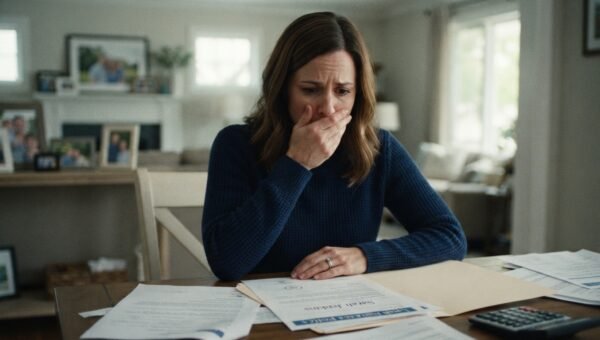
“He manages the household accounts now,” she said, looking down at her stained gloves. “Megan said it was easier that way since I get confused with the banking apps. They took the master bedroom four years ago, David. They said it made more sense because Julian works from home and needs the office space. I stay in the back sewing room off the garage.”
“The sewing room doesn’t have an air conditioner, Mom,” I said.
“They bought a window fan,” she said quietly. “It works okay at night if I leave the hallway door cracked.”
I looked toward the large glass sliding doors that led to the covered patio. Through the tinted glass, I could see the polished granite kitchen island, the stainless steel range, and the air-conditioned living room where Julian was sitting on a white sectional sofa, typing on a laptop with his bare feet propped on a glass table.
“Get up, Mom,” I said.
I took her by the elbow and helped her to her feet. Her knees popped, and she leaned heavily against my shoulder as we walked across the lawn toward the sliding patio doors.
“David, don’t,” she pleaded, tugging at my shirt. “Julian has a temper when he’s interrupted. He tells me all the time that if I make trouble, he’ll have Megan put me in that state home outside Temple. He says without his credit score, we wouldn’t even have this place.”
“He told you that?”
“He said he pays the taxes,” she whispered. “He said the deed is under a family partnership that he controls.”
I stopped at the patio threshold, reached into my pocket, and pulled out my phone.
Before I left Dubai, I had downloaded a certified copy of the Travis County property records onto my drive for my overseas tax filings. The county database doesn’t lie.
Parcel ID 041829.
Owner: David Miller.
Status: Sole Owner, Fee Simple.
Property taxes: Paid directly every November through an automatic escrow withdrawal from my Chase checking account.
Julian had not paid fifty cents toward the land, the structure, or the county assessment.
I slid the heavy glass door open and walked my mother straight into the cool air of the living room.
PART 3
Julian looked up from his laptop, his face instantly souring as he saw my mother’s dirty work pants on the edge of the beige area rug.
“Evelyn, what did I tell you about the sliding door?” he barked, closing his laptop with a sharp snap. “Take your boots off outside. And who is this guy? Why is he in the house?”
“My name is David,” I said.
Julian blinked. The irritation on his face flickered, replaced for a second by confusion, then by a tight, defensive smirk.
“David. Right. Megan’s brother from the oil company.” He didn’t stand up. He leaned back into the sofa cushions, crossing one leg over his knee. “We weren’t expecting you until next month. You should have texted first. We have guests coming tomorrow night, and the house isn’t set up for company.”
“This isn’t company, Julian,” I said, keeping my voice very quiet. “This is my house.”
Julian let out a short, patronizing laugh. “Look, buddy, I know you helped with the down payment six years ago. Megan mentioned it. But things change. I’ve been managing this property, maintaining the grounds, and running this household for five years while you were off living the expat life. Evelyn can’t live alone anymore. She needs structure.”
“You made a seventy-four-year-old woman clear cedar thorns in ninety-two-degree heat,” I said.
“She needs to contribute,” Julian said, his voice rising, taking on the hard, practiced edge of a man used to bullying older women. “She lives here for free. I feed her. I pay for her utilities. She does light yard work to stay active. It’s good for her circulation.”
The front door clicked open, and Megan walked in carrying two shopping bags from an upscale boutique at the Domain.
She froze in the foyer when she saw me standing by the kitchen island next to our mother.
“David?” Megan dropped the bags onto the entry bench. The color drained out of her cheeks. “You’re… you’re home early.”
“I am,” I said. “Just in time to see Mom living in the sewing room without air conditioning while you two sleep in the master suite.”
Megan looked at Julian, then at the floor. “David, it made sense. Julian needed an executive office for his consulting calls. Mom said she preferred the smaller room because it’s closer to the garden.”
“Mom didn’t say that, Megan,” our mother said.
Her voice wasn’t loud, but it was the clearest I had heard it all day. She took off the straw hat and set it on the granite counter, looking right at her daughter.
“Julian told me that if I didn’t move my dresser into the sewing room by the first of May, he would stop driving me to my arthritis therapy,” she said.
Megan winced, but Julian stood up from the sofa, his chest puffed out, pointing a finger directly at my face.
“Listen to me, David. You don’t get to march in here after six years in the desert and start giving orders. I have legal residency here. Megan and I have established tenancy. If you try to push us around, I will tie this property up in landlord-tenant court for eighteen months while you sit in a hotel. You can’t touch me.”
I didn’t yell. I didn’t step toward him.
I picked up my phone, unlocked the screen, and tapped the emergency contacts menu.
“Megan,” I said, “six years ago, I gave you power of attorney over Mom’s local medical care and added you as the secondary contact on the municipal water and gas accounts. Did you think that gave you ownership of the ground?”
Megan didn’t answer. She was biting her lower lip, staring at the polished wood floor.
“Julian,” I continued, looking the man in the eyes, “you have thirty minutes to pack two suitcases each and get off my property.”
“You can’t do that!” Julian shouted. “It’s an illegal lockout! I know the law!”
“It isn’t a lockout yet,” I said. “It’s an immediate termination of guest privileges for domestic elder exploitation. Officer Ramirez from the Austin Police Department’s senior protection unit is already reviewing the file I submitted electronically an hour ago while I was in the cab. If you want to argue about whether forcing an elderly dependent into ninety-two-degree heat to bag brush violates the Texas Human Resources Code, you can explain it to him on the sidewalk.”
Julian’s mouth worked, but no sound came out. He turned to Megan, waiting for her to defend him, but Megan was already weeping against the entryway wall.
ENDING
Julian was out of the house by six-fifteen.
He didn’t get eighteen months. He didn’t even get eighteen minutes of argument once two patrol officers pulled into the driveway to conduct a welfare check on my mother. When Officer Ramirez saw Evelyn’s blistered hands, the thermometer in the un-airconditioned sewing room reading eighty-nine degrees, and the warranty deed showing my sole ownership, he made the ground rules very clear.
“You have twenty minutes to take your personal clothes and your car, sir,” Ramirez told Julian on the front porch. “If you set foot back on this parcel without an escort, it’s criminal trespass.”
Julian loaded his golf clubs and three garment bags into his leased German sedan, his face pale and furious, refusing to look at me as he backed out into the street. Megan stayed behind for an hour, sitting on the porch steps, crying and asking if we could work it out through a family counselor.
I didn’t yell at my sister. That was the hardest part. I looked at her and felt nothing but an empty, quiet sadness for the weak person she had become to keep a bully happy.
“You let your husband treat your own mother like a field hand in a house I bought for her,” I told Megan quietly. “Pack your bags, Megan. Go find an apartment with Julian. If you want to see Mom again, it will be in a public diner, and only when she asks to see you.”
Megan left in a rideshare at seven-thirty.
By nine that evening, a mobile locksmith van was parked in the driveway. The technician replaced every deadbolt on the exterior doors with commercial-grade keypad locks, gave me four fresh brass keys, and re-coded the garage transmitter.
While the locksmith worked, I sat at the kitchen table and logged into my mother’s healthcare portal. I revoked Megan’s medical power of attorney, removed her from the emergency contact cards at the clinic, and updated the authorized guardian profile to my name and my personal cell number.
At ten o’clock, the house was finally quiet.
I had carried my mother’s old oak dresser and her floral quilt out of the stuffy sewing room and set them back where they belonged, in the master bedroom with the ceiling fan spinning and the air conditioner humming at a steady seventy-one degrees.
Evelyn was sitting on the edge of the mattress, wearing clean cotton pajamas, her hands covered in thick healing ointment.
I walked into the room carrying a mug of hot chamomile tea and set it on the nightstand next to her reading glasses.
“David,” she said, looking around the large, cool room as if she still couldn’t believe the doors were locked from the inside. “Are you going back to Dubai?”
I sat down in the armchair by the window, the same chair my father used to read the evening paper in thirty years ago.
“No, Mom,” I told her, leaning back against the cushions. “My contract is done. I’m staying right here.”
She took a sip of the warm tea, set the mug down with steady hands, and pulled the soft quilt up over her lap. For the first time in six years, the house was completely at peace.