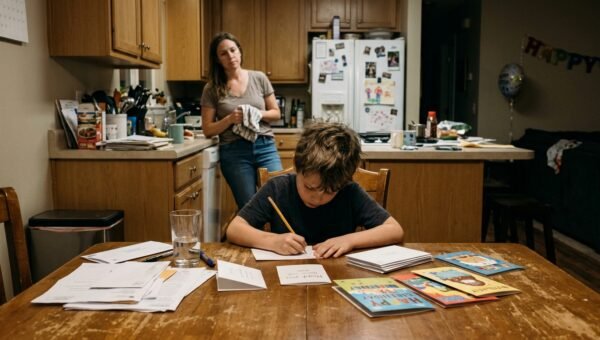
The last normal thing David said to me was that the roast chicken needed ten more minutes. I was at the stove, and he was washing his hands at the sink like any Thursday. A few minutes later, I set my laptop on the table and pressed play.
The video showed his truck leaving his office, turning onto the county road, and driving 22 miles to a lake house. A woman came out onto the porch.
David kissed her the way he’d kissed me at our wedding 31 years ago, with both hands on my face.
His fork stopped halfway to his mouth. He didn’t look up.
“Thirty-one years,” I said.
“Ask your sister,” he whispered.
I’d expected a denial, maybe some clumsy excuse about the camera catching things wrong. I wasn’t ready for my sister’s name. The chicken sat there getting cold while I tried to understand why Eleanor belonged in a video of my husband kissing another woman.
Five weeks earlier, I’d bought the dashcam for $79 at AutoZone. David had been “working late” for 13 months. He’d always been practical about work, so at first I let it go. Then the same days kept coming around, Tuesdays and Thursdays, and I started counting the hours he was gone the way I used to count rain days when we were trying to get the garden in.
I didn’t like who I became. I checked his truck mileage. I listened for his phone buzzing. I told myself I was looking for a reason to stop worrying, which wasn’t true. I wanted proof.
The first video showed him driving to the lake house. The next Tuesday showed the same route. I watched four weeks of footage, a little at a time, usually after he’d gone to bed. He brought groceries every trip. The bags looked full. I could see him carrying them up the porch steps, and sometimes the woman stood in the doorway waiting.
He spent about $180 each visit. I know because I found the receipts in the truck. At home, I was making our $120 weekly grocery budget cover everything, including coffee and the cat food. That Thursday, I’d cooked the chicken and cut the last of the carrots into thin slices so they’d look like more.
At the table, David finally pushed his plate away.
“Who is she?” I asked.
“Brenda.”
My niece. Eleanor’s daughter.
“What’s she doing at a lake house?”
“She needed help.”
“Then why lie to me for 13 months?”
He rubbed a thumb over the handle of his fork. “Your sister told me not to involve you.”
I looked at the laptop. The video was paused on the porch. His hand was still on Brenda’s cheek.
“That’s what you call this?”
“I was trying to keep her safe.”
“You kissed her.”
He looked down again. “It got complicated.”
I knew what that meant. I also knew that some part of me wanted the story he was offering. A family crisis. A frightened young woman. A man who stepped up because nobody else would. I wanted there to be a decent reason for the groceries and the secret, because 31 years is a long time to find out your husband has been keeping a second life.
But the kiss stayed there on the screen.
“Tell me what Eleanor did,” I said.
“She’ll tell you.”
“That’s not an answer.”
He didn’t give me one. So I called my sister.
Eleanor answered on the fourth ring. It was late enough that I could hear the television in the background, some bright game show she liked. I told her David had sent me to her. She went quiet for a moment, then said, “I knew you’d find out eventually.”
That was when I stopped hoping the whole thing was a misunderstanding.
“Why is Brenda at that house?”
“She left her husband.”
“Then she came to you.”
“She made her choices.”
“She has a four-year-old.”
“I couldn’t have them in my house.”
Eleanor said it flatly, like we were talking about a leaky faucet. Brenda had fled an abusive marriage 13 months ago. She’d asked her mother for a place to stay. Eleanor had refused, cut her off, and told her not to come back.
“Why didn’t you tell me?” I asked.
“Because you would’ve gone running over there.”
“Yes. I would have.”
“David promised not to bring you into it.”
I had to sit down. The chair scraped against the kitchen floor. Eleanor said she’d let David handle the situation because she didn’t want Brenda making a scene or bringing shame to the family. She’d also threatened to expose an old financial mess of David’s if he went against her.
“What kind of mess?” I asked.
“It’s not the point.”
It was the point, but I could hear her turning the blame toward him, and I knew she’d keep doing that until I hung up. Eleanor had always been good at making her fear sound like a rule everyone else had to follow.
“You left your daughter with nowhere to go,” I said.
“She was an adult.”
“She was your daughter.”
Eleanor told me not to lecture her. I ended the call before I said something I couldn’t take back. I was angry at her, and at David, but also at myself for having let Eleanor set the terms for what I could know about my own family.
The next morning, I drove the same 22 miles I’d watched him drive on the laptop. I passed the county line, then the little feed store with a faded sign, then the turnoff into the pines. The route was familiar by then, though I’d never taken it before. Funny how quickly a road can become part of your week.
At the end of a gravel lane, I saw a small car beside the lake cottage. A child’s plastic truck lay on its side near the steps. I nearly turned around. I didn’t want to scare Brenda, and I didn’t want to see my own face in hers when she realized I knew.
She opened the door with the little boy tucked behind her leg.
“Auntie?” she said.
I hadn’t seen her in close to two years. I remembered her as a lanky teenager who put too much sugar in her tea. She was grown now, tired around the eyes, but still had that same small crease between her brows when she was trying not to cry.
“I’m not here to take your son,” I said. “I need to know what David’s been doing.”
She looked at the road behind me. “He told me you knew?”
“No.”
She let out a breath and stepped aside.
I could see the groceries in the kitchen. Fresh food, not just canned soup and bread. A bunch of flowers sat in a jar by the sink. Brenda told me David had found the rental and paid for it. At first, he’d only brought food and checked that the locks worked. He told her he was helping family.
“I know,” I said.
“Then he started staying longer.”
She looked at the floor. I waited. I didn’t want to make it easy for her, but I didn’t want to punish her for answering me either.
“He said he cared about me,” she told me. “He said he hadn’t felt this way in years.”
I looked at the flowers. One stem had bent over the rim of the jar.
“Did you care about him?”
She nodded, barely. “I did.”
There it was. Not a mistake on the video. Not a strange angle. Not charity that had somehow looked like a kiss. David had made himself the person Brenda could count on, then let that closeness turn into something else. Brenda had accepted it. Neither of them had told me.
She opened a kitchen drawer and took out a stack of folded cards. David had put them in with the groceries. Some were short notes about when he’d be back. The newest one was dated three weeks earlier.
“I didn’t know what to do with these,” Brenda said.
I unfolded it. David’s handwriting was the same as the notes he used to leave me on the fridge when he went fishing. The card said he hadn’t felt this way in thirty years. That he wished he could tell me everything, but couldn’t.
I read it twice. Then I folded it along the same crease.
“Did he ever ask you to leave your husband?” I said.
“No. I left before he came into this.”
That mattered. It didn’t fix anything.
I told Brenda I was glad she was safe, and that I wouldn’t leave her and her son without help. But David’s secret money wasn’t going to be the plan. I’d call a local family service and make sure she could get proper support, including legal help and a safe place if she needed one. She could decide what help she wanted.
She said, “I’m sorry.”
I believe she was. I also knew sorry didn’t make me responsible for keeping her secret. I left the cards on the counter and drove home.
David was waiting on the porch. He had a small overnight bag beside him, like he’d started packing and then got tired of the sight of it.
“She told you,” he said.
“I saw the cards.”
“I was trying to help her.”
“You wrote that you hadn’t felt this way in thirty years.”
He pressed his palms against his jeans. “It started as help.”
“And you kept going.”
“I know.”
“Did you think I’d never find out?”
He didn’t answer. For a minute, I could see the man who’d carried my mother’s old dresser up two flights of stairs without complaining. The man who brought me coffee when I was sick. That was real too. So was this.
“You could’ve told me,” I said.
“I was afraid Eleanor would drag up things I’ve spent years trying to bury.”
“So you let her decide what I was allowed to know.”
“I’m sorry.”
“I know you are.”
I didn’t yell. I was too tired to give him a version of this he could blame on my temper. I put the cards beside the laptop, then took the truck key from the hook and set it on top of them. The dashcam’s SD card sat beside the laptop. It looked small enough to lose in a pocket.
“Pack your things,” I said. “You’re leaving today.”
He asked if I was really ending 31 years over this.
“No,” I said. “I’m ending it because you had 13 months to tell me the truth.”
He left with his bag and slept in his truck that night. The next week, I closed the joint checking account and opened one in my name. I went through the statements and marked every $180 grocery charge and cash withdrawal I could find. There were more than I’d expected. I filed for legal separation and got a lawyer to put the house and retirement accounts in writing. I kept the house. We divided the retirement assets.
I also called Eleanor. She tried to explain that she’d been protecting the family name. I told her I wasn’t going to help her hide what she’d done to Brenda, or what David had done to me. I haven’t spoken to her since.
Brenda took the number for the family service. I told her I’d help with her son’s needs, but not through secret grocery bags or private notes. I don’t know if she and I will be close again. We’re speaking, carefully, and that’s what I can manage.
The following Thursday, I sat alone at my clean kitchen table with a cup of coffee. The house was quiet in the plain, ordinary way I used to think meant everything was fine. My car keys were beside the unplugged $79 dashcam.
I let the coffee cool before I picked up the keys.