The box Mark handed me at the bar had a strip of masking tape across the top. My name was written on it in black marker, though we’d never met before that week.
Two weeks earlier, Mark’s father had died. Now Mark was trying to sort out the books at the little tavern where Richard had gone every Friday for years. He called me at work, and I went straight there.
“I’m sorry to call you with this,” he said. “But I need to show you something.”
I thought he meant a bill. Richard always said he spent about $30 on Friday nights. “Just one drink with the guys,” he’d tell me, shrugging out of his coat. Sometimes he came home smelling faintly of wine, but I figured one of his friends had ordered a bottle.
Mark put the box on the bar. “My dad let people run tabs. He trusted them to settle up.”
“How much is Richard’s?”
Mark looked down at the ledger. “Ma’am, your husband’s tab is $47,000.”
I actually laughed once. Not because it was funny. It was the number my brain chose while the rest of me tried to catch up.
Then Mark slid a stack of receipts toward me. Every Friday bill had two names.
“Your husband. And a woman named Diane,” he said. “Every Friday. Dinner for two. Wine. For four years.”
I kept my hands on the bar so I wouldn’t reach for the papers too fast. I knew the place. I’d been there with Richard a few times, years ago. His father used to sit near the front window and save us the corner booth. He’d been a kind man, maybe too kind about letting people pay later.
“Did my husband tell your dad why he wasn’t paying?”
Mark shook his head. “He said he was taking care of business. Dad thought he’d settle the whole thing.”
The first thing I felt was embarrassment. The second was anger, though I had nowhere sensible to put it yet.
“I’m not paying this,” I said.
“I’m not asking you to,” Mark said. “I just wanted you to know what was in the books.”
He gave me the box. Under the receipts was a folded police report. The date on it was three months old.
I read it standing at the bar. The paper smelled like old smoke and that lemon cleaner they used on the tables. I remember that because I had to stop twice and start again.
Diane Miller had reported Richard for fraud and intimidation. She said he’d talked her into investing in a private commercial real estate project. She was widowed, and he’d known she’d received life insurance money after her husband died.
The report said Richard claimed he had a building lined up and a group of private investors. He showed Diane charts and updates. He met her every Friday to talk about the project, usually over dinner at the tavern.
Then she tried to get her money back.
Richard told her she’d signed a non-disclosure agreement and would owe penalties if she discussed the investment. He also warned her that he knew people who could make trouble for her.
She’d gone to the city zoning office herself. The building Richard kept describing didn’t exist.
At the bottom of her statement, I saw the line that explained why the report had started:
“I need to report a man who’s been taking my money and threatening me when I ask for it back.”
I read it twice.
I’d gone to the bar expecting to learn my husband had a girlfriend. Instead, I was holding proof that he’d been running a scam while coming home to me every Friday night.
I thought about all the times I’d asked whether he wanted dinner before he left. “Don’t wait up,” he’d say. “I’ll grab something with the guys.”
He made it sound small. He made it sound harmless.
I called Richard from the parking lot. He didn’t pick up. That was when I remembered he’d stopped going to the tavern three months earlier. He’d said his friends were getting boring. I’d teased him that he was getting old.
I hated how easily I’d taken the explanation.
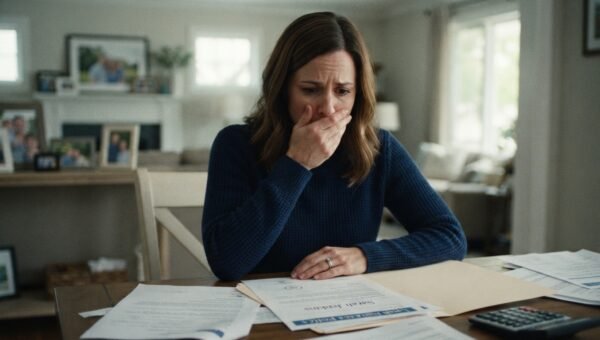
At home, I opened our bank statements on the computer. I’m not a numbers person, but I’ve managed the household bills for years. I know when the power payment is due and how much we keep in savings. I don’t miss an $83,000 hole.
At first I thought I’d opened the wrong account. I checked the date range, then printed the statements and laid them beside Diane’s report.
The withdrawals were spread out in smaller amounts. Every few weeks, money left our savings. The dates lined up with what Diane called Richard’s “dividend payments.” He’d used our money to send her fake returns, making the investment look real and keeping her from asking too many questions.
He’d taken $83,000 from our savings. It wasn’t the money he’d stolen from Diane. Her inheritance was much larger, and according to the report, Richard had moved it into an account she couldn’t see.
The $47,000 bar tab was different. He hadn’t been paying for the dinners at all. He’d talked the owner into carrying the cost, week after week, because the owner trusted him.
I called Diane the next morning. I got her number from the report and almost hung up before she answered.
“This is Richard’s wife,” I said.
There was a pause. “I wondered if you’d call.”
“I saw the receipts. And your report.”
“I’m sorry,” she said.
That caught me off guard. “You don’t need to be sorry to me.”
“I didn’t know he was married when we started meeting. He said he was single.”
I believed her. I don’t know how to explain it except that she sounded tired in the same way I felt tired. Not weak. Just done with having to prove every little thing.
“Did he ever say why he stopped going to the bar?” I asked.
“He stopped after I went to the police,” she said. “He told me I’d ruined everything.”
I asked whether he’d threatened her directly. She said he’d called several times and left messages about the supposed penalties. She’d saved them. She’d turned them over with the report.
“I kept thinking I should have known,” she said.
I wanted to tell her I’d known nothing either, but I didn’t. I had spent four years hearing the same sentence and not asking one more question. “Just one drink with the guys.” I’d chosen not to look too closely because looking would have meant a fight, and I was good at putting off fights.
The next day, I met Detective Alvarez, the financial crimes officer named on Diane’s report. I brought the box, the bank statements, and the household records showing what Richard had taken.
He didn’t promise me the case would be quick. He asked careful questions, then said, “This gives us a clearer trail.”
“What about the money left in our joint accounts?” I asked.
“Talk to a lawyer before moving anything,” he said. “We need to protect your share and document every step.”
I got legal advice that afternoon. The remaining joint funds were put on hold while the accounts were sorted out, and my lawyer helped separate my share into an individual account. I gave Detective Alvarez copies of everything. I did not call Richard to warn him.
That Friday, Richard came home just after six. I’d packed a suitcase for him and set it by the back door. The file was on the kitchen table.
He looked at the papers, then at me. “What’s all this?”
“The tavern bill. The receipts. Our bank statements. Diane’s police report.”
His smile came and went. “This is a misunderstanding.”
“Which part?”
He pulled out a chair but didn’t sit. “The investment was real. It got complicated.”
“The building doesn’t exist.”
“You don’t understand how these deals work.”
“I understand $83,000 leaving our savings.”
He started to talk about temporary cash flow. He said the tavern owner had offered to let him pay later. He said Diane had misunderstood the agreement. It came out so smoothly that for a second I could hear the old Richard, the one who knew how to make a simple thing sound like my fault for asking.
Then he saw the detective’s card beside the receipts.
“You called the police?” he said.
“I gave Detective Alvarez the records. I also spoke with a lawyer.”
“You moved money?”
“My share is protected. The rest is being handled through the lawyers.”
His voice got louder. “You can’t just decide that.”
“I already did.”
He looked down at the receipts. Every one of them had his signature. Some were so familiar I could tell where he’d pressed harder with the pen.
“You’re going to wreck our life over this?” he said.
“No. You did that.”
A knock came at the front door. Detective Alvarez was there with another officer and paperwork. Richard looked at me as if he still expected me to smooth it over.
I didn’t.
He was taken in for questioning about the fraud and the money Diane had reported. The tavern’s claim was filed against Richard’s personal estate, not against me. My lawyer and the records I’d turned over helped show I hadn’t known what he was doing. The house remained protected while the divorce and financial claims moved forward.
Diane and I stayed in touch. We weren’t close in the way people are in movies. We checked on each other, shared updates, and once had coffee after an appointment with the detective. That was enough to start with.
The divorce went through. Richard didn’t come back. I didn’t give him another chance to explain a number that was already there in black ink.
The following Friday, I sat at my kitchen table with a cup of tea. I could hear the refrigerator click on. I wasn’t waiting for Richard to come home, and I wasn’t checking the clock.
The deadbolt was turned. I let the tea cool before I drank it.