The detail that didn’t fit was the time stamp on the video: 6:14 a.m. David was due out of prison that morning. The package had no return address, just a thumb drive and my name written on a plain label.
I sat at the kitchen table and played it. A woman I knew as Sarah Jenkins looked into the camera. She was 24, with the same careful, ordinary look I remembered from the photo Mark Vance had shown me.
“She wasn’t a waitress,” Sarah said. “She was an undercover agent. And my husband wasn’t planning to fake his death. He was planning to FAKE MINE.”
I stopped the video there. Not because I couldn’t watch the rest. Because I needed to understand how my name had become part of a plan I thought I’d already stopped.
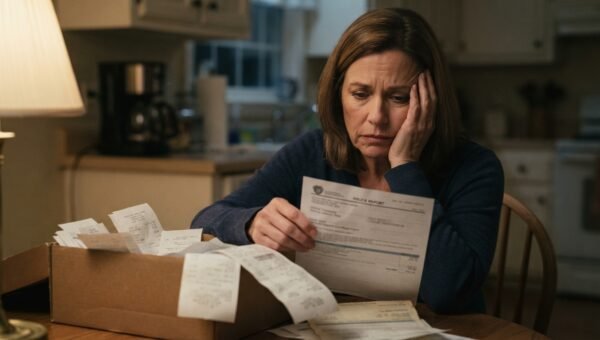
A year earlier, I’d been looking for our tax documents. David kept those in the desk at the end of the hall, though he’d always been the one who filed them. I found a folder marked “Important” tucked behind an old stack of receipts. I don’t know why that word bothered me so much. Maybe because David usually left his important things where I could see them.
Inside was a $1 million life insurance policy he’d taken out on himself the year before. I checked the beneficiary line twice. It wasn’t my name. It wasn’t either of our children’s names.
It said SARAH JENKINS, “Domestic Partner.”
I called David at work. He answered on the fourth ring, sounding busy but not surprised to hear me.
“What’s Sarah Jenkins?” I asked.
There was a pause. A short one, but I heard it.
“Somebody I met on a trip,” he said. “It’s not what you think.”
That was the first thing he said. Not that the policy was a mistake. Not that he’d fix it. Just that I was thinking wrong.
I hired Mark Vance, a private investigator, because I wanted proof before I made a mess of my family. Mark found Sarah in a few days. He told me she was a waitress David had met on a business trip. He had a photo of them together and dates that matched David’s travel records.
Mark thought David was planning to fake his own death and run off with her.
I believed him. It fit the insurance policy, and it fit the parts of David I’d spent years making excuses for. He liked being charming. He liked having a second story ready if the first one failed.
I reported the fraud. David was arrested and convicted on an attempted insurance-fraud charge. The larger scheme never came up in the courtroom. By the time I learned there was more, I’d already set the first part in motion.
The prison sentence was shorter than I expected. David’s release date kept moving closer while I tried to make the house feel normal for our kids. I changed the locks. I put his mail in a box. I told the kids their dad was getting out, but I didn’t tell them I was afraid he’d show up on the porch.
The package came on release day. The video had more than Sarah’s face. There were case numbers and audio timestamps in the file details, the kind of thing I would’ve ignored a year earlier.
I wrote down a phone number embedded in the metadata and called it.
Sarah answered on the second ring.
“Read me the case number on the screen,” she said.
I did.
“Good,” she said. “Now listen carefully.”
Sarah told me she was a state financial-crimes investigator. The waitress story was a cover. She’d been working her way into a group that arranged false identities and staged deaths, then used those deaths to drain estates and move money overseas. David had joined them because he was in debt and wanted out from under it.
My first report had ended his cover before the larger investigation was ready. He went to prison for the insurance fraud we could prove, not the conspiracy Sarah was tracking. She’d sent the video because David believed he could still finish the plan when he got out.
I didn’t like hearing that. I liked even less that she had known for months and had been unable to tell me.
“Why send it now?” I asked.
“Because he’s out today,” she said. “And because he still thinks he can get to you.”
Sarah explained the policy. It wasn’t just a payout if David died. Buried in the terms was a reciprocal death-benefit and spousal-estate rider. If I were legally declared dead, it could trigger payments tied to his policy and let him press claims against my estate. My family had inherited land and savings from my parents. David wanted to use a forged death abroad to get at it, along with our shared assets, then leave the country under a new identity.
The policy had been written on his life. The plan was aimed at mine.
I’d spent a year thinking David wanted to disappear. I had not thought he wanted to take my place in my own life first.
Sarah told me not to go home alone and not to contact him. She also said I wasn’t required to help with the case. I knew that was fair. I was still angry that she had to say it.
I did help. I went through the old household files, looking for anything David had left behind. I found a key tag and a storage-unit receipt with his name on it. The unit had been paid in advance and listed under an address from one of his business trips.
Sarah connected me with the task force. They got a warrant. I gave them the paperwork and went with an investigator to identify the unit, because David had used our old family address when he registered it.
The storage door rattled as it rolled up. My mouth tasted like the pennies I used to get from our kids’ school fundraiser. I remember that ridiculous detail more clearly than the boxes.
The agents checked the unit first. Behind a stack of old suitcases, we found a lockbox. I identified the key from the ring in David’s desk. Inside were pre-signed estate transfers and a foreign death certificate with my name on it.
There was a line for the cause of death. Drowning.
I held the paper by the edge. It had my birth date wrong by one day. David had gotten so much right and still managed to get that wrong.
The file included plans for an anniversary trip abroad. I recognized the dates. I’d thought we were looking at hotels because David wanted to make one last effort at being a husband. I had even saved the travel ideas in an email folder.
I don’t feel proud of that. I had wanted to believe him when he acted sorry. Some part of me still wanted the version of David who packed snacks for the kids and remembered how I took my coffee. That man had been real, I think. He just wasn’t the whole man.
The task force took the documents and made copies. Sarah told me David had already reached out, acting as if he wanted to talk things over. I agreed to meet him at a station café near the transit stop. It was a public place, with agents nearby. I chose it because I didn’t want him near the house.
He arrived in a clean shirt and carried himself like he had somewhere better to be. He sat across from me and kept his voice low.
“I know I hurt you,” he said. “I just want to talk.”
I let him finish. Then I slid a manila envelope across the table.
He opened it. The first page was the forged death certificate. The second was a transcript of Sarah’s debrief.
David stared at my name on the certificate, then looked at me.
“You don’t understand what this is,” he said.
“I understand enough,” I told him.
His hand stayed on the paper. He didn’t reach for me. He didn’t smile. For once, he had no easy answer ready.
The agents stepped in. David tried to stand, but one of them took his arm and told him to sit back down. Another read him the charges. The new federal conspiracy and identity-fraud case meant he was taken back into custody. His parole violation was added before he could leave the building.
He looked at me while they walked him out. I kept my hands on the table until the door shut behind him.
The court severed the remaining financial ties and reciprocal insurance clauses. An emergency order settled the parental-rights questions and put the kids’ inheritance beyond his reach. Sarah called once to say the case was moving ahead. I thanked her. I meant it, though I still wish the warning had come before the package did.
I went home after the hearing. The kids were inside, laughing about something I couldn’t hear from the yard. I had the last of the insurance folders in my hands. I set them in the firepit and lit them.
The paper curled inward. The smoke lifted into the clear morning air while my children laughed inside the house.