PART 1
My son sat at my kitchen table and asked me to put my house up as collateral for his loan.
The house his father and I paid off in 1994.
Mark is forty-six years old. He looked worn down, staring into a cold mug of coffee he had barely touched. His general contracting company was eighty thousand dollars underwater, and the local commercial lender told him flat out that they would not extend his credit line without a hard asset backing it. They wanted real equity, and Mark did not have any left.
“Mom, if you don’t do this, we lose our house and the kids will have to change schools,” he said.
He said it quietly, but the words hit like a hammer against the wall. I have three grandchildren: Chloe, who is eleven, and the twins, Leo and Ben, who are eight. Those kids live five minutes down the road. Leo has reading support at the elementary school across from their subdivision, and Ben knows every neighbor on their cul-de-sac.
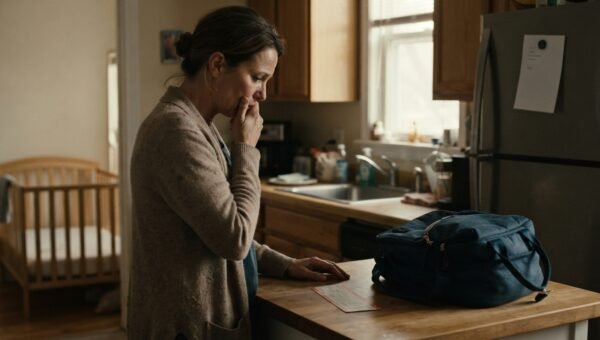
I kept my hands busy. I picked up a blue-and-white checked dish towel from the counter and folded it in half. Then in half again. Then I smoothed the crease with my thumb, unfolded it, and started over. My late husband, Ray, used to say that when I start folding laundry that is already clean, it means my mind is racing faster than my mouth can keep up.
Ray passed away seven years ago from a sudden stroke. He left me this single-story ranch house free and clear, alongside his pension and my Social Security, which brings in exactly nineteen hundred dollars a month.
Nineteen hundred dollars covers my property taxes, my heating oil, my supplemental health insurance, and groceries. It does not leave room for disasters. If Mark took out a lien against this place and his business went under anyway, the bank would foreclose. At seventy-two, I would be on the street with zero savings and no way to earn my living.
“How did it get to eighty thousand, Mark?” I asked him. My voice was unsteady, but I kept my eyes on his face. “Last summer you told me you were booking jobs through November.”
He wouldn’t look up from the formica tabletop. “A commercial developer out in Shelby County stiffed us on a framing sub-contract.
Forty-five thousand right there. Then materials doubled on two fixed-bid remodels. I carried the crew payroll on three business credit cards because I thought the next draw would clear. It didn’t. The bank won’t touch me unless I have a co-signer with clear deed property.”
He reached into his leather work jacket and pulled out a thick manila folder. He slid it across the table toward my placemat.
“I’d never ask if there was any other way, Mom,” he muttered. “You know that. I know what Dad put into this place. But it’s just a temporary pledge. Twelve months, eighteen at the most. I already bid on the county library annex. If I land that contract, the bank gets paid in full, the lien comes off, and nothing changes for you.”
I looked down at the folder. On top was a standard commercial loan application with a yellow sticky note pointing to a line labeled “Grantor / Co-Signer Signature.” Beside the note lay his business financial statement.
I did not sign it right then. I told him I needed twenty-four hours to look over the numbers myself.
He looked disappointed, almost stung that his own mother didn’t instantly write her name down to rescue his family, but he nodded, stood up, and kissed my cheek. His beard felt rough, and he smelled like cedar sawdust and stale truck air.
After he drove off in his work truck, I sat in the quiet kitchen. The refrigerator gave its familiar low hum. I opened Mark’s folder. I am not an accountant, but Ray had made me sit with him every January to do our taxes, so I know how to balance incoming cash against outgoing debt.
As I flipped through the stapled profit-and-loss sheet Mark had printed from his office computer, something odd jumped out at me. The eighty-thousand-dollar deficit was real enough, but under the itemized company disbursements for the last nine months, there were regular, identical transfers of twenty-two hundred dollars marked simply as “Special Vendor Retainer.”
There was no vendor name, no tax identification number, and no invoice attached. Just nine straight months of money quietly draining out of his operating budget while his payroll was failing.
PART 2
I didn’t sleep more than an hour that night. Every time I shut my eyes, I saw those three grandbabies sitting on cardboard boxes in their driveway, followed immediately by a picture of an eviction notice pinned to my own front door.
At seven in the morning, I put on my coat, grabbed my purse, and drove over to the office park on Miller Road where Mark rented a two-room suite for his contracting business.
His office manager, Brenda, has worked for him for eleven years. Brenda’s husband used to bowl with Ray on Thursday nights, and Brenda has never known how to tell a polite lie in her life. When I walked in through the glass door, she was setting down a fresh pot of coffee.
“Ruth,” she said, looking surprised. “Mark isn’t in yet. He had a site meeting over in town.”
“I know,” I said. I set my purse on the counter and pulled out the disbursement sheet from Mark’s folder. “I need you to tell me what this line means, Brenda. He asked me to put my house up to secure an eighty-thousand-dollar commercial note, and I need to understand what I’m guaranteeing.”
Brenda’s face tightened. She looked down at the sheet, saw the yellow highlight I had put over the nine monthly payments of twenty-two hundred dollars, and pulled her hands back.
“You shouldn’t be asking me this, Ruth,” she whispered.
“I live on nineteen hundred dollars a month,” I said, keeping my voice level. “If Mark defaults, I lose Ray’s house. I am not signing my roof away while there’s twenty thousand dollars disappearing into thin air without an invoice.”
Brenda stood there for a long time, watching the steam rise off her mug. Finally, she walked over to the office door, clicked the lock shut, and went behind her metal filing cabinet.
“He told me he had an agreement with you,” Brenda said quietly. “He told me you approved this.”
“Approved what?”
She pulled out a slim file folder labeled “Equipment Lease – Titan” and laid it on the desk. Inside were nine carbon-copy payment stubs.
They weren’t for framing lumber. They weren’t for payroll taxes.
Fourteen months ago, Mark’s thirty-eight-year-old brother-in-law, Greg, had convinced Mark to buy into a heavy equipment rental side-venture. Greg had leased a brand-new track excavator and two commercial dump trailers using Mark’s business credit as the primary guarantor. Greg was supposed to rent the machinery out to regional utility crews and split the profits fifty-fifty.
Instead, Greg had defaulted on his portion of the payments four months in, leaving Mark on the hook for the entire monthly equipment nut. But it was worse than that. The file contained three certified demand letters from the leasing company. Two months ago, the leasing company had attempted to repossess the excavator, only to discover that Greg had illegally subleased the machine to an unlicensed clearing crew down across the state line, and the equipment was currently missing or tied up in an out-of-state yard impound.
Mark hadn’t just hit a dry patch in the construction market. He had been quietly bleeding twenty-two hundred dollars every thirty days to cover his brother-in-law’s disaster, hoping nobody would find out before the leasing company filed civil fraud charges against his business name.
“Does Sarah know?” I asked. Sarah is Mark’s wife, my daughter-in-law. Greg is her younger brother.
“Sarah knows Greg got him into a bind,” Brenda said. “She doesn’t know Mark has been draining his own payroll account to keep the repo company from suing Greg. She thinks the bank trouble is all from delayed commercial draws.”
I felt a cold tightness in the center of my chest. Mark hadn’t just asked me to help him weather a storm. He had asked me to put my home between him and the legal consequences of protecting his wife’s irresponsible brother.
PART 3
I took the file copies Brenda made for me, walked back to my car, and drove directly to Mark and Sarah’s house.
His truck was parked in the driveway beside Sarah’s minivan. Through the living room window, I could see Leo and Ben playing with plastic building blocks on the carpet while Chloe practiced her flute in the dining area. Seeing those children through the glass made my throat ache.
I walked in through the side garage door without knocking, like I always do.
Sarah was at the stove reheating soup, and Mark was sitting at their dining room table with his laptop open, surrounded by bank papers.
When Mark saw me, he smiled, thinking I had brought the signed guarantor form. “Mom. You looked it over?”
“I did,” I said.
I didn’t yell. I walked over to the table, pulled the copies Brenda had given me out of my bag, and laid them right on top of his open laptop keyboard. The certified demand letters from the equipment company were right on top.
Mark’s face went completely still. The color drained out of his cheeks.
“What is that?” Sarah asked, setting her wooden spoon down on the counter. She walked over, wiping her hands on an apron. “Mark, what’s that paper?”
“Mom, don’t,” Mark said, his voice dropping into a desperate rasp. “Please. That’s business stuff.”
“It stopped being just business when you asked me to bet my kitchen on it,” I said.
I looked straight at Sarah. “Mark didn’t get eighty thousand dollars behind because a developer stiffed him on framing, Sarah. He’s behind because your brother Greg lost a leased excavator, and Mark has been paying twenty-two hundred dollars a month out of his payroll cash to keep the leasing company from taking him to court. He wants me to pledge my home to the bank so he can roll Greg’s mess into a new commercial loan.”
Sarah stared at the paper. Then she looked at Mark.
“You told me Greg was making those lease payments,” she said to him. Her voice wasn’t loud; it was trembling. “You told me he was handling it directly with the equipment yard.”
“He was supposed to,” Mark said, his hands shaking as he touched the papers. “He swore he had a job lined up in Clarksville that would cover the arrears. If the bank saw the default, they were going to call our personal mortgage note too, Sarah! I was trying to save our house!”
“By risking mine?” I asked him.
The room went dead quiet. In the other room, Chloe stopped playing the flute.
Mark couldn’t answer. He slumped forward, burying his face in his rough, calloused hands. He looked like the frightened boy who used to hide behind our garage when he broke a neighbor’s basement window with a baseball. But he wasn’t a boy anymore. He was forty-six years old, and he had been willing to let his seventy-two-year-old widowed mother walk into financial ruin rather than face his wife and demand accountability from her family.
“I am not signing the bank papers, Mark,” I told him.
He didn’t look up, but he gave one small, shuddering nod.
“If I sign, I teach you that you can lie to your family and bury your mistakes under my roof,” I continued. “And if you fail, none of us have anywhere to go. I won’t do it.”
Sarah pulled the chair out next to him and sat down hard. She looked at her husband with tears in her eyes, but she didn’t defend him. She looked at the lease documents, saw the dates, and realized the truth.
“What do we do?” she whispered, looking up at me.
“You call an attorney who specializes in commercial contracts,” I said. “You take these letters, you report the equipment missing through the proper legal channels, and you let Greg face the company he signed for. If you have to downsize your house to pay off the legitimate business debts you actually owe, you do it. But you do it on your own two feet.”
ENDING
That conversation happened ten months ago.
Mark didn’t speak to me for three weeks after that morning. The silence in my house was heavy, and there were evenings when I sat at my table, looking at my nineteen-hundred-dollar monthly budget, wondering if I had been too hard on him. A mother’s instinct is always to put her body between her child and the ditch, even when the child dug the ditch himself.
But my refusal forced the truth into the open where it belonged.
Sarah called her parents and her brother the next night. Greg didn’t have the money, of course, but the leasing company negotiated a surrender agreement once Mark retained an attorney and stopped hiding the unauthorized transfer. It cost Mark twelve thousand dollars in settled damages rather than twenty-two hundred a month indefinitely.
To clear the remaining sixty-eight thousand dollars in real business supplier debt, Mark and Sarah had to make hard choices. They didn’t lose their home, but they sold Mark’s second truck, cut their household spending down to the bone, and Sarah took a job managing billing at a dental clinic in town.
The kids didn’t have to change schools. Leo is still getting his reading support, and Ben is still riding his bicycle around the cul-de-sac.
Last Saturday, Mark came over to my house by himself.
The weather was turning cool, and he noticed that my front storm door was sticking along the bottom sill, something Ray used to plane down every couple of years. Without saying a word, Mark went out to his truck, got his toolbox, took the door off its hinges, and shaved the swollen edge down until it clicked shut smooth as butter.
When he finished, he came into the kitchen to wash the dust off his hands at the sink.
I picked up that same blue-and-white checked dish towel from the counter and handed it to him.
He dried his hands, looked down at the clean fabric, and then looked at me. His eyes were tired, but the evasive, shifty look from last winter was gone.
“Thanks for the coffee, Mom,” he said softly.
He folded the towel neatly in half, laid it beside the sink, and walked out the front door, closing it quietly behind him.