PART 1
The paperback had an embossed silver title, but I did not need to read the cover to recognize what was inside.
My best friend of twenty-two years, Brenda Vance, had just hit the regional bestseller list with her debut psychological novel. Everyone in our small Ohio town was talking about it. When I bought my copy at the local bookstore on Fourth Street and opened to chapter four, my stomach dropped so hard I had to steady myself against the display rack.
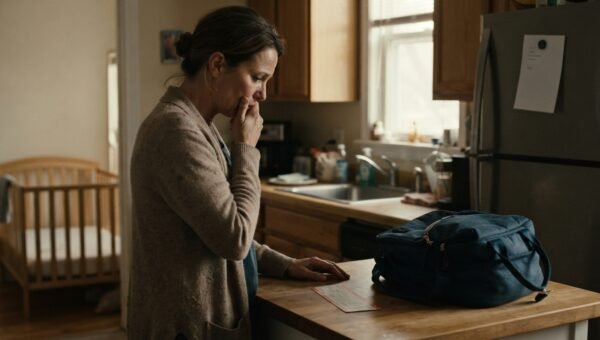
The main character had my maiden name spelled slightly differently. She lived in a drafty brick colonial with yellow linoleum in the pantry, just like mine. But those were small things. What made my breath catch was the paragraph describing an old tin Band-Aid box tucked behind winter coats, and the worn leather blue suitcase beneath the bed where the woman hid her cash and medical records during the year her life fell apart.
That was ten years ago. It was the year my late husband, David, had been diagnosed with early-onset cognitive decline, the year our savings drained away, the year I nearly lost my mind trying to keep him safe while our debts piled up. I had never spoken about that blue suitcase to anyone in the world except David on a single Tuesday night while he sat on our rug, weeping into his hands. Brenda had brought over soup that evening, but she had stayed downstairs in the foyer.
Or at least, that was what I had believed for a decade.
At her Saturday afternoon book signing at the public library, sixty people stood in line holding copies. Brenda was wearing a cream blazer, smiling warmly, signing every title page with a silver gel pen. When I finally reached the front of the folding table, her smile tightened around the edges, but she didn’t look away.
“You came, Martha,” she said, her voice smooth and polished for the crowd. “I was hoping you would.”
I laid the book flat on the white tablecloth. “Brenda, how did you know about the blue suitcase beneath my bed?”
A woman behind me in line coughed softly. Brenda did not blink. She leaned forward, resting her forearms on the table, offering a practiced, gracious smile for the room.
“Good writers notice everything, darling,” she said.
Then she took her pen, scribbled three quick lines across the dedication page, and closed the book with a firm tap of her fingers.
I took the book and walked to my car without greeting anyone else.
Under the dome light of my sedan, I opened to the title page. In her sharp, slanted cursive, she had written: *To Martha, the woman who forgot.*
My hands shook as I turned the ignition key. That phrase was not an inscription of affection. It felt like a deliberate challenge.
When I got home, I carried the book upstairs to the spare room where I kept my old storage bins. In the bottom drawer of an oak dresser, I kept three spiral-bound journals from that terrible year. I had used them as a daily log to track David’s medication, his moods, and my own quiet unraveling.
I sat down at the kitchen table with a mug of black tea, laying Brenda’s novel next to my spiral notebooks. Page by page, I traced the parallels. She had lifted entire conversations word for word: the exact dollar amount we owed on our second mortgage, the prescription mistakes, the private shame I felt when David wandered down to the creek in his slippers.
Then I turned to the final chapter of her book.
The story had thirty-two chapters. Up until thirty-one, it mirrored my life with painful accuracy, right down to David’s passing in the hospice wing. But chapter thirty-two took a sudden, bizarre turn. It was written in the present tense. It described the main character sitting alone in her drafty house on an autumn night, deaf to the quiet clicking of the range burner downstairs, until a fire took the kitchen at exactly 11:40 p.m.
I stared at the page. The hairs on my arms stood up. I glanced up at the microwave clock above the counter.
It was 11:32 p.m.
I told myself it was just fiction. It was Brenda’s idea of a dramatic thriller ending to sell copies. But a smell crept into the dining room, faint and sharp, like scorching plastic and hot grease.
At 11:34, the shrill, deafening beep of the kitchen smoke alarm tore through the quiet house.
I dropped the book, ran into the hallway, and pushed through the swinging door into my kitchen.
The back door stood wide open to the cold autumn wind. Thick gray smoke curled toward the ceiling from the four gas burners on my stove, where a stack of yellowed papers was smoldering directly over open blue flames.
Standing right beside the counter, holding a heavy metal flashlight in one hand and a single torn spiral page in the other, was Brenda.
PART 2
She didn’t flinch when I came through the door. She reached over with a gloved hand and turned off the front two burners, her face calm, illuminated only by the flicker of the burning paper and the green glow of the digital microwave clock.
I grabbed a wet dish towel from the sink and smothered the flames on the stove before reaching up to punch the plastic hush button on the smoke detector. The piercing shriek finally died out, leaving only the sound of our breathing and the hum of the refrigerator.
“What are you doing in my house?” I demanded, my chest heaving. “Brenda, are you out of your mind?”
“I still have the back door key you gave me when David was sick,” she said quietly. She didn’t drop the flashlight. She held up the torn piece of paper between two fingers. The edges were charred brown, but I could see my own handwriting across the blue lines. “You always thought you were the only one who carried a burden in this town, Martha.”
“That is my journal,” I said, stepping toward her. “You stole my life, you put it in a book for strangers to read, and now you break in here to start a fire?”
“I didn’t come to burn your house down,” she replied, her voice dropping to a harsh whisper. “I came to burn the one thing you were too cowardly to remember. But you beat me to it. You dug these notebooks out tonight, didn’t you? I saw the light on through the dining room window.”
“Explain yourself right now, or I swear I will dial 911.”
Brenda gave a small, bitter laugh and set the flashlight down on the granite counter. “Go ahead. Call Sheriff Miller. Tell him I came to destroy the proof of what happened on October 14th ten years ago. Tell him why the fire chapter had to be written.”
Her words stopped me cold. October 14th was the date David had his final, fatal fall down the basement stairs. The county coroner had ruled it an accidental death due to disorientation and medication interactions. I had spent a decade feeling guilty that I had fallen asleep on the couch while he was wandering the halls.
“What does that date have to do with you?” I asked.
Brenda pointed to the charred paper on the stove top. “Look at it, Martha. You wrote that entry at three in the morning, two days before David died. But your sweet little narrative in your head cleaned it all up, didn’t it? You forgot the part where David didn’t just wander. You forgot who was in the house with him that afternoon.”
I reached past her, ignoring the heat radiating off the metal grate, and pulled the blackened scrap toward me.
My handwriting on the page was jagged, written during a night when David had been screaming at shadows in our bedroom. But below my handwriting, scrawled in faint blue ink near the bottom margin, were three lines written in David’s shaky, deteriorating hand. He had written a name, an amount of money, and a sentence I had never seen before:
*Brenda took the blue suitcase. She said it was for the investment. Martha cannot know.*
I looked up at her, the room suddenly feeling very cold. “The money from the suitcase. It didn’t go to the hospital.”
“No,” Brenda said, her eyes hard. “It didn’t.”
PART 3
Ten years of assumed truth cracked wide open right there over the kitchen counter.
Back in 2014, when David’s illness was accelerating, we had $36,900 in cash locked in that blue suitcase. It was money David had pulled from his old contracting business account before he surrendered his license, our absolute last safety net to pay for in-home nursing so he wouldn’t have to be placed in a state facility. One morning in early October, I opened the suitcase to pay the agency deposit, and twenty thousand dollars was gone.
David was so confused by then that when I asked him about it, he wept and told me he must have lost it or buried it in the yard. I blamed his illness. I spent ten years believing my husband’s fading mind had swallowed our life savings.
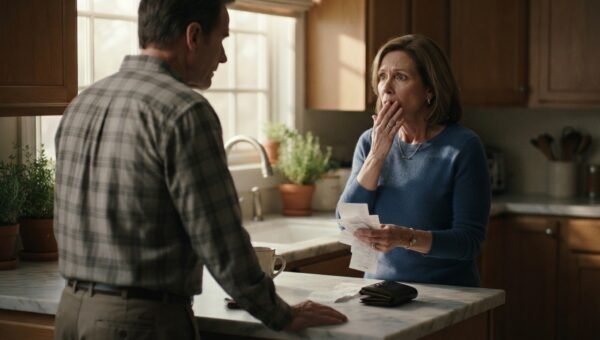
“You took twenty thousand dollars from a dying man,” I whispered, my voice trembling with rage.
“David offered it to me,” Brenda spat back, stepping closer. The composed author from the library was completely gone. “My husband’s garage was going under. We were facing bankruptcy. David was lucid enough that morning to understand. He told me to take it as a loan. He said you were too proud to let him help his friends.”
“He was not lucid, Brenda! He had advanced dementia!”
“He knew what he was doing!” she insisted, her voice rising. “He gave it to me! And then, two days later, he fell down those stairs. And you were so consumed by grief and your own misery that you never even checked the bank trail. You just buried him and played the martyr.”
“And the book?” I demanded, pointing to the living room where her novel lay. “Why write the book? Why put our misery on paper for everyone to buy?”
Brenda looked at the blackened stove, her posture sagging slightly. “Because my husband died three years ago, Martha. And he left behind ninety thousand dollars in commercial debt. The bank was taking my house. I couldn’t get a loan. I didn’t have any money left. But I had your journals.”
The confession hung in the air, sickening and plain.
“You took them from my house back then,” I said.
“While you were at the funeral home making arrangements,” she confessed, not looking at me. “I came over to clean up your kitchen, like a good friend. I found the journals in David’s nightstand. I took them because I knew David had written that note in the back of the October book. I was terrified you would find it and have me arrested. I kept them locked in my cedar chest for nine years.”
“Until you needed a plot,” I said.
“Publishers don’t want quiet stories, Martha. They wanted a gritty, authentic memoir masked as fiction. I changed our names. I thought you would never read it. You never read thrillers. But then the advance money wasn’t enough, and the publisher wanted a dramatic climax. They told me the husband’s death was too quiet. They wanted a fire. They wanted an ending where the guilty party gets erased.”
She looked at me, her eyes wet with self-pity and desperation. “When you confronted me at the signing today, I knew you were going to go home and check your records. I panicked. I drove over here tonight thinking I could get in, find whatever notes you still had left from that year, and burn them before you figured out the money was missing. When I heard you walking upstairs, I set the papers on the stove and turned on the gas. I wasn’t going to burn the house down. I just wanted the pages gone.”
She held up the single scrap she was gripping. “She said, ‘This ending was never mine.’ That’s what I wrote on the last page of my manuscript. Because none of this was supposed to end like this.”
I stood there looking at the woman who had sat beside me at my husband’s wake, the woman who had patted my knee while I cried over medical bills, the woman who had used our family’s tragedy to pay off her own debts twice over.
“Give me that page,” I said evenly.
“Martha, please. If you go to the police, my publisher will pull the book. The local papers will destroy me. I’ll lose everything.”
“Give me the page, Brenda.”
She hesitated for three seconds, then slowly opened her hand. I took the charred leaf of paper and laid it flat on the counter next to my car keys.
Then I picked up my house phone from the wall mount.
ENDING
I did not call the fire department. There was no active fire left to fight, and the smell of scorched paper was already drifting out into the cold night air through the open back door.
Instead, I called our county attorney, Arthur Vance, who happened to be Brenda’s brother-in-law. I told him to come to my house immediately, or my next phone call would be to the state police post in Mansfield.
Arthur arrived twenty minutes later in his wool overcoat. He sat at my kitchen table while I laid out the charred journal page, Brenda’s novel opened to chapter four, and the original police report from David’s fall in 2014. Brenda sat on the stool by the pantry, silent, her head in her hands.
It took two weeks of quiet, brutal negotiation behind closed doors. Because ten years had passed, criminal charges for the original twenty thousand dollars faced statute-of-limitations hurdles that Arthur admitted would be messy and prolonged. But Brenda’s unlawful entry into my home, the destruction of my property, and the undeniable paper trail of David’s handwriting gave us all the leverage we needed.
Arthur handled it with cold professional efficiency to spare his family public disgrace.
Brenda was forced to sign a legal settlement. All royalties and earnings from her novel—past, present, and future—were assigned directly to a trust in my name until the full twenty thousand dollars, adjusted for ten years of interest at six percent, was repaid in full. Any remaining funds after that balance is satisfied are legally mandated to be donated to the local hospice facility that cared for David during his final forty-eight hours.
Furthermore, Brenda had to issue a formal withdrawal of the book’s second print run, citing personal copyright disputes. Her burgeoning literary career ended before it ever truly began.
She moved out of our town three months later. She sold her house to an investor and relocated to a condo outside of Indianapolis, where nobody knows her name or her book. We have not spoken a single word since the night Arthur walked her out my back door.
Yesterday, the first royalty disbursement arrived in my mailbox: a check for $4,120.
I took the check down to the bank on Main Street and deposited it into a separate savings account. Afterward, I drove out to the cemetery on the north ridge where David is buried beneath an old sugar maple.
The wind was brisk, rustling the dry grass against the gray granite stone. For ten years, I had stood at that grave carrying the private guilt that I had failed him, that his mind had broken down so completely he had thrown our future away.
I set a small bunch of fresh grocery-store carnations on the grass beside his marker. I ran my fingers over the carved letters of his name.
David had not been irresponsible. He had simply been sick, and he had been preyed upon by someone we invited to our dinner table.
Knowing the truth did not bring him back, and it did not undo the lonely years I spent struggling to pay our debts. But as I stood there in the quiet afternoon, looking down at his stone, the heavy knot in my chest finally loosened.
I walked back to my car, pulled the door shut against the wind, and drove home to my quiet kitchen.