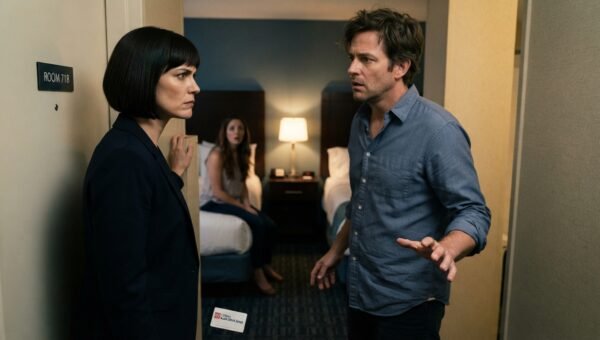
The dust got in my mouth when Brenda said it. I was standing in the third attic doorway with a brass key in my hand, and she was gripping the frame like she needed it to hold her up.
“Your father promised that child was never coming home.”
For a second, I couldn’t make that sentence fit the room. There was a crib behind me. A wall calendar with the year I was born.
A stack of birthday gifts with my name on them. Brenda had just told me my father had promised I would stay away.
That was the moment I understood the room wasn’t an attic storage space. It was proof.
Two days earlier, I was still wearing the same black shoes I’d worn to Dad’s funeral. I was standing beside the mailbox, looking at three trash bags filled with my clothes. The bags were tied in tight knots. One had split at the bottom, and a sleeve from my old winter coat was dragging in the gravel.
Brenda stood inside the front door. She didn’t step onto the porch.
“The house goes to family,” she said.
I looked at the bags, then at her. “I’m family.”
She shut the door.
I don’t know why I expected something kinder. Brenda and I had never been close. Still, Dad had been dead for two days.
I thought there’d be some room for grief before she started sorting out who was allowed to stand where.
I didn’t call the police. I didn’t want my father’s neighbors watching me argue on the porch. I was ashamed of the bags, which is a strange thing to be ashamed of when I hadn’t put them there. I carried what I could into my car, left the rest by the mailbox, and called Arthur.
Arthur had been Dad’s locksmith for years. He knew the house better than I did, at least the parts that involved doors. He’d fixed the back lock once when I was young. Dad used to tease him that he could hear a bad key turn from across the street.
Arthur answered on the fourth ring.
“Brenda changed the locks,” I said.
He was quiet for a moment. “I’m coming over.”
He didn’t ask me to pay. I offered anyway. He said, “Not today.”
When I went back, the front door was locked. Brenda didn’t answer when I knocked, though I could hear movement inside. Arthur arrived with his tool bag and gave me a quick nod. I remember his jacket smelled faintly of machine oil. I remember that because it was the same smell on Dad’s old work shirts.
Arthur checked the new deadbolt. He didn’t say much at first. He pressed his thumb against the plate, then leaned closer to the lock.
“This plate doesn’t sit right,” he said.
“It’s new.”
“I can see that. But look here.”
He pointed low, near the edge of the door. There was a second keyhole, partly covered by the new brass plate. It was old, the kind of lock that had been there so long the paint had gathered around its edges.
“Why would someone cover this?” I asked.
Arthur ran a finger along the plate. “Because they wanted the new lock to hide it.”
He looked at me then. “Your dad never told me why this one was still here.”
I wasn’t sure I wanted to know. I also wasn’t sure I could walk away without knowing.
So I stood there while Arthur removed the plate. He worked carefully, not rushing. The metal clicked against the floor when he set it down.
A narrow brass key dropped out from behind it.
A paper tag was tied to the key with faded string. The words were written in Dad’s blocky handwriting.
ATTIC 3.
I stared at it. There were two attic rooms in the house. I’d slept in one of them as a kid when cousins came to visit. The other held old boxes and a folding table. There had never been a third.
Arthur turned the key over in his palm. “You want to see?”
I wanted to say no. I also knew I’d be thinking about that tag every night if I left. Brenda hadn’t answered the door, and I was not going to stand outside waiting for permission to look for a room my father had hidden in his own house.
I took the key.
We went through the kitchen, then up the back stairs. I’d come up those stairs a hundred times in childhood, usually carrying a plate or a laundry basket. The steps still made the same squeak near the top.
The upper hallway was narrow. Two doors faced each other. Beyond them, a heavy wooden bookcase stood against the far wall. I remembered it from when I was little. Dad kept old dictionaries and paperbacks there. If I had known it moved, maybe I would have tried to shift it years ago. I hadn’t. I was a kid. Dad had told me not to mess with it.
Arthur put both hands against the side. I helped him push. It moved a few inches, then scraped the floor with a long, dry sound. Behind it was a door painted the same color as the wall.
The paint had sealed the edges.
Arthur found the old lock beneath it. I held the key while he scraped at the paint with a small tool. A little strip came loose and stuck to my thumb. I pressed the key into the lock.
It turned.
The door opened only a few inches at first. The air inside smelled like cedar, dust, and the sweet powder Dad used in the drawers of his dresser. I remembered that smell from being small enough to sit on his bed while he hunted for a clean shirt.
Arthur pushed the door farther.
There was a crib in the room.
Not a new one. It had a chipped corner and a faded yellow blanket folded over the rail. Beside it, a row of wrapped gifts sat on a shelf. The paper had gone soft in places. The tags were yellow with age, but I could read my name on every one.
I didn’t touch them right away.
The calendar was on the wall beside the crib. It was from the year I was born. Several dates had been circled in Dad’s handwriting. One was my birthday. Another was marked “home.”
I read that word a few times.
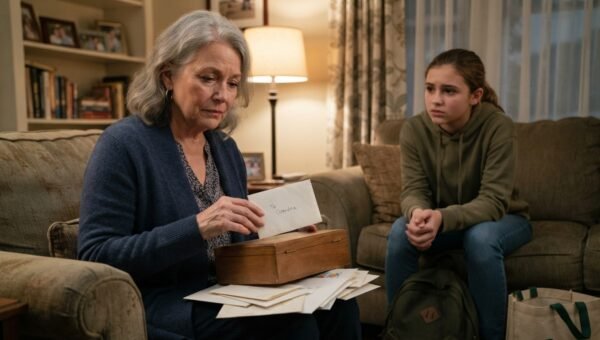
Brenda had always told me she met Dad when I was already older. She said he’d been alone for years, and that I came into his life later, after most of my childhood was behind me. She said it like a settled fact. I was young enough then to let her version sit there. I had a few memories of this house, but memories from when I was very small are easy to doubt. Maybe I had mixed up the rooms. Maybe I had made more of my time with Dad than there was.
I’d asked him once, years ago, why the dates didn’t match what Brenda said. He rubbed at the edge of his coffee mug and told me families remember things differently. I was angry with him for not answering, but I let it go. I had work and bills and my own life. Dad was alive. I thought there’d be another day to ask.
Then I saw the calendar.
I mean, I still tried to make excuses for him. I told myself the room might have been set up for someone else. The gifts had my name, yes, but maybe they were old presents he’d never mailed. Maybe the calendar had been saved for some reason that made sense to him. I kept looking for a version that would hurt less, because the other version meant Dad had built a whole private place for me and let me believe his silence was just poor memory or bad timing. And if he’d kept the room hidden from Brenda, then maybe he’d hidden the truth from me too. I could hear Arthur moving behind me, opening a drawer and shutting it again, but I didn’t turn around. I just stood beside that crib, reading “home” in Dad’s handwriting, and tried to remember whether he’d ever told me not to come back. I couldn’t remember him saying it. I could remember him saying, “You know where I am.” For years I’d taken that as a kind thing. It was a small sentence, but standing there, it felt like a door he had left open and never explained.
The front door slammed downstairs.
Arthur looked toward the hall. I heard Brenda’s footsteps on the stairs. They were fast, then slower near the top. She stopped when she saw us.
Her eyes went first to the crib. Then the gifts. Then the calendar.
She looked at the room as if she’d walked into a place she had spent years trying not to see.
“What are you doing in here?” she said.
“I found the key.”
“You need to leave.”
I looked at the calendar. “This is the year I was born.”
Brenda’s mouth tightened. “Your father said you weren’t coming back.”
There it was again. The sentence she’d brought to the door with her.
I stepped out of the room but didn’t move away from it. “What does that mean?”
She looked at Arthur, like he had no right to hear this. He stayed where he was.
“Your father promised that child was never coming home.”
It came out too fast. She seemed to hear herself after she said it. Her hand lifted toward the crib, then dropped.
I asked, “Why?”
Brenda shook her head. “It was a long time ago.”
“It was my life.”
“He said he’d keep you away. He said you were gone from the family.”
The words were plain. That made them worse.
I asked her what she meant by gone. She didn’t answer. She said she had been trying to protect her marriage. She said Dad had made promises before she knew the full story. Then she stopped talking. None of it explained why there was a crib, why the gifts had my name, or why he’d kept the door painted shut.
Arthur picked up one of the gifts and checked the tag. He didn’t open it. He set it back in the same place.
Brenda told us to leave the house. I said I wasn’t leaving until I had a lawyer and a clear answer about the estate. She said the house was hers. I told her the probate papers were Dad’s business, not hers to decide on the porch.
I should say I wasn’t calm. My voice shook. I was also angry enough to say things I regret, including that she’d spent years acting like my childhood belonged to her. It wasn’t fair to put all of Dad’s choices on her. He had made his own choices. I knew that, even then.
Still, she had changed the locks two days after his funeral and put my clothes in garbage bags. So I did not apologize.
Arthur walked downstairs with me and called the attorney who had handled Dad’s will. I spoke to him from the kitchen. I told him about the new locks, the key, and the room. He said the estate could not be settled by Brenda changing the locks. He asked me to send pictures of the calendar and gifts. I took them, though my hands were not steady.
The lawyer filed notice that the estate was being contested. Brenda could not sell the house or transfer it while the matter was being reviewed. Arthur agreed to give a statement about the lock and the hidden key. He had no reason to take my side, but he had seen the door and the room himself.
Three weeks later, I got the first clear answer from Dad’s papers. He had left the house to me. Brenda had the right to stay there while the estate was handled, but she did not own the house outright. The will did not explain the attic. It did not explain the promise she’d mentioned, either.
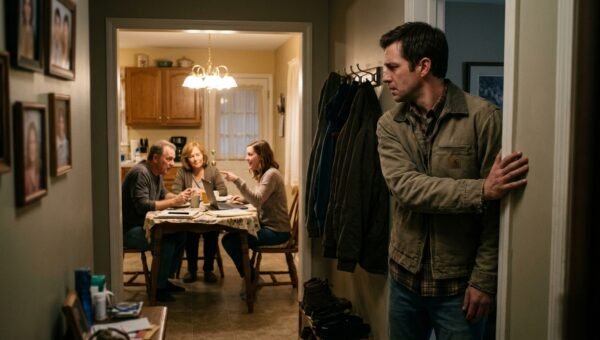
The probate process took months. Brenda and I did not speak except through the lawyers. I went back to the house with Arthur once to make a list of Dad’s belongings. Brenda stayed downstairs while I went up. She didn’t try to stop me.
The court confirmed the will. The house became mine.
I didn’t throw Brenda’s clothes into bags. I didn’t want to become the person she’d been to me. I gave her time to take what was hers, and she left without coming up to the attic. That part was final. The locks were changed again, this time with my name on the paperwork.
I kept the room as it was. I had the old door repaired so it would open without scraping, but I didn’t paint over the marks around the frame. I put the gifts back on the shelf. I didn’t open them. I still don’t know if I will.
Sometimes I tell myself Dad meant the room as an apology. Sometimes I think he made it to quiet his own guilt. I can’t make those two things separate. He kept the proof, but he also kept me from knowing it was there.
The last time I went upstairs, afternoon light came through the small window and caught the dust over the crib. I stood in the doorway with the brass key in my hand. The tag still said ATTIC 3.
On the floor by the crib was a birthday gift with my name on it. I picked it up and held it there.