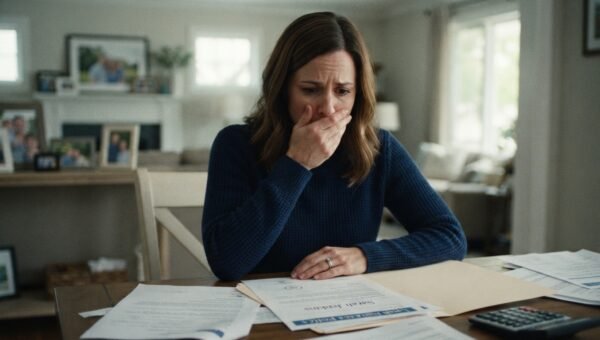
Why did I put Dale’s phone in my hand before I checked the landline bill?
I still ask myself that, years later. He was standing by the kitchen counter, one thumb on his screen, showing me a clean call history like he was helping me solve a simple mistake. I could hear the refrigerator humming. My eight-year-old daughter, Tess, was at the table peeling the paper off a straw.
“See?” Dale said. “No calls.”
I handed the phone back. I wanted to believe the neat little list more than I wanted to hear what Tess had told me.
She’d said it that morning while buttering toast. “Dad calls Aunt Lena after you go to sleep.”
I laughed at first. Not because it was funny. Because neither of us had an Aunt Lena. Then Tess said, “He says, ‘The papers are ready. She still thinks the accident was random.’”
Dale’s eyes went to her. Just for a second.
“Where’d you hear that?” he asked.
“By the stairs,” Tess said. “You thought I was asleep.”
He told her she must’ve heard something on TV. She shook her head. “It was Dad’s voice.”
I should’ve said something then. Instead, I asked Dale to show me his phone. He did it without an argument, which made it easier to feel foolish. He even smiled a little.
“Come on,” he said. “You know I’d tell you if something was going on.”
I did know him, or thought I did. We’d been married eleven years.
He packed Tess’s lunch every weekday, and he always cut the crust off her sandwich even though she’d stopped asking him to. That morning, those small things felt like evidence on his side.
I told myself Tess had mixed up a phone call with something she’d heard in a show. My parents had died in a car accident when I was nine. Everybody called it random. It was the word I’d used for it my whole life.
Dale went to work. I stood at the counter after he left, trying to get the butter off a plate without tearing the toast. Tess watched me from the table.
“You’re not mad at me?” she asked.
“No, honey.”
“I didn’t mean to listen.”
“I know.”
I wish I’d hugged her right then. Instead, I started doing dishes. I can be very good at finding chores when I don’t want to feel something.
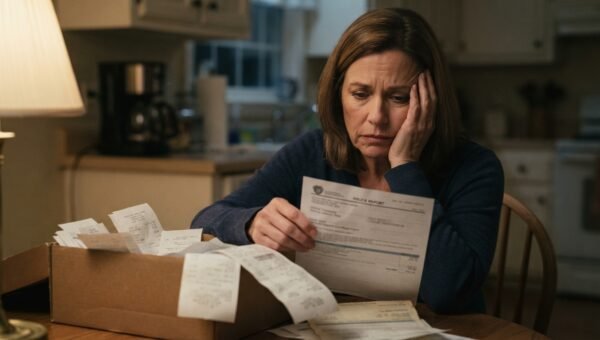
The landline bill was still in its envelope near the mail basket. We kept the phone because the service came with our internet plan, though we almost never used it. I’d opened the bill the night before, checked the total, and set it aside.
I pulled it back out. There were nineteen calls to the same number over twenty-one nights. All after 10:30. Most lasted between six and twelve minutes.
The area code was local. The number looked familiar, but I couldn’t place it. I wrote it on the back of a grocery receipt, then went to the county directory online. The address belonged to Ruth Bell.
Ruth had lived down the road from my parents when I was a kid. Her farmhouse was about forty minutes out of town. I remembered her as a quiet woman who brought casseroles after the accident and stayed with me while people handled things. I hadn’t seen her in years.
I called the number from my cell. It rang until voicemail picked up. No name. No greeting, just a beep.
Dale came home a little after six. I’d put the bill back in its envelope, but I hadn’t put the receipt away.
“Do you know Ruth Bell?” I asked.
He stopped taking off his coat.
“From where?”
“My parents’ old road.”
“No,” he said. “Why?”
I put the grocery receipt on the counter. He looked at the number, then at me.
“Those are the landline calls,” I said.
He picked up the paper. “It’s probably a wrong number.”
“Nineteen wrong calls?”
“You said Tess heard something. Maybe she’s making connections that aren’t there.”
That was a low thing to say about an eight-year-old. I knew it while he was saying it, and I still let it sit between us.
“I’m calling Ruth tomorrow,” I said.
Dale folded the receipt in half. “Don’t go stirring up things about your parents. You know what that does to you.”
That hit the spot he aimed for. I’d spent most of my life trying not to be the person who dragged everyone back into the worst day of mine.
The next morning, he left for work at 7:12. I know because the kitchen clock had stopped, and I checked my phone before I got Tess on the school bus. I waited until she was at school, then took the landline bill and drove to Ruth’s farmhouse.
I told myself I was going to ask one question. That’s how I make bad decisions sound manageable.
The road got narrower after the last gas station. I passed a feed store with a hand-painted sign and a mailbox bent sideways from a plow. I remember that mailbox because I nearly turned around when I saw it. I could’ve gone home. I could’ve waited for Dale to explain.
Instead, I kept going.
Ruth opened the door before I knocked a second time. She was older, of course, with short white hair and a brown sweater. Her eyes went straight to the bill in my hand.
“Is Dale coming?” she asked.
I didn’t answer right away. “Why are you getting calls from my house?”
Ruth opened her mouth, then shut it. A yellow sleeve hung over her arm.
It took me a moment to understand what I was seeing. The raincoat was small and bright, with one black button missing near the neck. My mother had sewn a green thread through the next buttonhole because the coat was loose on me.
I was wearing it the night of the accident.
“Where did you get that?” I said.
Ruth held it tighter. “You shouldn’t have come alone.”
“Where did you get it?”
A door opened behind her. A woman stepped into the hall.
She had my mother’s nose, her mouth, the little crease between her eyebrows when she was worried. I knew her face from old photographs, but I knew it from somewhere else too. She had the same habit of pressing her lips together before she spoke.
My mother looked at me.
“Lena isn’t a person,” she said. “It’s the name Dale gave the evidence.”
I gripped the bill hard enough to crease it. “You’re dead.”
“I know what they told you.”
“Mom?”
She nodded once. Ruth set the raincoat down on a chair. My mother kept coming toward me, slowly, with both hands out.
I stepped back onto the porch.
My father had died in the crash. My mother hadn’t. The story I grew up with was that they had both been in the car, both had been identified, and both were gone before I got to the hospital. But my mother’s body had never been found. Ruth had said it was because of the fire.
That was the first thing my mother corrected.
“Your father died at the scene,” she said. “I got out.”
“And you let me think you died?”
“I thought it was the only way to keep you safe.”
“From who?”
She looked at Ruth. Ruth didn’t look away, but she didn’t answer either.
My mother told me she and Ruth had been trying to get money out of a property trust my father controlled. There was life insurance too. She said she’d planned to leave him and take me with her. Ruth had a repair shop contact who could make the car fail without leaving an obvious sign. The plan was to scare my father and force him to sign papers. He died. My mother got out of the car, and Ruth helped her disappear before anyone figured out she’d survived.
“Then you took the insurance money?” I asked.
My mother looked down. “Some of it.”
“Some of it?”
“I know how it sounds.”
“You left me with strangers at a funeral.”
My voice came out louder than I meant it to. I heard it bounce off the porch wall.
Ruth said, “I’m sorry.”
I turned to her. “You brought me food.”
“I did.”
“You sat with me.”
“I did.”
“You let me call you when I was scared.”
Ruth’s mouth moved, but no words came.
That was when the whole thing changed from a story about my mother to something I could touch. Her old handwriting showed on the folder inside the house. My father’s name was on a copy of the insurance form. Ruth’s name was on a repair invoice dated four days before the crash. There was a police report with the part about the failed steering linkage underlined in blue pen.
And there was a paper with Dale’s signature.
He hadn’t been there that night. He’d found the old property records years later while helping me refinance the small strip of land my father had left in my name. He’d found the hidden file too. Instead of telling me, he’d gone to Ruth and my mother.
The folder was marked LENA in block letters. Inside were copies of the old records, newer property papers, and a list of the calls Dale had made from our landline. The name had come from a note my mother had once used to label the file. Dale kept it because he thought it would hide the contents from me.
The papers he’d discussed on the phone were a transfer of my inherited land to a company tied to Ruth. Dale had signed as a witness. His plan, from the notes, was to get my signature and finish the transfer before the old claim could be challenged.
My mother’s lips were moving. I couldn’t hear her over the blood in my ears. I hate that phrase, actually. What I heard was the porch screen tapping in the wind and Ruth saying my name once.
I picked up the folder.
“Don’t take the original,” Ruth said.
“You kept my coat for thirty years.”
My mother reached for my sleeve. I pulled away.
“I’m your mother,” she said.
“You were supposed to be.”
I left with copies of the file and the raincoat. Ruth didn’t try to stop me. My mother stayed in the doorway, one hand still lifted, like she thought I might come back if she waited long enough.
I called an attorney from the parking lot of a grocery store. I didn’t know what else to do. I read the name on the folder, the numbers on the bill, and the signatures on the papers. The attorney told me not to confront Dale alone and to keep the originals safe.
I went to my sister-in-law’s house with Tess that evening. Dale called six times. I answered on the seventh because I wanted to hear him say it out loud.
“Where are you?” he asked.
“Did you sign the land papers?”
There was a pause. “I can explain.”
“Did you sign them?”
“I was trying to protect us.”
“You used the landline because you knew I’d see your cell history.”
“I didn’t want you to panic before I knew what we could do.”
“You told Tess nothing was happening.”
“She’s eight.”
“She heard the truth.”
He let out a breath. “Your mother’s alive. That’s the part you need to focus on.”
“No. The part I’m focused on is you helping her hide the truth.”
“I didn’t make the accident happen.”
“You helped them take my land.”
“I was trying to keep it in the family.”
“It was mine.”
He didn’t have an answer for that. Not a real one.
I told him I’d filed for separation through my attorney. I said he wasn’t to contact Tess about the case, and every message was going to the lawyer. He said I was throwing away our marriage over old papers.
“No,” I said. “You threw it away when you signed my name into this.”
The legal process took months. The land transfer was stopped. Investigators got the original records from Ruth, and the old insurance claim was reopened. I gave them every bill, every copy, and every call time I could find. Dale moved out. My mother stayed away after my attorney told her not to contact me.
Tess asked once if her grandmother was still alive.
“Yes,” I said. “And what she did was wrong.”
“Is Dad bad?”
“I don’t know how to answer that,” I told her. “But I know he lied, and I won’t ask you to pretend he didn’t.”
I didn’t want to make Tess carry my anger, so I kept the details away from her. I also didn’t tell her everything was fine. It wasn’t. For a while, even the landline ringing made me check who was in the house.
I gave the raincoat to the investigator after they photographed it. They returned it when they were done. I washed it once, by hand, then folded it and put it on a locked shelf in my attorney’s office with the evidence file.
The transfer papers never got signed. Dale and I are no longer married. My mother is alive, but she isn’t in my life. I used to think the hardest thing would be finding out she’d survived.
It wasn’t.
The hardest thing was hearing how many people had stood close to me afterward and let me believe the accident was random.
The yellow raincoat is folded on the locked table beside the file marked LENA.