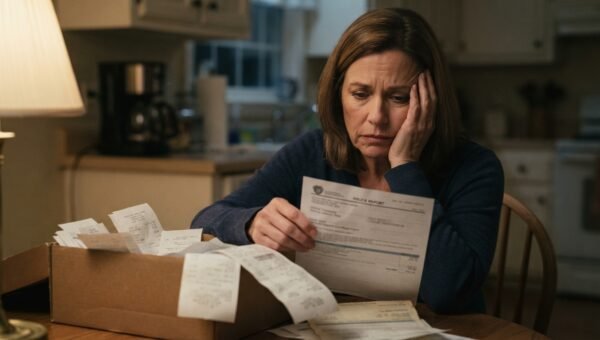
I was wrong about why my son went quiet, and I learned it from the signature he swore wasn’t his.
That’s the part I keep going back to. Not the police cars, even though I saw their lights before I saw Nate. Not the fact that I was standing at his curb in my slippers at 1:12 in the morning. The part I keep seeing is a line of ink on a piece of paper.
Two weeks before that night, Nate asked me to co-sign a $38,000 truck loan. He’d already told me I was “too old-fashioned” to give him financial advice. He said it in my kitchen, leaning against the counter, with his phone in his hand. I said no. For the next month, I didn’t hear from him.
Then Paige called.
“Please come get the kids.”
I’d been asleep. I remember the clock because I had to pick up my glasses to read it. Paige was crying hard enough that I couldn’t make out the next thing she said, so I asked her to repeat it. I put on my slippers and drove the forty minutes to their house without changing out of my nightgown.
I’m a retired hospital worker. You learn to do the next useful thing before you decide how you feel. I was good at that on the job. I’m not always good at it with my family.
The loan came up after Nate had been telling me about the truck for a few weeks. He wanted something newer, bigger, something he could take the kids in and still feel proud to pull into the neighborhood. Nate has always cared what people think. I knew that, but I’d mistaken it for a phase that would pass once he had bills of his own.
At my table, he showed me the monthly payment on his phone. I asked how much insurance would cost. He said he hadn’t checked yet. I asked if he’d saved anything for a down payment. He said that wasn’t the point.
Then I reminded him I’d already helped with a few expenses after he and Paige bought their house. Not a fortune, but enough that I kept my old checkbook records. I wasn’t trying to shame him. I was trying to say I couldn’t keep being the backup plan.
He heard something else.
“You’re too old-fashioned to give me financial advice,” he said.
He didn’t shout. That almost made it sting more. He said it with a little laugh, like I’d just made a silly suggestion. I put my mug down. There was a dried ring of coffee on the table from that morning, and I rubbed at it with my thumb while I thought.
“I’m not signing,” I said.
His face changed, but he kept his voice even. “You don’t think I can handle it.”
“I think the payment is too much.”
“Fine.”
He left without taking the printed loan estimate he’d brought. I folded it and put it in the drawer with the takeout menus. I know I could have called him after. I could’ve said I loved him and still didn’t think the loan was wise. I didn’t. I was hurt, and I told myself he was a grown man who could make the next move.
That was my part in the month of silence.
Nate didn’t call. When I texted to ask how the kids were, he answered, “They’re fine.” Paige stopped sending me pictures. I assumed Nate was still mad about the loan. I did not know the money had become a problem inside their house, too.
At first, I heard nothing. Later, Paige told me she’d been hiding bills and trying to keep up the look of a family that had everything under control. There were online gambling losses and store cards she hadn’t told Nate about. She had been borrowing, paying one thing with another, and telling herself she’d win some back or catch up after the next paycheck.
I don’t say that to excuse her. I say it because she wasn’t a stranger who broke into a bank. She was a person who kept making the next bad choice because admitting the first ones had become too hard.
The police cars were already outside when I pulled up. Nate was sitting on the curb, jaw tight, his hands clasped between his knees. One officer stood near him with a folder. Paige was inside. I could see movement in the front room, but the curtains were mostly shut.
Nate looked up when my car stopped.
“Mom, tell them I didn’t do this.”
I got out. The officer asked who I was, and I told him I was Nate’s mother. He checked my name against something in the folder. I didn’t like that. I didn’t like any of it.
“What happened?” I asked.
“They’re looking into a loan application,” Nate said. “They think I signed something.”
The officer spoke calmly. He explained that a dealership’s compliance department had flagged an identity verification mismatch on an application for a truck. The application used my Social Security number and showed a signature authorizing me as a co-signer. It also included Nate’s authorization.
I looked at the officer. “I didn’t sign anything.”
“I understand,” he said. “We’re trying to confirm who submitted it.”
I felt the old irritation from the kitchen visit come back, then hated myself for feeling it at a time like that. Nate was innocent of this part, and he was sitting there scared. I’d been right not to sign the loan, but being right was not much comfort.
The officer handed me the paperwork. The pen marks were dark and hurried. I looked first at my own name. Then at the line with my Social Security number. I had to read it twice.
The signature had a sharp slant, with the last letters looping back under the first. It was not Nate’s handwriting. He prints in big square letters, even on birthday cards. I knew that because I’ve kept every card he’s ever given me, though I wouldn’t tell him that.
I knew this hand, too.
I’d seen it on the family calendar Paige kept on their refrigerator. I’d seen it on school permission slips, grocery lists, and the envelopes she addressed for the kids’ birthdays. I had once teased her that she wrote like she was late for everything. She’d laughed and said she usually was.
I didn’t say her name there on the curb. I looked at the officer and told him I recognized the handwriting, but I wanted to speak to Paige before I made an accusation. I also told him I wasn’t going to say I’d signed anything, because I hadn’t.
He nodded. “That’s the right thing to do.”
Nate stared at me. “You know who it is?”
“I think I do.”
His mouth opened, then shut. He looked past me toward the house. I could hear one of the children crying inside, a thin, tired sound. I stopped thinking about the truck.
“Can I see them?” I asked.
The officer said I could go in, but he needed to speak with Paige. I told him the kids could come home with me for the night if Nate agreed. Nate nodded without looking at me.
Inside, one child was sitting on the couch in pajamas, holding a stuffed dog by one leg. The other was standing near the hallway with a blanket around their shoulders. I didn’t ask them what had happened. I sat down and opened my arms. They came over, both at once, and I held them until their breathing slowed.
The kitchen was the only place Paige could talk without the kids hearing. Her hands were shaking so badly she couldn’t get a cup into the cupboard. I closed the cupboard for her.
“Paige, did you sign my name?”
She looked down at the counter. “I didn’t want it to get this far.”
That wasn’t an answer. I waited.
“I used the tablet,” she said. “Your information was saved on it.”
Nate had used that tablet when he was younger to scan some family paperwork for me. I’d forgotten about it. I’d trusted a shared device to keep things safe because the files were in a folder with a name that sounded boring. That was careless. It still didn’t make the papers hers to use.
“You used my Social Security number,” I said.
“I was going to pay it back.”
“With what?”
She pressed both hands against the counter. “I don’t know.”
I kept my voice low. I was angry, but the kids were a few steps away and I did not want the night to become something they’d remember in pieces.
“How did Nate’s name get on it?”
“I made the application.”
“Did he know?”
“No.”
She said it quickly. Then she started crying again. She told me she’d been gambling online and hiding retail debt. There were cards Nate didn’t know about and payments she’d missed. She wanted the truck because she thought she could sell it, or use it to borrow enough to cover what was due. She said she meant to intercept the paperwork before anyone asked questions.
I thought of the truck estimate folded in my drawer. I thought of Nate leaving it there because he didn’t want to hear me say no. I was still angry with him. I was also looking at the person who had used both our names to try to make the loan happen.
“You can’t put this on him,” I said.
“I wasn’t trying to hurt him.”
“You put his name on it.”
She covered her face. “I know.”
I called the officer back into the kitchen and told him what she’d said. I did not soften it. I did not try to turn it into a family misunderstanding. He wrote down the details and told her they’d need a full statement. The application had been submitted digitally from an IP address inside the house, using saved information from the shared tablet. That matched what she had just told me.
Nate came in when the officer asked him to. He looked at Paige, then at the folder in my hands.
I showed him the signature page.
He looked at the writing for a long time. “That’s yours.”
Paige wiped her face with the back of her hand. “Nate, I was going to fix it.”
“You signed Mom’s name.”
“I know.”
“You used my name too.”
She didn’t answer. There wasn’t a good answer.
Nate’s anger didn’t disappear. It changed direction. He looked like he’d lost the map of his own house and was trying to work out where the doors were. I wanted to put my hand on his shoulder. I didn’t. He needed to hear what had happened without me stepping in to make it easier.
The officers finished their questions. They told us the loan application would be treated as fraudulent and that the lender had already stopped the financing. There was no truck. No new payment. There would be credit reports to check, accounts to freeze, and more calls to make in the morning.
The children stayed with me for the rest of the night. I packed their school things because they had school in the morning, though one backpack was missing a library book and I couldn’t remember which child was supposed to return it. The small ordinary things kept happening around us. That helped.
The formal part took longer. The lender voided the application. I put a fraud alert on my credit and checked my reports. The police investigation continued, and Paige was later charged with identity theft and fraud. I did not pay the loan, cover her debt, or tell anyone she had signed by mistake.
Nate and Paige separated. Their marriage did not end in one loud fight. It came apart in a run of hard conversations, bills, and things Nate learned one at a time. He was angry with me for refusing the truck before he understood why I’d been worried. He apologized for the “old-fashioned” remark. I apologized for letting my own hurt keep me from checking in more carefully.
Neither apology fixed the night. But he started calling again.
The kids come to my house after school now. We still do homework at the kitchen table, and I still ask where the permission slips are before anyone leaves. I don’t keep personal documents on a shared tablet anymore. Nate handles his own credit. I handle mine. When family money comes up, we talk about the numbers before anyone gets offended.
At dawn, the children’s backpacks sat beside two empty coffee mugs on my kitchen table. I looked out the window while the house was quiet. The papers were still there, and on the signature line was Paige’s sharp, hurried handwriting.