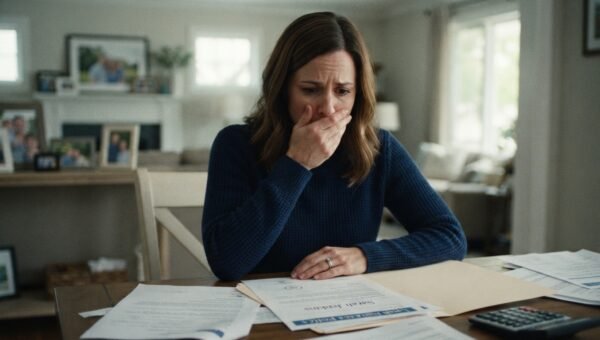
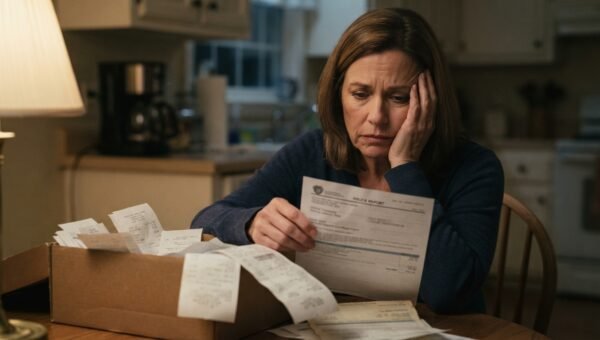
At Mom’s 82nd birthday, Kevin handed me her $2,450 assisted-living bill in front of our family. I’d already paid that amount every month for eighteen months. I was tired of being called controlling for doing it, but I still hadn’t told anyone how much it had cost me.
Mom had asked for dinner at the Italian place near Oak Ridge Manor. She liked their chicken soup, and the staff knew her well enough to bring her tea without asking.
I sat across from her. Lisa was beside me, and Kevin had taken the chair at the end of the table like he was running the evening.
He raised his glass and said, “Sarah likes controlling people with money, sigh money, so maybe she can stop pretending she’s generous.”
The wording was odd. The laugh wasn’t. Two cousins laughed out loud, and Lisa did a little cough that was close enough. Mom looked down at her plate. I could see the corner of the folded invoice sticking out of Kevin’s jacket pocket.
Then he pulled it out and slid it toward me.
“Since you insist on running everything, this is yours.”
The paper stopped beside my water glass. I looked at Mom. She whispered, “Please don’t fight.”
“I won’t,” I said.
Kevin smiled.
“I mean I won’t pay it.”
His smile went away. I folded the bill once, put it in my purse, and got up.
I didn’t yell. I didn’t give him the scene he’d set up. Mom watched me leave, and I felt awful about that all the way to my car.
For eighteen months, I’d thought keeping quiet was the kindest thing I could do. That was the part I got wrong.
Mom’s pension and Social Security came to $3,200 a month. Oak Ridge Manor’s base care level was $5,650. The gap was $2,450, not counting her personal items. Mom needed help with her medicine and with getting around safely. She wasn’t asking for extras. She needed the care she was already getting.
When she moved in, I set up an automatic payment from my account for the difference. I told myself we could talk about it later, once Mom was settled. I didn’t want her worrying that she was costing us money. I didn’t want a family argument while she was learning a new place and a new routine.
So I paid it. Month after month.
I work in payroll, and I’m the person in my family who keeps copies of everything. I know how that can look. I like things organized. I get impatient when people don’t answer a straight question. I can be controlling in small ways, and Kevin knows exactly how to use that word on me.
But I wasn’t taking Mom’s money. I wasn’t making choices about her care to get my way. I just wanted her bill paid on time. I didn’t tell Kevin or Lisa the actual numbers, though. That part was mine to own.
I thought I was preventing a fight. Instead, I gave them room to tell themselves there wasn’t a real shortfall. They figured Mom’s income covered it, or that she had savings I knew about. When I made calls about her care, Kevin said I acted like I owned Mom.
When I asked Lisa to read a form, she told me she’d leave the decisions to me.
Neither one offered to pay. Neither one knew I was covering the difference.
On the drive home, I kept hearing Kevin’s toast. The invoice was on the passenger seat, folded down the middle. I remember the scratchy sound of the paper when I picked it up at a red light. It had my name nowhere on it. It was Mom’s bill. Kevin had handed it over as if I’d been making the whole thing up.
I had. Not the cost. The silence.
By the time I got home, I knew I couldn’t pay another month without saying what I was doing. I still wanted to fix it for Mom. I still wanted her to have her room and the staff who knew when she needed a hand. But I couldn’t keep paying while my brother made jokes about how generous I was.
Monday morning, I went to Oak Ridge’s billing office.
The woman at the desk printed a form and asked if I wanted to change the payment method or just update the card. I told her to remove my card and stop the automatic payment. She asked if I was sure. I said yes, then asked for an itemized statement and the payment history.
I didn’t want my siblings to be able to say the numbers were something I’d invented. I asked the office to contact Kevin, the alternate emergency contact, about the account. I also gave them Lisa’s number and asked them to send the statements to all three of us.
The billing clerk looked at the screen and said, “The account will need attention soon.”
“I understand,” I said. “Please contact them directly.”
I was uneasy walking out. I knew what the missed payment could mean. The thought of Mom getting a notice made my hands feel clumsy on the steering wheel. I almost called the office back from the parking lot and told them I’d keep paying while we sorted it out.
I didn’t.
I wasn’t proud of how close I came. I’d trained myself to step in before anyone else had to feel a problem. That’s not the same as being kind. Sometimes it’s just a habit that makes everyone else comfortable.
The first week was quiet. Kevin didn’t call. Lisa sent me a picture of Mom holding a birthday card, with a heart emoji. I sent one back. We didn’t talk about the bill.
Two weeks after the dinner, the facility mailed a formal past-due notice and asked for an urgent meeting. Kevin called me that afternoon. His voice had changed. He said Oak Ridge was claiming Mom owed money and wanted to discuss her account.
“They’re not claiming anything,” I said. “That’s the bill.”
He asked why I hadn’t told him the amount was that high. I said I had paid it for eighteen months and that the ledger would show him exactly what had happened.
He went quiet, then said I was making a point at Mom’s expense.
That landed because it was the thing I’d been afraid of from the start. I didn’t want Mom paying for my anger. I told him I wasn’t going to let the account go unanswered, but I also wasn’t putting my card back on it.
Lisa called later. She said Mom was upset and didn’t need family trouble. I told her I agreed. Then I asked her how much she could put toward the bill each month.
She didn’t answer right away.
“Sarah, you know I don’t have your money.”
“I know what you have,” I said. “You don’t have to pay what I pay. You have to pay your share.”
She said I was making it sound simple. I told her it wasn’t simple. It was still the bill.
That was the long, ugly part. I wanted them to understand why I’d been quiet, but I also wanted them to feel ashamed. I wanted Kevin to remember how everyone laughed. I wanted Lisa to admit she’d heard what he was saying and let him say it anyway. I wanted Mom not to be in the middle, and still I kept picturing her at that table with her eyes on her plate. I could have told them the numbers from the first month. I could have shown them the account statements before I got so angry. I’d chosen the quiet route because I thought it made me the good one, and because, if I’m honest, being the person who could solve it gave me a kind of control too. That doesn’t make Kevin’s toast fair. It does mean I can’t act like I had no part in how we got there. But I wasn’t going to buy my way out of that part by paying another $2,450 alone.
At the meeting, Director Vance had the official figures ready. Kevin arrived first. Lisa came in a few minutes later and sat down without taking off her coat. I brought the bank statements from my account, though I’d already asked Oak Ridge to print the payment history.
Director Vance went through Mom’s monthly income and the base care charge. She explained the difference between them, then turned to the payment ledger.
The total I’d paid over eighteen months was $44,100.
Kevin looked at the paper. He asked if the payments had come from Mom’s account. Director Vance said they had come from mine. She showed him the dates and the amounts, all listed on the facility’s records.
I placed my bank statements on the desk beside the ledger.
“That’s my account,” I said.
Kevin didn’t answer. His face had changed, not in some dramatic way. He just looked down at each line like he was hoping one of them would explain the whole thing differently.
Lisa asked if Mom had any savings they could use. Director Vance went over what was on file. There wasn’t a hidden account waiting to make the problem disappear. Mom’s income was what it was. The monthly shortfall was real.
Kevin said he’d thought I was handling Mom’s money. He said he’d assumed I was making small payments and using them to get my way about decisions.
“You thought I was pocketing her pension?” I asked.
He rubbed his thumb along the edge of the paper. He said he hadn’t put it that way. He said he thought I liked being in charge. He said he’d been frustrated because I made the calls and knew the staff.
That was at least honest. It wasn’t an apology.
I told him I had made the calls because someone had to make them. I told him the bill had been paid on time because I paid it. I didn’t raise my voice. I’d spent too many months arranging my words so nobody would get upset.
Kevin tried to turn it into a question of whether I was abandoning Mom. I slid the statements closer to him.
“I’m not abandoning her,” I said. “I’m stopping the automatic payment.”
He said there was no way he could pay $2,450 alone. I told him I hadn’t asked him to. Lisa said she couldn’t cover half either. I said I hadn’t asked that of her, either. We needed three shares, or we needed another care plan.
Director Vance explained what options Oak Ridge could offer and what costs came with them. She also made clear that if the account stayed past due, there would be a point when Mom’s room could no longer be held. I asked her not to issue a notice to vacate while we were making a plan. She agreed to give us time, as long as the family followed up quickly.
That was why I’d brought the records. Not to punish them. I needed them to see the numbers before Mom was the one left worrying about where she would go.
Kevin turned to me outside the office and said, “You could’ve told me.”
“I should have,” I said. “I also shouldn’t have been the only one paying.”
He started to say something, then stopped. I didn’t fill the space for him.
We came back to the table and worked out a written agreement. The three of us would contribute equally to a separate account used only for Mom’s care. Oak Ridge would receive the payments from that account. Each of us would get the statements. If one person couldn’t make a contribution, we would meet before the payment was late and choose a different care plan together.
If Kevin and Lisa wouldn’t sign, then they would need to take responsibility for Mom’s daily care themselves, including arranging and covering the help she needed. I was not going to keep paying for the current arrangement while being told I was using money to control everyone.
They signed.
Kevin didn’t make a speech. He read the form twice and wrote his name. Lisa signed after him. The first payment into the shared account was set up that week. It wasn’t easy for either of them, but it was no longer something I had to carry by myself.
A few days later, one of our cousins called and said Kevin had told the family he’d misunderstood the bill. I don’t know exactly what he said. He didn’t call to correct his birthday toast, and I didn’t ask for a public apology. The people who laughed had the numbers now.
I still visit Mom. I still check that she has what she needs. What I stopped doing was quietly fixing a bill while everyone else got to believe there was nothing to fix.
Last Sunday, Mom and I had tea in the sunroom. She asked if the money trouble was over. I told her the payments were sorted out and she didn’t need to carry it. I didn’t tell her about Kevin’s toast. I let her talk about the soup at Oak Ridge and the woman down the hall who keeps losing her reading glasses.
My account is no longer attached to Mom’s bill. The old ledger is closed in my bag, and when I left that afternoon, I zipped it shut and went home.