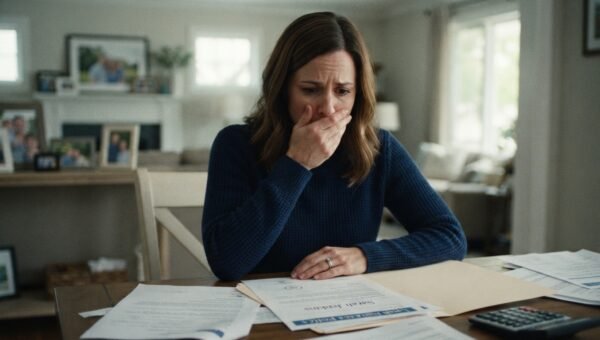
Three nights in one week, Lowell said Sondra in his sleep. The third time, I was counting the little cracks in our ceiling and heard him say it as clearly as if he were awake. We’d been married 34 years. I’d never known a Sondra.
I didn’t wake him. I lay there beside him, counting the cracks again, because that was easier than asking myself what kind of name a person says three times when he thinks nobody can hear.
By breakfast, I’d made a decision I’m not proud of. I checked our bank account.
I’ve always handled the bills. Lowell usually asked if the electric bill was paid, and I’d say yes. That was our system. I thought I knew where our money went, down to the little automatic charge for the water softener. So when I saw cash withdrawals for $250 every other Friday, I noticed. There were a lot of them.
I told myself there was probably a simple reason. Maybe he’d been paying for a golf league. Maybe he’d lent money to someone and didn’t want me fussing. I’m good at finding a sensible explanation when I don’t want to look at the less sensible one.
Then I walked out to the garage.
Lowell’s golf clubs were still in their bag, right where they’d been since spring. A gray film of dust sat on the top of the bag.
I rubbed it with my thumb and came away with a dirty stripe. He’d been saying he was golfing every other Friday for months.
I remember standing there with my thumb out, looking at it like it could tell me what I was supposed to do next. It couldn’t. So I went inside and looked in his desk drawer.
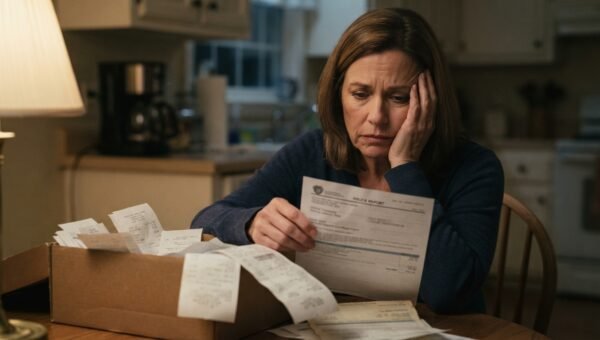
The receipts were in a plain envelope, tucked behind the tax papers. I found two years’ worth. Each one showed a $250 cash withdrawal, always on a Friday. I added them up at the kitchen table because I didn’t trust my head. Twenty-six withdrawals a year. Two years. $13,000.
On the back of one receipt, Lowell had written a phone number.
That was the part I couldn’t leave alone. I set the receipt beside the phone and went to wash a cup that was already clean. Then I came back. I picked up the phone.
Put it down. I wasn’t trying to catch him in an affair, I told myself. I was trying to find out why my husband had been lying about golf and taking cash out of our account. Those sounded different to me at the time.
I waited until Lowell left for work. Then I sat at the kitchen table and dialed the number.
A woman answered on the second ring. Before I could speak, she said, “Lowell, honey, you’re early.”
The first thing I noticed was her voice sounded tired, not flirty. I don’t know why I noticed that. Maybe I was trying to place her before I had to say my name.
I told her who I was.
She went quiet. I could hear a small click on her end, like she’d set something down. Then she said she was sorry, and that Lowell had told her he hadn’t told me yet.
She didn’t sound angry with me. She sounded like somebody who had just learned she’d stepped into a room where she didn’t belong.
I asked her who she was.
She said her name was Sondra. Then she said, “I’m Lowell’s daughter.”
I held the phone tighter. Not because I was about to drop it. I just needed my hand to do something.
Sondra told me Lowell had reached out to her again about two years earlier. Her mother was sick, and Sondra had been trying to keep up with rent and basic bills while caring for her. Lowell had been sending cash to help. He came by on Fridays, the days he told me he was golfing. She didn’t know he’d been saying that to me.
“Is he your father?” I asked.
“Yes,” she said. “He is.”
There were years of history in that one word, and none of it belonged to me. Not yet, anyway. I asked how old she was. Thirty-eight. She said Lowell had told her he’d tried to get in touch when she was younger, but the contact had stopped. I heard enough to know there was a story before me, but not enough to know what was true. I told her I needed to talk to Lowell.
She offered to call him. I said no. I wanted to hear it from him, in our kitchen, looking at the receipts.
I didn’t tell her she had to keep quiet. I didn’t ask her to prove anything. I wasn’t proud of that, either. Part of me still thought that if I could get Lowell to explain first, I’d be able to tell whether the story was real. As if 34 years of marriage had trained me to read his face better than his own daughter could.
I hung up and sat at the table for a long time.
Then I called the bank and asked for the last two years of statements to be sent to our house. I made a pot of coffee I didn’t drink. I lined up the receipts by date and set the phone number face up in the middle. I could have called Lowell at work. I could have texted him. Instead, I left the evidence out and waited. That was my choice, and I knew it would turn a hard conversation into a worse one.
The hours dragged. I tried to do laundry and put one of Lowell’s shirts in with the towels. I caught the mistake before the machine started, but I was so annoyed with myself that I stood there holding the shirt for a minute. It was the sort of thing that happens when a person is pretending her day is ordinary.
Lowell came home just after six. I knew it was him because he always dropped his keys in the ceramic bowl by the door, and they made the same sharp little clink. He came into the kitchen, saw the receipts, and stopped.
I didn’t say anything at first. I wanted him to see that I had counted them. I wanted him to know I had called the number. I also wanted, unfairly, for him to start talking without me having to ask.
He looked at the receipt with the phone number on it. Then he looked at me.
“How much did you hear?” he asked.
“Enough to know she’s your daughter.”
He sat down across from me. His hands stayed on the table, one over the other. He looked older than he had that morning, which makes no sense, but I remember thinking it.
He said he’d met Sondra’s mother before we met. He was young. The relationship was brief. Sondra was born, and he knew she was his, but he didn’t know how to be a father to a child whose mother didn’t want him in her life. There had been some contact when Sondra was little. It faded. He said he was ashamed of how he’d handled it, and then he’d spent so long keeping it quiet that telling me seemed harder each year.
I listened. I didn’t nod. I didn’t help him finish the story for him.
He said Sondra had called him two years ago. Her mother was sick, she needed help, and he had gone to see her. The $250 was for bills and groceries. He’d kept helping her because he could, and because he was afraid she’d be left with nothing if he stopped.
“Why didn’t you tell me?” I asked.
He rubbed his thumb over the edge of one receipt. He said he was scared I’d think our whole marriage had been a lie. He said he thought he could handle it himself. He said he kept waiting for the right time.
There wasn’t a right time. There had been two years of Fridays and a drawer full of proof.
I was angry. I also felt sorry for him, which made me angrier. It was familiar, that reflex. I’d spent a lot of our marriage making things easier for Lowell when he was uncomfortable. I’d smooth over a forgotten birthday, a missed call, a bad mood. I’d tell myself he’d had a long week. I had probably helped him believe he could keep this part of his life away from me, too.
But the money wasn’t the only thing. I could replace $13,000 over time. I couldn’t go back to every Friday he’d said “golf” and sit beside that word without hearing this conversation behind it.
I asked him if there was anything else. Any other child. Any other account. Any other person he was helping. He said no. I asked him to slow down and tell me what he knew about Sondra’s childhood, what he’d said to her, and what he’d promised. I didn’t want the short version. I’d had enough short versions.
He told me he hadn’t promised her anything beyond help with the bills while her mother was ill. He said he wanted to see her again, and he wanted me to meet her if I was willing. I didn’t answer right away.
I looked at the receipts. I thought about the first time Lowell taught me to use the old coffee maker, because I kept forgetting which side the filter went in. I thought about all the normal things we’d built, the mortgage, the dentist appointments, the meals where we barely talked because we’d already told each other everything about the day. I had thought that kind of closeness meant there were no rooms left in the house I didn’t know about.
I was wrong about that.
I told Lowell the secrecy had to stop. From then on, I wanted to see every account, every withdrawal, every message about money. I wanted to know when he spoke to Sondra, and I wanted the truth before he made plans with her that involved our shared money or our shared life. I wasn’t telling him he couldn’t help his daughter. I was telling him he couldn’t keep making me the last person to know.
He said he understood. I told him understanding was easy. Doing it was the part that mattered.
We called Sondra together the next day. Lowell told her I knew and that he was sorry he’d made her part of a secret. I said I wasn’t angry with her. That wasn’t the same as saying I was ready to meet her. We agreed to talk again after her mother’s next appointment, and Lowell made no promises on my behalf.
The account statements came in the mail a few days later. We went through them side by side. There were no other hidden withdrawals. The total was $13,000, all of it tied to those Friday visits and the help he’d given Sondra. That didn’t erase what he’d done, but at least there wasn’t another number waiting for me in another drawer.
We kept the receipts for a while. Then Lowell asked if I wanted to throw them out. I said yes, so we sat at the table and put them in the shredder. I watched every one go through. It was petty, maybe. I didn’t care.
The next morning, two cups of coffee sat between us at the same kitchen table. Neither of us had touched them. We were still figuring out how to say Sondra’s name without making it sound like an accusation, and how much of our old life could hold this new truth.
I took a breath and told Lowell we’d talk to her again that afternoon. He nodded. The coffee stayed where it was, cooling between us while we worked out what to say first.