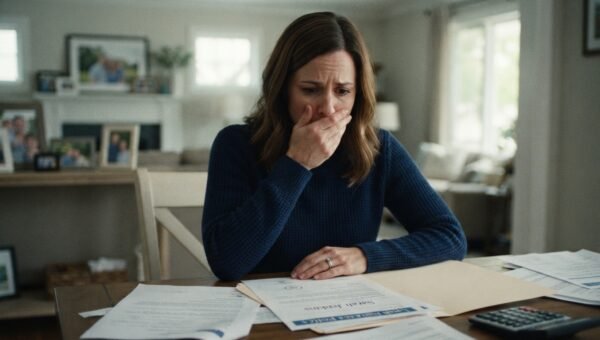
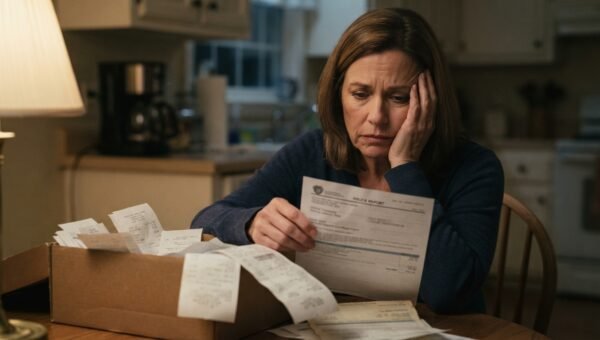
I had my hand on the screen door when the Social Security letter slid out of its envelope and landed on my kitchen floor. I picked it up before I went outside. The first number I saw was 48 months. The second was $91,536.
Mom had been dead for four years.
I read the letter once standing up, then again at the table with my reading glasses on. It said her monthly benefit had kept going into an active account.
The account belonged to my brother, Wade. I set the page down and went to wash a mug that was already clean.
I don’t know why I did that. Maybe I wanted one ordinary thing to do with my hands. The letter stayed on the table, and that number stayed there with it.
There were other details. The payments had continued every month after Mom died. Someone had sent in paperwork saying she was alive but incapacitated. Someone had also attached a medical form with a doctor’s name on it.
I called the number on the letter. The woman who answered was careful with her words, which I understand. She asked if I had proof of Mom’s death. I told her I had the funeral home paperwork and a copy of the death certificate.
“Please send those in,” she said.
“I will. But whose account is it?”
“I can’t discuss another person’s account.”
I knew what that meant. I knew whose account it was.
Four years earlier, Mom died at hospice after a long stretch of bad days and a few good ones.
I remember her asking for ginger ale, then complaining the can was too cold. I remember because I had to wrap it in a dish towel before she would hold it.
Joann, my sister, handled a lot of the hospice paperwork. She had worked in a medical office and could read forms without getting lost in them. Wade was good with a phone and a bank app, but he hated paperwork. I did the meals and drove over after work.
I trusted both of them. That’s the part that keeps catching me.
At the funeral, Joann cried so hard she had to sit down. I remember her black sleeve pressed against her face. Wade stood close to the front and kept rubbing Mom’s old rosary between his fingers. We were all hurting, and I didn’t look too closely at anything else.
After the letter came, I started remembering little things I had let pass.
Joann had asked for a copy of Mom’s death certificate, then said she needed to check one last hospice bill. Wade had told me the bank “was still sorting out Mom’s stuff,” even though the bank wasn’t his to sort out.
At the time, I thought they meant paperwork. I didn’t want to ask questions while Mom’s things were still in boxes. That was my excuse, anyway.
The Thanksgiving after Mom’s death, I hosted at my house. I set out the same chipped gravy boat she’d used for years, then got mad at myself for noticing it. Wade brought a pie from the grocery store. Joann brought rolls and offered to help with dishes.
I’d had the letter for almost a month by then. I hadn’t told either of them. I wanted to see what Wade would say if I asked him plainly, and I knew that wasn’t the kindest way to do it.
We were halfway through dinner when Wade asked me to pass the salt. The turkey was already carved. I remember the knife handle felt tacky from gravy.
“Your name is on Mom’s Social Security deposits,” I said.
Wade lowered his fork. Joann stopped reaching for the rolls.
“What are you talking about?” Wade said.
I put the letter beside my plate. “Forty-eight months. Ninety-one thousand, five hundred thirty-six dollars.”
He looked at the page, then at me. He didn’t ask if the letter was real. He didn’t look surprised for more than a second.
“I earned it,” he said. “I took care of her.”
“You didn’t visit her the last two years.”
The room got quiet. My niece was in the living room watching a show, so I kept my voice down. I wish I could say I did it to protect her. Mostly I didn’t want to sound like I was losing control.
Wade leaned back. “I paid for things.”
“What things?”
“Gas. Food. Whatever she needed.”
“You didn’t go to hospice.”
“I had a life too.”
Joann looked down at her plate. Then she said, “Can we not do this at dinner?”
That bothered me almost as much as Wade’s answer. Still, I folded the letter and put it in my purse. I was not going to let them turn the whole thing into my bad manners.
Wade left before dessert. Joann stayed to wrap leftovers. She asked if I was going to report him.
“I haven’t decided,” I said.
She wiped the counter in the same spot twice. “You could make this a lot worse for everyone.”
That was a clue. I knew it was a clue even then. I let it sit between us anyway.
The next morning, I called the Social Security office again. They told me how to report suspected fraud. I wrote down every name and number, then made copies of the letter, the death certificate, and the hospice records I still had.
I almost stopped there. Wade was my brother. Joann was my sister. I could already picture the family calls, the people asking why I’d done it, the ones who would tell me to let the government handle its own records.
But the checks had kept coming after Mom died. The money had gone somewhere. I couldn’t pretend I hadn’t seen the letter.
So I filed the report.
A few weeks later, I got a call from Agent Vance. He asked me to sit down with him at my house. He didn’t sound angry or friendly. Just careful.
He asked what Wade did for work, who had access to Mom’s medical paperwork, and whether I knew why the checks would go to Wade’s account. I told him what I knew and what I didn’t. I didn’t make anything up to make my case look stronger.
“I need you to be exact,” he said.
“I am.”
He opened a folder on my kitchen table. The paper inside had a copy of the doctor’s stamp and two signatures. One was Wade’s. The other was written on the line for a family member who could confirm Mom’s condition.
Agent Vance tapped that second signature with his pen.
“Your brother isn’t the only name on the forged documents,” he said. “Someone co-signed the medical form. Someone who attended your mother’s funeral.”
For a second, I couldn’t make myself look at the page. Then I did.
He didn’t tell me the name right away. He asked me to think about who had been helping with hospice paperwork and who had access to Mom’s records. I said Joann’s name. It came out too fast.
Agent Vance nodded. “We’re checking the signature against the records.”
I wanted to say that couldn’t be right. I wanted to say Joann had cried at the graveside. But I had watched her look down when Wade admitted taking the money. I had heard her warn me not to make it worse for everyone.
The small things had been there. I just didn’t want them to add up.
Agent Vance asked about Mom’s hospice doctor and the office where Joann had worked. I told him Joann had helped with the hospice forms because she knew how the paperwork worked. I also remembered her taking a folder home one afternoon to finish copying things. Back then, I’d thanked her.
The investigator asked if I had any old emails or visitor notes. I dug through a box in the hall closet. I found a hospice visit sheet, a few printed emails, and the receipt for the funeral flowers. The visit sheet listed Joann as the person who’d helped coordinate the doctor’s paperwork.
That didn’t prove the fraud by itself. I understood that. But it gave the investigator a place to look.
A month passed. Agent Vance called to say the signature had been compared with Joann’s records. He also said the doctor’s office had confirmed the stamp on the form had been kept in a locked desk. Joann had been there with Mom’s hospice file during the week the form was dated.
I asked if Wade had done it alone.
“No,” he said. “The records don’t support that.”
I sat on the edge of my bed after the call. Mom’s old house key was still in the drawer beside me. I’d kept it for no good reason, and I was suddenly mad at myself for that too.
The investigator told me they were tracing the money. Some of it had gone from Wade’s account into another account linked to Joann. He didn’t give me every detail, and I didn’t ask him to. I had enough.
I called Joann and asked her to come over. I told her I wanted to talk about the letter and the hospice forms. She arrived alone and took off her coat like she planned to stay for dinner.
I put the federal file on the table.
She looked at the top page, then at me. Her hand went to her necklace. “What is this?”
“Your signature.”
“You’re saying I signed something?”
“I’m saying Agent Vance has the original.”
Joann sat down. I pushed the copy toward her, and she touched the page with one finger. She didn’t deny the signature. She said she’d signed because Wade told her the checks were being held up and he needed help getting them released.
“Mom was dead,” I said.
“He said it was temporary.”
“For four years?”
“He said he’d fix it.”
I felt my face get hot. I was mad at Wade. I was mad at Joann. I was mad at myself for still waiting for a version of this that would hurt less.
“You took money from Mom after she died,” I said.
“I didn’t take it for myself.”
Agent Vance had told me there were transfers into Joann’s account. I said that. She shut her eyes.
“Wade was going to give me some,” she said. “I handled everything when Mom was sick.”
That was the first time she said the quiet part plainly. She had handled the forms. She had the access. She had signed the lie, and Wade had taken the deposits.
“You cried at her funeral,” I said.
Joann started crying again. It sounded like it had at the funeral. I hated myself for noticing.
“I loved Mom,” she said.
“I know you did.”
That was true. It didn’t change what she had done. I told her the investigator had the records and that I wasn’t going to help her explain them away.
She stood and reached for the file. I kept my hand on it.
“Don’t take that,” I said.
“I’m your sister.”
“I know.”
She left without her coat. I called after her to take it, but she didn’t turn around. I left the coat on the chair.
After that, the case moved through the channels I’d started by filing the report. The government froze the accounts while the investigation continued. Wade and Joann were charged with wire fraud, identity theft, and forgery. I was told the stolen funds had been secured. I did not get a check for them, and I didn’t ask for one.
The family split into people who called me and people who didn’t. A few wanted me to say I’d gone too far. One cousin said Mom wouldn’t have wanted her children in court. I told him Mom wouldn’t have wanted her name used to keep money coming after she was dead.
I stopped answering calls from Wade and Joann. I stopped explaining it to people who had already decided what they wanted to believe. Maybe that made me hard. I can live with that better than I can live with staying quiet.
A few relatives came by one evening after the charges were filed. They said they wanted everyone to talk. I told them there wasn’t anything left to discuss with Wade or Joann. They stood on the porch, waiting for me to change my mind.
I didn’t.
I closed the door and locked it. Mom’s framed photograph was still on the table, taken years before any of us started keeping score.