PART 1
The gold band was what caught the glare of the October sun first.
I was walking down Maple Street on my lunch break, holding a lukewarm coffee, thinking about nothing more important than picking up laundry detergent on my way home. Then I stopped dead in front of Miller’s Loan and Jewelry.
There, sitting on a black velvet riser right behind the plate glass, was a vintage Omega Constellation.
It had a heavy link bracelet and a distinct, diagonal hairline scratch running straight through the date window.
My stomach dropped straight through my shoes.
I knew that scratch because I was twelve years old when I dropped that very watch onto our concrete back patio. My father had never yelled at me for it. He just picked it up, rubbed his thumb over the cracked crystal, and wore it every single day for the next forty-four years until the cancer finally took him.
Six months ago, we buried him with it.
I stood in the cemetery breeze remembering the exact weight of that afternoon. Dad had told us both, years before he got sick, that he wanted that watch to go into the ground with him. It had been his father’s before it was his. My younger brother, Jesse, had been the one to stay behind in the viewing room at the funeral home.
Jesse insisted on having five private minutes with Dad before the lid was locked. When he came out into the hallway with red-rimmed eyes, he looked me dead in the face and said, “It never left his wrist, Beth. I saw them lock the casket myself.”
I pushed the heavy brass door of the pawnshop open. A chime clattered above my head.
A short man with reading glasses pushed up on his bald head looked up from behind the counter. His name tag read Sal.
“Help you with something in the case?” he asked.
“The Omega in the window,” I said. My voice was shaking, and I couldn’t stop it. “Where did you get it?”
Sal gave me the cautious, practiced look of a man who dealt with stolen property accusations twice a week. “Someone brought it in. Came across the counter yesterday afternoon.”
“Can I see it?”
He hesitated, then reached into the window display and set the watch down on the rubber mat between us.
I didn’t even have to pick it up. On the clasp, faint but clear, were the initials: H. E. M. Harold Edward Miller. My father.
“This belonged to my dad,” I whispered. “He died in April. We put this in the ground with him.”
Sal frowned, leaning on his forearms. “Lady, I don’t know what to tell you. A woman walked in here yesterday around three o’clock. She had an Ohio driver’s license, signed the intake sheet, took seven hundred bucks in cash, and walked out.”
He pulled a gray binder from beneath the register, flipped through several plastic-sleeved carbon slips, and turned it toward me.
There, on the customer signature line, was my name: Elizabeth Miller.
The handwriting wasn’t just a scribble. It had the loop on the capital E that I have made since middle school, and the slight slant on the double-l. It was an exact duplicate of my signature.
“That isn’t me,” I said, my heart hammering against my ribs. “I was at work yesterday until five. I work at the county clerk’s office. You have cameras, don’t you?”
Sal stared at me for a long beat, seeing the genuine panic in my face. He stepped into a cramped back room and returned a minute later with a small black monitor hooked to a digital recorder. He hit play and turned the screen around.
The time stamp read 3:14 PM yesterday.
A woman walked into the frame. She was wearing an oversized wool coat with large tortoiseshell buttons and a wide, plum-colored knit scarf pulled up high around her chin, topped with a dark ball cap. She was roughly my height, slender, keeping her head tilted downward toward the counter.
When she laid the watch down, I didn’t care about the face on the screen anymore. I was staring at the coat.
It was a wool charcoal pea coat with custom tortoiseshell buttons. My mother had given it to me three winters ago. Three weeks after Dad’s funeral, I had gathered four boxes of my old winter clothes, driven across town, and dropped them into the donation bin behind the community center where Jesse’s girlfriend, Kendra, worked as a part-time program director.
I pulled my debit card from my purse with trembling fingers. “I want to buy it back. Right now.”
Sal charged me eight hundred and fifty dollars. I didn’t haggle. I took the watch, walked out to my sedan, and sat behind the steering wheel in total silence.
As I lifted the heavy gold links to put them into my purse, I felt a faint, sharp tick inside the case.
I shook it gently near my ear.
Something was loose. It wasn’t the steady, weighted swing of an automatic rotor. It was a light, metallic clinking, as if a tiny loose piece was sliding back and forth inside the sealed gold backplate.
PART 2
I drove straight to Keller Jewelers on 4th Street. Old Mr. Keller had maintained Dad’s watches for thirty years, and his son David ran the bench now.
David smiled when I walked in, but his expression shifted as soon as he saw the Omega in my hand.
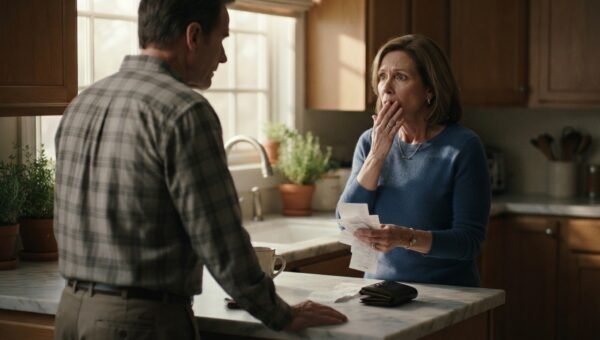
“Beth? Your brother told me Dad was buried with that.”
“He was supposed to be,” I said, setting it on the counter. “Something is rattling inside it. David, can you take the back off?”
David took the watch, popped his jeweler’s loupe into his eye, and brought it over to his workbench under the bright lamp. He used a rubber suction ball and a small notch tool to unscrew the case back. It gave way with a soft click.
He pulled the backplate away, and his brow furrowed. “That’s strange.”
“What is it?”
“This isn’t an automatic movement,” David said slowly. “It was originally, but someone gutted the internal gearing. Look here.”
He turned the watch toward me. The delicate gears and springs were completely gone. In their place sat a small square of dense foam, hollowed out in the center. Resting inside that foam cutout was a tiny, flat brass key, no bigger than an inch long, with three distinct notches filed into the edge and the number 114 stamped into the head.
“A safe deposit box key,” David said quietly. “Or a lockbox.”
My phone rang in my pocket. The screen showed Jesse’s name.
My breath caught. I answered, putting the phone to my ear while staring at the tiny brass key on the counter.
“Hey, Beth,” Jesse said, his tone casual, almost too casual. “You around your place tonight? I was thinking of dropping by to grab that old box of Dad’s fishing tackle from the garage.”
“Jesse,” I said, keeping my voice steady. “Where are you right now?”
“Just leaving the site,” he said. Jesse did freelance drywall work, always hopping from one small residential gig to another, always perpetually behind on his truck payments. “Why do you ask?”
“I’m standing in Keller Jewelers,” I said. “I’m holding Dad’s watch.”
The line went completely dead. Not disconnected, just pure, hollow silence on the other end.
“Jesse?”
“Where did you get that?” His voice had lost all its warmth. It sounded tight, strained, and suddenly hostile.
“I bought it out of Miller’s Pawn an hour ago. A woman sold it yesterday using my name.”
“Beth, listen to me,” Jesse said, speaking fast now, his breath coming hard over the speaker. “Don’t mess with that. Don’t touch it. Dad promised that watch to me before he died. He pulled me aside in hospice and said whatever was inside of it belonged to me to settle what he owed me. Bring it to my apartment. Right now.”
“What did he owe you, Jesse? Dad gave you eight thousand dollars last December to keep your truck from being repossessed.”
“You don’t know the whole story, Beth! You never knew anything about his business! Just give me the damn key!”
He didn’t ask what was inside. He didn’t ask if there was a key. He already knew.
“Did you dig him up?” I whispered, tears burning my eyes. “Jesse, tell me the truth. Did you dig up our father?”
He hung up on me.
I stood in the jewelry shop, clutching the little brass key in my palm until the metal cut into my skin. David looked at me with open horror.
Before I could even put the watch back in my purse, my phone buzzed with an incoming call from a local landline. It was Sal from the pawnshop.
“Miss Miller?” Sal sounded breathless and uneasy. “You need to come back over here. That woman just walked back in.”
PART 3
“Keep her there,” I told Sal. “Call the police.”
“I can’t call the cops over a regular buy, lady, but I told her my system was down so she’d wait. You better hurry if you want to catch her.”
I drove the six blocks back to Miller’s Pawn with my hands shaking on the wheel, running a yellow light on 5th.
When I pulled up to the curb, I saw a familiar silver Honda Civic parked two doors down with the engine running. It was Kendra’s car.
I walked into the shop.
Standing at the far end of the counter was Kendra. She had taken off the large knit scarf because of the shop’s indoor heat, but she was still wearing my donated charcoal wool coat. On the glass counter sat a heavy gold pocket watch that had belonged to my great-uncle Frank, along with a stack of old yellowed envelopes.
She turned around when the door chimed, and her face went paper-white.
“Kendra,” I said.
She grabbed for the items on the counter, but Sal had already slid his hand over them, pulling them behind the security glass.
“Don’t move,” I said, stepping between her and the exit. “Don’t you dare take another step.”
“Beth, please,” Kendra stammered, her hands trembling as she pulled the coat tightly around herself. “It’s not what it looks like. Jesse told me to do it. He said it was family stuff you gave him permission to sell.”
“Using my signature? Wearing my coat?”
“He said they wouldn’t take it from him because of his record!” she cried out. Jesse had an old misdemeanor for theft from a job site six years ago. “He forged your name. He practiced it on a legal pad for two days! He gave me your old coat so if anybody asked questions or looked at the cameras, they’d just assume it was you clearing out your parents’ estate!”
“Where did he get the watch, Kendra? Look at me. Did he go out to Oakridge Cemetery with a shovel?”
Kendra began to sob, covering her face. “No! God, no, Beth, he didn’t dig him up! He never put it in the casket!”
I froze. “What?”
“At the funeral home,” Kendra whispered, tears streaming down her cheeks. “During those five minutes when everyone was in the hall. Jesse took the watch off your dad’s wrist right before they closed the lid. He replaced it with a cheap thirty-dollar gold replica he bought on Amazon.”
The bile rose in my throat, hot and bitter. My brother hadn’t desecrated a grave with a shovel in the middle of the night; he had robbed our father’s dead body right in the viewing parlor while I was standing twenty feet away in the hallway, crying into a paper tissue.
“Then what is this?” Sal asked from behind the counter.
He held up an 8×10 photograph that had slipped out from the yellowed envelopes Kendra had laid down.
I took the photograph from Sal.
It was a Polaroid, dated August of 1994. It showed my father, in his work boots and dirt-stained jeans, leaning on a shovel next to an old stone wall out at the back edge of our family’s former cabin property near Hocking Hills, which we had sold off five years ago. Next to the photo was an old handwritten note from my father: *Key 114 opens the lockbox under the hearthstone. For an emergency only.*
“He thought Dad put money in the ground,” Kendra sobbed. “Jesse found that note in Dad’s desk two weeks before he died. He thought the key in the watch opened a metal box under the floor at the old cabin. But when he drove out there last month, the new owners had poured a full concrete patio over the old hearth. There was nothing to dig up. He realized the key was useless to him, and he had three months of rent past due. So he told me to pawn the original watch.”
ENDING
I didn’t yell. I didn’t scream at Kendra. The anger inside me had burned down into a cold, heavy ache that left me completely hollow.
I stood there in the quiet of the pawnshop while Sal watched us both.
“Take the coat off,” I said quietly.
Kendra sniffled, unbuttoned the tortoiseshell buttons with clumsy, shaking fingers, and slipped the heavy wool coat off her shoulders. She laid it across the glass counter.
“Call Jesse,” I told her. “Tell him the police aren’t involved yet, but if he ever contacts me, steps onto my property, or mentions Dad’s name again, I will hand the forged pawn receipts and the security footage directly to the district attorney. He has forty-eight hours to pay back what he owes on his own, because he doesn’t have a sister anymore.”
She nodded, terrified, grabbed her purse, and ran out the front door. A second later, the silver Honda sped away down Maple Street.
I paid Sal for my great-uncle’s pocket watch and took the yellowed envelopes, the photograph, and my old coat.
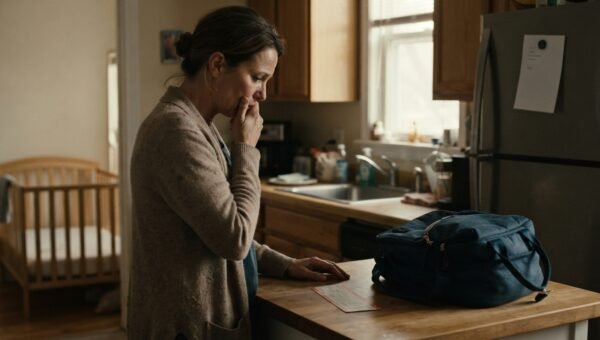
That evening, I sat at my kitchen table with the brass key and the Omega Constellation.
I knew where lockbox 114 actually was. It wasn’t at the cabin. Dad had used the same safe deposit box number at First National Bank in town since the late seventies. The cabin note had been an old contingency plan from thirty years ago before the bank branch even opened.
The next morning, I took my letters of executorship and walked into First National Bank.
The bank officer led me into the quiet, fluorescent-lit vault, turned her key alongside mine, and pulled open box 114.
Inside, there was no secret fortune. There were no piles of cash to pay off Jesse’s reckless debts.
There was a thick manila envelope containing Dad’s honorable discharge papers from the Navy, our mother’s silver wedding band wrapped in tissue paper, and a clean, sealed envelope with my name written across the front in his neat, deliberate handwriting.
Inside was a single folded sheet of paper and a small savings bond he had purchased the day I graduated from college.
*Beth,* the note read. *If you’re reading this, it means you took the time to look after things the way you always did. Your brother moves too fast and looks for easy answers, but you were always the one who stayed steady. The watch has kept time for three generations of Miller men. Pass it to someone who knows what time is really worth.*
I sat in the small private booth of the bank vault and cried for the first time since the funeral. Not tears of grief, but of relief.
Dad had known Jesse. He had known his son’s weakness, his shortcuts, and his desperate habits. He hadn’t hidden a fortune; he had left a simple test of character, and Jesse had failed it at every turn.
I took the watch back to David Keller the following week. He sourced the original vintage movement parts, cleaned the gold casing, and rebuilt the ticking heart of the watch.
It sits in a velvet-lined wooden box on my dresser now, ticking quietly in the dark. It never goes near a drawer, and it will never go into the ground. When my nephew turns twenty-one, I will decide if he has earned the right to wear it. But until then, it stays with me, keeping quiet, honest time.