PART 1
The ink on the divorce decree had been dry for exactly five days when Mercedes let herself in through the back door.
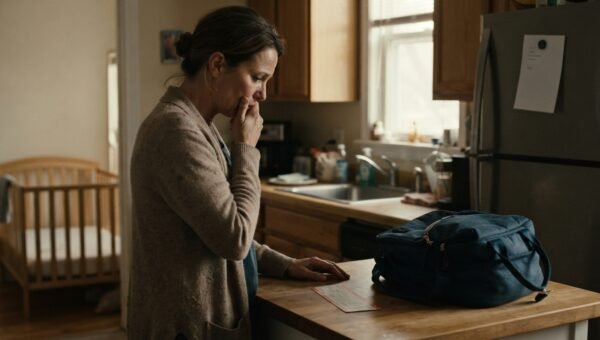
It was raining hard across Charlotte, the heavy, blinding downpour that drowns the azaleas and clogs the gutters along Providence Road. I was standing barefoot by the sink, holding a half-empty mug of black coffee, wearing an old faded sweatshirt with the sleeves pushed past my elbows.
Right beside my coffee cup sat a thick olive-green folder tied with frayed cotton tape. I had carried it up from the crawlspace under the back stairs an hour earlier, coughing through ten years of spiderwebs and mildewed cedar shavings.
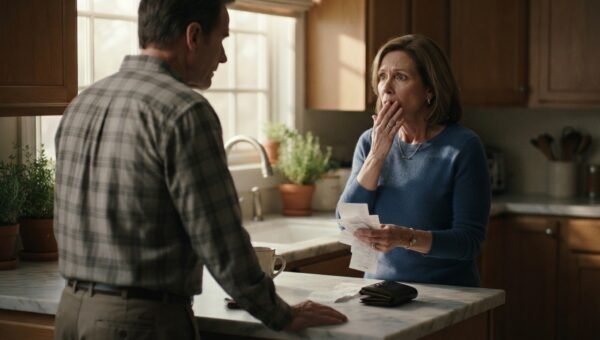
Mercedes didn’t knock. She never did. She pushed the heavy back door open so hard the brass latch clattered against the drywall, bringing the wet smell of cold pavement and expensive gardenia perfume straight into my kitchen. Behind her, two gigantic hard-shell suitcases bumped over the hardwood threshold.
“Good thing the paperwork is signed,” she announced, dropping a damp designer purse onto my dry butcher-block island without looking at me. “Now this house finally goes back to the family where it belongs. You have no business being here anymore, Clara.”
She stood there in her tailored camel-hair coat, shaking rain from an umbrella she had bought during some summer trip to Rome, surveying the tall ceilings and the custom white oak cabinets as if she had just arrived to inspect a vacation rental.
She had spent fourteen years speaking to me in that exact tone: soft, polished, and completely convinced that the ground beneath my feet was borrowed soil.
Before I could set my mug down, footsteps creaked on the second-floor stairs. Daniel came down slowly, wearing his running shoes and an old fleece vest. He stopped on the bottom step, his shoulders hunched, his hands shoved deep into his pockets. He looked at his mother’s matching luggage, then glanced toward the kitchen island, saw the olive-green folder sitting next to my mug, and instantly froze.
His jaw went rigid. His eyes darted away, staring at the floorboards near the refrigerator. He could not look his mother in the face.
“Daniel, darling,” Mercedes said, already unclipping her pearl earrings and laying them right beside my morning mail. “Have the mover carry the brown trunks up to the master suite on Friday. I will take the downstairs guest room for the rest of the week while she gets her personal items packed into boxes.
I brought enough linens to last until the deep cleaning crew arrives.”
She reached out, pulled the chair out from the kitchen table, and smoothed her slacks as she sat down. “You have until Sunday evening, Clara. We are being more than generous. Most women in your situation would have been escorted off the premises by the sheriff on the day of the hearing.”
I didn’t scream. I didn’t reach for the phone. I just placed my hands flat against the cold counter and looked at Daniel.
“Did you explain things to your mother, Daniel?” I asked quietly.
Daniel cleared his throat. The sound caught in his chest like gravel. He shifted his weight from one shoe to the other, his gaze pinned strictly to the corner baseboard. “Mom,” he muttered, his voice barely louder than the rain outside, “you shouldn’t have brought those bags today.”
Mercedes laughed, a sharp, patronizing chime that had cut me down at every Thanksgiving dinner since 2011. “Don’t be soft, son.
You let her walk all over you for fourteen years because you felt guilty about your father’s money. Well, your father is gone, the decree is filed at the courthouse, and the family trust built this roof. She is a stranger now. Strangers do not sleep in my family’s bedrooms.”
I slowly untied the frayed cotton ribbon around the green folder.
Inside was the paper trail Daniel had spent four years hiding in a metal lockbox behind the furnace, convinced I would never crawl into that dark space behind the ductwork.
“Mercedes,” I said, sliding the top document halfway out of the sleeve, “you might want to leave your coat on.”
PART 2
Mercedes didn’t look at the paper. She didn’t even drop her chin. She just smiled that thin, polite southern smile she reserved for waitresses, bank tellers, and me.
“Clara, save your theatricals,” she said, waving a manicured hand toward the rain. “I know how divorces work. My brother is a probate attorney in Raleigh. You get your half of Daniel’s 401(k), you keep that sensible sedan in the driveway, and Daniel retains the ancestral estate. That was the understanding when his grandfather left the seed capital.”
“Show her the deed, Daniel,” I said.
Daniel didn’t move. He stood glued to the kitchen floor, his face drained of color, staring at the green folder like it was an unexploded mortar shell.
“Daniel?” Mercedes turned in her chair, her brow furrowing slightly. “What is she talking about? Tell her to stop pawing through your business files and go call a van.”
“He can’t show you his name on the deed, Mercedes,” I said, “because his name was removed from the county register six years ago.”
I pulled out the first document: a certified warranty deed stamped by the Mecklenburg County Register of Deeds, dated August 14, 2018. Beneath that lay a second sheet: a notarized quitclaim deed bearing Daniel’s loopy, hurried signature and the blue seal of a notary public at First Citizens Bank on Park Road.
Mercedes finally leaned forward, squinting through her designer reading glasses. “What is that nonsense? That’s a forgery. Daniel, tell her that’s ridiculous. Your grandfather gave you three hundred thousand dollars toward this parcel in 2009.”
“His grandfather gave him a loan against an inheritance that had already been spent on bad commercial real estate in Wilmington,” I answered, placing the third paper down. It was a formal promissory note, signed by Daniel’s late father, showing that the so-called family trust had been completely insolvent two years before Daniel and I even met.
Mercedes’s mouth opened, but no words came out for three full seconds. “That’s impossible. My husband was a senior director at Duke Energy. We had the trust fund structured in Delaware.”
“Your husband leveraged the Delaware trust to cover nine hundred thousand dollars in defaulted land contracts along the coast,” I said, keeping my voice down. “Daniel knew. He found out three months after we married. And instead of telling you, Daniel tried to trade tech stocks on margin to win it all back before you noticed the quarterly disbursements had stopped.”
Mercedes whipped her head around toward her son. “Daniel Arthur Vance. Is this true?”
Daniel pressed his palms against his temples. He looked smaller than I had ever seen him, shrinking into his fleece vest. “Mom… please. Don’t do this here.”
“Answer me!” she snapped, the polished socialite veneer cracking wide open.
“I lost the remaining cash in 2017,” Daniel whispered, his voice trembling. “All of it. The options expired worthless. The bank called the second mortgage on this house. They were going to post the foreclosure notice in the Charlotte Observer by the end of that month. We were four days away from a sheriff’s auction.”
Mercedes sat frozen, her hand hovering in midair above her pearl earrings. “And what did you do?”
Daniel couldn’t answer. He turned his head toward the window, watching the rain pour off the roof shingles.
“I paid it,” I said.
The room went dead quiet. Even the hum of the refrigerator seemed to dip.
“I had inherited two hundred and eighty thousand dollars from my grandmother’s farm sale in Albemarle,” I told Mercedes, tapping the bank transfer receipts lined up beneath the deed. “Daniel fell on his knees in this exact kitchen, on this exact tile floor, begging me not to let his mother find out that the great Vance family name was bankrupt. He swore on his life that if I pulled out my grandmother’s money and paid off the delinquent balance, he would deed the entire property solely to me.”
Mercedes stared at the certified bank wire confirmation. She stared at the signature at the bottom: *Daniel A. Vance, Grantor, to Clara M. Vance, Sole and Separate Property.*
“You tricked him,” Mercedes breathed, her fingers clutching her purse handles so tight the leather groaned. “You took advantage of his panic. You were his wife. A wife supports her husband. She doesn’t extort his ancestral home.”
“This home isn’t ancestral,” I said calmly. “It was built in 2004 by a developer named Peterson. And the reason we got divorced last week wasn’t irreconcilable differences, Mercedes. Tell your mother about the second hidden file in that crawlspace, Daniel. Tell her why you signed the final divorce agreement giving up every claim to this zip code.”
PART 3
Daniel took a step backward toward the stairs, looking around the foyer like a cornered animal searching for an open door.
“Daniel,” Mercedes commanded, her voice dropping an octave into pure ice. “What else did you sign?”
“He didn’t just borrow my grandmother’s money to stop the foreclosure,” I said. I lifted the remaining stack of papers from the green folder. These weren’t county records; they were typed ledgers and printed payroll slips from the architectural firm where Daniel had worked as an office manager until last November.
“Show her the termination letter, Daniel,” I said.
“Clara, stop,” Daniel begged, tears suddenly pooling in his red-rimmed eyes. “You don’t have to show her that. We had an agreement. The divorce settled it. The judge signed off.”
“Your agreement was with me,” I said, looking right through him. “You begged me to handle the divorce through private mediation so nobody in town would pull the court docket. You gave up every single penny of equity in this house, you took your personal clothes and your car, and you agreed never to contest the ownership, because you knew what was in this folder.”
I laid the white corporate letterhead on the table directly under Mercedes’s nose.
The letter was from the managing partners of his firm. It detailed seventy-two thousand dollars in unauthorized transfers Daniel had moved from the firm’s escrow account into his personal brokerage app over an eighteen-month span. Daniel had falsified subcontractor invoices to hide the missing funds.
When the partners discovered the discrepancy during their annual audit, they didn’t call the police right away. They called Daniel into a private conference room. Daniel had broken down, promised full restitution within sixty days, and resigned on the spot.
“Where did the seventy-two thousand come from, Daniel?” Mercedes asked. Her voice was shaking now, stripped of every trace of authority. “You didn’t ask me for seventy-two thousand dollars.”
“He couldn’t ask you,” I said, “because you had already spent the last twelve months complaining at church that Daniel’s firm wasn’t paying him what he was worth. He was too terrified to tell you he was an embezzler facing five years in state prison.”
Mercedes turned pale. The color drained from her cheeks until her face looked as gray as the storm outside. “Who paid them back?”
“I did,” I answered. “With the last remaining slice of my retirement account from sixteen years of teaching middle school math. I paid the partners seventy-two thousand dollars in cash so the firm wouldn’t file criminal charges against him with the district attorney. And in exchange, Daniel sat in front of a private arbitrator last month and relinquished every single claim, right, interest, and entitlement to this house, the furniture inside it, and every asset in my name.”
I turned the final page of the divorce settlement, bearing the blue seal of the Mecklenburg County Family Court and the signature of Judge Reynolds.
On page seven, Daniel had initialed paragraph twelve: *Defendant acknowledges and agrees that Plaintiff holds sole, separate, and unencumbered title to the real property located at 4122 Hemlock Lane, and Defendant forever waives any claim of marital equity, reimbursement, or residency.*
“He gave up the house to keep himself out of an orange jumpsuit,” I said to Mercedes. “And you packed your bags and showed up here to throw me out on the street.”
Mercedes sat completely motionless. Her reading glasses slipped down her nose. For the first time in the fourteen years I had known her, she had nothing to say. Her mouth worked silently, trying to find some loophole, some shred of family dignity to hide behind, but the paper was too clear. The ink was too dark. The numbers were too exact.
“Daniel,” she whispered, not looking at him. “Is this why you asked to sleep on my pull-out sofa last Tuesday?”
Daniel didn’t answer. He slumped against the bottom banister, buried his face in his hands, and began to sob, the ugly, shuddering sound echoing through the tall foyer.
ENDING
The rain kept drumming against the back patio, steady and cold.
I stacked the papers back together neatly, slid them into the olive-green folder, and tied the worn cotton ribbon into a clean square knot. Then I picked up my coffee mug, walked over to the back door, and held it wide open against the damp September air.
“Take your bags, Mercedes,” I said.
She sat at my table for another thirty seconds, staring at her pearl earrings sitting on my counter. Her hands were trembling so badly she fumbled twice trying to pick them up and push them back into her earlobes. When she finally stood up, she looked ten years older. The rigid posture was gone. The grand entrance she had rehearsed in her head was lying in pieces on the hardwood.
She walked past me without raising her eyes. She grabbed the handle of the first heavy suitcase, wheeled it out onto the covered porch, and came back for the second. Daniel stepped forward to help her, his face blotchy and wet, but she pulled the handle away from his reach with a stiff, violent jerk of her arm.
“Don’t touch it,” she said to him, her voice dead and flat. “Get to your car.”
Daniel looked at me once more from the porch threshold. He tried to speak, his lips parting as if he could still offer some small explanation that might soften the air between us. But there was nothing left to trade. He had spent his grandfather’s phantom legacy, he had spent my grandmother’s savings, and he had spent every ounce of pity I had stored up inside me since our wedding day.
I didn’t say goodbye. I didn’t tell him I was sorry. I simply pulled the heavy back door shut and turned the deadbolt until the brass lock clicked firmly into the strike plate.
Through the window above the sink, I watched them load the trunk of her car in the heavy downpour. Daniel struggled with the zipper on the second suitcase while Mercedes stood under her Roman umbrella, facing away from him, staring down the driveway toward the road. Neither of them looked back at the second-story windows or the porch lights. A minute later, the red taillights backed out into the street, turned south toward the highway, and disappeared behind the wet hedges.
I walked back over to the butcher-block island, untied my apron, and dumped the cold coffee down the drain. Then I picked up my phone, called a locksmith service off Sharon Amity Road, and scheduled an appointment for two o’clock to have every deadbolt on the property re-keyed.
When the kitchen went quiet again, the house didn’t feel empty. It just felt clean.