PART 1
I was seven months pregnant, and my ankles felt like water balloons by the time the Route 14 bus stopped at Maple Street. It was four in the afternoon on a humid Thursday. Every seat was taken by people staring down at their phones or pretending to sleep behind dark sunglasses.
At the third stop, an older woman stepped up through the folding doors. She walked with a stiff, halting limp and carried a plastic grocery bag that looked heavy enough to tear at the handles.
She had white hair tucked under a beige headscarf and wore a faded brown wool jacket that was far too warm for September.
She stood in the center aisle, holding on to the metal pole with both hands. Her knuckles were white. The bus jerked forward, and she stumbled backward a few inches. A young man sitting directly beside her in the priority seating row pulled his baseball cap lower and looked out the window. Nobody moved.
My lower back was throbbing, but I couldn’t sit there and watch an elderly woman fall onto the floor. I stood up, gripped the overhead strap, and caught her eye.
“Here,” I told her, pointing to my seat. “Take this one.”
She didn’t rush into it. She took three slow steps, slid into the plastic seat, and rested her bag between her worn canvas shoes. Then she looked up at me.
She did not say thank you. Instead, she stared directly into my face.
Her eyes were a sharp, pale blue, and she studied my forehead, my mouth, and then dropped her gaze straight to my swollen belly. Most people look away after a second when you catch them staring, but she didn’t blink. She tracked every breath I took as I stood over her, swaying with the turns of the bus.
It wasn’t a mean look, but it made the hair on the back of my neck prickle. It felt like an inspection. When my left hand gripped the seat back near her shoulder, her eyes dropped to my gold wedding band and stayed there for four full city blocks.
At 9th Avenue, the driver pulled to the curb and the brakes let out a long hiss. The woman stood up, moving much faster than she had when she boarded. As she squeezed past me into the narrow aisle, her hand brushed against the side of my maternity cardigan.
I felt a sudden drag on my right pocket. Something cold and solid hit against my hip bone.
By the time I turned around, the woman was already down the three rubber steps and out onto the sidewalk. The doors snapped shut behind her, and the bus pulled away.
I reached my hand into my pocket. My fingers wrapped around cool metal and heavy paper.
I pulled the object out into the gray afternoon light.
It was a solid pewter baby rattle, dented near the rim, with an ornate handle shaped like an ivy vine. Engraved along the bowl in faint script were five words: David Miller, Born May 14.
David was my husband. May 14 was his birthday.
Wrapped tightly around the handle of the rattle was an official cashier’s check made out to David for $4,500, and a torn piece of lined notepad paper.
The note had three short sentences written in shaky blue ink:
“I took this bus because I wanted to see if David married a woman with a decent heart.
Tell him his mother is staying at the Lincoln Motel on 4th Street. He has one week to decide if he wants the rest of the money back.”
PART 2
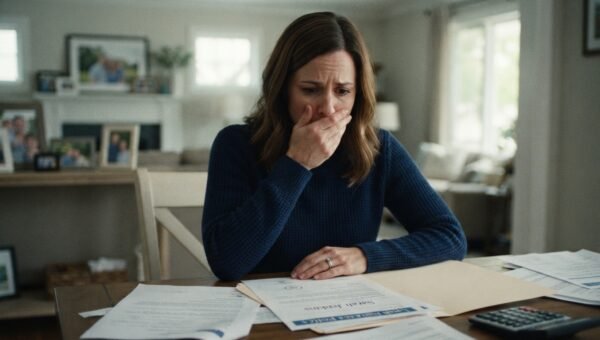
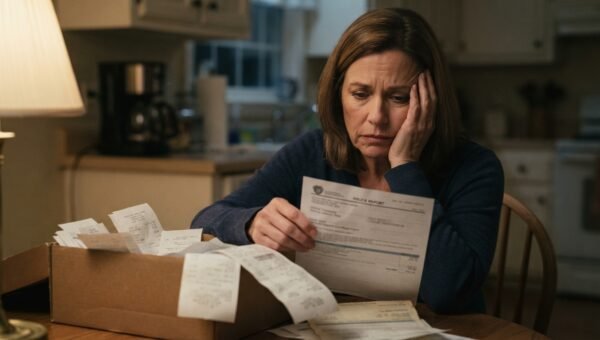
I stood by our kitchen counter for an hour before David got home, staring at that dented pewter rattle.
David had told me about his mother on our third date, five years ago. He kept his voice completely flat that night, the way men do when they talk about a fire that burned their childhood home to the ground. Her name was Eleanor. When David was eight years old, his father took a second job at the lumber yard to save money for a house outside the city. Eleanor had packed two suitcases while David was at school, cleared out their joint account containing $18,400, and vanished on an overnight Greyhound.
His father spent seven years trying to pay off the debts she left behind before his kidneys gave out at fifty-four. David grew up watching his dad work double shifts on broken arches. He had never received a birthday card, a phone call, or a single dime from Eleanor in twenty-four years. As far as David was concerned, Eleanor Miller did not exist.
At five-thirty, the back door clicked open. David dropped his metal lunchbox on the washing machine and kicked off his steel-toed work boots. He works as a maintenance technician for the county water district, and his blue uniform shirts always smelled like chlorine and engine grease.
“Hey,” he called out, wiping his forehead with the back of his arm. “Traffic was backed up all the way from the bridge.”
He walked into the kitchen, smiled at my stomach, and reached for the faucet to wash his hands. That was when he saw the counter.
The pewter rattle was sitting on top of the yellow lined note. The cashier’s check was laid out flat beside it.
David stopped with his hands hovering over the stainless steel sink. The water ran cold over his wrists. He did not ask what it was. His eyes locked onto the dented bowl of that rattle, and his jaw hardened until the muscle jumped under his cheek.
“Where did you get that?” he asked. His voice dropped to a low, quiet rasp.
“A woman gave it to me on the Route 14 bus,” I said gently. “She sat in the seat I offered her. When she got off at 9th Avenue, she put it in my pocket.”
David shut the faucet off. He didn’t dry his hands. He picked up the piece of paper, read the three lines once, and let it drop back onto the counter.
“She tracked you,” he said. His voice wasn’t loud, but it was shaking. “You’re seven months pregnant, and she followed you onto a public bus to test you.”
“David, look at the check,” I said.
“I don’t care about the check,” he snapped, turning his back to the counter. He gripped the edge of the kitchen table with both hands. “My dad had to borrow two thousand dollars from his brother just to bury my grandfather because she cleaned out the vault account in 2002. She let him die thinking he was a failure who couldn’t protect his family. And now she shows up at a bus stop playing games with my wife?”
“She left an address,” I said quietly. “The Lincoln Motel. Room 12.”
“She can stay there until the roof caves in,” David said. He took a heavy breath, picked up the rattle, and threw it into the plastic trash bin under the sink. It landed against an empty coffee can with a dull clatter. “We don’t touch her money, and we don’t open that door.”
PART 3
David didn’t sleep that night. Every time I turned over in bed, I saw the blue light from his phone illuminating the bedroom ceiling. He was looking through his late father’s old probate records, which he had scanned into a digital folder years ago.
By six in the morning, the rattle was back on the kitchen table. David had fished it out of the trash, washed it with dish soap, and set it on a clean dishtowel. Beside it lay an old black-and-white snapshot of a toddler sitting on a porch rug, holding that exact pewter toy.
“Get your coat,” David said quietly when I walked into the kitchen.
“Are we going to the police?” I asked.
“No,” he said. “We’re going to the motel. If she thinks she can drop cash into your coat and buy her way into seeing my kid, I’m going to tell her to her face that it isn’t happening.”
The Lincoln Motel sat behind an abandoned gas station on the industrial side of 4th Street. The gravel lot was full of potholes filled with muddy rainwater. Room 12 was on the ground floor, its beige curtains drawn shut against the morning sun.
David walked up the two concrete steps and knocked hard on the hollow metal door. Three sharp raps.
A deadbolt clicked. The door pulled back four inches, held by a brass security chain. Eleanor looked through the gap. In the morning light, without her headscarf, she looked terribly old. Her hair was thin and dry, and her face was lined with deep gray hollows under her cheekbones.
She looked at David. For five seconds, neither of them said a word.
“You got taller than your father,” she whispered.
“Take the chain off, Eleanor,” David said. His voice was steady, but cold as ice.
She closed the door, unlatched the chain, and opened it wide. The room smelled of rubbing alcohol, stale tea, and old carpet. On the small laminate nightstand sat an open planner, three amber pill bottles, and a thick brown expanding folder stuffed with receipts.
David didn’t step inside. He stayed on the threshold, holding the cashier’s check in his left hand.
“You don’t ambush my wife,” David said. “You don’t follow her onto a bus. And you don’t use four thousand dollars to buy an invitation into my life.”
Eleanor didn’t flinch. She sat down on the edge of the unmade double bed and folded her hands over her knees.
“I didn’t give her the money to buy you,” Eleanor said in a dry, thin voice. “That check is twenty-five percent of what I took from the First National account in August of 2002. Plus interest. The total was eighteen thousand four hundred. With four percent annual simple interest, it comes to thirty-four thousand nine hundred and sixty.”
She pointed a crooked finger toward the brown folder on the nightstand.
“I set up a dedicated escrow account in Portland five years ago,” she continued, looking right into his eyes. “Every month, six hundred dollars went into it from my pension at the laundry facility. It’s all there. The statements, the bank numbers, and the transfer forms. I have stage four renal failure, David. The doctors gave me six months in June.”
David didn’t move. “You think dying makes you innocent?”
“No,” Eleanor said plainly. “I don’t think anything makes me innocent. I left because your father was a proud man who wouldn’t let me work, and I was too weak and selfish to live in that house another day. I took that money because I wanted to start over, and I ruined his life doing it. That is a fact. It will be a fact after I’m dead.”
“Then why come here now?” David asked, his knuckles white around the check.
“Because the state gets the money if there is no designated beneficiary,” Eleanor said. “And I wasn’t going to let eighteen thousand dollars of your father’s hard work sit in an unclaimed property fund in Oregon. I hired an investigator to find your current address. When he told me your wife was expecting, I wanted to see her. I wanted to see if you picked someone like me, or someone like your father.”
She looked at me then, her pale blue eyes completely clear.
“She stood up on swollen feet to give an old woman a seat,” Eleanor said. “You chose your father’s side of the family.”
ENDING
David didn’t yell. He didn’t break down, and he didn’t offer her a hug. The anger didn’t disappear from his face, but the stiff tightness in his shoulders settled into something heavy and sober.
He walked over to the nightstand, picked up the brown folder, and checked the official bank letter inside. It was certified by an Oregon credit union. The escrow balance stood at $30,460, naming David as the sole payable-on-death beneficiary, with the first $4,500 already drawn as the cashier’s check he held in his hand.
“We are keeping the money,” David told her, setting the folder under his arm. “Every single cent of it. My father worked eighty hours a week in the winter mud to earn it, and it belongs to his grandchild’s college fund.”
Eleanor nodded once. Her chin trembled slightly, but she kept her hands folded. “I know.”
“And that’s where this ends,” David added, his voice completely level. “You don’t come to our house. You don’t come to the hospital when the baby is born. You don’t get to be a grandmother because you settled a financial debt on your deathbed.”
Eleanor looked down at her canvas shoes. She swallowed hard, took a shallow breath, and said, “I understand.”
David turned to walk out the door. He took three steps across the gravel, then stopped near the driver’s side of our truck. He looked back at the small, open door of Room 12. Eleanor was still sitting on the edge of the mattress, looking down at the carpet.
David reached into his coat, pulled out the business card for the county hospice center where his uncle had stayed, and walked back to the doorway. He set the card on the small table beside her pill bottles.
“If your clinic appointments get too hard to manage,” David said, looking straight at her, “call that number. Tell them I sent you, and they will arrange transport so you don’t have to ride the city bus.”
He didn’t wait for her to answer. He walked back to the truck, opened my door, helped me into the passenger seat, and climbed behind the wheel.
The $4,500 check went into an educational savings bond the following Monday morning, just as David said it would. Two weeks later, the paperwork for the remaining escrow balance arrived by certified mail, signed and stamped by an estate administrator in Portland.
David never visited the Lincoln Motel again, but once every two weeks, he called the hospice coordinator to make sure Eleanor’s transport van arrived on time for her dialysis treatments. He never stayed on the phone longer than two minutes, and he never asked to speak to her.
The pewter rattle sits on the top shelf of our daughter’s nursery closet, tucked behind the spare blankets and baby books. It isn’t a family heirloom, and it isn’t an apology. It is simply an old piece of metal that marks the exact spot where a twenty-four-year debt was finally paid in full.