PART 1
The man at the commuter station smelled like cedar sawdust and cold coffee. He had gray stubble, deep lines around his mouth, and a faded navy work jacket with the zipper pull replaced by a paperclip.
“Excuse me, ma’am,” he said, clearing his throat. “My battery just gave out, and my train is boarding on track four. Could I borrow your phone for thirty seconds to call my wife? Just to let her know I made the connection.”
I hesitated. I was sixty-two years old, standing alone on the cold platform at five on a Tuesday evening, and everything in me usually said no to strangers. But he looked tired in a way I recognized. He was holding an old flip phone with a cracked hinge that was plainly dead.
“Just a quick call,” I said, unlocking my screen and keeping my fingers near the edge as I handed it over.
“Thank you,” he said. His voice was rough. “I promise.”
He did not look at my photos or open my apps. He dialed ten digits from memory, held the phone to his ear, and waited four rings.
“It’s me,” he said when the line picked up. “I’m on the platform now. I’ll be home by six fifteen.”
He did not wait for a long reply. He pressed the red button, handed the phone back with both hands, and looked straight into my eyes.
His expression was strange. It was not the casual look of a stranger who had just saved four dollars on a payphone. It was heavy, like he had spent twenty minutes working up the nerve to step across the concrete toward me.
“That means more than you know,” he said.
Before I could answer, he turned into the crowd moving toward the stairs for track four.
I stood by the timetable board and wiped the glass screen against my coat. That was when I tapped the green icon to put my phone back in my bag. The text thread at the top of my inbox was unfamiliar. It was sent to a local number with a 412 area code, stamped exactly one minute earlier.
The message was just seven digits: my own phone number.
He had not just made a call. He had opened a blank text, typed my number, and sent it to his own phone before he dialed.
My stomach tightened. I thought about walking over to the transit booth to report it. I thought about calling my brother Greg to ask what a woman was supposed to do when a man stole her number right in front of her. But what would I tell them? A man borrowed my phone, called his wife, sent himself my contact info, and caught the train to Greensburg. It sounded small. It sounded like an accident or an annoyance.
So I went home to my quiet kitchen, put my keys on the counter, and watched television until ten. For three days, every time the screen lit up, my shoulders rose to my ears. When nobody called by Friday, I told myself he had typed his wife’s number wrong in the text box. By the second week, I had stopped thinking about the navy jacket and the paperclip zipper.
Fourteen days later, on a Tuesday night while I was folding laundry on the sofa, the phone buzzed against the coffee table.
The text was from the 412 number.
“My wife is Janet,” it read. “She doesn’t know I took your number.
She won’t ask you for anything, but Greg just put the farm up for sale, and you need to see what she’s kept in our hall closet since 2019.”
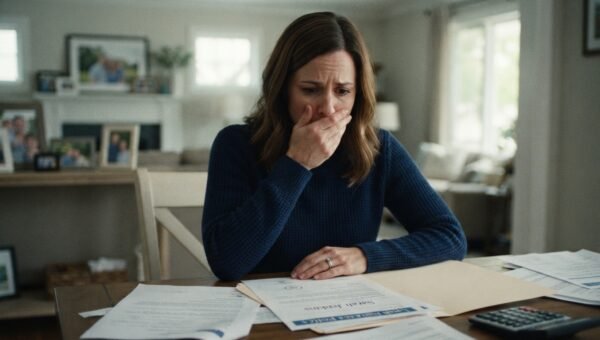
My hands stopped on the corner of a bath towel. Janet was my younger sister. I had not spoken to her in seven years, not since the day my mother was moved into the nursing wing at Oak Ridge and forty-eight thousand dollars vanished from Mom’s savings account.
PART 2
I stared at the screen until the light clicked off.
The last time I saw Janet was in the parking lot outside the county probate office in August of 2019. Greg had stood between us near his truck, his face red, holding a printout of Mom’s checking statement. He told me Janet had cleaned out the farm reserve account right after Mom’s stroke. Janet had not yelled back. She had just looked at me with her mouth open, shaking her head, until Greg told her to leave before he called the sheriff. She got into a rusted red wagon and drove away.
She never answered my letters. Her old phone was disconnected two weeks later. After that, Greg took over everything. He managed the eighty acres of hay and pasture outside Blairsville, paid the care facility bills from the family account, and told me twice a year that Janet was living off Mom’s stolen money somewhere south of Pittsburgh.
Now, a stranger who smelled like sawdust was telling me Greg was selling the land.
I typed back with stiff fingers: “Who are you?”
The reply came three minutes later: “Mark. We’ve been married four years. I saw you at the station because I work maintenance at the lumber yard two blocks from your office. I recognized you from the picture on Janet’s dresser. If you don’t believe me, look up the county deed registry tonight. Parcel 14.”
My heart sat like lead in my chest. I opened my laptop at the kitchen table.
I had not checked the county records in years because Greg was the executor and Mom’s legal guardian before she passed in 2022. I trusted my brother. He was three years older than me, went to church every Sunday, and took care of the tractors. But when I pulled up the Westmoreland County recorder of deeds and typed in Mom’s parcel number, my breath hitched.
The listing was there. It was marked active as of Monday morning. Asking price: $420,000.
Under the owner of record, it did not say the Estate of Clara Miller. It said Gregory Miller, Sole Owner, transferred by quitclaim deed in October 2019.
October 2019 was two months after Greg told me Janet had stolen the reserve fund, and one month before Mom’s dementia reached the point where she could no longer sign her own name.
I didn’t sleep that night. Every time I shut my eyes, I saw Janet standing by that red station wagon with tears on her cheeks, unable to speak while Greg shouted over the hood of his truck.
At seven the next morning, I texted Mark: “Send me the address.”
He sent an address for a small duplex in Derry, forty minutes east.
I took the afternoon off from my bookkeeping job at the hardware supply. When I pulled up to the curb at two o’clock, the yard was neat, with two plastic planters of dead geraniums waiting for spring and an old toolbox sitting on the front porch. Mark opened the storm door before I reached the top step. Up close, in the gray daylight, he looked older than he had at the station.
“She’s in the kitchen,” he said quietly, stepping back. “She still thinks I’m at the yard. Don’t be hard on her, Nora. She carries enough.”
I walked through a narrow hallway that smelled of lemon cleaner and vegetable soup.
Janet was standing at the stove in a gray cardigan, stirring a pot with a wooden spoon. Her brown hair had turned entirely silver at the temples, cut short behind her ears. When she heard my boots on the linoleum, she turned around, thinking it was Mark.
The spoon hit the side of the pot with a dull clatter.
“Nora?” she whispered.
PART 3
Neither of us moved for ten seconds. The refrigerator hummed in the corner.
“What are you doing here?” Janet asked. Her voice cracked on the last word. She looked at Mark, who stood by the kitchen door with his head down. “Mark, what did you do?”
“He borrowed my phone at the station two weeks ago,” I said. My voice was surprisingly steady, though my knees felt hollow. “He told me Greg listed the farm.”
Janet turned off the burner. She leaned both hands against the counter, her shoulders rounded like an old woman’s. “I told him to leave it alone. I told him there was no point.”
“Is it true?” I asked. “About the deed?”
Instead of answering, Janet walked past me into the short hallway. She pulled a low cardboard box out from beneath a row of winter coats. The edges were worn soft with age, held together at the corners with gray duct tape. She brought it back to the laminate table and set it down between two ceramic mugs.
“Look at them yourself,” she said.
Inside were four thick folders, labeled by year from 2017 to 2020.
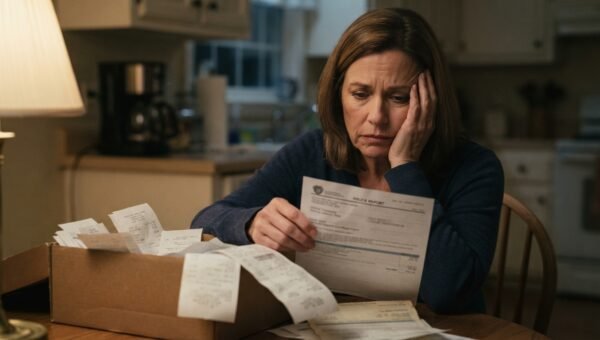
I pulled out the top stack. They were not bank drafts to private accounts. They were monthly carbon copies of certified cashier’s checks made out directly to Oak Ridge Senior Living, each for $1,600. Every single check had Janet’s signature at the bottom, drawn from her personal credit union savings.
“Where is the forty-eight thousand Greg said you took?” I asked.
“There was no forty-eight thousand,” Janet said. Her eyes were dry, but her hands were trembling against her apron. “Mom had nineteen thousand left when her hip gave out. Greg told me the farm was barely clearing taxes and that if we didn’t pay Oak Ridge upfront, they would put a lien on the house. He said he couldn’t afford it. He asked me to use my divorce settlement money to cover her room until he could lease the lower twenty acres.”
I picked up the statements. The withdrawals matched the certified checks to the dollar.
“Then why did you leave the courthouse that day?” I asked. “Why didn’t you show me this?”
“Because you were standing right behind him, Nora,” she said, looking straight at me. “He brought a printout from a joint account he made Mom open six months before she got sick. He told me that if I opened my mouth to you or called a lawyer, he’d file elder exploitation charges against me in Greensburg and drag Mom through a court hearing while she was dying. He said nobody would believe the sister who got divorced and worked part-time over the brother who lived on the home place.”
She wiped the corner of her eye with her thumb.
“I didn’t have money for a lawyer after I paid Oak Ridge,” she added. “My settlement was gone. I was working nights at the bakery. I couldn’t fight him, Nora. And you looked at me like I was a thief.”
That sentence felt like a cold stone sliding into my ribs.
I remembered that August afternoon. I had stood four feet behind Greg. I had held my purse against my stomach and looked down at the gravel because I was too ashamed to look my sister in the face. I had let Greg do all the talking because it was easier to believe one sister had gone bad than to admit the brother I relied on was capable of stealing our mother’s home out from under us.
“He quitclaimed the title to himself two months later,” Mark said from the doorway. “He used a power of attorney he had Mom sign during her first week at the facility. He told the county clerk it was to settle outstanding estate debts.”
I looked down at the carbon slips. Forty-eight thousand dollars was not what Janet had stolen. Forty-eight thousand was roughly what Janet had paid out of her own pocket to keep our mother in a clean room with a window while Greg kept the farm rents.
“Where is the quitclaim copy?” I asked.
Janet pulled a thin manila envelope from the bottom of the box. The notary stamp on the final page was dated October 14, 2019. The notary was Greg’s hunting partner from Latrobe.
I closed the box. I took my phone out of my purse and set it on the table next to the tea mugs.
“Call him,” I said to Janet.
“Nora, no,” she said. “He won’t talk to me.”
“He won’t talk to you,” I said. “He will talk to me. And we are going to his house right now.”
ENDING
Greg’s kitchen still had our mother’s yellow floral wallpaper from 1984.
When we walked through the back porch unannounced, he was sitting at the table with a mug of black coffee and a stack of listing agreements from a real estate office in Ligonier. He stood up fast when he saw Janet behind me, his mouth twisting into the hard, dismissive frown he had used on us since we were children.
“What is she doing on this property?” he snapped, pointing a finger toward the mudroom. “I told you seven years ago, Nora, she isn’t permitted here.”
“Sit down, Greg,” I said.
My voice was not loud. It was the same tone I used when I audited the invoices at work and found twenty bags of gravel billed twice.
I set the duct-taped box in the middle of his paperwork, right over his real estate contract.
“We just came from the county clerk’s office,” I lied. I hadn’t gone to the courthouse yet, but I knew what was in the folders. “I have the cancelled certified checks from Janet’s account to Oak Ridge. I have the bank records showing you stopped making facility payments in July 2019. And I have the transfer deed you had Donald notarize without my signature or a court order.”
Greg looked at the box. He didn’t touch it. The color left his forehead, settling into two dark, blotchy patches under his cheekbones.
“Mom wanted me to have the land,” he said, but his voice was thin. “I did the mowing. I kept the roof on this place.”
“You took forty-eight thousand dollars from your sister’s savings while you let her believe she was going to jail,” I said. “And you took four hundred thousand dollars of family property that was supposed to be divided three ways.”
The room was quiet for a long time. The grandfather clock in the front hall ticked twice, heavy and slow.
“What do you want?” he asked. He looked down at his coffee, avoiding both of us.
“You’re taking the listing down today,” I said. “Tomorrow morning at nine, we are meeting at Miller and Vance in Greensburg. You are going to sign a corrective deed putting all three of our names on the title as tenants in common. And you are going to sign a promissory note from the farm account to repay Janet every dollar she sent to Oak Ridge, plus four percent interest, before any timber or hay money is touched.”
Greg stared at the table. He didn’t argue. He didn’t shout. A man who has spent seven years hiding behind a paper lie knows when the paper has run out.
“All right,” he muttered.
We walked out to my car without another word. The afternoon sun was low over the ridge, catching the bare limbs of the oak trees along the driveway where Janet and I used to wait for the school bus with our lunch pails.
I drove Janet back to the duplex in Derry. When we pulled into the gravel drive, Mark was sitting on the front steps with his work boots unlaced, watching the road.
I put the car in park and kept the motor running.
“I’m sorry,” I said. The words felt small against seven years of silence, but they were the only ones I had. “I should have asked you. I should have looked at the papers myself back then.”
Janet looked at her lap. Her hands were still red from the cold air, her wedding ring catching the dashboard light.
“You were afraid of him too,” she said softly. She reached across the console and laid her fingers over the back of my hand. Her skin was dry and warm. “He had that way about him. Like he owned the ground you were standing on.”
She didn’t tell me it was fine, because it wasn’t fine. We had lost seven years, and our mother had died with only one of us in the room at the end. But she didn’t pull her hand away.
“Come inside,” she said, nodding toward the porch where Mark was standing up. “The soup is still hot.”
I turned the key, took my bag from the floorboard, and followed my sister up the steps.