PART 1
At 7:20 on a rainy Tuesday morning, my neighbor Brenda knocked on my front door with both hands wrapped tight around her coffee mug. She was sixty-eight, lived across the street, and usually kept to herself unless the mail carrier mixed up our packages.
“I didn’t want to alarm you, Joyce,” she said, keeping her voice down as if someone were standing right behind me. “I hesitated to say anything, but I have seen a man walking up to your side door before dawn. He has been coming every morning for months.”
I live alone with my fifteen-year-old daughter, Chloe. Her father died when she was seven, and I work thirty-five hours a week managing accounts for a local lumber yard. My first thought was that Brenda had mistaken the meter reader or a delivery van. I asked what he looked like.
“Tall,” Brenda said, looking past my shoulder toward the dark hallway. “Late thirties. Wearing a dark hooded jacket and work boots. He walks right up the gravel path, and by the time I turn on my kitchen lights at six, he is gone.”
I thanked her, closed the door, and locked both the deadbolt and the chain. My hands felt clammy. Three months earlier, after someone broke into two sheds at the end of our road, I had bought a motion-activated security camera for the side entrance. I had set the alerts to silent because the neighbor’s outdoor cats kept tripping the sensor during my work shifts.
I sat down at the kitchen counter, opened the camera application on my phone, and filtered the history by time, searching between 2:00 and 5:30 in the morning.
Brenda had not imagined it.
On Monday at 3:14 a.m., a man in a navy jacket walked up our side steps, reached into his pocket, took out a silver key, unlocked the door, and walked straight inside. He did not look around. He did not hesitate. At 5:10 a.m., he stepped back out, locked the door behind him, and walked down toward the county road.
I scrolled back three weeks. He was there four nights out of seven. I scrolled back two months. There he was again. Always using a key.
When Chloe came downstairs for school with her backpack slung over one shoulder, I held the phone toward her and hit play on Monday’s recording.
The color dropped from her face. Her backpack slipped off her arm and hit the linoleum floor with a heavy thud.
“Mom, please don’t be angry,” she whispered, backing up until her shoulder touched the doorframe.
I kept my voice quiet because my chest was so tight I could barely draw breath. “Who is that, Chloe? Why does he have a key to our house?”
Chloe stared at the floor tiles for several seconds, twisting the hem of her sleeve. “He told me never to tell you. He said he is my brother.”
PART 2
I stood frozen beside the kitchen island. For eight years, since my husband David died in a highway crash outside Scranton, I believed our family consisted of just the two of us. David and I had been married sixteen years. We had Chloe late, after four miscarriages and thousands of dollars in fertility treatments that nearly drained our savings. David was an only child whose parents passed away before Chloe turned two.
“What did you just say?” I asked.
Chloe began to cry, small and silent, wiping her nose with her sleeve. “His name is Marcus.
He reached out to me on my social media back in November. He sent a photo of Dad holding him when he was a toddler. He had Dad’s old watch, the silver Timex with the scratched glass. He said Dad paid child support for him until he turned eighteen, but kept it secret so our family wouldn’t fall apart.”
“Why was he coming into this house in the middle of the night?” My voice shook, but I tried to stay level. “Why would you let a grown man into our home while we were sleeping?”
“He didn’t want you to throw him out before he could explain,” Chloe sobbed. “He said you hated his mother and that you would never let him near me. He told me he was working the night shift at the distribution warehouse down on Route 9. He said he just wanted to sit in the basement and talk to me, to know his sister. He copied my spare key from my backpack while I was at track practice.”
The sheer violation hit me squarely in the stomach. A stranger had been inside my home while my daughter and I slept upstairs, manipulating a fifteen-year-old girl who desperately missed her father.
“Did he ever touch you?” I asked, my voice dropping so hard that Chloe flinched. “Did he ever go into your bedroom?”
“No,” Chloe said quickly, looking directly into my eyes. “Never, Mom, I swear. We sat on the couch in the basement family room. He asked about Dad. He asked about how Dad was before he died. And then he started asking about Dad’s things.”
“What things?”
“He asked if Dad had papers in the metal lockbox in the attic. He asked about the life insurance Dad left us.” Chloe looked down again, ashamed. “Last week, he told me that half of Dad’s estate belonged to him by law, but that you hid it from probate. He told me that if I helped him find the old bank records, he would take care of me when I went to college.”
I told Chloe to sit at the table and not touch her phone. I took the day off work, called our county sheriff’s department, and reported an unlawful entry and trespassing. But when Deputy Miller arrived forty minutes later, he listened to the story, looked at the footage, and rubbed his chin.
“Ma’am, if your daughter willingly gave him access to her key or knew he was coming, criminal trespassing gets murky, especially if he claims paternity and family access,” Deputy Miller said. “I can write a report and issue a trespass warning if we locate him. But if you want to keep him away legally, you need to file an emergency protective order, and you need to figure out who he actually is.”
I changed the deadbolts on both doors by noon, paying eighty dollars at the hardware store for two heavy commercial locks. Then I went up to the attic.
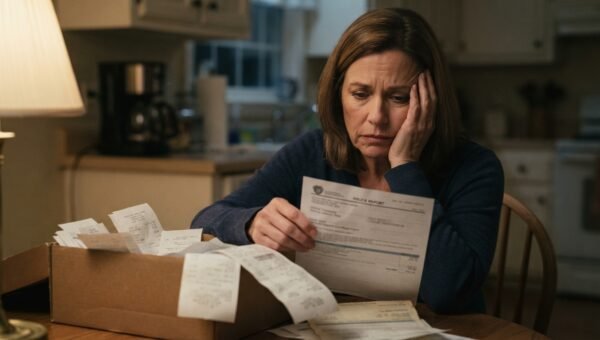
David had kept a green metal filing box tucked behind our old winter coats. I pulled it down into the light of the hallway. Inside were our marriage license, the deed to our modest two-bedroom home, our joint tax returns, and David’s life insurance policy from his union job. There was also an accordion folder marked “Personal 2002-2006,” years before David and I were married.
I untied the cloth string around the folder. The first sheet was a notarized paternity acknowledgment from 2004, listing David as the father of a boy named Marcus Vance, born to a woman named Evelyn Vance. Underneath it was a signed voluntary support agreement: David had agreed to pay $450 every month directly to Evelyn until the child graduated high school.
David had a son. He had a son five years before Chloe was born, and he had carried that secret into his grave.
PART 3
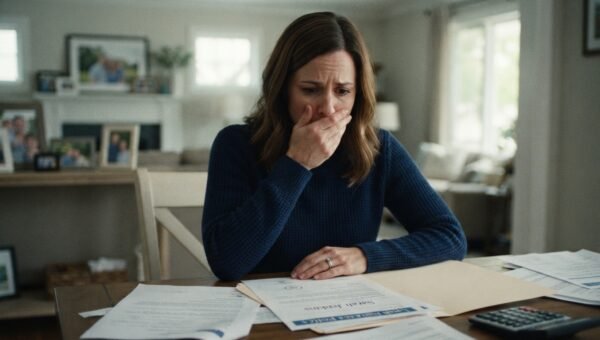
Finding that paper felt like a second death. Sixteen years of marriage, and David had never uttered Evelyn’s name. But as I read through the rest of the folder, the story twisted into something darker.
Tucked into the back of the folder was a court order from Luzerne County dated October 2011. Evelyn Vance had filed for an upward modification of child support, demanding $1,200 a month after David took a promotion. Attached to the filing was a court-ordered genetic test report.
I turned the page and held it under the hall lamp.
The laboratory findings were printed in stark, cold numbers: the probability of David’s paternity was zero percent. David had been completely excluded as the biological father. The judge’s order had terminated the support obligation immediately, though Evelyn was not ordered to repay the money David had already sent over seven years.
David had kept the documents because he had been betrayed, not because he was hiding an ongoing child.
I took the papers down to the kitchen table. Chloe was sitting on the edge of the sofa, watching me with wide, frightened eyes. I laid the genetic report in front of her.
“Read this,” I said gently.
She read it twice, her lips moving over the clinical phrases. “He isn’t Dad’s son?”
“No,” I said. “He never was. Your father believed he was for seven years, and then he found out he had been lied to. This man knows that. His mother was in that courtroom. He knows your father was not his father.”
“Then why was he here?” Chloe whispered. “He told me he loved Dad.”
“He was here because he thought you were fifteen, grieving, and easy to convince,” I said. “He wanted money.”
At 3:30 that night, I did not sleep. Chloe was asleep in my bed with the bedroom door locked. I sat downstairs in the dark living room, wrapped in a blanket, watching the live feed of the side porch on my phone.
At 3:42 a.m., the gravel crunched outside.
A tall figure stepped onto the porch. Through the camera feed, I watched him pull a key from his pocket and slide it into the new deadbolt. It did not turn. He wiggled it, pulled it back slightly, and tried again. Then he knocked, three quick taps, the signal Chloe had admitted they used.
I turned on the exterior floodlights.
The sudden white glare caught him dead center. He was thirty-eight years old, with high cheekbones and hollowed eyes that looked nothing like my late husband. He pulled his dark hood lower, turning his face away from the camera.
I opened the heavy front window two inches, keeping the security latch engaged.
“Marcus,” I called out.
He stopped on the gravel path, his shoulders tensing.
“David was excluded as your father in October of 2011,” I said, my voice carrying clean and cold across the yard. “Judge Keller signed the termination in Luzerne County Court. I have the certified test in my hand, and I have three months of video of you entering this house with a stolen key.”
He didn’t speak. He stood on the path, his hands shoved deep into his jacket pockets.
“The sheriff has the files and the footage,” I told him. “If your car so much as turns onto this road again, I will have you arrested for criminal harassment and trespassing on a minor. Leave my daughter alone.”
Marcus looked toward the window for four or five seconds. There was no grief on his face, no family longing. There was only the flat, ugly annoyance of a man whose con had run out of road. He turned on his heel, walked down the driveway without a word, and disappeared into the darkness toward the highway.
ENDING
The sheriff’s department served Marcus Vance with a formal no-trespass notice at his job two days later. Deputy Miller called to tell me Marcus did not contest it, nor did he ask about Chloe. He simply signed the acknowledgment and took his jacket off the breakroom hook.
The house felt larger and colder over the weeks that followed.
The betrayal I felt toward David did not vanish overnight. He had chosen silence over honesty. He had hidden seven years of checks and a painful court battle because he was likely ashamed of being duped, and his silence had left a door unlocked for someone to take advantage of his teenage daughter years after he was gone.
Chloe spent the rest of the spring in counseling with a woman named Sarah down at the family clinic. We went together twice a month. Chloe had to work through the anger of feeling tricked, and I had to learn how to listen to her without letting my own fear sound like blame. She had not let Marcus in out of rebellion; she had let him in because she wanted a piece of her father that she couldn’t remember on her own.
On a Saturday in late May, Chloe helped me clean out the attic.
We went through the green metal box together. We shredded the old collection notices and the bitter court filings from Evelyn Vance, but we kept David’s high school diploma, his union apprentice card, and the small album of photos from the summer he built our back deck.
Chloe carried David’s scratched Timex watch downstairs and set it on her nightstand beside her lamp.
“It doesn’t keep time anymore,” she said, looking down at the scuffed crystal.
“We can get a new battery for it on Monday,” I told her.
She nodded, pulled her sweater around her shoulders, and for the first time in five months, she closed her bedroom window and locked it herself before coming down to help me start dinner.