PART 1
My daughter-in-law, Brenda, told everyone in our family that having a home aide was an act of mercy. She arranged it through a private agency in town, three days a week, four hours a morning, at ninety dollars a visit.
Every Tuesday, Thursday, and Saturday, a strange woman with a plastic badge would unlock my front door, check my blood pressure, wipe down counters that were already clean, and sit on my good sofa watching game shows.
I paid for it out of my late husband Arthur’s pension. Brenda managed the account online, but the money came directly from my checking.
I resented every single dollar. At sixty-eight years old, I had lived in this house on Maple Street for forty-one years. I gardened, I did my own laundry, and I kept my house tidy. Brenda insisted I needed supervision after Arthur died, telling my son, Kevin, that grief made older women absent-minded. Kevin worked sixty hours a week managing a regional auto parts warehouse. He looked tired down to his bones every time he stopped by, carrying grease under his fingernails and tension in his neck. He wanted so badly to believe Brenda had everything handled so he would not have to carry my life along with his job.
I did not want to add one ounce of trouble to his shoulders. That was why I never told him about the soup.
For eight months, I had been living on clear broth, tea, and warm water. It started in the fall as a dry scrape at the base of my throat whenever I tried to eat crusty bread or dry roast beef. Within two months, scrambled eggs began catching halfway down, sitting like a heavy stone behind my breastbone until I gagged into a dish towel over the kitchen sink. By spring, even cooked oatmeal would not pass.
I bought cartons of beef and chicken stock at the grocery store, heated them on the stove, and sipped them from a heavy ceramic mug. When Kevin came over on Sunday afternoons with pizza or deli sandwiches, I told him my stomach was feeling acidic, or that I had eaten a late lunch before he arrived. I packed away half a sandwich in foil, waited until his truck pulled out of the driveway, and dropped it into the outside garbage can behind the garage so he would never find it.
I had lost twenty-eight pounds since October. My clothes hung on me like sacks, but I wore thick knit cardigans and heavy wool skirts to hide the sunken hollows above my collarbones. I told myself it was an ulcer or just an old woman’s nerves. The truth was, I was terrified of what a doctor might find, and even more terrified of bankrupting Kevin or turning myself into a helpless invalid in his guest bedroom.
Then the agency sent Etta.
The previous two aides had barely looked at me. One spent her entire shift talking on her headset in the hallway; the other read paperback novels at the kitchen table. Etta was different. She was a woman in her late fifties with silver-streaked hair tied in a neat bun, wearing soft blue scrubs and orthopedic walking shoes. She spoke softly, moved without making noise, and had eyes that did not miss anything.
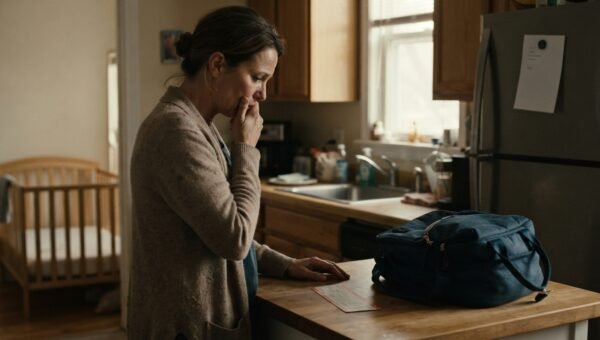
On her first three visits, Etta did not say much, but she watched. She noticed that the box of blueberry muffins Brenda brought over sat untouched on the counter until they grew mold. She noticed that my refrigerator held six cartons of organic bone broth, three bottles of water, and nothing else. She noticed how slowly I stood up from my armchair, my legs shaking with weakness because my body was slowly starving.
On her fourth visit, a chilly Tuesday morning in early May, Etta brought a small plastic container from home.
“I made some vegetable beef soup last night, Clara,” she said, setting it on the kitchen island. “Soft carrots, shredded potatoes, very tender meat. I heated a small bowl for you.”
My chest tightened until it felt hard to breathe. “Oh, thank you, Etta, but my stomach is acting up today. I was just about to have some warm water.”
“Just two spoonfuls,” Etta said gently. She did not sit down. She stood by the stove, leaning against the counter, her dark eyes fixed on my face. “I want to make sure the seasoning is right.”
I did not want to insult her, and I did not want her asking questions. I picked up the metal spoon with a hand that shook slightly. I took the tiniest piece of cooked carrot, barely larger than a pea, with a drop of warm broth. I put it in my mouth, chewed it until it was practically liquid, and swallowed.
It stopped instantly in my esophagus.
A cold panic rushed over my skin. The carrot hung right behind my throat, refusing to slide down. My airway spasmed. I tried to swallow a mouthful of air to push it down, but the blockage was absolute. Pain flared across my chest, sharp and hot, radiating toward my spine.
I coughed, clamping my hand over my mouth. Tears stung my eyes as my body rejected the food, the violent heave forcing the tiny piece of carrot back up into the paper napkin I snatched from the holder. I leaned over the table, panting, my ribs aching, clutching my chest with both hands.
Etta did not gasp. She did not run around in a panic. She walked over, set her clipboard and pen flat on the laminate table, and pulled a chair right up next to mine.
She reached out, took my icy right hand between both of hers, and held it firm.
“Clara,” she said, her voice dropping to a low, quiet level that cut through the silence of the room. “How long have you been hiding that you cannot swallow?”
PART 2
The room seemed to shrink. The ticking of the mantel clock in the living room sounded loud enough to hammer through the walls.
“I just took it down the wrong pipe,” I whispered, trying to pull my hand back. “That is all. My throat was dry.”
Etta did not let go. Her grip was warm, solid, and steady. “Do not do that to me, Clara. And do not do it to yourself. I took care of my older sister for three years when she had a stricture in her throat. You have no food in this house except liquid stock. Your slacks are pinned at the waist with safety pins under your sweater. You have lost weight since I walked through that door two weeks ago. How long?”
The weight that had been pressing down on my chest for eight months suddenly broke open. My shoulders collapsed forward. A tear slipped down my cheek, hot and shameful, splashing onto the faded floral tablecloth.
“Eight months,” I whispered. The words tasted bitter in my mouth. “Since Arthur’s headstone was placed. Just broth. Some days tea.”
“Why haven’t you told your son?” Etta asked. There was no anger in her voice, only a deep, heartbreaking patience.
“Kevin works sixty hours a week,” I cried, the tears coming faster now, washing away months of stubborn pride. “He has an auto loan, his wife wants a new kitchen, and his company is talking about layoffs in the fall. If he knows I am sick, he will try to pay for tests. He will lose sleep. He has enough on his mind without me becoming another bill he cannot afford. Arthur always said a parent’s job is to protect their children, not lean on them until they break.”
“Clara, look at me,” Etta said, squeezing my fingers until I lifted my head to meet her eyes. “This is not picky eating. And this is not grief. Something inside your throat is closing shut. It could be scar tissue, it could be a pouch, it could be something worse. If you keep starving yourself to protect your grown son, you are going to collapse on this linoleum, and he will be the one who finds you dead of dehydration. Is that how you protect him?”
Her words felt like a slap, but they were the cold truth. I looked down at my knuckles, knobby and blue under the pale skin.
Etta stood up. Without asking my permission, she pulled the black landline telephone off the wall mount beside the refrigerator. She walked back over, set the heavy receiver in front of me, and pulled a scrap of paper from her pocket where Kevin’s emergency number was written.
She dialed the ten digits herself. I could hear the line ringing through the earpiece from across the table.
“Etta, please, he is at work,” I begged in a hushed whisper.
“He needs to hear your voice,” Etta said firmly. “Not Brenda’s. Not mine. Yours.”
The line clicked open. “Kevin Miller,” my son’s hurried voice came over the speaker. In the background, I could hear the metallic clatter of forklifts and the echo of the warehouse garage. “Who is this? Is this Mom’s house?”
Etta pushed the receiver directly into my palm. She leaned over my shoulder, her eyes boring into mine, and mouthed the words: *Tell him now.*
My hand trembled so hard the plastic receiver rattled against my ear. “Kevin?”
“Mom? What is wrong? Are you okay? Brenda said you had the aide this morning.”
My breath hitched. I wanted to lie. Every instinct I had spent forty years building—to protect my boy, to keep things smooth, to swallow my own trouble—screamed at me to tell him I had dialed by accident. But Etta kept her warm hand resting firmly on the top of my shoulder, grounding me to the floor.
“Kevin, I am not okay,” I said. My voice broke on the last word, sounding small and cracked. “I have been lying to you. I have not been able to swallow solid food since October. I have been living on broth, and I cannot get bread or water down anymore without choking. I need to see a doctor today. I need your help.”
There was total silence on the other end of the line. The warehouse noise seemed to drop away.
“Mom,” Kevin said. His voice was suddenly thick, stripped of that rushed, business tone he always used. “What did you say?”
“I am sick, Kevin,” I sobbed, the dam completely broken now. “And I am scared.”
“Do not move,” Kevin said, his voice shaking with a terrifying mixture of shock and fury. “I am leaving the warehouse right now. I will be at your house in twelve minutes.”
PART 3
Kevin did not take twelve minutes; he took ten. His truck tires skidded slightly against the curb outside, and he burst through the front door without knocking, his high-visibility work vest still zipped up over his gray company polo shirt.
He stood in the kitchen doorway, breathing hard, his eyes darting between me and Etta. For the first time, he really looked at me. He looked at the hollow skin around my temples, the way my collar stood two inches away from my neck, and the half-empty cup of broth on the counter.
“Mom,” he whispered, crossing the room in three long strides. He dropped to his knees right beside my chair, burying his face against my lap just like he used to do when he was eight years old and had scraped his knee on the sidewalk. “Why didn’t you say something? How could you let yourself get like this?”
“I didn’t want to cost you money,” I wept, smoothing his messy brown hair. “Brenda said things were tight with your mortgage. I thought it would pass.”
Kevin lifted his head, his eyes rimmed in red. “Cost me money? You are my mother! What does money have to do with you starving in your own kitchen?”
Etta stepped forward then, her voice calm and authoritative. “Mr. Miller, my name is Etta. I am the home aide from the county registry. We do not have time for guilt right now. Your mother needs an emergency gastroenterology consult and an endoscopy. Her esophagus is clearly obstructed. If she tries to drink more fluids without medical evaluation, she is at severe risk for pulmonary aspiration.”
Kevin stood up immediately, wiping his face with the back of his work sleeve. “I am taking her to the regional medical center right now.”
“I will help you get her into the truck,” Etta said. “And Clara, take your purse with your insurance card. You are not coming back home until they know what is happening inside your chest.”
The next twenty-four hours were a blur of cold hospital rooms, harsh fluorescent lights, and medical jargon that sounded like a foreign language. The emergency room doctor took one look at my blood panel—severe malnutrition, dangerously low potassium, and dehydration—and admitted me immediately.
Brenda arrived at the hospital two hours later. She smelled of expensive perfume and looked irritated, carrying a large leather handbag.
“Kevin, this is an overreaction,” Brenda said in the hallway outside my room, unaware that her voice carried cleanly through the open door. “She probably has acid reflux. You walked out of your shift during inventory week. If you lose your bonus over this, we cannot cover the deposit on the patio remodel.”
“Shut up, Brenda,” Kevin said.
I had never heard my son speak to his wife in that tone in the twelve years they had been married. It was cold, flat, and final.
“She has lost thirty pounds,” Kevin told her, his voice trembling with contained rage. “She has been choking on broth for eight months while you spent three hundred and sixty dollars a month of her money on an aide so you wouldn’t have to visit her. Don’t say another word about the patio.”
The gastroenterologist, Dr. Vance, performed an upper endoscopy the following morning under twilight sedation. When I woke up in the recovery alcove, Kevin was sitting in the vinyl chair beside my bed, holding my hand.
Dr. Vance pulled the privacy curtain closed and pulled up a rolling stool.
“Clara, we found the problem,” Dr. Vance said, showing us color photographs printed on glossy paper. “You have severe benign esophageal stricture complicated by a condition called achalasia. The lower muscular ring of your esophagus had locked shut and developed heavy scar tissue from untreated reflux. The opening was barely three millimeters wide. A single grain of rice was enough to block it.”
“Is it cancer?” Kevin asked, his voice barely audible.
“The biopsies will take forty-eight hours to confirm, but visually, no. It looks entirely benign,” Dr. Vance said, smiling gently. “We performed a balloon dilation while we were in there. We stretched that narrowed band back open to fifteen millimeters. You are going to stay on IV fluids tonight, and tomorrow morning, we are going to try a clear soft diet.”
I looked at Dr. Vance, then at Kevin. “Stretched it open?”
“You have been starving behind a locked door, Clara,” Dr. Vance said softly. “We just unlocked it.”
ENDING
The next morning, a nurse named Sarah wheeled a breakfast tray into my room. On it sat a small bowl of vanilla pudding, a cup of warm apple juice, and a cup of lukewarm chicken broth.
Kevin was there, having slept in the vinyl recliner in his work clothes. He sat up, his hair sticking out in back, and watched me with wide, anxious eyes.
My hands shook as I picked up the plastic spoon. The memory of choking was so deep, so violent, that my throat tightened in pure terror before the spoon even touched my lips. I scooped up a small dollop of the pudding.
“Go slow, Mom,” Kevin whispered. “Just a tiny bit.”
I placed the pudding on my tongue. It was sweet and cool. I swallowed.
It slipped down.
There was no burning stone in my chest. There was no scrape against my collarbone. There was no violent spasm throwing it back into my mouth. It traveled smoothly all the way down into my stomach, landing like a warm, comforting promise.
I let out a sound that was half laugh and half sob. I took another spoonful, and another, the sweet vanilla filling an emptiness that had gnawed at my bones for nearly a year.
Kevin covered his face with his hands and wept openly in the chair.
The biopsy results came back clear two days later: entirely benign, just as Dr. Vance had suspected. I spent two more days in the hospital receiving vitamin infusions to restore my electrolytes before Kevin brought me home to Maple Street.
Things changed quickly after that.
Kevin took over my banking himself. When he looked through the checking records, he discovered Brenda had been funneling forty dollars extra each week into an online shopping account under the label of “care supplies.” He did not scream or throw things; he simply removed her access to my accounts and took away her key to my house. Brenda stopped coming by, but Kevin started coming three times a week on his lunch breaks, bringing containers of beef stew, chicken dumplings, and warm peach cobbler that he cooked himself on Sunday nights.
We fired the private agency that charged ninety dollars for neglectful companions. Instead, Kevin hired Etta directly as my personal household companion, paying her a fair wage out of my own pension to come by twice a week for tea, grocery trips, and gardening.
Three weeks after the hospital stay, Etta and I sat together at my kitchen table on a bright Tuesday morning. The windows were open, letting in the smell of cut grass and lilac bushes. Between us sat a plate of fresh scrambled eggs with cheddar cheese and warm buttered toast.
I chewed a piece of toast, swallowed it without a second thought, and took a sip of hot coffee.
Etta watched me, a small, knowing smile touching the corners of her mouth.
“Eating well today, Clara?” she asked.
“Better than I have in years,” I told her, reaching across the table to squeeze her hand, this time with strength in my fingers. “Thank you for not minding your own business.”
“Some business is meant to be shared,” Etta said. “Especially when carrying it alone will kill you.”
She was right. I thought I was protecting my family by suffering in silence, but all I was doing was digging my own grave to save them the trouble of digging it for me. It took a stranger with sharp eyes to teach me that love does not mean disappearing until there is nothing left of you. It means being brave enough to sit at the table, hold out your empty bowl, and say you need to be fed.