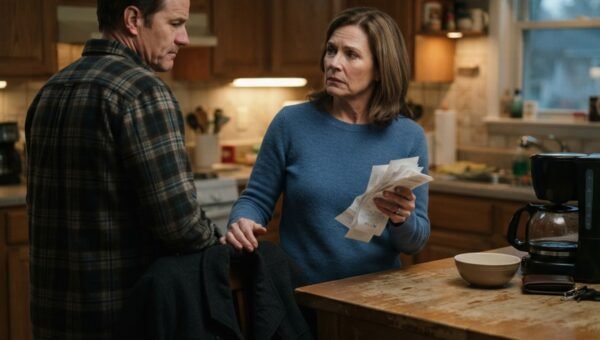
PART 1
My daughter-in-law started mailing my birthday cards back unopened. I didn’t raise my voice. I’d learned a long time ago that arguing too early only gives people time to change their story. I didn’t want one bad moment to become a family war.
Her name is Karen. She married my son, David, seven years ago, and for the most part, we kept a polite distance that worked well enough.
But six months ago, after my grandson Toby turned eight, things went cold. It began with missed Sunday dinners. Then David stopped answering my Tuesday afternoon phone calls. When Toby’s birthday came in August, I mailed a card with a handwritten note and twenty dollars inside.
Ten days later, that same envelope arrived back in my mailbox. A bright yellow postal sticker covered Toby’s name, marked return to sender. The seal hadn’t been broken.
I called Karen that night. David didn’t pick up his mobile, so I tried the house phone.
“We got the envelope back today, Karen,” I said, keeping my tone gentle. “I thought maybe there was a problem with the address.”
“There wasn’t a problem with the address, Evelyn,” Karen said. Her voice was flat and perfectly calm. “The kids are overwhelmed right now. Toby’s room is overflowing, and they need less clutter. We’re cutting down on physical mail, gifts, and distractions. Please respect our boundary.”
“It was just a card for his birthday,” I told her.
“We made our decision,” she said, and then she hung up.
Part of me wanted to pretend I hadn’t noticed the edge in her voice. Once you ask the right question, you can’t always go back to the old version of your family. If David wanted me out of his son’s life, I needed him to tell me himself, but every time I reached out to my son, Karen answered the text or the phone rang until voicemail picked up.
Over the next four months, I sent four more cards. One for Toby’s first week of third grade. One for Halloween. One for Thanksgiving. One for his school honor roll after David’s sister mentioned he made the list.
Every single card came back to my house. Each one had the yellow label over the center.
Then came the fifth card, my little Christmas greeting. When it landed in my metal box at the end of the driveway on a gray Tuesday morning, something felt off. The yellow label was crooked. It looked like it had been peeled back at one corner and pressed down again in a hurry.
I carried it inside to the kitchen counter. I waited until I was alone, poured a cup of coffee, and sat down at the table. On that fifth returned card, I held the envelope up against the kitchen window light.
Beneath the postal label, where the smooth paper showed through the faint glare, there was shaky blue ballpoint print. It was Toby’s handwriting. He had pressed hard into the paper, hard enough that the ink dented the envelope.
He had written three words I was never meant to see:
Don’t stop writing.
PART 2
I set the envelope down on the formica table. The blue ballpoint ink had pressed so hard that Toby’s pencil strokes were visible on the back of the envelope too.
He hadn’t rejected my letters. He had seen at least one of them.
If Toby wrote those words under the label, Karen hadn’t simply dropped the mail back into the outgoing box on the porch. She had brought it inside. Toby had found it, written on it, and Karen had slapped the yellow sticker right over his plea before sending it back. Or Toby had stuck the note under the sticker himself before Karen mailed it. Either way, my grandson knew his mother was sending his grandmother away.
I sat with my coffee until it went cold. My first instinct was to drive thirty minutes across town, march up their front path, and pound on the door. But a loud grandmother on a porch just looks unstable. Karen would use that against me in an instant. She would tell David I had lost control, and David, who hated confrontation more than anything on earth, would retreat behind his wife’s rules.
I needed to know why David was letting this happen.
David was my only son. When his father died twelve years ago, David had taken a semester off college to help me manage the house and sort through the debts. He was a decent boy, but he avoided conflict at all costs. When he married Karen, she took over their schedules, their savings, and their holidays. I had never interfered. I stepped back because I wanted his marriage to work.
That afternoon, I didn’t call Karen. I didn’t text David.
Instead, I drove to the public library where David’s younger cousin, Sarah, worked the circulation desk. Sarah’s mother was my husband’s sister. The family talked, even when they pretended they didn’t.
I found Sarah shelving paperbacks in the back aisle.
“Aunt Evelyn,” she whispered, looking around. “What are you doing here?”
“I need two minutes, Sarah. Not family gossip. Just truth.”
Sarah looked down at the cart of books, her mouth tightening. “If this is about David, I’m not supposed to say anything.”
“Who told you not to say anything?”
“Karen called Mom last month,” Sarah said quietly. “She said you were having memory issues and that you kept sending inappropriate things in the mail to confuse Toby. She said the doctor told you to rest and that David was handling your affairs from a distance.”
A cold weight settled directly behind my ribs.
“Memory issues?” I asked. My voice didn’t waver, but my fingers dug into the strap of my purse. “Sarah, look at me. Do I look confused to you?”
“No,” Sarah said softly. “You look like you always look. But Karen said you promised David eighty thousand dollars from Uncle Ray’s pension to help them put an addition on their house, and then you backed out and told Toby he was selfish.”
“I never promised eighty thousand dollars,” I said. “I don’t have eighty thousand dollars sitting in cash. And I have never, in Toby’s eight years of life, called that child selfish.”
Now the shape of it came into view. It wasn’t about clutter. It wasn’t about overwhelming an eight-year-old with cards.
David and Karen had taken out a bridge loan eight months ago. David had mentioned it in passing at Easter, talking about building a second-floor master suite so Toby could have his own bathroom. Karen had expected me to fund it. When I didn’t offer, she didn’t just ask; she built a wall between my grandson and me, then painted me as unstable so David wouldn’t question why his mother had disappeared from their lives.
I left the library without another word.
When I got home, I walked into my small office. I pulled out my banking records, my estate papers, and the original certified deed to my house. Then I took the fifth returned envelope, placed it inside a clean legal folder, and picked up the phone.
I didn’t call David’s mobile. I called his direct line at the municipal water department where he had worked as an engineer for nine years. He answered on the second ring.
“David Miller,” he said.
“David,” I said. “I am sitting in my kitchen. You have a forty-five-minute lunch break starting at noon tomorrow. You are going to meet me at the diner on Route 4, or I am walking into your office lobby with two police officers and the letter your son hid from you.”
PART 3
The diner booth smelled of burnt coffee and fried onions. The clock over the pie case read five past twelve when David walked through the glass door.
He looked tired. The skin under his eyes was dark, and his jacket was zipped all the way to his chin despite the diner’s radiator clanking against the floorboards. When he saw me sitting in the corner, he hesitated, his shoulders slumping.
He slid into the vinyl seat across from me. He didn’t look at my eyes.
“Mom,” he said, keeping his voice low. “Why are you doing this? Karen said you called Sarah. You can’t be dragging the family into our private disagreements.”
“What private disagreement, David?” I asked.
“You know what,” he muttered. “You promised you’d help us with the contractor. We put down a twelve-thousand-dollar deposit based on what you said at Easter. Then you went completely silent, and Karen said you called her house to tell her Toby was spoiled.”
“Did you hear me say that?”
David paused. “Karen wouldn’t make that up.”
“Did you hear me say it?” I repeated, leaning forward.
“No,” he whispered. “I was at work.”
“And did you see the birthday cards I mailed to your son?”
David shook his head. “Karen told me you stopped sending them because you were angry about the remodel. She said you didn’t even acknowledge his eighth birthday.”
I reached into my canvas bag and pulled out the legal folder. I laid all five envelopes on the table between his coffee cup and the paper napkin dispenser.
Each envelope had my neat script: Toby Miller. Each envelope had the red canceled stamp from the post office. Each envelope had a bright yellow sticker over the address.
David stared at them. He picked up the first one, Toby’s birthday card from August. He felt the weight of the unopened envelope.
“These are returned,” he said, confusion creeping into his voice. “Why didn’t they go through?”
“Because Karen marked them return to sender and put them right back in the slot,” I told him. “She told me you were overwhelmed by clutter. She told Sarah I had dementia and called your son selfish. And she told you I forgot Toby’s birthday.”
David’s hands started to shake. “Mom, Karen wouldn’t…”
“Pick up the fifth one,” I said.
David looked down at the pile. He took the Christmas envelope, the one with the crooked label.
“Hold it toward the diner window,” I said.
David lifted the envelope. The pale afternoon sun cut through the cheap paper. His eyes tracked the blue ink beneath the yellow sticker.
Don’t stop writing.
David didn’t speak for a full minute. The clatter of plates behind the counter seemed very loud. A waitress asked if we needed menus, and David waved her off without looking up.
“That’s Toby’s handwriting,” he said. His voice was cracked, barely louder than a whisper.
“Toby found that card in your recycling bin or on your hall table,” I said. “He knew it came from me. He knew his mother was sending it back. He peeled the corner of that postal sticker, wrote those three words with his school pen, and put it back so I would find it.”
David pressed the heels of his hands into his eyes. “She told me you were slipping, Mom. She told me you forgot where the money was. She said you got hostile on the phone.”
“I have my bank statements right here,” I said, tapping the folder. “I have my phone logs printed from the carrier. I never had eighty thousand dollars in cash, David. You know what your father left me. It pays my property taxes and my supplemental insurance. If you needed help, you should have sat at my table like a grown man and asked me yourself. Instead, you let your wife turn your mother into an enemy so she had an excuse to cut me off.”
“I didn’t know,” he said.
“You didn’t look,” I told him. “There is a difference.”
He sat there with Toby’s handwriting between his fingers, looking smaller than he had in twenty years.
“What do I do?” he asked.
“You take those five envelopes,” I said. “You go home to your house. You sit across from Karen, and you tell her that if she ever comes between me and that boy again, or tells another relative I am losing my mind, I will file for grandparent visitation rights in county court. And you will tell Toby that his grandmother never stopped writing.”
ENDING
David didn’t go back to work that afternoon. He drove straight home.
I didn’t call him to ask what happened. I drove back to my house, hung my coat in the hall closet, and made myself a fresh pot of tea. The silence in the kitchen felt different now. It wasn’t the silence of waiting for bad news; it was the quiet that comes after a fence has been set back on its posts.
Two nights later, my front doorbell rang.
I opened the door to find David standing on the porch. Beside him stood Toby, bundled in his heavy navy blue winter coat, holding a brown paper grocery bag. Karen’s car wasn’t in the driveway; David had driven his work truck.
“Go on, buddy,” David said gently, his hand on Toby’s shoulder.
Toby stepped into my foyer. He didn’t say anything about clutter or cards. He reached into the brown bag and pulled out a shoe box.
Inside the box were seven cards. They were the ones I had sent over the past two years, smoothed out, the envelopes slit neatly at the top with a kitchen knife. On the bottom of the box was the crisp twenty-dollar bill I had mailed him in August.
“Mom kept them in her closet,” Toby said, looking up at me. “Dad made her give them back.”
I knelt down on the hardwood floor until I was eye-level with my grandson. I didn’t cry. Crying would have made him feel responsible for the mess the adults had made, and none of this belonged to him.
“You’re a good boy, Toby,” I said, pulling him into a hug. “And your handwriting is getting very neat.”
“I knew you’d see it,” he whispered into my neck.
Karen didn’t come to my house for Christmas. David brought Toby over for two hours on Christmas Eve, and we baked the sugar cookies with the red sprinkles, just like we did before the remodel started. David sat at my kitchen table, quiet and watchful, like a man who was learning the floor plan of his own marriage all over again.
Karen sent me a text on New Year’s Day. It was two sentences: I am sorry for how things were handled. We are working on our communication.
I didn’t reply to the text. Some apologies are just paperwork.
Instead, I bought a fresh box of stationary from the drugstore on Route 4. Every other Thursday, I sit down at the kitchen table, address an envelope to Toby in blue ink, and walk it down to the metal box at the end of the driveway. I don’t put money inside. I just tell him about the birds on the feeder, the books I’m reading, and how much he is loved.
And every single letter stays right where it belongs.