PART 1
My brother skipped our mother’s last Christmas, but three weeks after her funeral, he showed up at her front door with empty cardboard boxes.
His name is Greg. He had not answered Mom’s phone calls throughout that final December. Mom sat in her floral armchair by the window, watching the street every afternoon until it turned dark. She kept an extra plate warmed on the stove until nine that night, convinced he had simply hit holiday traffic on the highway from Charlotte.
He never came. He did not call until three days later, saying his wife, Brenda, had booked a ski trip with her side of the family and his cell phone battery had died in the mountains.
Mom never yelled at him. She just set that warmed plate into the refrigerator without saying a word.
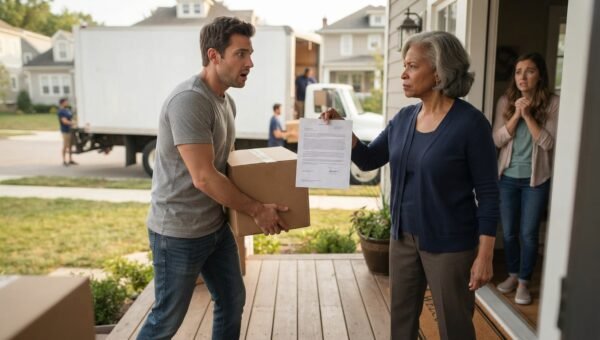
Now, Mom was gone, and Greg stood on the hardwood floor of the dining room with a roll of brown packing tape tucked under his arm.
“Brenda wants the Franciscan Apple pattern dishes,” he said. He did not ask how I was doing. He did not mention the unpaid utility bill on the kitchen counter or the hospice nurse who had stayed past midnight holding Mom’s hand while I called his phone and got his voicemail.
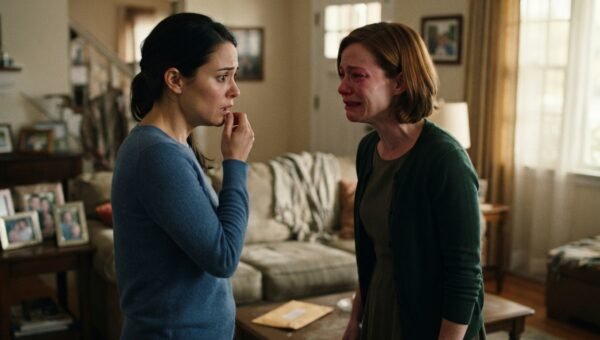
“Those dishes belong in this house,” I said. “We haven’t even finished going through her clothes yet.”
“Brenda’s having an Easter dinner for twenty people in April,” Greg said.
His voice had that flat, practical tone he used whenever he wanted to treat other people’s feelings like an inconvenience. “Mom always wanted us to share. She told Brenda three summers ago that she loved seeing a young hostess keep traditions alive. You don’t entertain, Sarah. You have paper plates in your pantry right now.”
That stung, mostly because it was partially true. I lived alone in a small garden apartment two miles away, and I rarely cooked big dinners. But I had spent every Sunday of the last four years sitting at Mom’s oval maple table, washing those exact heavy plates by hand in lukewarm suds because the green leaf trim came off in the dishwasher.
“I am not handing them over today, Greg,” I told him.
“Look, I brought the boxes,” he answered. He set two heavy-duty corrugated cartons on the rug. “Brenda already cleared a shelf in our buffet.
If you want to be petty about a holiday from two months ago, that is on your conscience. Mom wouldn’t want you holding grudges.”
He started opening the glass cabinet doors.
That was when I noticed the gravy boat. It sat on the second shelf, right beside the covered butter dish. It had a tiny strip of yellowed masking tape folded tightly along the hollow base underneath. Mom used masking tape for everything, but she never labeled good dishes unless she had taken them to a church potluck.
And Mom had never, in seventy-four years, taken her grandmother’s china out of this house.
“Leave the boxes,” I told Greg. My hands were shaking, but my voice stayed steady. “If you touch that cabinet today, I will call our probate lawyer before you reach your car. Mom named me executor. I will pack them myself, item by item, so nothing gets chipped. Come back Saturday morning.”
Greg stared at me for five long seconds. He checked his watch, shrugged, and dropped the roll of tape on the table.
“Fine. Saturday at ten. Make sure you wrap the serving platters in bubble wrap. Brenda will notice if there is a scratch.”
The screen door slammed behind him. I locked the front deadbolt, walked straight back into the dining room, and lifted the gravy boat off the shelf.
PART 2
The tape under the base of the gravy boat was brittle. It had been pressed so tightly into the recessed rim that I had to use the edge of a butter knife to pry up one corner.
Beneath the tape was not a yard sale price or an inventory number. It was a slip of blue-lined ledger paper from Mom’s household grocery pad, folded into a tight square no bigger than a postage stamp.
I sat down in Mom’s chair and smoothed the paper flat against my knee.
The writing was in Mom’s sharp, slanted ballpoint script. The date in the upper corner was from four years earlier, the weekend after Greg and Brenda had moved into their four-bedroom house in the suburbs.
“Brenda told me today that this set would look wonderful in her dining room as soon as I am moved into assisted living. She said an old woman has no need for eight place settings. Under no circumstances is Brenda to ever receive this china.”
My stomach knotted up. I sat there in the quiet dining room, listening to the hum of the refrigerator in the other room.
Four years ago, Mom had still been driving her own Buick to the supermarket. She had been tending her tomato plants in the backyard. She had not needed assisted living, but Greg and Brenda had spent that entire summer dropping brochures on her coffee table, talking about stairs being dangerous and yards being too much work. Mom had stayed in her house until the final three weeks of her life, and I had been the one sleeping on the folding cot in her parlor to keep her there.
I went to the cabinet and took out every single piece.
I took out the twelve dinner plates, the bread bowls, the teacups, and the rimmed soup dishes. I checked the bottoms of all of them. Most were clean white porcelain stamped with the factory mark. But under the large turkey platter, tucked inside an old seed envelope taped flat against the unglazed ring, was a second note.
This one was dated December 26th of that winter. Just two months ago. The handwriting was shaky and uneven, written in the faint purple ink of the pen the hospice nurse had left on the bedside stand.
“Greg called from the ski lodge,” the note said. “He told me he could not drive two hours in the snow just to watch me sleep. He asked if I had already packed the china for Brenda.”
Mom had written only one line below that:
“He broke my heart for the last time. Sarah gets the dishes, the silver, and the memories. If he asks, tell him I gave them away while I could still speak.”
I read those two sentences three times until the words burned into my head.
I didn’t cry. The time for crying had passed during those long nights when Greg’s phone kept ringing through to voicemail. What settled into my chest was a cold, absolute certainty.
I went out to the garage, brought back four sturdy plastic storage bins from my own apartment, and spent Friday evening wrapping every single plate, cup, saucer, and serving dish in thick quilted dish towels. I packed them carefully, carried them to my car in the dark, and drove them to my apartment.
By Saturday morning at nine, the glass display cabinet in Mom’s dining room stood completely empty.
PART 3
Greg pulled into the driveway at exactly ten o’clock.
He didn’t come alone. Brenda was in the passenger seat of their SUV, wearing sunglasses and holding a cardboard tray with two iced coffees. She didn’t get out of the car. She just lowered her window and tapped her fingers on the steering wheel while Greg walked up the porch steps carrying two more empty storage totes.
“Morning,” he said, stepping into the hallway. “You got everything boxed up? Brenda wants to get home before noon to start setting the table for Easter pictures.”
“I have everything handled,” I said.
He walked into the dining room, expecting to see his taped cardboard boxes stacked by the table. Instead, he saw the empty cabinet. The glass doors were wide open. The bare wooden shelves showed only the dust rings where the dishes had rested for thirty years.
Greg turned around, his eyebrows pulled together. “Where are they? Did you leave them in the garage?”
“They aren’t in the garage,” I said.
“Sarah, I don’t have time for games. Brenda took time out of her Saturday to come help me load. Where did you put them?”
“I took them to my apartment last night,” I replied.
His face flushed dark red. “We had an agreement. Mom told Brenda three years ago that she wanted her to have them. Mom always said things should be shared in this family. You are being deliberately spiteful because I missed one Christmas dinner.”
“It wasn’t one dinner, Greg,” I said. “And Mom didn’t say she wanted Brenda to have them.”
“Brenda was there! She heard her say it!”
I reached into my cardigan pocket and pulled out the two small pieces of paper. I had slipped them into a clear plastic sandwich bag so they wouldn’t tear. I held them out to him.
“What is this?” he asked, not taking them.
“That’s Mom’s handwriting,” I said. “The first one was taped under the gravy boat four years ago, after Brenda told her she ought to give up her house and move into a home. The second one was taped under the turkey platter on the morning of December 26th. Right after you called her from the ski lodge.”
Greg’s jaw tightened. He snatched the plastic bag from my fingers.
I stood there in the center of our mother’s dining room and watched his eyes scan the blue-lined paper. He read the older note first. His mouth twitched, but he didn’t say a word. Then he opened the folded seed envelope and read the shaky purple ink from December.
His hand dropped to his side.
Outside, Brenda tapped the car horn twice, a short, impatient double-tap.
“She… she was confused at the end,” Greg mumbled, looking at the floorboards. “She was on strong medication, Sarah. You know she wasn’t thinking straight in December. She didn’t mean this.”
“She meant it four years ago, too,” I said. “Her mind was completely clear four years ago when Brenda measured the buffet while Mom was making iced tea in the kitchen. And her mind was clear enough on December 26th to know you only called her to see if her dishes were ready for pickup.”
Greg swallowed hard. He looked at the two slips of paper, then tried to slide them into his coat pocket.
“Give those back,” I said. My voice was very quiet, but he stopped instantly. “Those belong to the estate. Just like the china.”
He looked at me, then at the empty cabinet. He didn’t have a comeback. There was no lawyer he could call, no family lie he could hide behind, and no way to pretend Mom had loved Brenda’s hosting more than her own dignity.
He handed the bag back to me without meeting my eyes.
ENDING
Greg walked down the front steps with his head down, carrying the two empty plastic totes he had brought in.
I stood on the porch and watched through the windshield of the SUV as Brenda started talking the second he opened the car door. She was gesturing toward the house, her mouth moving fast and angry, asking where the boxes were. Greg didn’t look at her. He threw the empty totes into the trunk, slammed the lid, got into the passenger seat, and stared straight through the glass at the road ahead.
They backed out of the driveway and turned down the road. They did not wave. They did not come back.
I went back inside and locked the deadbolt.
The house felt larger without the furniture crowded with old expectations. I spent the rest of that afternoon wiping down Mom’s empty maple shelves with a damp cloth, taking my time with each corner until the wood was clean and dry.
I still live in my small apartment, but the Franciscan Apple dishes are no longer packed in bins. They are stacked neatly in the two high cabinets above my stove.
On Sunday evenings, I don’t use paper plates anymore. I take down one heavy dinner plate with the painted green apple leaves on the rim. I heat up a simple meal, sit at my small kitchen table, and eat off Mom’s good china.
The gravy boat sits right in the center of the shelf above my sink, catching the late afternoon sun. The yellow tape is gone, but the porcelain is completely whole.