PART 1
My brother had our father sign a new will two days after Dad came home from anesthesia. I almost let it go. There was more history behind it than anyone at the table seemed to remember, and after three weeks of hospital shifts and sleeping in waiting room chairs, I was tired enough to believe anything that sounded easy.
Dad had undergone hip surgery following a bad fall in his kitchen.
At seventy-eight, the recovery took more out of him than the doctors had warned us about. He came back to the split-level house on Maple Avenue with a walker, three new prescriptions, and a fog over his eyes that lifted only in short bursts. Most afternoons, he sat in his recliner with an unread newspaper in his lap, asking what day it was every twenty minutes.
My brother, Dennis, arrived on a Thursday morning carrying a blue folder. He set it right beside Dad’s water glass at the dining room table.
“It’s just administrative,” Dennis told me, keeping his voice light and practical. “Dad asked me to update the addresses on the family trust and the deed paperwork. The lawyer said we needed a clean document with the current parcel numbers, otherwise probate will take eighteen months if anything happens.”
I looked at the cover sheet. It had the firm’s letterhead at the top, but the staple was crooked, and Dennis had already marked the signature lines with small yellow sticky tabs.
“Did you talk to Mr. Henderson?” I asked. Mr. Henderson had handled our parents’ affairs since our mother passed away six years ago.
“Henderson retired in August,” Dennis said smoothly. He tapped the paper with the back of his knuckles. “This came from an associate who took over his desk. Look, Dad knew exactly what he was doing when we talked about it last week. You don’t need to make every single form an argument, Sarah.”
Dad was sitting across from us in his gray cardigan, his fingers trembling slightly around a mug of lukewarm tea. When Dennis set the pen in his hand, Dad looked down at the blue ink line, blinked twice, and looked up at me.
“Do I sign here, Dennis?” Dad asked. His voice was thin and dry.
“Right on the line, Dad,” Dennis said, guiding his wrist down gently. “Just like we talked about.”
I stood there in the doorway between the kitchen and the dining room, holding a roll of paper towels.
I wanted to believe Dennis. He had a wife, two teenage daughters, and a mortgage on a house forty miles north that he was always complaining about. He had never been cruel to Dad, only distant, the kind of son who showed up on holidays with expensive wine but never stayed to clean the gutters. Taking care of paperwork felt like his way of contributing while I handled the doctor visits and the grocery runs.
Dad signed. The handwriting was shaky, dragging along the bottom edge of the paper, nothing like the firm, slanted script he used when he worked thirty years at the county water authority.
Dennis closed the folder immediately, slid it into his briefcase, and stood up before I could read the middle pages. He kissed Dad on the forehead, told me he had an afternoon meeting in Lansing, and was out the front door in under ten minutes.
It was only later that evening, while Dad was sleeping in the back bedroom, that I noticed Dennis had left a photocopy of the execution page on the credenza by the coats. It had probably slipped out when he gathered his papers.
I picked it up. Dad’s signature was there, ragged and faint. Below it were two witness lines. One was signed by a notary from Dennis’s bank branch in Grand Rapids. The second signature belonged to Rosa Mendez.
Rosa was the home-health aide who came three mornings a week to help Dad bathe, check his vitals, and fix him a hot lunch.
I stared at her name on the line. Rosa’s handwriting was neat, slightly tilted, written with a fine black gel pen. The date stamped next to her signature was Thursday, October 12th at 10:30 AM.
I stopped arguing with myself and checked the kitchen calendar on the refrigerator door.
Rosa had not been in the house on Thursday morning. Her agency had called on Wednesday afternoon to reschedule her shift because she had a mandatory training session across town. On Thursday morning, it had been just me and Dad in the house until Dennis pulled his car into the driveway at eleven.
I didn’t challenge Dennis right away. I knew how he would answer: he would tell me Rosa must have signed it beforehand, or that she stopped by while I was in the basement doing laundry, or that I was being paranoid because I was exhausted.
I took a photograph of the page with my phone and placed the paper back on the credenza.
For four days, I watched Dad slowly regain his footing. His mind cleared a little. By Tuesday, he remembered that his lawn mower needed a new belt, and he complained about the lack of salt in his soup. Everything seemed normal on the surface.
Then on Wednesday afternoon, my phone rang while I was sitting in the pharmacy parking lot waiting for Dad’s refill.
The screen showed Rosa’s mobile number.
I answered, expecting her to confirm her hours for the rest of the week.
“Sarah?” Rosa said. Her voice was unusually quiet. “Are you alone right now?”
“I’m in my car,” I said. “Is everything all right with Dad?”
“Your dad is fine,” she said. She paused, and I could hear the faint sound of traffic behind her. “I’m calling because I received a packet in the mail this morning from a county probate office in Kent County. It had a copy of your father’s new will attached to an affidavit request.”
My chest tightened. “What kind of affidavit?”
“They asked me to confirm my address and return a certified statement as a witness,” Rosa said, her voice shaking slightly with frustration. “Sarah, I have never signed that page in my life. I wasn’t even in your father’s town that day, and I need to know why my legal name and my certification number are on a legal document.”
PART 2
Rosa stayed on the line while I sat with the engine idling in the pharmacy lot. She explained that home-health workers registered with the state registry have a unique professional tracking number. Whoever filled out that witness line had copied her full legal name, including her middle initial, and had written her agency identification digits directly under the date.
“I called my agency director the second I opened the mail,” Rosa told me. “She told me to call you first before filing an official fraud report with the state board. If my name gets tied to a falsified estate document, I lose my license. I have three kids to feed, Sarah.”
“I know,” I told her. “I’m looking at a photo of the signature right now. It looks like it was written in your usual pen.”
There was a short silence on the line. Then Rosa said something that made the hair on my arms stand up. “Two weeks ago, before your dad’s surgery, your brother Dennis came by while I was finishing my shift. He brought a box of pastries. He asked if I could sign a state Medicaid caregiver verification log so he could submit it for tax deductions. He handed me a clipboard with three yellow sticky tabs.”
She had signed where he pointed, trusting that an adult son was handling his father’s medical accounting.
Dennis had not forged her signature with a pen in Dad’s kitchen. He had harvested her real signature on an intake form, trimmed it, and photocopied it onto the final page of a newly drafted estate plan.
I drove back to Maple Avenue with Dad’s pills in my purse. When I walked in, Dad was sitting in his chair watching an old baseball replay. He looked smaller than he used to, his ankles still swollen from the bed rest.
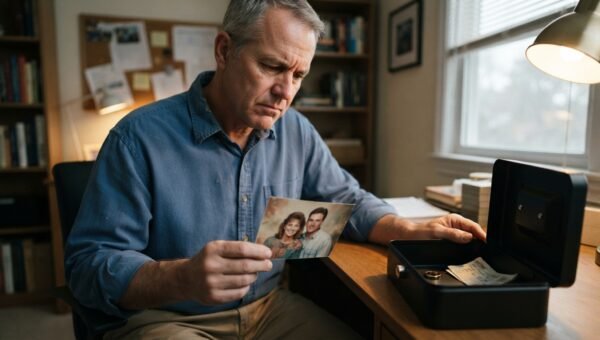
I walked into Dad’s home office, a small room off the back porch that had smelled like pipe tobacco and printer paper for thirty years. I opened the bottom drawer of his green metal filing cabinet where he kept his original blue legal folders.
The original will, drafted by Mr. Henderson four years earlier, was still in its sleeve. Under that agreement, the house on Maple Avenue and Dad’s remaining $140,000 retirement account were divided straight down the middle between Dennis and me. Dennis had already received forty thousand dollars six years earlier as an early advance toward his share when his business hit a rough patch, a detail Dad had noted carefully in pencil on the margin of the inventory sheet.
I pulled Dennis’s copy off the credenza and compared the two.
Dennis had not merely updated addresses. In the new document, the entire house, valued at roughly $280,000, was deeded directly to Dennis upon Dad’s passing, along with sole executorship. The remaining cash was left to me, minus an itemized deduction for “reimbursement of historical family loans” totaling $40,000.
Dennis had rewritten Dad’s life so that he walked away with the house, erased his own past debt, and left me with whatever crumbs remained after funeral expenses.
I picked up my phone and called Dennis at his office.
“Hey, Sarah,” he said, speaking in his hurried business tone. “I’m between calls. Dad doing okay?”
“Dad is doing better,” I said. “Rosa just called me.”
Dennis went completely quiet. The background noise of papers rustling on his desk stopped.
“What did she want?” he asked, his tone dropping several degrees.
“She wanted to know why her signature is on a will she never saw,” I said. “She has the probate verification packet from Kent County sitting on her kitchen table.”
Dennis didn’t panic. That was the hardest part to take. He let out a long, irritated sigh, the exact sound he used to make when we were teenagers and I caught him taking money from my baby-sitting jar.
“Look, Sarah,” Dennis said. “You don’t understand the financial situation. Dad’s house needs eighty thousand dollars in structural work that you can’t afford to maintain. I’m taking the burden off your shoulders. The lawyer told me as long as Dad signed it himself, the witness technicality is just an administrative formality. Nobody was trying to hurt you.”
“You tricked an hourly aide into risking her license,” I said. “And you stood over Dad while he was still slurring his words from anesthesia.”
“Dad knew what he was signing,” Dennis snapped. “He wanted me to have the house. He always told me that.”
“He told you that thirty years ago before Mom died,” I said. “Not last Thursday.”
“If you make a scene out of this, you’re going to tear this whole family apart,” Dennis said. “Think about Dad. You think his heart can take a legal fight right now?”
He hung up.
I stood in the office holding the receiver. My hands were shaking, not from fear, but from the cold realization of how long Dennis had been planning this. He had calculated that Dad was too weak to remember, that Rosa would simply sign any form the court sent her, and that I would be too polite and exhausted to read past the first page.
PART 3
The next morning, I took Dad to his follow-up appointment with Dr. Miller. On the way home, instead of turning toward Maple Avenue, I pulled into the small brick office park near the town square.
Mr. Henderson had indeed retired, but his former partner, Eleanor Vance, had taken over the firm’s probate practice. I had called her office early that morning from my car.
Dad walked slowly into the conference room with his walker, his eyes darting around the framed diplomas on the wall. Eleanor was a woman in her late fifties with sharp gray eyes and a calm, quiet manner. She offered Dad a glass of water and waited until he had settled comfortably into the leather armchair.
“Arthur,” Eleanor said gently, leaning forward. “Do you remember signing a new will last Thursday at your dining room table?”
Dad frowned. He rubbed his thumb over the gold band on his left hand. “Dennis brought some papers. He said it was for the property taxes or the county assessment. Something about the water hookup.”
“Did you intend to leave your home entirely to Dennis?” she asked.
Dad stopped rubbing his ring. He looked directly at Eleanor, then turned his head slowly to look at me. His expression was clear, without a trace of the fog that had dulled him right after the hospital.
“No,” Dad said firmly. “The house belongs to both of them. Their mother made me promise that before she went into hospice. Fifty-fifty. Always fifty-fifty.”
Eleanor nodded once. She slid a fresh, clean document across the table. It was a formal revocation of any document executed on October 12th, along with an updated durable power of attorney naming me as primary healthcare and financial agent, with Eleanor’s firm acting as independent estate executor.
“Arthur,” Eleanor said. “We are going to sign this today with two of my paralegals present as sworn witnesses. Nobody will ever question where your mind was.”
Dad signed his name. His hand still shook a bit, but the letters were deliberate and clear.
When we walked out into the lobby, Rosa was sitting in one of the waiting chairs. Eleanor had asked her to come in to sign a sworn affidavit describing how Dennis had obtained her signature under false pretenses. Rosa had her husband with her, a quiet man in work boots who held her purse while she signed.
When Rosa finished, she looked up at Dad. “I’m sorry, Mr. Arthur. I didn’t know.”
Dad took her hand between both of his palms. “You didn’t do anything wrong, Rosa. Thank you for looking out for my girl.”
By Friday afternoon, Eleanor had filed the revocation and the affidavit with the probate court, along with a formal notice to Dennis that his drafted will was null and void due to lack of proper execution and improper witness procurement. A copy was sent to Dennis’s personal email and his office by certified courier.
Dennis called my cell phone six times between five and seven that evening. I didn’t pick up.
At seven-thirty, a loud knock rattled the front door.
I left Dad in the living room and stepped onto the front porch, closing the door firmly behind me. Dennis was standing on the top step under the porch light, his tie undone, his face red from the cold October wind.
“Are you happy now?” he said, his voice raw. “You hired a lawyer behind my back? You dragged Dad into an office when he can barely walk?”
“Dad walked in on his own feet, Dennis,” I said. “And he spoke for himself.”
“You humiliated me,” he said, stepping closer. “That firm called my office to confirm the delivery. My partners asked what kind of legal mess I was involved in. Do you have any idea what that does to my reputation?”
“You forged a certified nurse’s witness line,” I told him, looking him straight in the eyes. “You sat at our father’s table while he couldn’t remember what day it was and pointed his hand where you wanted it to go. Your reputation is not my responsibility.”
“I was going to pay you your share of the cash!” Dennis shouted, though he lowered his voice when he glanced at the curtained living room window. “I needed the equity in the house to bridge a loan. I was going to pay the estate back in five years.”
“You weren’t going to pay back anything,” I said. “You subtracted your old forty-thousand-dollar debt from my inheritance on page four. I read every line, Dennis.”
Dennis looked at me, his mouth slightly open. For the first time since we were children, he had no quick answer. His shoulders slumped, and he looked down at the concrete steps.
“I needed the money, Sarah,” he whispered. “The mortgage is two months behind. If I lost the house up north, Karen would leave me.”
“Then you should have asked for help,” I said. “Like an honest man. Not stolen from your father while he was recovering from surgery.”
ENDING
Dennis did not come inside that night. He walked down the porch steps, got into his car, and drove away into the dark.
Over the next few months, the split-level house on Maple Avenue grew quiet. Dad finished his physical therapy in December, trading his walker for a wooden cane that had belonged to his grandfather. His memory stayed solid, though he tired more easily in the evenings.
Eleanor’s firm handled all the estate correspondence. Dennis was removed entirely from any administrative authority over Dad’s accounts. When the family gathered for Thanksgiving, Dennis did not show up. Karen sent a brief text saying the girls had school projects, and we left it at that.
In March, Dad decided on his own to put the house up for sale. He told me he didn’t need four bedrooms and a large yard anymore, and that he wanted to move into an assisted living apartment near the lake where several of his old church friends lived.
We spent two weeks packing boxes. I found old tax returns, photo albums with faded corners, and boxes of Mom’s old canning jars in the fruit cellar.
On our last afternoon in the house, Dad sat on an upturned milk crate by the kitchen counter while I wiped down the shelves. He held a small, weathered leather notebook where he had kept household expenses since 1974.
He flipped to the back page and showed me a line written in his own steady hand from ten years ago: *Dennis loan for business – $40,000.*
Underneath it, Dad took out a pencil from his shirt pocket, drew a single line through the entry, and wrote: *Forgiven. Closed.*
He closed the notebook and placed it in the box marked for donation.
“Don’t hold on to it, Sarah,” Dad said quietly, looking out the kitchen window at the bare maple trees in the yard. “Bitterness is too heavy to carry into a smaller house.”
Dennis calls Dad once a month now. The conversations are short, mostly about the weather and the grandchildren’s soccer games. Dad answers every time, listens patiently, and tells him to be safe on the road. Dennis has never apologized to me, and we have spoken only three times in two years, always at a distance during family funerals.
The proceeds from the house sale sit safely in a trust that pays for Dad’s two-room apartment, his dining service, and the small garden plot he tends every morning.
Every Tuesday, Rosa still stops by to check on him. She isn’t his assigned nurse anymore, but she brings her youngest daughter to visit, and Dad always keeps two peppermint candies waiting in his pocket for the little girl. Some things in a family cannot be mended back to what they were, but sitting beside Dad in the afternoon sun, watching him teach a seven-year-old how to tell time from the shadows on the porch, I know we kept what mattered most.