PART 1
My mother stood in the hallway with both hands flat against the painted wood of my old bedroom door. Behind her, on the rug where I used to sit to tie my school shoes, my sister’s golden lab lay stretched out across a fleece dog bed. The dog had two water bowls, a basket of chew ropes, and a fan humming in the corner.
“Chloe needs a quiet space,” my mother told me. “The thunder bothers her, and Brenda cannot keep her in that fourth-floor walkup during the day. You are an adult. Figure it out.”
I had two suitcases in the trunk of my car and a cardboard box of legal papers on the back seat. My marriage of nineteen years had ended four days earlier when the final decree came through the mail, leaving me with half of a depleted savings account and nowhere to sleep while I looked for a job.
I did not raise my voice. I had learned a long time ago with my mother that arguing too early only gives people time to change their story. If I yelled, she would call my aunts before nightfall and tell them I was hysterical. So I picked up my purse, walked out to the driveway, and drove three miles down Route 9 to the Pine Crest Motor Lodge.
The Pine Crest had faded brown curtains, a humming ice machine outside the door, and an odor of floor wax and stale coffee.
I told myself it would only be for four or five days. But four days turned into two weeks, and two weeks stretched into a month while every apartment complex in town demanded three months of rent upfront and two pay stubs I did not yet have.
I stayed quiet. I went to interviews, bought bread and sliced turkey at the grocery store, and kept my clothes folded inside my suitcases. By the start of the sixth week, I printed out my bank activity at the public library.
That was when I saw the number: $4,680 in motel charges.
Forty-two nights at eighty-nine dollars plus local room taxes and utility surcharges had wiped out nearly half of the cash I had left from the divorce. The total sat right there in black ink. I stared at the paper in the library carrel, realizing I could not explain this away as a temporary rough patch anymore.
My mother had pushed me out into a motel parking lot to save a dog from being startled by thunder, and it had cost me $4,680 I could not afford to lose.
I walked back to the motel office to ask the front desk clerk, Pete, for an itemized receipt for my records.
Pete had run that front desk since my father and I used to buy bait from the tackle shop next door twenty years ago. He was seventy, wore reading glasses on a silver chain, and knew everyone in our end of the county.
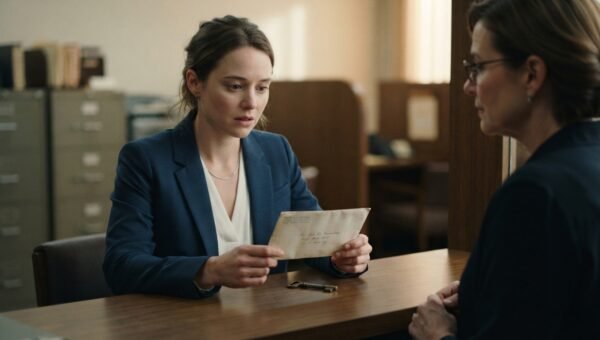
When Pete saw me, he did not reach for the receipt book. He reached beneath the counter and brought out a plain white letter envelope with no stamp.
“I was just about to dial your room,” Pete said, keeping his voice low. “A man dropped this off twenty minutes ago. He told me to put it straight into your hands and not leave it in the mail slot.”
My name was written across the front in my father’s heavy, slanted pencil print.
Inside the envelope was a heavy brass key to the kitchen deadbolt of my parents’ house, folded into a piece of lined notebook paper. The note was short, written in three lines:
“I saw the charges. Come to the house tonight at eight-fifteen through the garage door. Evelyn is at her bridge league in town. Do not call first.”
PART 2
I sat in my parked car behind the grocery store until eight o’clock, watching the rain beat against the windshield.
My father was seventy-two and spent most of his days in his basement woodworking shop or running errands for the hardware store where he used to work. For the last ten years, my mother had handled all the mail, the banking, and the family news. If my father wanted to know how Brenda or I was doing, he heard it through my mother over supper. When I left my husband, my mother had told me Dad was too frail to handle family trouble and that I should not burden him.
I had believed her. That was my mistake. I had spent forty-two days in room 14 protecting a man who had not even known I was there.
At eight-fifteen, I drove down their street with my headlights turned down to parking lights. My mother’s silver sedan was gone from the driveway. The porch light was off, but a pale yellow lamp showed through the side window of the kitchen.
I unlocked the garage door with the brass key. It turned without a sound.
My father was sitting at the oak kitchen table with his reading glasses on, a blue folder open in front of him, and two bank statements spread flat against the wood. He had an old thermos of black coffee and two ceramic mugs already set out.
He did not look frail. He looked tired, angry, and cold.
“Sit down, Sarah,” he said quietly, pointing to the chair across from him.
“Dad, how did you find out about the motel?” I asked.
“Pete called my personal cell phone yesterday morning,” Dad said. “He asked me why my daughter was paying commercial motel rates on Route 9 for six weeks straight when we had a four-bedroom house with an empty upstairs. Pete thought maybe I was in the hospital.”
I swallowed the lump in my throat. “Mom told me there was no room. She said Chloe needed the back bedroom because of the thunder, and Brenda had nowhere else to keep her.”
My father pushed the blue folder across the table toward me.
“Your mother told me you moved into an executive suite near the hospital where you were doing medical billing,” he said. “She told me you were embarrassed about the divorce and begged her not to let me see you until you had your life pulled together. She said you asked for space.”
I opened the folder. Inside were copies of our family checking ledger and three canceled checks drawn on their joint household account over the last two months. Each check was made out to cash for fifteen hundred dollars, signed by my mother. In the memo line of each check, in my mother’s neat hand, were the words: Sarah transition assistance.
“She took forty-five hundred dollars out of our savings,” my father said, his voice dropping into a rough whisper. “She told me she was handing it to you each week in cash so you could pay for your executive suite and keep your pride. Meanwhile, you were running through forty-six hundred dollars of your own divorce money at the Pine Crest while a dog slept in your bed.”
PART 3
The paper shook slightly in my hands. The pieces were plain and ugly.
My mother had not turned me away because of a dog. She had turned me away because if I stayed under her roof, my father would have talked to me every morning over breakfast. He would have known I did not have forty-five hundred dollars in pocket money. He would have asked where the withdrawals went.
“Where did the cash go, Dad?” I asked.
“Brenda’s credit card debt,” my father said flatly. “Brenda bought two thousand dollars worth of salon equipment for a dog-grooming venture that failed in March, and the collection agency was threatening her car. Your mother cleaned out our emergency cushion to bail her out, then used your divorce as the cover story so I would not stop her.”
Before I could answer, headlights swept across the kitchen ceiling. Tires crunched over the gravel in the driveway.
A car door slammed. Then the side door rattled open, and my mother walked in carrying her raincoat and an umbrella. She stopped dead in the doorway when she saw me sitting at the table with the folder open.
“Sarah?” she said. Her face tightened, but she did not drop her chin. “What are you doing here? I told you your father needed quiet.”
“Her room at the Pine Crest cost forty-six hundred and eighty dollars, Evelyn,” my father said, standing up from his chair. He did not yell. He spoke with the heavy, level weight of a man who had worked forty years on his feet. “Pete told me yesterday. And I have the three checks you wrote for her transition assistance right here on the table.”
My mother’s eyes darted between the folder and my father’s face.
“Brenda was about to lose her car, Arthur,” she said, her voice rising fast into that sharp, defensive tone she used whenever someone caught her in a corner. “Sarah has a divorce settlement. Brenda has nothing. I had to protect Brenda. Sarah is an adult. She has always been able to land on her feet.”
“You made your own child sleep six weeks in a drafty motel beside the highway so you could steal from our retirement and lie to my face,” my father said.
“I did what a mother does!” she snapped. “And Sarah could have gone anywhere. Nobody forced her to stay at the Pine Crest.”
“I forced her,” my father said. “Because I believed you.”
He reached into his pocket and pulled out a cashier’s check from our local credit union. It was already made out in my name for forty-six hundred and eighty dollars, drawn against his own personal pension account that my mother had no signature authority on.
He placed the check in front of me.
“Take this, Sarah,” he said. “This is your money. You are moving your suitcases into the house tonight. You will take your old bedroom. The dog bed goes back to Brenda’s apartment before nine o’clock tomorrow morning, or Brenda can come pick up her dog from the shelter.”
“Arthur, you cannot do that to Brenda!” my mother shouted.
“I can,” my father said. “The deed to this property has my family’s name on it, and the bank accounts are being separated at nine in the morning. If you want to run Brenda’s debts, you can do it on your own half of the pension. But you will not lock our daughter out of her home again.”
ENDING
I did not move back into my childhood bedroom.
I took my suitcases from the trunk of my car that night and carried them into the small den on the ground floor, just off my father’s study. I stayed there for twenty-two days. I did not take the bedroom upstairs because I did not want to sleep where my mother had placed a dog bed out of spite. Some rooms cannot be reclaimed once people show you what they really think of you.
My father took me to the credit union the next morning. He deposited the $4,680 check into a fresh checking account in my name alone, then sat across from the branch manager and removed my mother’s name from all his primary operating accounts.
Brenda came by that afternoon in her hatchback. She did not look at me while she carried the dog bed, the chew toys, and the dog out to her back seat. She tried to tell Dad that our mother had promised her the room would stay open for her business, but Dad closed the garage door while she was still talking.
My mother spent the rest of that month sleeping in the guest room at the end of the hall. She made coffee in silence, went to the grocery store alone, and stopped mentioning Brenda’s car payments. She tried once, while Dad was in the yard, to tell me that I had ruined her marriage over a motel bill.
“You told me I was an adult and had to figure it out,” I told her, setting my coffee cup in the sink. “I figured it out.”
By the end of the month, I was hired full-time as an intake coordinator at the regional health center six miles away. With my divorce funds restored by the check my father gave me, I put down first and last month’s rent on a clean, sunny one-bedroom apartment over an old brick bakery on Maple Street.
The brass house key is still on my key ring. I visit my father every Sunday morning at ten. We sit at the kitchen table, drink black coffee from the old mugs, and talk about his garden or the news from the hardware store.
My mother usually stays upstairs until my car leaves the driveway. We do not argue anymore. We do not need to. We both know the price of that silence down to the penny.