PART 1
The insurance adjuster told me our home was worth $410,000, but standing in front of the pile of black ash and melted siding, that number meant nothing. In four hours, twenty-two years of life disappeared into smoke. My eleven-year-old daughter, Chloe, had managed to grab her school backpack and an old fleece blanket. I had my purse, my phone, and the keys to our ten-year-old Chevy Impala.
We didn’t have family nearby. My parents passed away years ago, and my ex-husband had moved across the country six years back and rarely answered my calls.
The local motels wanted over one hundred and forty dollars a night, plus security deposits I couldn’t afford while waiting on insurance claim paperwork. So, for nearly three weeks, that beat-up car became our bedroom, our dining room, and our storage unit.
Every night followed the same exhausting pattern. I parked under the high halogen lights of twenty-four-hour big-box store lots, cracked the windows half an inch for air, and locked the doors. Chloe slept curled up in the back seat with her backpack tucked under her head. I leaned my seat back just enough to watch the mirrors, waking up at every loud exhaust pipe or squealing tire. We washed our faces and brushed our teeth in public park bathrooms at six in the morning before I dropped Chloe off at school, acting like everything was fine. I washed two shirts and two pairs of pants in a laundromat sink, hanging them on the car grab handles to dry while I drove.
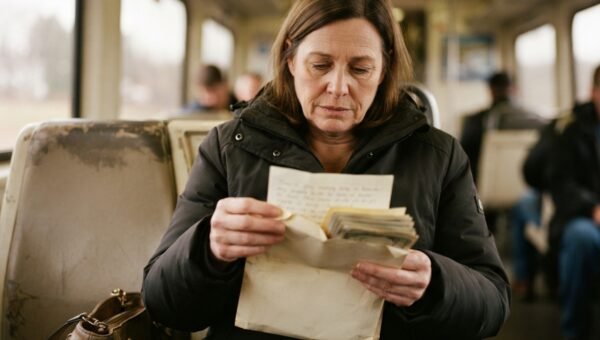
By the nineteenth day, the physical exhaustion felt like lead in my bones. It was a Thursday afternoon, around four o’clock. Chloe had a headache, so after picking her up, I pulled into the far edge of a busy gas station off Route 9 to let her nap before we figured out where to park for the night. I counted eighteen dollars and twenty cents in change from my cup holder, wondering if I should buy two sandwiches or save five dollars for gas.
Outside my driver’s window, a woman in a crisp beige coat walked past carrying a carton of bottled water. She looked directly into our backseat, noticed our clothes piled in grocery bags, and met my eyes. Her mouth twisted into an ugly sneer.
“Homeless people shouldn’t be clogging up customer parking,” she said, loud enough for Chloe to hear. “Go down to the shelter like everyone else.”
I felt my neck burn with pure shame. I looked down at my steering wheel, biting the inside of my cheek so Chloe wouldn’t see my eyes water.
I just wanted the ground to open up and swallow that car whole.
Then, two sharp raps hit the driver’s side glass.
My stomach dropped into my shoes. I thought it was the gas station manager coming to kick us off the property. I turned my head, ready to apologize and start the engine, but the breath caught in my throat.
The man standing outside the glass was wearing a faded navy blue work jacket with the name “Artie” stitched on the pocket. He had deep gray hair, heavy lines around his brown eyes, and his hands were resting flat against his coat.
It was Arthur Miller. He was the master mechanic who had run the small repair shop two miles from my old neighborhood for thirty years. My late father had taken his truck to Arthur back in the nineties, and I had taken my car to him until his shop closed down three years ago.
Arthur didn’t yell. He didn’t point at the store signs. He leaned down slightly, tapped the glass again with one knuckle, and said, “Sarah? Roll the window down, honey. I’ve been driving around looking for this car for four days.”
PART 2
I rolled the window down two inches. The cool October air rushed into the warm car, smelling of gasoline and damp pavement.
“Arthur?” My voice came out cracked and thin. “What are you doing here?”
Arthur didn’t answer right away. He looked past me into the backseat where Chloe was sitting up, rubbing her eyes with her sleeve. His gaze lingered on the taped cardboard box sitting on the floorboard and the plastic bag of clothes jammed against the back glass. A quiet sadness crossed his face, but his voice stayed completely steady.
“Your uncle Joe in Ohio called my house on Sunday night,” Arthur said. “He said you called him asking about an old title document for your house, and he could hear the wind blowing through your phone. He knew your place burned down on the news, but when he asked where you were staying, you hung up.”
I stared at my dashboard. Uncle Joe was seventy-eight and lived on a fixed pension in Toledo. I had called him to ask if he remembered who my dad had used for our original homeowner deed, but when he pressed me about our motel address, the shame had overwhelmed me. I couldn’t bear telling him we were sleeping on vinyl seats.
“Joe knew I still lived out off the county road,” Arthur continued, resting one calloused hand on the car door frame. “He asked me to check the motels. I went to four of them in town. None of them had a Sarah Jensen registered. Then yesterday, Pete down at the diner told me he saw an old silver Impala with a dented rear bumper parked by the creek rest stop two mornings in a row. I took a drive out here hoping I’d spot you.”
“We’re fine, Arthur,” I said automatically. The lie felt ridiculous even as it left my lips. “The insurance adjuster is still processing the paperwork. The policy was four hundred and ten thousand dollars. We’re just waiting on the settlement check to clear so we can sign a lease on an apartment.”
Arthur didn’t argue. He reached into his coat pocket, pulled out a small notepad, and tore off a yellow slip of paper.
“Sarah, I’m seventy-one years old,” he said softly. “I’ve known your family since you were riding a bicycle with training wheels down Elm Street. You don’t have to put on a brave face for me. Chloe needs a real bed, and you look like you haven’t slept in three weeks.”
He handed the paper through the crack in the window. On it was an address on Oak Ridge Road, about four miles west, past the old quarry.
“My wife Martha passed two years ago,” Arthur said. “Her sister moved to Arizona last spring, and the little guest cottage behind my garage has been sitting empty ever since. It has heat, a working stove, and two clean twin beds. I don’t want a single dime from you. You follow me home right now, or you park in my driveway tonight. But you are not spending another night behind a dumpster.”
Chloe leaned forward from the backseat. Her voice was tiny. “Mom? Can we please?”
I looked in the rearview mirror at my daughter’s pale face, then out at Arthur’s steady eyes. The pride that had kept me quiet for three weeks finally gave way. I nodded, put the car in drive, and followed his old red pickup truck out of the lot.
PART 3
The cottage behind Arthur’s garage was small, clean, and smelled of cedar. That first night, Chloe slept for twelve uninterrupted hours under a heavy patchwork quilt. I took my first hot shower in twenty-one days and sat at Arthur’s kitchen table while he brewed a pot of decaf coffee.
While we sat there, Arthur pushed a manila folder across the table toward me.
“Before we talk about you staying here, you need to look at this,” he said.
I opened the folder. Inside was a stack of yellowed receipts, carbon-copy work orders, and a legal notice dated six years earlier from the town zoning board.
“What is this?” I asked, confused.
“Your house,” Arthur said quietly. “Your ex-husband, Greg.”
My chest tightened. “What does Greg have to do with the fire?”
“Nothing to do with the fire, Sarah. The fire was an electrical short in the attic, the fire marshal confirmed that. But Greg has everything to do with your insurance.”
Arthur pointed to the bottom document. It was a secondary lien filing against my property from 2020.
“When Greg walked out six years ago, he left a lot of unpaid commercial debt from his landscaping company,” Arthur explained. “He had his name on your deed back then, didn’t he?”
“Yes,” I whispered. “We never formally removed him. The divorce was messy, and I couldn’t afford the legal fees to force a deed transfer. The judge awarded me the property in the decree, but the county records were never updated.”
“I know,” Arthur said. “Because Greg owed thirty thousand dollars to a parts supplier in town, and that supplier took him to court. The county placed an automatic indemnity lien against the property address. If your insurance company pays out that $410,000 policy while Greg’s name is still attached to the municipal title, the check has to be issued in both names. And the state treasury holds the funds in escrow until his creditors get paid.”
My stomach turned to ice. “The adjuster told me two days ago that the claim was on a legal hold. He wouldn’t tell me why over the phone. He just said there was a title discrepancy.”
“That’s why,” Arthur said. “Greg’s creditors found out about the fire claim through public loss notices. They filed an emergency claim to intercept the payout. If you don’t file the certified divorce decree with the county recorder and petition for an emergency title clearing, you won’t see a dollar of that insurance money for three years while it sits in court.”
Arthur leaned back in his chair. “My son-in-law, David, is a county clerk in the records division. He called me on Monday because he recognized your dad’s old family name on the docket notice. He couldn’t reach you because your phone went straight to voicemail when your battery died.”
The reason Arthur had been searching the parking lots wasn’t just to give us a bed. He was trying to stop my ex-husband’s creditors from freezing the only money my daughter and I had left in the world.
ENDING
The next morning at eight-thirty, Arthur drove Chloe to school while I sat in the county clerk’s office with David. I had my original divorce decree, which I had kept in the glove compartment of my car inside an old vinyl pouch with my vehicle registration.
David walked me through three separate affidavits of sole equitable ownership. Because the divorce judgment explicitly granted me the house free and clear, Greg had no legal right to encumber the property after the divorce date. By noon, the clerk’s office issued a certified certificate of non-attachment, releasing the insurance funds from the third-party claims.
Four days later, the insurance company released the initial living-expense advance of twelve thousand dollars into my bank account.
Chloe and I stayed in Arthur’s cottage for five months. I bought groceries every week, cooked dinner for Arthur every evening, and Chloe started doing her homework at his kitchen table while he showed her how to clean carburetor parts on an old lawnmower engine.
When the full $410,000 settlement finally cleared in the spring, I put down a deposit on a small three-bedroom ranch style house three streets over from Arthur’s shop. It wasn’t as large as our old home, but it had a fenced yard and a wide front porch with room for two chairs.
Before we moved our boxes out of the cottage, I tried to hand Arthur an envelope containing five thousand dollars for rent and utilities.
He looked down at the envelope, pushed my hand back across the counter, and shook his head.
“Your dad replaced the transmission in my first tow truck back in 1984 when I didn’t have fifty dollars to my name,” Arthur said. “He told me to pay him back when my feet were under me. He never sent me a bill.”
I put the envelope away.
Yesterday afternoon, Chloe and I walked down the gravel driveway of our new house to check the mailbox. On the front seat of my old Impala, which was parked neatly in our own paved driveway, sat Chloe’s old school backpack and a clean set of house keys on a brass ring. We don’t sleep in that car anymore, but I keep those keys sitting on the kitchen counter right by the front door, just so I never forget who came looking for us.