PART 1
I gave birth alone in a small room on the third floor of Memorial Hospital on a Tuesday night. My husband, Mark, told me he was stuck in bumper-to-bumper traffic out on Route 9, but the hours kept ticking by and his chair stayed empty. The nurse assigned to my room was named Evelyn. She had gray hair pinned back in a neat clip and soft, steady hands.
Evelyn stayed by my side for nine hours. When the contractions made me sick, she brought me fresh cups of ice chips and wiped my forehead with a damp washcloth. When my labor stalled, she helped me walk the linoleum hallway, one slow step at a time. And when the monitor suddenly screamed because the umbilical cord was wrapped tight around my baby’s neck, Evelyn did not lose her head. She hit the call button, repositioned my body, worked the cord free with her fingers, and delivered my little girl before the on-call doctor even made it through the door.
I was bleeding heavily and shivering from exhaustion. I was too weak to sit up or hold my child. Evelyn carried the baby to the warming cart beneath the heat lamp. I lay on the delivery bed, drifting in and out, listening to Evelyn softly hum an old church hymn while she cleaned and bundled the infant.
When she finally brought the tight swaddle over and laid the baby against my chest, she whispered that I had a survivor. Mark showed up nearly forty minutes later, smelling like diner coffee, apologizing about his car radiator. I was too tired to argue. I looked down at the tiny pink face, and I never forgot Evelyn’s quiet kindness.
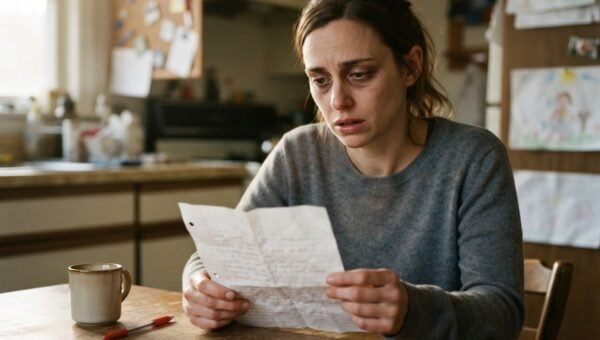
Three years passed. We named our daughter Sophie. She grew into a bright, funny toddler with curls that never stayed flat and a small brown mark shaped like an almond on the inside of her left wrist. Mark always called it her lucky stamp.
On a rainy Thursday evening, I was sitting on the living room rug folding laundry while Sophie lined up her plastic farm animals by the sofa. The local news was playing on the television across the room. A breaking report flashed across the screen with bright yellow letters: Former Memorial Hospital Nurse Arrested in Multi-Year Infant Trafficking Operation.
Evelyn’s mugshot filled the screen. Her gray hair was loose, and she was wearing handcuffs. The reporter stated that over an eight-year period, Evelyn Miller had systematically taken and traded fourteen infants from the hospital maternity ward, working with an unlicensed private broker.
The room felt completely airless. I looked down at Sophie, who was humming to a plastic cow. Then the broadcast cut to a photo recovered by county investigators from Evelyn’s house. It was an old snapshot of Evelyn in her blue hospital scrubs, holding a newborn in a nursery blanket. The camera was zoomed close on the infant’s left arm.
On the baby’s left wrist was an almond-shaped brown mark.
My hands shook so hard I dropped the towel I was holding. I picked up my phone from the coffee table and dialed the tip line number running across the bottom of the television screen. When the investigator answered, I gave him my name, the hospital room number, and the exact date I gave birth.
Detective Keller listened without interrupting. I told him about the photograph on the news, about Evelyn humming by the warming cart, and about the mark on my three-year-old daughter’s wrist.
The line went silent for four long seconds. Then Detective Keller cleared his throat.
He said, “Ma’am, that photograph was not taken of a missing child we are still hunting for. That photograph was filed by the state three years ago when a mother named Sarah Evans reported her newborn stolen from Room 310 on your floor. If your child has that mark, she does not belong to you. And your biological daughter was carried out the hospital fire door three hours before you woke up.”
PART 2
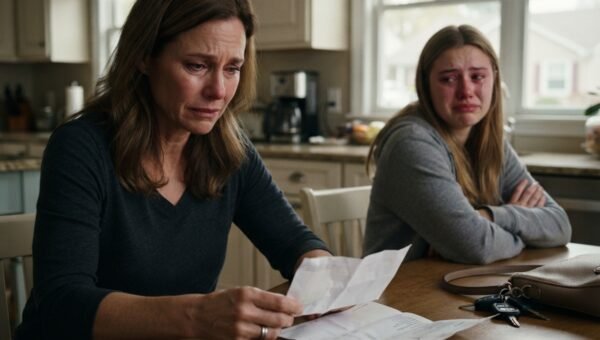
The phone slipped out of my fingers and hit the carpet with a dull thud. Detective Keller’s voice was still coming through the small speaker, tinny and urgent, asking if I was still there.
Sophie looked up from her toys. She tilted her head and asked, “Mommy, did you drop it?”
I could not breathe. I picked the phone back up and told the detective I would come to the station in the morning. He told me that was not fast enough. He said he was sending two county officers to my address immediately to bring me, Sophie, and my husband down to the county justice building for formal identification and mouth swabs.
Mark came through the front door from work twenty minutes later, setting his metal lunch pail on the kitchen counter. When I told him what Detective Keller said, his face went completely blank. Then his jaw tightened.
“Hang up the phone,” Mark said, walking into the living room and turning the television off with the remote. “Do not let anybody in this house. Claire, think about what you are saying. Sophie is three years old. We brought her home. Her birth certificate has our names printed on it.”
“The detective has a ledger from Evelyn’s lockbox, Mark,” I said. “The dates match. The room numbers match. The baby on the news has Sophie’s mark.”
“Then the nurse made a mistake on a piece of paper,” Mark said, his voice rising. “People make clerical errors every day. If you open the door to those detectives, they will take her away from us. We raised her. She is our daughter.”
“And what about the child I delivered?” I asked him. “What about the baby that came out of my body while you were sitting in traffic?”
Mark looked down at the floor. He rubbed the back of his neck, the same way he did whenever money was short or whenever he wanted to dodge a hard conversation. “We don’t know that anything happened to our baby. You’re getting hysterical over a television segment.”
A cruiser pulled into our gravel driveway, its headlights washing across the living room window.
Mark grabbed my arm near the elbow. His grip was tight. “Claire, listen to me. If you walk out that door with her, you blow our family apart. Tell them you were mistaken. Tell them Sophie’s mark is just a freckle. We turn the porch light off and we keep our life.”
I pulled my arm free from his fingers. I went to the closet, got Sophie’s yellow jacket, and zipped her into it. I knew what running or lying would mean. It would mean another mother somewhere was still staring at an empty crib, wondering if her baby was warm, wondering if her baby had lived. And it would mean my own flesh and blood was living with strangers, completely erased from her own family.
“I am not living a lie,” I told him.
I carried Sophie out the front door, walked down the porch steps, and sat in the back of the county car. Mark stayed on the porch, his arms crossed over his chest, watching our red taillights fade down the road.
PART 3
At the county justice building, the lights were harsh fluorescent white. Detective Keller was an older man with tired eyes and a thick file spread across a metal desk. A female officer sat with Sophie in an adjoining room, giving her apple juice and coloring books.
Detective Keller set three documents in front of me.
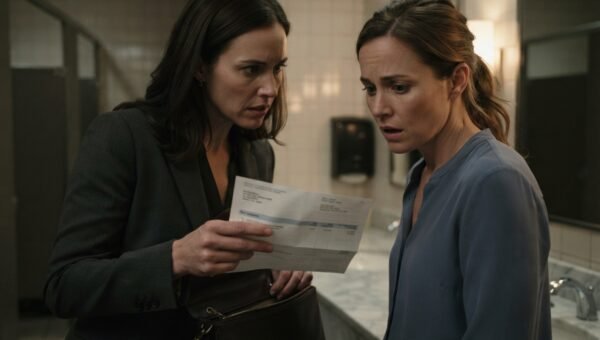
The first was a copy of Evelyn Miller’s private notebook, seized from a safe in her basement. In thin pencil, Evelyn had written my name, my room number, and the time of birth: 11:14 PM. Right beside it was an entry for Room 310, time: 9:40 PM.
The second document was an intake report from May 12th. Sarah Evans, a twenty-one-year-old clerk from the nearby township, had delivered a baby girl with an almond mark on her wrist. Sarah had suffered severe blood loss and was put under general anesthesia. Evelyn had wheeled the infant down to the utility room, swapped the identification bands, and told the night doctor that the Evans infant had suffered fatal oxygen loss.
The third document was an envelope addressed to an attorney sixty miles away in Harrisburg. That attorney had paid Evelyn twenty-two thousand dollars in cash for a healthy newborn girl. My biological daughter.
“Evelyn targeted mothers who were alone,” Detective Keller explained plainly. “She watched the ward. If a woman had no partner in the room, no family in the waiting area, and had heavy medical complications, Evelyn knew there were no witnesses to challenge the transfer. Your husband wasn’t there to hold your baby. By the time you woke up, the child on your chest was Baby Evans, and your daughter was already on Route 81 in a car seat.”
My chest felt crushed under a terrible weight. Every warm memory of Evelyn holding my hand, wiping my brow, and humming hymns turned cold and sickening. Her gentle voice had not been kindness. It had been a calculated trap to keep me quiet and docile while she stole my child.
The door to the interview room opened thirty minutes later. Detective Keller stepped out, spoke to someone in the hallway, and then stepped back inside with a young woman.
Her name was Sarah. She wore a faded green cardigan, and her dark hair was pulled into a low ponytail. Her face was pale, and her eyes were red from crying. She stopped two feet from the table. She looked at me, and I looked at her.
“She has your hands,” Sarah whispered. Her voice was barely audible. “On the news… they showed the clothes your little girl had on when you called the tip line. She has the birthmark, doesn’t she?”
I could not speak. I only nodded.
“I spent three years thinking I failed her,” Sarah said, pressing both hands against her mouth. “The hospital gave me a death certificate with no footprints. They told me she didn’t breathe. I have visited an empty grave every Sunday for thirty-six months.”
I stood up from the chair. My legs were shaking, but I walked around the desk and opened the door to the side room. Sophie was sitting on the carpet, coloring a sheep with a green crayon.
Sarah saw her through the open doorway. She did not rush in. She did not scream. She dropped to her knees right in the hallway, buried her face in her cardigan, and wept with a quiet, terrible grief that had waited three years to be answered.
Then Detective Keller placed his hand on my shoulder. “Mrs. Miller gave up the Harrisburg attorney an hour ago, Claire. The couple who took your baby thought it was a legal private placement. They live two hours west. We know where your daughter is.”
ENDING
The DNA results came back six days later, confirming what the paperwork had already proven.
The law did not sweep in and rip two children out of their beds overnight. Real life does not work like that. The county brought in social workers, child psychologists, and family advocates to handle what everyone called an unprecedented transition.
The couple in Pennsylvania, David and Ellen, were devastated. They were decent people who had paid a crooked adoption lawyer thirty-five thousand dollars of their life savings, truly believing they were adopting a baby whose mother had voluntarily surrendered her rights. They named my biological daughter Grace. Grace had my late grandmother’s hazel eyes and my father’s slight cowlick along her forehead.
Mark could not endure the reality. When the county mandated regular joint visitations, home evaluations, and legal meetings, Mark pulled away. He wanted to pretend none of it was happening. He packed two suitcases three months into the process, moved into an apartment near his work depot, and filed for divorce. I let him go without an argument. A man who would trade the truth for comfort was never going to protect our children anyway.
Over the next fourteen months, Sarah, David, Ellen, and I did the only thing four broken parents could do. We put our egos aside and focused on the two little girls who did not understand why the world was shifting around them.
We did not sever bonds. We built a bridge.
Today is Saturday. The sun is warm over the grass in my backyard. Sarah is sitting on my porch bench with a mug of black coffee, watching Sophie and Grace share a plastic bucket in the sandbox. Sophie is chattering about her preschool teacher, her little left wrist flashing in the sunlight with that familiar almond mark. Beside her, Grace laughs, throwing sand against the plastic rim, her hazel eyes squinting up at the afternoon sky.
They call Sarah ‘Mama Sarah’ and they call me ‘Mama Claire.’ It is not the simple, quiet life I imagined when I lay in that hospital bed three years ago, listening to a nurse sing false comfort in the dark. But it is an honest life.
I keep Sophie’s original hospital band in a small cedar box on my dresser, the ink smudged and corrected by a hand that meant to destroy us. Every morning when I see it, I am reminded that the truth costs a great deal of pain, but a lie would have cost us our souls.