PART 1
For twelve years, the third Thursday of the month belonged to the drive-through lane at Miller’s Pharmacy.
It started back in the spring of 2014 when Evelyn’s heart medication jumped to four hundred and eighty dollars a month. My husband, Greg, had come home from Sunday dinner at her house looking gray around the mouth. He sat on our back porch, turned his coffee mug in circles, and told me his brothers couldn’t swing it.
Rick had two kids in braces and worked on commission. Todd was between contracting gigs and living in a rental behind the lumber yard. Greg said they talked about it in the garage while their mother was inside setting out the coffee cake, and neither one of them had twenty extra dollars to spare.
“We have to help her, Sarah,” Greg told me. “She’s eighty-one. She can’t ration blood thinners.”
I didn’t argue. I worked forty hours a week as a records clerk at the county water district, and Greg had his thirty years with the state road maintenance crew. We were not wealthy people, but we owned our small split-level on Elm Street, our truck was paid off, and our daughter, Megan, was already out on her own with a teaching job. Evelyn had never been warm, exactly, but she was decent. She sent handwritten birthday cards with crisp five-dollar bills inside, and she never forgot my name or complained about my potato salad at Thanksgiving.
She was family, and in my mind, that was where the conversation began and ended.
So every month, I picked up the brown paper sacks.
The blood thinners were the worst of it, but by 2019 there were drops for her eyes, two kinds of insulin, and an inhaler that cost two hundred dollars even with her supplemental plan. Some months were three hundred dollars. Some were six hundred. I paid with our joint debit card, drove three miles out of my way to her yellow brick ranch house on Maple Avenue, and set the bottles on her kitchen counter right next to her tea kettle.
Evelyn always did the same thing. She would stand by the sink with her dish towel pressed against her apron, watch me line up the amber vials, and say, “Tell Greg I’m obliged.”
She never thanked me directly. She always thanked Greg through me. At first, it stung a little, but after four or five years, I let it go.
Older women from her generation sometimes had a hard time acknowledging money coming from an in-law. I figured she was embarrassed, and there was no sense in making an old woman feel small in her own kitchen.
Then Evelyn caught pneumonia three weeks after Thanksgiving. She spent twelve days at St. Jude’s, came home on home hospice, and slipped away on a cold Tuesday morning with Greg holding her left hand.
The house was not even cold when the cars started pulling into the gravel drive.
I was in the basement laundry room, pulling the last set of hospital sheets out of Evelyn’s washer. I wanted the house smelling clean and peaceful before the neighbors brought over the casseroles. Through the narrow basement window, I heard truck doors slamming. Then boots sounded on the floorboards directly over my head.
When I carried the plastic laundry basket upstairs, Rick was already in the dining room with a yellow legal pad.
Todd was standing in the hall with a roll of green painter’s tape, sticking torn squares onto the walnut hutch and the grandfather clock.
“We need to inventory the front rooms before the estate appraiser gets out here next week,” Rick said without looking up from his paper. He had a pencil behind his ear and a cup of black coffee on Evelyn’s lace tablecloth.
“The washer’s done,” I said, holding the basket against my hip. “I’m just going to fold these blankets and put them in the linen press.”
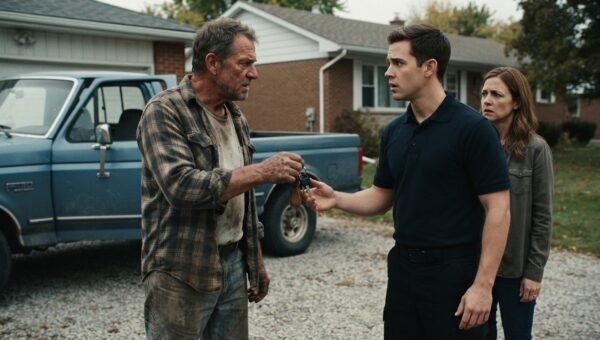
Todd walked out of Evelyn’s bedroom holding her small oak jewelry box by the brass handle. He didn’t set it down. He tucked it right under his arm like a football.
“Don’t worry about the closets, Sarah,” Todd said. His voice was flat and quick, the same tone he used when he tried to sell people storm windows they didn’t need. “Greg can help us sort through Mom’s personal effects. The jewelry and the keepsakes are blood family only. You know how it is. It’s just cleaner that way.”
I stood there in my sneakers, smelling bleach and damp wool. Greg was sitting on the edge of the sofa with his elbows on his knees, staring down at the floral rug. He didn’t lift his head. He didn’t say, “Sarah’s been here every week for a decade.” He didn’t say, “Sarah paid for the medicine that kept her alive long enough for you to stand here.”
He just kept his head down, tired and worn out by grief, letting his brothers push the furniture around.
I set the laundry basket on the kitchen table. I took my coat off the peg by the door.
“I’ll see you at home, Greg,” I said quietly.
Neither Rick nor Todd looked up when the screen door latched behind me.
PART 2
I spent the next forty-eight hours cleaning my own house until my knuckles were raw. I scrubbed baseboards, washed windows, and baked two pans of ziti for the post-funeral gathering that I knew I would have to attend.
Greg slept in four-hour stretches on the recliner. When he spoke, it was about burial plots, the cost of the vault, and how Rick and Todd wanted to list the Maple Avenue house immediately. The house had been built by their grandfather in 1958. It sat on two flat acres near the county line, and a developer had already offered three hundred and twenty thousand dollars for the parcel.
“They want to split it three ways,” Greg told me on Thursday night, staring into his plate. “Rick needs to pay off his truck, and Todd’s behind on his shop rent. They want to close before spring.”
“Did your mother have a will?” I asked.
“Just the old one from when Dad died in ninety-two,” he said. “Everything goes equally to the surviving boys. That’s what Rick said. He has the copy from the courthouse.”
I didn’t say another word about it. I went to the service on Friday morning in my dark navy dress, sat in the second pew beside Greg, and shook hands with people from Evelyn’s church. Rick wore a new suit. Todd had his hair combed back with pomade. When the service ended, they stood on the church steps talking to an agent from Miller Realty, laughing softly with their hands in their pockets.
On Monday afternoon, my cell phone rang while I was filing property tax assessments at work.
The caller ID showed Miller’s Pharmacy.
“Mrs. Miller?” a girl’s voice asked. It was young, hesitant.
“This is Sarah,” I said.
“Hi, Sarah. This is Donna from the pharmacy. We were clearing out the will-call bins for the end of the month, and Evelyn’s special-order bag from last week was still sitting on the bottom shelf. The pharmacist said she passed away, but there’s an envelope stapled to the front invoice that has your name on it. It says, ‘Deliver by hand to Sarah Miller only.'”
I sat back in my desk chair. “My name?”
“Yes, ma’am. In blue pen. The tape is sealed across the back. Did you want us to shred it, or do you want to swing by after five?”
“Keep it right there,” I said. “I’ll be there in twenty minutes.”
I left the office on my break. The drive to the pharmacy felt longer than usual, through four red lights on Route 9. When Donna handed me the package across the counter, it wasn’t the usual brown paper sack. It was a thick manila envelope, sealed with heavy clear packing tape, with my full name written across the front in Evelyn’s shaky, narrow cursive.
I took it out to my car, sat in the front seat with the heater blowing on my boots, and used my house key to slit the tape.
Inside was a cardboard shoebox lid cut down to size, wrapped around a thick stack of white register slips bound with three thick rubber bands. Each slip was a pharmacy receipt from Miller’s Pharmacy. Every single one, dated from April 2014 through November 2026. On every slip, Evelyn had drawn a line with a blue ballpoint pen under the copay amount.
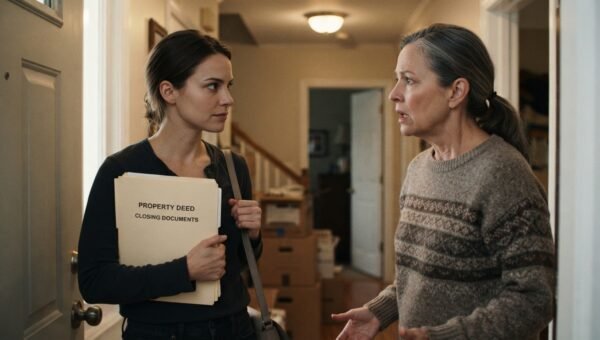
Behind the receipts was a single sheet of cream-colored paper with the letterhead of an attorney in town named Walter Briggs, stamped with a gold notary seal.
At the top, Evelyn had written in her sharp hand:
“Total pharmacy expenses paid directly from Sarah Miller’s private funds: $48,260.00.”
Below the total, there was one typed paragraph, signed by Evelyn and witnessed by Walter Briggs three months before she took sick:
“I, Evelyn Mae Miller, acknowledge that my son Gregory’s wife, Sarah, has carried the cost of my daily living and medical care without assistance from my sons Richard or Todd. My sons have repeatedly informed me they provided these funds to Gregory. Gregory has informed me he paid them from his own pocket. In October of 2023, I asked Mr. Briggs to pull the bank records. I know where the money came from.
Therefore, I place a formal vendor and care lien against the property at 414 Maple Avenue in the exact sum of $48,260.00, to be paid in full to Sarah Miller from the gross proceeds of any sale prior to the distribution of any inheritance to my heirs. Furthermore, if my sons attempt to contest this debt, I direct my executor to execute the attached deed transfer, conveying a fifty percent tenant-in-common ownership of 414 Maple Avenue directly to Sarah Miller.”
I read the page once. Then I read it again.
Then I put my truck in gear and drove straight to my house.
PART 3
Greg was at the kitchen counter making a ham sandwich when I walked in. He had a yellow legal pad next to the mustard jar, where he was trying to calculate funeral costs against his third of the house sale.
I didn’t yell. I didn’t throw the envelope.
I set the cream paper on top of his legal pad, right over his penciled numbers, and dropped the stack of pharmacy receipts beside his plate.
“Sit down, Greg,” I said.
He looked at my face, stopped spreading the mustard, and pulled out a chair. He sat down before I even finished the first sentence.
“Where did you get this?” he asked, his voice cracking on the second word.
“Donna called from Miller’s. Evelyn left it in her final prescription bag.” I pulled the chair opposite him and leaned forward, resting my forearms on the table. “You told me twelve years ago that Rick and Todd couldn’t afford twenty dollars. You told me they were broke.”
Greg’s jaw worked. He looked at the gold seal on the paper, then at the rubber-banded receipts. He reached out to touch the top slip, then pulled his fingers back like the paper was hot.
“Sarah,” he whispered. “You don’t understand how it was.”
“Explain it to me,” I said. “Because Evelyn wrote here that your brothers told her they were sending money every single month. Did they give you money for her medicine?”
He closed his eyes. The kitchen clock on the wall ticked three times before he answered.
“Not at first,” he mumbled. “At first they really were broke. But after about three years, Rick got that dealership job. Todd picked up the commercial accounts. In 2017, Rick started giving me two hundred a month in cash. Todd gave me a hundred and fifty whenever he had it.”
I looked at him. The room felt completely silent. “And where did that cash go, Greg?”
He swallowed hard. “I put it into the garage account. I used it for the boat payments. I used it when we had to replace the roof on our house. I thought… I thought we were carrying the weight anyway, taking her to doctors, driving her around. I thought it was all going to the same family pot.”
“You let me work thirty hours of overtime every November to cover her winter refills,” I said. My voice was completely steady, which surprised me. “You let Todd tell me to my face three days ago that I wasn’t blood family, while you were sitting on the couch knowing you’d pocketed seven years of their contributions and let me pay the counter.”
“I was going to pay you back when the house sold!” he pleaded, reaching across the table to grab my wrist. I pulled my hand away and set it in my lap. “I swear to God, Sarah. I was going to cut you a check for fifty grand out of my share the day of closing. I just couldn’t tell Rick and Todd. They would have taken me to court. They would have said I stole from them.”
“They don’t have to take you to court,” I said. “Because Evelyn already did the work.”
I pointed to the notarized paragraph. “She knew. She went to Walter Briggs three months ago. She pulled the debit slips from the pharmacy account. She saw my name on every single charge since 2014. She knew you were taking their cash and letting your wife pay the bill.”
Greg stared at his mother’s signature. A drop of sweat ran down the side of his neck into his collar. “What are you going to do?”
“I’m calling Rick,” I said.
“Sarah, please. Don’t do that. It’ll destroy the family. Rick won’t ever speak to me again.”
“Rick didn’t speak to me when he carried your mother’s jewelry box out to his truck,” I told him. “Get your coat.”
We drove over to the Maple Avenue house twenty minutes later. Rick’s truck and Todd’s van were still parked by the barn. Inside, they had already placed cardboard boxes along the hallway, labeled “Kitchen,” “Basement,” and “Keep.”
When we walked through the back door, Rick was taking down Evelyn’s cast-iron pans from the wall hooks.
“We told you guys we had this covered today,” Rick said, wiping dust on his jeans. “The appraiser’s coming tomorrow at ten. We don’t need any more hands in here.”
I walked right up to the kitchen island, picked up his yellow notepad, and slid Evelyn’s notarized statement directly in front of him.
“Read that, Rick,” I said.
Todd walked in from the pantry holding a box of silver-plated flatware. “What’s going on?”
“Read it out loud,” I said.
Rick’s eyes moved back and forth across the page. His face went through three distinct changes: confusion, irritation, and then a deep, mottled red that started at his ears.
“What the hell is this, Greg?” Rick turned on his brother. “A lien? What forty-eight thousand dollars? We gave you cash for Mom’s medicine twice a month for eight years!”
Todd dropped the silverware box onto the counter with a loud rattle. “You what?”
“He took your cash,” I said clearly, looking straight at Rick and Todd. “And I paid the pharmacy with my paycheck. Every bottle. Every syringe. For twelve years. Your mother kept every single receipt, and she had Walter Briggs file this lien at the county courthouse on November second.”
The room went cold. Rick turned his back on me and stepped into Greg’s space, his chest practically touching Greg’s jacket.
“You took thirty-five thousand dollars from us?” Rick hissed. “You sat there at Sunday dinner and told us her medicine was getting higher and higher, and you took my cash?”
“You never came to the pharmacy,” Greg said, his voice trembling now. “You never once walked in that door. You dropped fifty bucks on the table and thought you were done for the month! Sarah was the one who drove her! Sarah was the one who sat in the waiting rooms!”
“With my money!” Rick shouted.
“No,” I interrupted, stepping between them. “With my money. That paper has my name on it. Not Greg’s. Not yours. If that house sells to that developer for three hundred and twenty thousand, Walter Briggs holds forty-eight thousand two hundred and sixty dollars in escrow for me before a single nickel is split between the three of you.”
Todd looked at the paper, his mouth slightly open. “Sarah, come on. We’re family. We can work this out between us. You don’t need a lawyer taking a cut.”
“Blood family only, Todd,” I said. “Isn’t that what you told me on Tuesday?”
ENDING
The closing on the Maple Avenue house happened four months later, on the last Friday of March.
Walter Briggs handled the distribution in his wood-paneled office downtown. It took twenty minutes. The developer’s title company issued a cashier’s check directly to me for forty-eight thousand two hundred and sixty dollars. Rick and Todd received their remaining shares, minus the legal fees and the funeral costs.
Neither Rick nor Todd looked at Greg across the mahogany conference table. When the papers were signed, Rick picked up his check, nodded once to Mr. Briggs, and walked out the glass doors without saying goodbye to anyone. Todd followed two paces behind him. They haven’t called our house since.
Greg and I drove home in the same silence that had lived in our truck since December.
He didn’t fight me on the money. He knew better. That evening, he took his work boots off on the back porch and went down into the basement, where he spent three hours cleaning out his tackle box. He was quiet, subdued, like a man who had realized the floor beneath him was made of cheap pine instead of concrete.
I took the check down to First National Bank the following morning and opened a high-yield savings account in my name alone. Not joint. Just Sarah Miller.
When I got home, I went into the dining room where the manila envelope from the pharmacy still sat on the sideboard. I pulled out the shoebox lid and the receipts. At the very bottom of the envelope, tucked beneath the rubber bands, was a small, torn slip of yellow memo paper that I hadn’t noticed that first afternoon in my truck.
It had Evelyn’s handwriting on it, dated two days before she went to the hospital:
“Sarah—I never liked taking your money. A woman ought to keep what she earns. Tell Greg I’m obliged for the ride.”
I sat at my kitchen table with the late morning sun coming through the curtains, reading those fifteen words. She hadn’t been warm. She hadn’t been affectionate. But she had seen every single thing that happened in her kitchen, and in her own quiet, stubborn way, she had settled the account.
I folded the yellow note, put it in my wallet behind my driver’s license, and went out to the garden to plant the spring onions.