PART 1
Nobody from my family showed up to my wedding. Not my father, not my mother, and not my younger brother, Kevin.
There was no phone call that morning. No quick text saying their car had broken down or that someone felt sick. Four empty chairs sat in the front row of the chapel, right beside the aisle where the photographer kept trying not to aim his lens. My husband, Mark, held my hand at the altar while the minister spoke, and every time Mark squeezed my fingers, I knew he was trying to keep me from staring at those empty velvet cushions.
We had paid for sixty plates at the reception dinner afterward. Exactly fifty-six people ate. My family simply acted like the day did not exist on their calendar.
I spent the next three weeks in a quiet daze. I did not call them to ask why. When people who raised you choose complete silence on the biggest day of your life, asking them for an explanation only gives them another chance to hurt you. Mark and I focused on our routine. We unpacked gifts, wrote thank-you notes to his aunts and cousins, and settled into the small three-bedroom brick house on Elm Street that we had bought together five months before the wedding.
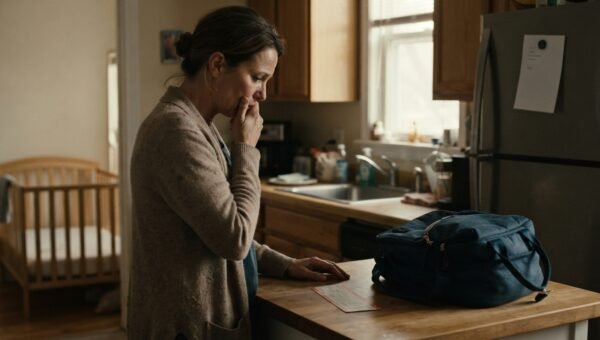
Then, on a Tuesday afternoon while I was sitting at the kitchen table sorting through mail, my phone buzzed. It was a text from my father.
There was no “Congratulations,” no apology, and not a single word about missing my wedding.
His text read: “We need to raise $8,400 for your brother’s wedding venue deposit by Friday. Send your share directly to my account today so the date doesn’t get dropped.”
I stared at the screen for a long time. The screen went dark, and I tapped it awake again just to make sure I had read the number correctly. Eight thousand four hundred dollars. Kevin had gotten engaged two months earlier to a woman named Chloe whose parents ran a local country club, and my parents had spent the entire spring bragging about how lavish that wedding was going to be. Now my father was texting me as if we were business partners settling an overdue utility bill.
My hands did not shake. That was the strange part. After three weeks of feeling a dull ache in my chest, something in me simply went flat and cold. I unlocked my banking app, entered my father’s checking account number, and typed in $1.00.
In the memo line, where you can leave a note for the recipient, I typed two words: “Best wishes.”
I hit send.
Mark was in the hallway closet hanging up his work jacket when I walked over to him. “Mark,” I said. “We need to call a locksmith right now. I want every lock on the front, back, and garage doors changed before five o’clock.”
Mark looked at my face, saw my phone still open in my hand, and did not ask a single question. He picked up his phone and called a mobile lock service across town. My father still had a spare key from three months ago when he offered to check on our water heater while we were closing on the house. I had forgotten about that key until the moment I pressed send on that one-dollar transfer.
The locksmith arrived forty minutes later. He had just finished tightening the brass deadbolt on our front door when a silver truck pulled hard into our driveway, tires skidding slightly against the dry gravel.
It was my father’s truck. But he had not come alone.
A white county cruiser pulled in directly behind him, blocking our driveway exit. My father stepped out of the truck, slammed his door so hard the metal rattled, and pointed a finger toward our front porch. A uniformed deputy stepped out of the cruiser, his hand resting casually near his duty belt.
My father walked right up the walkway, his face red with fury. He did not look at the locksmith, and he barely looked at Mark. He looked straight at me through the screen door.
“You think you’re cute?” my father shouted. “Open this door right now. The officer is here because you’re holding property that doesn’t belong to you, and we’re settling this today.”
PART 2
The locksmith gathered his drill and brass shavings from the porch without saying a word, handed Mark the new set of four silver keys, and walked quickly down the driveway past the police car.
The deputy walked up our porch steps. His name tag read Miller. He looked tired, the way county officers look when they realize they have been dragged into a petty family dispute on a hot afternoon.
“Ma’am,” Deputy Miller said, looking at me through the screen. “Your father here called dispatch reporting a domestic property dispute and a refusal to return family assets. He says there are several high-value family heirlooms and bank funds belonging to his household inside this home, and that you’ve locked him out after a financial disagreement.”
My father stood on the second step, chest puffed out, holding his phone in his right hand. “She took my mother’s diamond ring out of my safe two months ago, Officer. And she just sent a fraudulent transfer to mock me after agreeing to help with family expenses. I have a key to this house because I’m a co-owner of this property’s maintenance access, and she just had the locks changed right in front of me.”
Every word out of his mouth was a lie built out of half-truths he thought a stranger in uniform would believe.
“Officer,” I said, keeping my voice level. “My grandmother’s ring was given to me by my grandmother six years ago, with a signed handwritten letter and an appraisal receipt that are sitting in my lockbox. My father does not own this house. My husband and I bought it in March. Our names are the only names on the deed. My father had a spare key for emergencies, which I have the legal right to revoke on my own property.”
I opened the front door, leaving the locked screen in place. I held up my driver’s license against the mesh so Deputy Miller could see the address, then pointed to the stack of closing papers on the small entry table by the coat rack.
“If you’d like to see the deed and the mortgage agreement, Officer, they’re right here,” Mark added, stepping up beside me. “Mr. Vance has no ownership here. And as for the transfer, she sent him one dollar from her personal account with a note wishing his son well. That isn’t fraud. That’s a gift.”
Deputy Miller looked at my father. The officer’s posture changed immediately. The hand near his belt dropped to his side.
“Sir,” Deputy Miller said to my father. “Is your name on the deed to this house?”
My father’s jaw tightened. “I helped them find the place. I put time into this family.”
“Is your name on the title, sir?” the deputy repeated, louder this time.
“No,” my father muttered.
“Then you have no right to enter, and you cannot demand entry,” Deputy Miller said firmly. “Civil disputes over rings or family money have to go through the courthouse downtown. You cannot use the sheriff’s office to force your way into an adult daughter’s home. You need to get back in your vehicle and leave this property now.”
My father glared at the officer, then looked back at me. His face was mottled with red patches. “You’re humiliating me,” he hissed under his breath. “You think you won something today, Rachel? Kevin is getting married at the grand ballroom at Stone Ridge. People with actual standing in this county will be there. You gave me one dollar. One dollar. You just cut yourself out of this family for good.”
“You didn’t come to my wedding, Dad,” I said. My voice was very quiet, but the porch was so still that even Deputy Miller heard every syllable. “You didn’t show up. None of you did.”
My father didn’t flinch. He didn’t look ashamed. Instead, a mean, dismissive smirk pulled at the corner of his mouth.
“Why would we waste an entire Saturday watching you marry a mechanic in a church basement?” he said. “Kevin is building a real future. He needed our focus. You always were selfish, Rachel. Even when your mother took that $8,400 loan out in your name back in college, you complained about paying it off. You owe this family.”
He turned on his heel before I could answer, stomped down the steps, and climbed back into his truck.
Deputy Miller stayed on the porch for another thirty seconds, watching my father back down the driveway. Then the deputy looked at me through the screen. “Make sure you keep those doors locked, ma’am. If he comes back without an invitation, don’t argue with him. Just call us.”
After the cruiser followed my father’s truck down the road, Mark closed the heavy wooden door and locked the new deadbolt.
I stood in the entryway, staring at the floor. My father’s words were ringing in my ears, but not the insult about Mark being a mechanic or the church chapel where we got married.
It was the other thing he said.
“Even when your mother took that $8,400 loan out in your name back in college.”
I looked at Mark. “Did you hear the number he just said?”
Mark frowned. “He said eighty-four hundred. The exact amount he texted you for today.”
PART 3
I was twenty years old when that loan happened.
I was working thirty hours a week at a dry cleaner while taking nineteen credits at the state college forty miles away. One afternoon during my junior year, my mother called me in tears, saying the bursar’s office was going to drop my classes because my financial aid paperwork had missed a filing deadline. She told me she had gone down to the local credit union and taken out an emergency education signature loan of $8,400 to cover my tuition, but because her credit score was low, she had to put me on the note as the primary borrower.
She promised she and my father would make the monthly payments.
They made exactly three payments before my father claimed his contracting business had hit a slow winter. After that, the collection letters started coming directly to my campus mailbox. I spent three years working double shifts, skipping meals, and putting every spare penny toward that debt until the credit union balance hit zero the summer I turned twenty-four.
My parents had always framed it as a sacrifice they made for me. “We put our neck on the line so you could finish school,” my father would say at Thanksgiving dinners whenever the subject of money came up.
I walked into our home office, opened the bottom drawer of our filing cabinet, and pulled out an old green accordion folder marked *College Debt 2017-2020*. I had kept every single statement and payment receipt, because when you pay off a debt with your own sweat, you never throw away the proof.
I pulled out the original loan agreement from First Valley Credit Union, dated October 14, 2017.
The loan amount was exactly $8,400.
I had been listed as the primary borrower, with my mother as the co-signer. But attached to the back of the agreement was a copy of the disbursement voucher. The money had never been sent to the university bursar. It had been issued as a cashier’s check made out directly to my father’s personal business account.
And stapled right behind that voucher was a small carbon slip I had never understood when I was twenty. It was a transfer receipt from my father’s account to a regional youth travel baseball league, paid the very next morning.
The notation on the check read: *Kevin Vance – Elite Team Registration, Uniforms, and Florida Showcase travel fee.*
They had never paid my tuition with that money. My tuition that semester had been covered by a state grant that arrived two weeks late. My parents had used my name and my clean young credit to borrow $8,400 so Kevin could play travel baseball in Florida for a season. And then they handed me the monthly bills and told me I was ungrateful if I complained.
The $8,400 my father demanded today for Kevin’s wedding venue was not a random estimate. In his mind, that was the dollar figure he associated with Kevin getting what he wanted at my expense. He had done it once before, and he thought he could intimidate me into doing it again.
I pulled out my phone. I took a clear, high-resolution photo of the original loan document, the disbursement voucher showing the money went to his business account, the Florida showcase receipt, and the final paid-in-full letter from 2020 showing every single payment made from my personal checking account.
Then I opened the family group chat. The chat had been dead silent since three days before my wedding, when my mother had stopped replying to my questions about ceremony flowers.
I uploaded all four photos into the chat.
Underneath the images, I typed:
“In 2017, you borrowed $8,400 in my name without telling me the money was going to Kevin’s baseball travel fees, and you forced me to pay it back alone while I was in school. Today, Dad brought a police officer to my front porch trying to extort another $8,400 for Kevin’s wedding venue after skipping my own wedding three weeks ago.
Consider the one dollar I sent today the final payment on my relationship with all of you. Do not call me, do not come to my house, and do not ever put my name on another family expense.”
I hit send. Then I exited the group and blocked my father, my mother, and Kevin on my phone.
ENDING
Ten minutes after I sent those messages, Mark’s phone began to ring. It was my mother.
Mark answered it, put it on speaker, and set the phone in the middle of our wooden kitchen table.
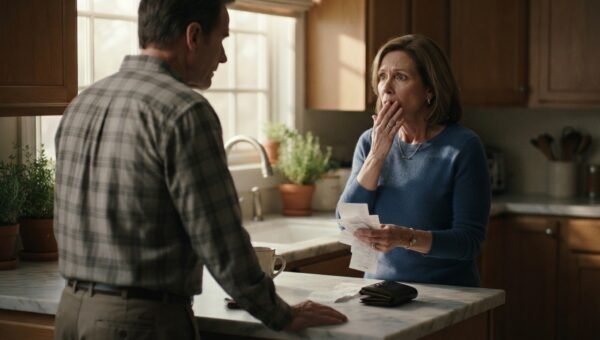
My mother was not screaming. Her voice was thin, nervous, and hurried. “Mark, please tell Rachel to take those pictures down. Kevin’s fiancee, Chloe, is on that family thread. Her mother saw the documents before Rachel left the chat. They’re asking questions about what kind of debts Kevin has and why his parents are hitting up his sister for venue money. This is ruining everything. Tell her to send a text saying it was a misunderstanding.”
Mark looked at me across the table. His expression was steady and calm.
“Mrs. Vance,” Mark said, his voice completely level. “Rachel didn’t create a misunderstanding. She posted receipts that she paid for with four years of her life. You skipped her wedding. You brought the police to our house today. There is nothing to take down, and there is nothing to discuss.”
“Mark, you don’t understand how this looks!” my mother pleaded. “The venue deposit is due Friday. If Chloe’s parents back out, Kevin loses the hall.”
“Then Kevin can get married at the courthouse,” Mark said quietly. “Or he can find a church basement like the one Rachel and I used. Goodbye, Mrs. Vance.”
He tapped the red button and ended the call. Then he blocked her number on his phone too.
We found out three weeks later through an old high school friend that Kevin’s wedding at Stone Ridge did not happen. Chloe’s parents did not cancel the wedding entirely, but they refused to co-sign the lavish package they had originally planned, and they moved the reception to a modest community banquet hall across town. My father had to take a second mortgage on his work truck to cover his portion of the catering.
Neither of my parents ever sent an apology. My brother never reached out to acknowledge that his sister had funded his teenage baseball trips with graveyard shifts at a dry cleaner. But the silence that followed was different from the silence on my wedding day.
On my wedding day, the silence felt like an insult I had to endure. Now, it felt like a boundary I had built with my own hands.
Two months later, on a cool Saturday in October, Mark and I planted two young maple trees in our front yard, right beside the gravel driveway where the police car had parked. When we finished packing the dark dirt around the second sapling, Mark wiped his forehead with the back of his work glove and handed me the garden hose.
I took the hose, turned the brass handle near the foundation, and watched the water soak deep into the soil around the roots. The silver keys on the kitchen counter inside belonged only to us, the house was quiet, and for the first time since I walked down that aisle, my life belonged entirely to me.