PART 1
My brother’s wife never let him answer his own phone.
For nearly two years, whenever I dialed David’s number, Karen picked up. She always had the exact same tone. Cheerful, slightly breathless, and completely dismissive. She would tell me David was out in the garage, or washing the car, or running an errand down the street. She always promised he would call me right back after dinner. He never did.
At family dinners before things got bad, we used to joke about it. My other brother, Mark, once called her David’s unpaid executive secretary. We laughed, but it was an uncomfortable laugh. David had always been quiet and slow to anger, the kind of man who smoothed over every rough edge in a room just to avoid an argument. Karen was the opposite. She managed everything. She managed their schedules, their social calendar, their bank accounts, and gradually, who David was allowed to see.
Then our father died.
It was sudden. Dad had a massive stroke on a Tuesday morning and passed away thirty-six hours later in hospice care. When I called David to tell him, Karen answered. She wept loudly, told me she would take care of David, and swore they would be at the service on Saturday.
Saturday morning arrived. The small chapel was filled with Dad’s old coworkers, his neighbors, and our cousins. David never walked through the door.
I called four times during the reception. Karen finally answered on the fifth ring, whispering that David had come down with a severe case of the flu. She said he had a 103-degree fever and was too weak to lift his head off the pillow. I was furious. I stood in the church parking lot with tears running down my face, listening to her apologize over and over, and all I could think was that she had stolen David’s last chance to say goodbye to our dad.
I did not call her back for two weeks. I was too angry. I told myself that if David wanted to let his wife cut him off from his own family in our worst moment of grief, that was his choice.
Three weeks after the funeral, a plain white postcard arrived in my mailbox.
There was no return address. There was no greeting or signature. In the middle of the white card, written in shaky, broken ink, were two sets of numbers.
They were GPS coordinates. The handwriting looked jagged, like a child trying to press a pen through wood.
I typed the numbers into my phone at the kitchen counter. The map zoomed in on a wooded area three counties north, just outside a town called Pine Creek. It was marked as Cedar Crest Restorative Care.
I left the dishes in the sink, grabbed my purse, and drove two hours up the interstate.
The building did not look like a nursing home. It was a secure, specialized rehabilitation facility for patients recovering from catastrophic brain trauma. When I walked up to the reception desk and asked for David Miller, the woman behind the glass checked her computer and frowned. She asked for my identification.
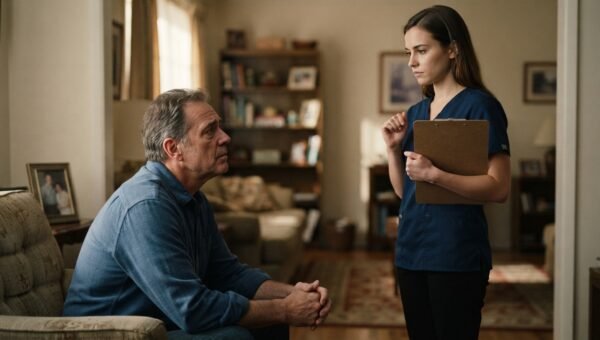
A few minutes later, a social worker named Evelyn came out to the lobby. She asked me to step into an empty consultation room. Her first question was quiet and direct: “How did you find him?”
I told her about the postcard. Evelyn looked down at her clipboard and let out a long breath. She told me that according to David’s legal intake documents, his wife was listed as his sole emergency contact and medical power of attorney. Karen had explicitly informed the staff that our family was estranged, hostile, and wanted zero contact with David during his recovery. Karen had instructed the facility to turn us away if we ever showed up.
“He’s been here for five weeks,” Evelyn told me quietly. “He was transferred from the regional trauma ICU.”
My hands started shaking. “What happened to him?”
“The record Karen provided says he was involved in a single-vehicle collision late at night on Route 9,” Evelyn said. “She told the hospital he swerved to miss a deer, hit a guardrail, and sustained severe blunt force trauma to the skull.”
Evelyn closed the door, looked down the hallway, and then turned back to me. “He has an hour before his afternoon occupational therapy. I’m going to take you in. Technically, I’m risking my job. But your brother has been trying to communicate with someone outside for a month.”
David was sitting in a wheelchair by the window of room 114.
He had lost at least thirty pounds. The right side of his face hung slightly slack, and a jagged scar curved around his left ear into his hairline. When he heard my footsteps, his head turned slowly. His eyes widened, and a broken sound came out of his throat.
I crossed the room and fell to my knees beside his chair. When I took his hand, his grip was weak and trembling. He could barely form words. He tried to speak my name, but it came out as a cracked syllable.
“I’m here,” I kept saying. “David, I’m right here.”
Evelyn reached into a cabinet and pulled out a clear plastic bag marked with David’s intake number. She handed it to me. “These were the personal effects brought in from the emergency room. His wife refused to take them home. She told the nurse to throw them out.”
Inside the bag was David’s watch, his wallet, a cracked key fob, and his smartphone. The phone had been smashed with such force that the screen was spiderwebbed into powder, the metal casing bent nearly in half.
Folded underneath the phone was a small piece of hospital scratch paper. It had words scribbled on it, written with immense physical effort:
“The accident wasn’t on the highway. It happened at home.”
I looked up at David, my heart pounding against my ribs. “David, what are you saying? Karen told everyo
PART 2
David could not write any more. The effort exhausted him. His breathing grew shallow, and his head slumped toward his chest. Evelyn stepped into the room, gently checked his pulse, and told me he needed to rest before his physical therapy session.
Before I left the room, I pressed my hands around his. “I am going to get you out of here, David. I promise you.” He gave a single, faint nod.
I walked back out to the parking lot with his plastic property bag on the passenger seat. My hands were shaking so hard I dropped my car keys twice.
If David had fallen down the stairs at their house, why would Karen tell the hospital he was in a car crash on Route 9? And why would she claim he had the flu while our father was being lowered into the ground?
I sat in the car and looked at David’s smashed phone. The aluminum frame had a deep, curved dent on the back, like it had been struck against the edge of a heavy tool or a stone step. Someone had deliberately destroyed it so it could never be turned on again.
I knew their house. It was a two-story colonial on Elm Ridge Road with an attached garage. Two years ago, after David had a set of tools stolen from his truck, he had spent a weekend installing a hardwired security system with motion sensors and door contact logs. I remembered him showing me the keypad in their kitchen. The system was monitored by a regional security company based in our county seat.
David had added my name to their house key list years ago, back when our mother was sick and I had to stop by to feed their dog while they were at the hospital.
I drove straight to the security company’s office in town. The receptionist was skeptical, but I showed her my driver’s license and explained that my brother was incapacitated in a care facility. Because my name was still listed on the emergency contact and access profile David had created three years earlier, the supervisor agreed to print the household activity and sensor log from the night of his injury.
The incident had happened on a Thursday night, two days before Dad’s funeral.
The report showed every movement in that house.
At 11:14 PM, the front door opened and closed.
At 11:22 PM, the motion sensor in the upstairs hallway registered movement.
At 11:28 PM, the sensor at the bottom of the basement stairs triggered an impact alert.
At 11:29 PM, the garage door opened.
There was no 911 call dispatched from the security system because the monitoring was set to silent burglary, not medical alarm. But the report showed that David’s car did not leave the garage until 1:45 AM.
Two hours later.
If my brother had fallen down the basement stairs before 11:30 PM, why did his car stay in the garage for over two hours while he lay bleeding with a cracked skull?
I drove to their house. Karen’s SUV was parked in the driveway.
I didn’t knock. I walked up to the front porch, opened the screen door, and stepped into the entryway.
Karen was sitting at the dining room table, surrounded by manila folders, bank statements, and Dad’s handwritten estate paperwork. When she saw me standing in the foyer, she jumped up, knocking a pen off the table.
“What are you doing here?” she demanded, crossing her arms. “You don’t just walk into my home.”
“I saw David,” I said.
Her face hardened, but she didn’t flinch. “I told that facility to keep you out. You have no legal right to interfere with his recovery. The doctors said family drama would set him back.”
“He didn’t hit a guardrail on Route 9, Karen,” I said, holding up the security printout. “He fell down the stairs right here. And you waited over two hours to put him in his car and stage an accident.”
PART 3
Karen didn’t cry. She didn’t scream. She walked over to the dining room window and pulled the curtain back, looking out at the empty street.
“You don’t know what our life was like,” she said, her voice completely flat. “You only saw the sweet, quiet brother who gave you advice. You didn’t live with the bills.”
“What bills, Karen?”
She turned around, her eyes cold. “Your father promised David half of his estate. We were counting on it. We had ninety thousand dollars in credit card debt from the business David tried to start three years ago. I kept it quiet. I protected his pride. But when your father updated his will six months before he died, he left the house to you and split the cash into a trust that David couldn’t touch without Mark’s approval.”
I stared at her. “Dad set up a trust because he knew you were draining David’s accounts.”
“David found out that night,” Karen said. She wasn’t yelling; she was confessing out of sheer arrogance, convinced she was untouchable. “Your dad had mailed a copy of the revised trust documents to the house. I had hidden them in the basement filing cabinet. David found them while looking for his tax returns. He came upstairs furious. He said he was going to take the papers, drive to your house, and tell you everything about the debt.”
She stepped closer to me. “He was standing at the top of the basement stairs with his phone in his hand, trying to dial your number. I grabbed the phone. He pulled back, his foot slipped on the runner, and he went backward down all twelve steps.”
The room was dead quiet.
“You left him at the bottom of the stairs for two hours,” I whispered.
“I was panicked,” Karen said without an ounce of shame. “He wasn’t moving. If the police came here and saw him broken at the bottom of the stairs with his phone smashed, they would have arrested me. I knew what it looked like. So I dragged him out to the car. I drove out to Route 9, pushed the front bumper into the guardrail, and called 911 from the road. I told them he took the car late at night because he was stressed.”
“And Dad’s funeral?”
“He couldn’t talk,” Karen said. “If your family came to the hospital, you would have asked questions. The doctors would have noticed things didn’t match. I needed him somewhere safe, where nobody could see him until he learned to keep his mouth shut.”
She pointed toward the front door. “I am his legal wife. I have his medical power of attorney. The police already closed the file on Route 9 as a weather-related single-car accident. You have a printout from a security alarm that proves nothing. Get out of my house.”
I didn’t argue. I didn’t yell.
I looked at the dining room table one last time, walked out the front door, and got into my car.
Karen thought she had covered every track. She assumed that because she had medical power of attorney and a closed police report, David’s silence belonged to her forever.
She forgot one thing. The regional trauma center that initially treated David had preserved the complete emergency intake scans and forensic medical notes.
I didn’t go home. I drove directly to the county prosecutor’s office.
ENDING
It took four months of steady, grinding legal work.
I hired an estate attorney who immediately filed an emergency petition in probate court to suspend Karen’s power of attorney, citing David’s handwritten note and the blatant contradiction between the security activity log and her 911 call.
The county prosecutor reopened the investigation. When the forensic team examined David’s initial hospital records, the evidence was undeniable. The fracture patterns on the back of David’s skull and his broken shoulder were completely inconsistent with a front-end guardrail impact at thirty miles per hour. They were textbook deceleration trauma caused by a fall down wooden steps. Furthermore, the emergency room physician noted that David’s body temperature upon arrival on Route 9 showed he had been lying in an unheated space for hours prior to the staged crash.
Karen was arrested at her office on charges of aggravated domestic assault, reckless endangerment, and filing a false police report.
With Karen facing criminal charges, the probate judge formally revoked her authority. The court appointed me as David’s legal guardian and temporary conservator.
We moved David out of Cedar Crest the following week. I brought him to a specialized outpatient clinic twenty minutes from my house, where he now spends four mornings a week working with speech and physical therapists.
David still speaks slowly. He walks with a cane, and he has to pause to find common words when he gets tired. But his mind is clear, and the fear that lived in his eyes for months has finally faded.
Yesterday morning, we sat on my back porch drinking coffee. The weather was cool and bright, the kind of quiet autumn morning our dad loved.
David reached into his pocket and placed something small on the glass table between us.
It was his gold wedding band.
He didn’t say a long speech about forgiveness or anger. He just pushed the ring across the table toward me, took a slow breath, and pointed toward the small wooden box where we keep Dad’s old pocket watch.
“Keep it,” David said, his voice quiet but steady. “I’m done.”
I picked up the ring, closed my fingers around it, and let my brother finish his coffee in peace.
ne you had the flu. Then she told the hospital you hit a guardrail on Route 9.”
David raised his right hand. He pointed a trembling finger directly at the gold wedding band still on his left finger.
Then, leaning forward with his breath shaking, he pressed his index finger onto the smooth laminate surface of the bedside table. Very slowly, dragging his finger through the dust and light, he traced five letters:
S-T-A-I-R-S.
He looked at me, his eyes full of fear, and tapped the table twice.