PART 1
I gave up my brother’s dog on a drizzly Tuesday morning because I had forty-two dollars in my checking account and an eviction warning taped to my front door.
My brother, Mark, died eight months earlier from a sudden stroke at forty-nine. He left behind a mountain of unpaid tool shop debts, an old Dodge pickup with a bad transmission, and a twelve-year-old golden retriever named Rusty. Our older sister, Brenda, took the pickup and sold it within four days. She told me the dog was my problem.
“You always were his favorite, Janice,” Brenda told me over the phone back then. “Besides, you’re the one who lived three streets away. I have white carpets and travel for work. Take the dog or take him to county intake.”
I took Rusty because I could still hear Mark laughing in the yard, throwing tennis balls until his shoulder burned. But grief does not pay rent. Two months after Mark died, my hours at the medical billing office were cut from forty to twenty-four. I could not afford my rental duplex, so I downsized to a basement studio on Elm Street. The landlord made the rules plain on day one: no pets, no exceptions, fifty-dollar daily fines for violations.
For six weeks, I smuggled Rusty in and out through the back alley before sunrise and after dark. He had bad hips. He moved slowly, his gray muzzle almost white against his golden fur.
Every time he climbed the four concrete steps to the alley, his hind legs shook. Then my landlord saw us on the security camera. He gave me seventy-two hours to get the dog out or clear my apartment.
I called Brenda first. She did not answer. She texted back twenty minutes later: “Do what you have to do.”
That was how I found myself standing in the tiled lobby of the valley animal shelter. The smell of bleach and wet fur made my throat tight. The intake worker barely looked up from her clipboard.
“Just standard intake,” she said, sliding a pen across the counter. “Surrender fee is fifty dollars.”
I handed her my last paper fifty. Rusty didn’t bark. He didn’t pull on the rope leash. He just leaned his gray snout hard against the meat of my palm, dropped his ratty canvas chew toy at my boots, and let the worker guide him down the narrow hall. He did not look back.
Two weeks later, the shelter called. A soft-spoken girl named Sarah told me Rusty had passed away in his sleep on his kennel bed. Old age and a tired heart, she said.
I sat on the edge of my mattress for three hours after hanging up. The guilt felt like a physical stone sitting behind my ribs. Finally, I got up to clean the studio. Mark’s ratty canvas toy was still lying in the corner where I had dropped it after walking back from the shelter. I picked it up, walked to the kitchen trash can, and shoved it down. The seam caught on an open soup lid and tore clean down the middle.
A small, heavy piece of metal clattered against the plastic bin.
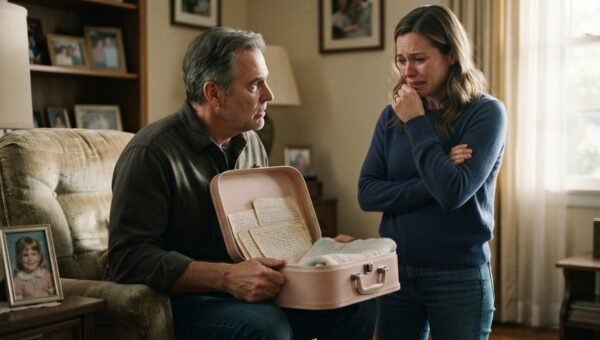
I pulled the canvas apart. Out fell a brass lockbox key, tarnished and green around the teeth. Wrapped tightly around the shank with a rubber band was a torn piece of yellow lined notebook paper. The handwriting belonged to Mark.
“If he gave you this, it means they finally backed you into a corner. Look under the floorboards behind the radial saw in my old garage. Brenda already took the deed, but she does not have the truth.”
PART 2
My hands were shaking as I pulled the rubber band off the paper.
Mark had owned an independent auto body and lawnmower repair shop on Tenth Street for fifteen years. When he died, Brenda had produced a typed power of attorney and a signed transfer agreement. She told me Mark had borrowed $62,000 from her over four years to keep his shop afloat, and that the property belonged to her to cover the debt. I had been too numb with grief to question it. Brenda had always handled money better than the rest of us. She drove a clean sedan, worked as an office manager for a regional contractor, and spoke with absolute certainty.
I took the afternoon bus out to Tenth Street. The shop had been locked behind a chain-link fence since November. A real estate sign was staked by the gravel drive: *Under Contract.* Brenda was selling the lot to a commercial storage developer.
I squeezed through the loose section of chain link near the overgrown sumac bushes. The side door to the shop was padlocked, but Mark had kept a spare key taped inside the electrical box behind the rain barrel since we were kids. I found it right where he always left it.
Inside, the shop smelled like motor oil, old grease, and cold concrete. Dust coated the workbenches. In the back corner stood his ancient radial arm saw. I got down on my knees in the dirt and felt around the perimeter of the wooden platform underneath. Three wide pine boards sat loose over a shallow foundation well.
I pulled the center board up. Beneath it sat an olive-drab metal ammunition box. The brass key from Rusty’s toy slid into the small padlock on the latch and turned with a dry snap.
Inside were three items: a handwritten ledger, a thick stack of bank deposit slips, and a certified copy of our mother’s original will from 2018.
I sat on the dusty floor and read through the pages under the gray light coming through the high shop windows.
Brenda had never loaned Mark $62,000. Mark had loaned Brenda $48,000 between 2019 and 2022 to cover her son’s legal troubles and her own credit card debt. Every check number, date, and repayment promise was documented in Mark’s careful, cramped pencil. Attached to the back was a notarized affidavit Mark had prepared two weeks before his stroke, alongside the original title to the shop.
Mark had not signed the shop over to Brenda. The deed Brenda used to put the property under contract was a forged quitclaim deed filed three weeks after Mark’s funeral.
Pinned to the back of the affidavit was a note Mark had written directly to me:
“Janice, Brenda threatened to tie the shop up in probate if I did not sign it over. I hid this here. Rusty knows to carry that toy when I tell him to watch something. If you have this key, you need to call John Keller at First County Legal. Don’t let her run over you.”
PART 3
I walked straight from the bus stop to the county recorder’s office the next morning. It cost me fifteen dollars to pull the recorded quitclaim deed Brenda had filed.
The signature at the bottom was a shaky, slanted copy of Mark’s name, dated two weeks before his death. Beside it was the stamp of a traveling notary whose commission had expired six months prior.
I did not call Brenda. I called John Keller. He had handled our parents’ modest estate five years back and remembered our family well. When I sat down in his small office on Market Street and laid Mark’s ledger, the original shop title, and the bogus quitclaim deed on his desk, his expression hardened.
“This isn’t just an estate dispute,” Mr. Keller said, adjusting his glasses. “This is felony forgery. If she closes on this sale, she is looking at wire fraud.”
He drafted an emergency lis pendens notice against the Tenth Street property that very afternoon, blocking the pending $210,000 sale to the storage developer. Then he sent a formal demand letter by certified courier directly to Brenda’s home address.
Brenda called my cell phone at seven that evening. Her voice was shrill, completely stripped of her usual polite condescension.
“What do you think you’re doing?” she demanded. “That sale was set to close on Friday. Do you have any idea how much money I have tied up in that property?”
“I found the ammo box under the radial saw, Brenda,” I said quietly.
The phone went dead quiet on her end. I could hear the television running in the background of her living room.
“You knew Mark didn’t owe you a dime,” I told her. “You took the Dodge. You forged his name on his shop. And when I was drowning and needed help with his dog, you told me to put him in county intake.”
“Janice, be reasonable,” she said, her voice dropping into a frantic, hurried pitch. “The developer was paying cash. I was going to give you twenty thousand out of the closing. I swear I was. We can split it. Just call Keller and pull the filing.”
“No,” I said. “You’re going to pay back the estate every dollar Mark loaned you, or Mr. Keller turns the notarized affidavit over to the district attorney on Monday morning.”
ENDING
Brenda did not go to jail, but she did not get the property either.
Faced with criminal prosecution for the forged deed, she signed a full release of claims and surrendered all authority over Mark’s estate. The title to the Tenth Street shop was cleared and returned to the probate estate, naming me as the sole surviving administrator and heir.
I did not keep the shop. I had no skill with engines or bodywork, and the building carried too many ghosts. Two months later, the storage company came back with an improved offer. We closed the sale for $225,000. After paying off Mark’s remaining vendor balances, the legal fees, and the back taxes, I received $168,000.
I paid off my small debts, left the basement studio on Elm Street, and bought a modest two-bedroom bungalow with a fenced yard on the south edge of town.
The guilt over Rusty didn’t vanish with the money. Some mistakes cannot be bought back, and letting that old dog spend his last fourteen days behind chain link will always remain my deepest regret. But on the afternoon I moved into the bungalow, I drove back out to the valley shelter.
I walked into the lobby, paid the adoption fees for two older, overlooked mutts who had been there for six months, and wrote a five-thousand-dollar check to their veterinary medical fund.
On my mantelpiece sits Mark’s brass key, polished clean, resting beside Rusty’s green canvas chew toy. I keep them right where I can see them every morning before I make my coffee. They remind me of the price of silence, and of the quiet loyalty of an old dog who held the truth until I was finally ready to look for it.