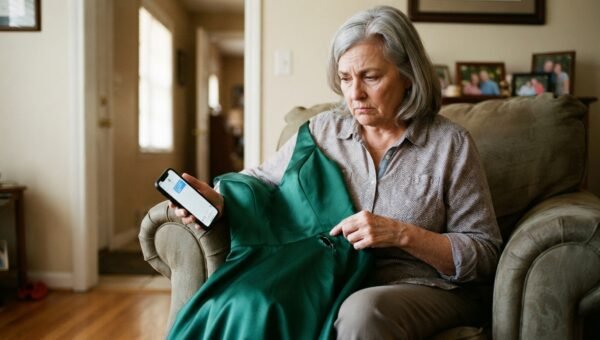
PART 1
I stood right next to the coat rack near the entrance of the banquet hall, holding a glass of ginger ale that had lost its ice twenty minutes earlier. The room smelled of expensive lilies, roasted beef, and the heavy perfume worn by women who had never worked a forty-hour week in their lives.
My older brother, Mark, was standing by the head table in a tailored black tuxedo.
He looked tall, polished, and completely at ease among people whose last names were on local hospital wings and law firm letterheads. His bride, Julianne, was laughing softly beside him, her diamond band catching the chandeliers.
Then came the moment that hollowed out the rest of my life.
Julianne’s father, a retired orthopedic surgeon who spoke with the quiet authority of a man used to being obeyed, tapped his butter knife against his champagne flute. The room went quiet. He pulled Mark forward by the shoulder and gave a glowing toast about character, perseverance, and background.
“When our Julianne first brought Mark home,” the father-in-law said into the microphone, smiling warmly across the room, “her mother and I wanted to make sure she was joining a good, steady family. And Mark showed us just that. He comes from such a clean, uncomplicated family. No drama. No baggage. Just good, quiet Midwestern roots.”
A ripple of polite applause went through the two hundred guests.
Mark laughed, nodded modestly, and took Julianne’s hand. He did not blink. He did not look toward the coat rack. He accepted every syllable of that lie like it was his birthright.
Ten minutes later, Mark walked Julianne over toward the lobby to greet a few late arrivals. As they passed me, Julianne glanced in my direction, noticing my plain navy dress that had come off the sale rack at Kohl’s.
“Oh, Mark,” she said, pausing with a gentle, patronizing smile. “Who is this?”
Mark looked directly into my eyes. His face did not twitch. His voice was completely steady, smooth, and pleasant.
“This is Sarah,” Mark said. “She’s a distant cousin from my mother’s side. She came in from out of town.”
Julianne gave me a polite half-second nod. “How lovely of you to make the trip, Sarah. Please enjoy the evening.”
Then they moved on toward the dessert table.
I did not scream. I did not make a scene. I simply set my warm glass of ginger ale down on the nearest linen-draped cocktail table, walked out the double glass doors into the rainy October evening, and got into my twelve-year-old Honda Civic.
I left before the three-tier cake was even cut.
Mark had not just been an older brother to me. He had raised me.
Our parents were killed in a two-car collision on State Route 41 when I was ten and Mark was barely nineteen. Our father was a drywall contractor who had let his life insurance lapse three months prior; our mother had worked part-time as a receptionist. There was no inheritance, no savings account to speak of, and no wealthy relatives waiting in the wings. There was only a mortgaged, drafty two-bedroom apartment above a laundromat on the north side of town.
The state social workers wanted to split us up or put me in foster care. Mark fought them tooth and nail. He went before a family court judge, worked two jobs—busting knuckles at an auto repair shop from six in the morning until three in the afternoon, and loading freight trucks until midnight—and proved he could support me. He gave up college. He gave up having friends his own age. He made sure my homework was finished, cooked pots of generic macaroni and beans, and sat in the front row at every single one of my middle school band concerts.
For nine years, Mark was my entire world. He was my father, my mother, and my protector.
And then, on the most public day of his life, in front of a room full of wealthy strangers, I became an inconvenient, distant cousin.
My phone started buzzing around nine that night while I was driving the ninety miles back to my small apartment in Indianapolis. It was Mark.
I did not answer.
He called three times the next morning. He left a voicemail on Tuesday saying, “Sarah, please let me explain. It’s not what you think. Just call me back.”
I erased the message. Over the next six months, he sent letters, cards on my birthday, and flowers on Christmas. I threw the flowers in the dumpster behind my complex and burned the envelopes unopened over my kitchen sink. If my existence was too dirty and complicated for his perfect new life, he was never going to have to worry about looking at me again.
I changed my phone number eight months later when my lease ended and I moved across town.
Ten years passed. A whole decade of silence, birthdays spent alone, and a stone cold anger that hardened in my chest until it became normal.
Then, on a Tuesday afternoon three weeks ago, a notification popped up on my personal email. The subject line read: *Sarah, please read this. It’s Julianne.*
PART 2
I almost deleted the email on the spot. My hand hovered over the trackpad of my laptop, my pulse thumping in my throat. Seeing Julianne’s name brought the shame of that wedding reception flooding straight back into the room.
Curiosity won. I opened it.
The email was short, formal, but clearly strained:
*Sarah, I know you have spent ten years avoiding us, and I know Mark hurt you deeply. Mark suffered a severe stroke two weeks ago. He is in the specialized rehabilitation wing at St. Vincent’s. He cannot speak right now, but he has been agitated and writing notes on a pad. The only thing he keeps writing over and over is your name, and “the blue notebook.” I searched our attic and went through his old boxes from before we met. I found his high school things, but the notebook isn’t here. If you still have that little blue spiral notebook from your childhood apartment, please write back. I think it is the only thing that might calm him down.*
I sat back in my desk chair, staring at the screen until the letters blurred.
Mark was fifty-one. A stroke.
My mind immediately went to the bottom drawer of my bedroom dresser. Underneath my winter sweaters and old tax folders lay a battered, five-by-seven blue spiral notebook with bent wire rings and rounded, frayed cardboard corners.
It was Mark’s notebook from the years he raised me.
When I moved out of our old apartment at nineteen to share a cheap flat with two roommates, Mark had handed it to me along with a spare set of car keys. He had told me to keep it somewhere safe so I would always remember how we survived.
I walked into my bedroom, pulled open the heavy bottom drawer, and lifted it out.
The front cover was faded, smudged with old grease marks from the garage where Mark used to work. I sat on the edge of my bed and flipped through the pages.
The first fifteen pages were mundane remnants of a hard, working-class life. Grocery lists from 2002: *eggs, powdered milk, cheap bread, generic oats, canned tuna.* Notes about my seventh-grade science project deadline. Reminders to get the brake pads checked on his pickup.
Then came the middle section. Mark had titled it: *Sarah’s Expenses & Milestones.*
Every single dollar he had scraped together for me was tracked in his neat, mechanic’s block handwriting:
– *Sept 14: School shoes and 3 pairs jeans – $84.50*
– *Oct 2: Sarah’s dental cleaning (cash discount) – $110.00*
– *Dec 18: Winter coat and boots – $62.00*
– *Mar 11: High school band trip deposit – $150.00 (Worked Saturday shift)*
Looking at those figures, written with so much devotion and exhaustion by a nineteen-year-old boy trying to keep his little sister fed, the thick wall of anger in my chest cracked. He had literally worked himself to the bone for me.
I turned past the lists, flipping through the back half.
On page forty-six, right at the bottom beneath the final tally of my first semester of community college tuition, Mark had written two sentences in heavy, black ink that I had never noticed before:
*”If she ever asks why I sent her away, give her page forty-seven.”*
I froze.
I pinched the paper and turned the leaf.
There was no page forty-seven.
The paper had been cleanly, deliberately sliced out with a razor blade close to the wire spiral. Only a tiny, jagged quarter-inch strip of white paper remained clinging to the metal rings. The back cardboard cover followed immediately after.
There were only forty-six pages in the book.
PART 3
I did not reply to Julianne by email.
The next morning, I took two days off from my job at the municipal water office, put the notebook in my purse, and drove three hours north to St. Vincent’s Hospital.
The rehabilitation unit smelled of floor wax and antiseptic. When I walked up to room 412, I found Julianne sitting in an armchair by the window. She had aged. Her hair was pulled back in a plain clip, her face was lined with deep exhaustion, and the diamond ring on her hand looked heavy against fingers that were trembling around a paper coffee cup.
She looked up when the door swung open. For a few seconds, she stared at me blankly, and then her eyes widened.
“Sarah?” she whispered.
She stood up, setting her cup down. Before I could say a word, her eyes welled with tears.
“You came,” she said quietly.
“Where is he?” I asked, keeping my voice level.
She stepped aside, gesturing toward the bed.
Mark lay there under a thin white blanket. The right side of his face was slightly slack, his dark hair streaked with grey, his breathing shallow and slow. He looked frail—nothing like the invincible big brother who used to carry fifty-pound sacks of concrete on his shoulder without grunting.
As if sensing someone in the room, his eyes fluttered open. He turned his head slowly toward the doorway.
When his eyes landed on me, his entire chest heaved. A low, broken sound came out of his throat, and his left hand—the good hand—clawed at the bedside railing, trying to reach out.
I crossed the room in three strides and grabbed his fingers. His hand was rough, calloused, and hot. He gripped my wrist with desperate, shaking strength, tears spilling immediately out of both eyes and running down his temples into his hair.
“I’m here, Mark,” I whispered, my voice breaking completely. “I’m right here.”
Julianne stood on the other side of the bed, wiping her face with a tissue.
“He’s been like this every time someone mentions you,” Julianne said. “Sarah… I owe you an apology that ten years cannot fix. But you don’t know the whole story. Neither of us did.”
I pulled the blue notebook out of my purse and set it on the nightstand beside his water pitcher.
“He wrote something in here,” I said, looking at Julianne. “He wrote: *If she ever asks why I sent her away, give her page forty-seven.* But page forty-seven was cut out. What did he do? Why did he call me a distant cousin at your wedding?”
Julianne closed her eyes and took a ragged breath.
“He didn’t do it to protect his pride, Sarah,” she said softly. “He did it to protect you.”
Julianne walked over to her tote bag on the window ledge and unzipped a side pocket. She pulled out a legal-sized cream envelope, creased from years of being folded and unfolded.
“Three weeks after Mark and I announced our engagement,” Julianne said, her voice shaking with quiet fury, “my father hired a private investigator to look into Mark. My father is an arrogant, controlling man who believed nobody was good enough for his daughter, especially a man who grew up in an apartment over a laundromat.”
She handed me the envelope.
“My father found something Mark thought had been buried twelve years earlier,” she continued. “The investigator found the original court records from when your parents died.”
ENDING
I opened the envelope. Inside was a photocopy of an old, faded sheet of ruled notebook paper—page forty-seven, the edges clearly matching the jagged strip still bound in the wire rings of the blue book.
Underneath the page was a formal legal document dated twelve years earlier, signed by an attorney representing the estate of the driver who had killed our parents.
I read the handwritten page first. It was Mark’s handwriting, dated the week after our mother’s funeral:
*Settlement offer: $185,000 for Sarah’s future care, college, and housing, paid into a restricted trust. Condition: Mark must surrender guardianship to the state or an approved foster home so the trust funds cannot be used to subsidize adult relatives. If Mark insists on legal guardianship, the insurer’s liability remains contested in court for years with no guarantee.*
*My decision: Refused the cash settlement. I will work whatever hours it takes to feed her myself. Nobody takes my sister.*
Tears were blinding me. I looked up at Julianne, unable to speak.
“My father didn’t care that Mark sacrificed a fortune to keep you,” Julianne said, her voice tight with grief. “My father found out that when Mark went to family court to fight the foster system, he had lied on his financial affidavit. Mark had taken an off-the-books loan of eight thousand dollars from an unlicensed lender—loan sharks my father called them—to prove he had enough emergency cash in the bank to qualify for your custody.”
Julianne swallowed hard.
“Two weeks before our wedding, my father sat Mark down in his study,” Julianne said. “My father told him that if Mark’s ‘trashy background’ embarrassed our family, or if his sister showed up acting like family, my father would hand those forged affidavits and the old loan records to the county prosecutor. He threatened to have Mark charged with perjury and financial fraud from twelve years prior. He told Mark it would ruin your clean record, too, because you had received state aid under that guardianship.”
My breath caught in my throat.
“Mark knew my father was bluffing about prosecuting you,” Julianne whispered, “but my father told Mark that if you were identified as his immediate sister, reporters and local society would dig into how Mark raised you, and the story of the loan sharks and the court fraud would be made public. He told Mark it would follow you into your career. Mark believed him. Mark was terrified of anything touching your life.”
I looked down at Mark.
He was watching me, his eyes wide and terrified, waiting for my verdict. He thought I would still hate him. He thought that after all these years, I would look at him with disgust.
The memory of the wedding reception flashed through my head—Mark standing stiffly beside the head table, taking the insult of being praised for a “clean, uncomplicated family” while his heart was breaking in half to keep his mouth shut. He hadn’t disowned me to elevate himself. He had played the part of the ashamed, distant cousin so Julianne’s father would have zero leverage to drag my name through the mud.
“Julianne,” I asked, my voice barely audible, “why are you showing me this now?”
“Because three days before his stroke,” Julianne said, her voice trembling, “Mark finally broke down and told me what my father had done ten years ago. I left my father’s house that night. I haven’t spoken to my father since, and I never will again. Mark kept this burden entirely on his own shoulders for a decade so I wouldn’t hate my own father, and so you wouldn’t be hurt.”
I dropped the papers onto the bed, leaned over the railing, and wrapped both arms around Mark’s neck.
His good arm came up instantly, clutching the back of my coat with every ounce of strength he had left. His face buried into my shoulder, and the quiet hospital room filled with the sound of a grown man weeping for the first time in ten years.
“I know, Mark,” I whispered into his ear, holding him tight. “I know everything now. You don’t have to carry it anymore. You don’t have to protect me from anything.”
His grip tightened, his chest shaking against mine.
For ten years, I had believed I was walking away from a brother who was ashamed of me. But standing in that quiet room, holding the man who had traded his youth, his peace of mind, and his own dignity just to keep a roof over my head, I knew the truth.
He had never sent me away. He had stood in the fire so the smoke would never touch me.
And this time, I wasn’t leaving before the end.