PART 1
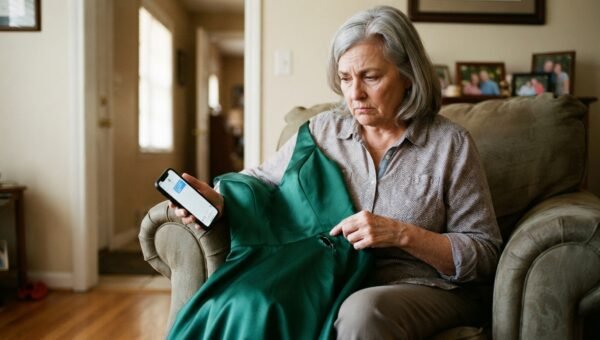
My daughter-in-law and I had been careful with each other since she and my son moved into my spare room after their apartment flooded. I let her choose the groceries, keep the baby’s schedule, and rearrange the kitchen. Still, one Sunday she set a place for me at the far end of the table and said, “We need to talk about boundaries.”
I assumed she wanted me to move out of my own home.
The house on Maple Street had been mine for thirty-one years. My late husband, Arthur, paid off the mortgage two years before he died, and the hallway still smelled faintly of cedar and lemon wax.
When the water main broke under Mark and Sarah’s duplex in June, soaking their subfloors and ruining half their furniture, I did what any mother would do. I opened my door. Mark took the garage for his toolboxes, Sarah set the portable crib by the radiator in my spare bedroom, and their eight-month-old boy, Leo, took over every flat surface in between.
I stayed out of their way. When Sarah bought unsweetened almond milk and whole wheat bread, I drank the almond milk and ate the bread. When she moved my spice rack from the counter to the pantry because the labels made the counter look cluttered, I left it there. When she pinned Leo’s nap chart to my refrigerator with heavy black magnets, I walked around on tiptoe between one and three in the afternoon.
I thought I was being a good host. I thought I was giving a young mother room to breathe.
That Sunday afternoon, Mark was at work pulling an eight-hour overtime shift at the lumberyard. Leo was down for his second nap. Sarah set down a chipped blue plate at the far head of the dining table, five feet away from where she usually sat. The chair was hard maple, pulled straight from the wall.
“Sit down, Evelyn,” she said. Her voice was flat, the way someone talks when they have practiced their lines in a mirror. “We need to talk about boundaries.”
The room went completely quiet. The only sound was the refrigerator compressor humming from the kitchen.
“If you need more space,” I started, folding my hands in my lap so she would not see my knuckles shaking, “I can stay with my sister Clara in town for a few weeks. You two need room with the baby.”
Sarah did not look relieved. She did not look angry, either. She reached into her canvas tote bag and slid a spiral-bound notebook across the mahogany tabletop.
The cover was bent at the corners. I opened it.
Every page was covered in Sarah’s small, tight pencil script, organized neatly by date and time.
July 14: Washed six Dr. Brown bottles and two pacifiers at 6:15 AM.
July 19: Picked up amoxicillin prescription at Walgreens drive-thru, paid $14.20.
July 26: Folded three baskets of infant laundry, placed on dresser.
August 2: Walked Leo in hallway from 2:10 AM to 4:15 AM so Mark could sleep.
August 11: Bought two boxes of sensitive wipes and four jars of strained carrots.
Page after page. She had recorded every load of wash I ran, every jar of baby food I bought, every floor I swept, and every hour I spent pacing the living room rug with my colicky grandson against my shoulder.
“Sarah,” I said, looking up over my reading glasses. “What is this?”
“That is ninety-two days of you helping,” she said. She was not crying, but her lips were pressed tight. “Ninety-two days of you stepping in.”
“I was trying to help,” I told her. “You have a baby. Your apartment is ruined. I live here.”
“I know what you were doing,” she said.
She reached across the table, took the corner of the notebook, and flipped past three months of dates until she reached the very last ruled leaf.
Taped to that cardboard backing was an empty white business envelope with a water stain along the bottom crease.
“You never said a word to Mark,” Sarah said, pointing a finger directly at the paper. “Why did you never tell my husband about the envelope you found behind the washing machine?”
PART 2
The white envelope had sat behind my Maytag washer for three weeks before I ever touched it.
It happened in the middle of July. Leo had spit up on his yellow blanket, and while I was shaking the blanket out near the laundry sink, a stray infant sock slipped off the rim and dropped into the dark space between the washer and the drywall.
I took an old wooden yardstick from the utility closet to fish the sock out. The yardstick hit something stiff. When I dragged it back into the light, the sock came with a heavy white mailing envelope, thick with dust and gray dryer lint.
There was no stamp on it. Across the front, someone had written one word in black marker: SARA.
I almost left it on the dryer lid. But the flap had never been licked shut, and when I picked it up, the contents shifted.
Inside was $4,600 in fifty-dollar bills, held together with two wide rubber bands. Tucked behind the bills were four yellow carbon receipts from Miller’s Gold and Pawn on 8th Street, dated two weeks before the duplex flooded.
The receipts were all made out to Sarah Miller. She had pawned an eight-millimeter gold link bracelet, two small rings, and a diamond filigree cross.
I knew that cross. Sarah wore it on her wedding day. Her mother had given it to her before she passed away from cancer five years ago. It was the only piece of jewelry from her mother that Sarah owned.
Underneath the pawn slips was a folded bank statement addressed only to my son, Mark. It showed a zero balance on their joint savings, followed by two overdraft notices totaling $3,800. Across the top of the statement, Mark had written a note to a man named Cooper: Cash deposit on trailer inventory. Balance due by July 1.
I stood there in the utility room with the basement draft on my ankles, piecing together the disaster Mark had made.
My son has always had big ideas that moved faster than his common sense. He had taken their entire emergency cushion, nearly four thousand dollars, to buy into a secondhand utility trailer scheme with a coworker. The money was gone. The coworker had disappeared with the deposit, and the duplex pipe had burst ten days later.
Mark had not told Sarah about the lost savings. He had blamed their empty bank account on moving costs and emergency hotel rooms after the leak.
Sarah had not believed him. She had taken her mother’s cross to the pawnshop on 8th Street, pulled out her own private emergency cash, and hid the money behind my washing machine so Mark could not touch it.
I did not go to Mark. I did not wave the envelope in his face.
Instead, I took the four pawn slips down to Miller’s Gold and Pawn on my lunch break that same Thursday. I took $1,280 out of my own checking account, paid the redemption fees, and got Sarah’s mother’s cross and rings back in their small velvet bags.
Then I walked back to my utility room. I placed the cash, the receipts marked PAID IN FULL, and the velvet bags into a clean two-gallon freezer bag so the concrete dampness would not ruin the bills. I slid the whole package back behind the washing machine, exactly where Sarah had tucked it.
I never said a single syllable to either one of them.
Now, sitting across from Sarah at my dining table, the clock in the hall struck two.
“I found it when I dropped Leo’s sock,” I said quietly. “The water hose on that machine sweats in the summer. I put it in plastic so the papers would not mold.”
Sarah stared at me. Her hands stayed flat on the table, but her fingers curled into fists against the wood.
“I checked that spot two days after you did it,” Sarah said. Her voice dropped to a whisper. “I went back to hide another hundred dollars, and the dust was gone. The jewelry box was sitting on top of the cash. The pawn slips were stamped paid. Your signature was on the ticket.”
She looked down at her notebook.
“I waited,” Sarah said. “Every single morning since July, I woke up waiting for you to tell Mark. I waited for you to tell him his wife had a secret stash. I waited for you to tell him I was keeping money from him while he was killing himself on twelve-hour shifts.”
PART 3
“Why would I tell him that?” I asked.
“Because he is your son,” Sarah said. A small, ragged edge broke through her calm voice. “Mothers protect their sons. My father would have called the whole family into the kitchen and made a speech about loyalty. He would have told everyone I was deceitful. If somebody in my family does something nice for you, there is a bill attached to it. Every single time.”
She tapped the open notebook with the flat of her pencil.
“That is why I wrote all this down,” she said. “The bottles. The laundry. The groceries. The cough syrup. I thought you were building a balance sheet against me. Every time you washed a dish without asking, I thought, that is another ten dollars I owe her. That is another reason she gets to tell me how to raise Leo. That is another reason she will hold the pawn shop over my head when she decides she wants us out.”
I looked at the young woman sitting at the far end of my table.
She was twenty-seven years old. Her collarbones showed sharp under her gray cotton sweater. Her hair was pulled back in a clip that was missing three teeth, and the dark circles under her eyes were the exact color of bruised plums.
She was not trying to run me out of my house. She was terrified.
“Sarah,” I said, keeping my voice very steady. “Look at me.”
She hesitated, then raised her chin.
“When Mark was seven,” I said, “Arthur decided he was going to buy an abandoned gas station on Route 9. He did not tell me. He took our savings, nine thousand dollars we had put away for a new roof, and gave it to a cousin who promised a franchise deal. The cousin lost the money in three months.”
Sarah did not blink.
“Arthur’s mother lived two streets over,” I continued. “When she found out, she came to my kitchen, sat in the chair you are sitting in right now, and told me that a good wife keeps her husband’s books. She told me it was my fault for not paying closer attention. She told me I drove him to it by asking for a vacation.”
I pointed toward the hallway, toward the framed photo of Arthur holding Mark on his shoulders by the lake.
“I spent twelve years paying off that nine thousand dollars with sewing work at night,” I said. “I never had an envelope behind a machine because I did not have four thousand dollars to hide. If I had owned a cross like yours, I would have pawned it twice over.”
Sarah looked down at the table. Her shoulders gave one hard, sudden jerk.
“You think I stayed quiet to build a case against you,” I said. “Sarah, I stayed quiet because I know how heavy it is to carry a man’s pride when you are trying to feed a baby. I did not tell Mark because it was not my place to shame him, and it was certainly not my place to expose you. You saved your family from an eviction notice.”
A tear ran down her nose and hit the blue spiral notebook, soaking into the date for August 11.
“I don’t know how to let people help me,” she whispered. “It makes me feel sick to my stomach.”
“Then we will fix the boundary,” I told her. “Right here. Today.”
ENDING
I stood up from the hard chair at the end of the table.
I did not go over and hug her. When a woman is that wound up, a hug feels like another person’s hands around her ribs. Instead, I walked to the kitchen, poured two mugs of black coffee, and brought them back. I set one in front of her and sat down in the chair right next to hers.
“Here is the rule,” I said, sliding the notebook toward myself. “You stop keeping score in my house. If I wash a bottle, it is because the bottle is dirty and I have two working hands. If I pick up a prescription, it is because I was already driving past the store.”
Sarah picked up her mug with both hands, using the heat to warm her fingers.
“And the money?” she asked.
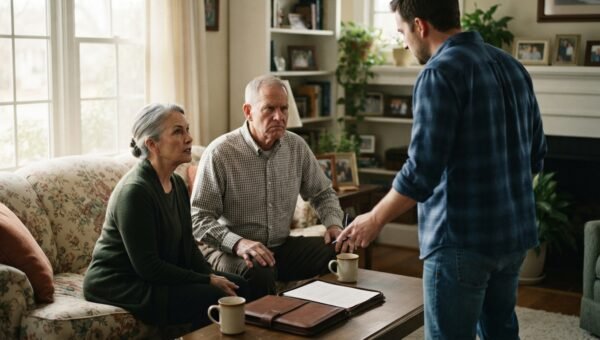
“You take that freezer bag out from behind the washer tonight,” I said. “You put it in your top drawer under your sweaters. That is your emergency fund, and it stays yours. But you do not carry Mark’s secret by yourself anymore. Next Saturday, the three of us are sitting at this table before his shift. We are putting every single bill on the wood, including the trailer deposit. He is going to look at what he spent, and he is going to help us build a budget to pay it back.”
Sarah looked at the white envelope taped to the paper. “He will be humiliated.”
“A little humiliation never killed a grown man,” I said. “Carrying it alone will kill a marriage.”
She sat there for five minutes without speaking, just sipping the coffee until the steam stopped rising. Then, slowly, she reached out, took the edge of the spiral notebook, and tore the last page off the wire binding. She folded the sheet with the envelope inside, stood up, and carried it down the hall toward her room.
That was fourteen months ago.
Mark did not like that Saturday meeting. He sat red-faced for an hour, staring at his boots while Sarah laid out the numbers line by line. But he stayed in his chair. He took a second job running weekend deliveries for the building supply company, and by March, he had repaid my checking account every dime of the pawn redemption fee.
In May, they found a small two-bedroom rental half a mile south, with dry floors and a fenced yard for Leo to crawl in.
Yesterday, I went over to their place to drop off a plastic tub of vegetable soup. When I walked into Sarah’s kitchen, the counter was clean, the baby gate was locked, and right beside the stove sat my old wooden spice rack. She had sanded the finish and painted it cream to match her cabinets, but the little notch Arthur had carved on the bottom corner was still there.
“You left this when you moved,” I said, setting the soup on the table.
Sarah smiled, wiping her hands on an apron. “I didn’t leave it, Evelyn. I borrowed it. Come sit down. The kettle is already hot.”