PART 1
My sister Brenda told me Dad’s mail had stopped because he had canceled everything before his death. She said he knew his time was short, so he sat down with his checkbook, paid off his final utility bills, and shut down his rural route box. It sounded like something Dad would do. He was seventy-four, stubborn about his privacy, and hated leaving loose ends.
Dad had supposedly passed away two months earlier in late September. Brenda had handled his final weeks at a private assisted-care cottage two counties over.
She told me he went peacefully in his sleep, and per his strict written wishes, he was cremated immediately without an open service. She brought home a plain cedar box of ashes, placed it on her living room mantel, and we held a small memorial at the Methodist church with twenty neighbors and a potluck lunch.
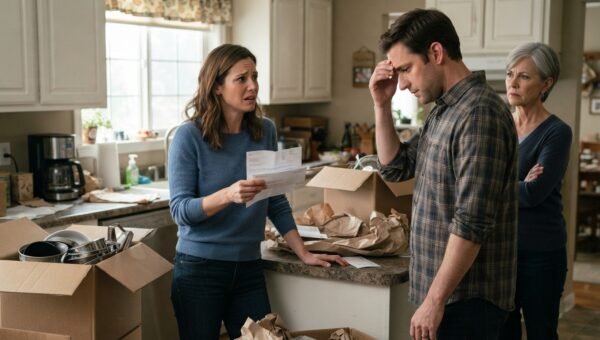
I took two weeks off work in November to drive out to Dad’s sixty-eight-acre farm on Mill Creek Road to start packing up the house. The place felt quiet and dusty. On my third day there, I stopped at the small county post office on Route 9 to ask about forwarding any final tax notices.
Jim, the postal clerk who had known our family for thirty years, pushed his glasses up his nose when I gave him my driver’s license.
“I’m glad you came in, Ruth,” Jim said. “We’ve got a whole stack of mail being held here in your name.
Your sister said you’d be stopping by to pick it up weeks ago.”
“Under my name?” I asked.
Jim pulled a thick bundle from the shelf behind him, held together with a thick blue rubber band. “She brought in a hold slip with your name signed at the bottom back in August. Said all mail for the farm address needed to sit right here until you cleared it.”
I took the stack to the wooden counter by the window. There were twelve letters. Every single one was addressed to Arthur Miller at the farm address. But when I looked at the edges, my stomach tightened. Each envelope had been sliced open with a letter opener, and then sealed shut again with a neat strip of clear Scotch tape. Someone had read them before me, taped them back together, and left them on the hold shelf.
I peeled back the tape on the top letter from a regional transit company in Lexington.
Inside was a printed receipt and a passenger bus voucher. The ticket was issued to Arthur Miller, and the travel date stamped across the bottom was October 14.
October 14 was three weeks after we had gathered at the church to mourn him.
My hands began to shake against the counter. I pulled my phone from my coat pocket and dialed Brenda.
“Brenda,” I said as soon as she answered. “I’m at the post office. There’s a bus pass here in Dad’s name. The date on it is three weeks after his funeral.”
Brenda did not gasp. Her voice stayed flat, almost bored. “Ruth, it’s just promotional junk mail. You know those travel clubs send fake voucher forms with names plugged in from old phone directories. Throw it in the trash and come over for coffee.”
“It’s not an advertisement,” I told her. “It’s an official receipt with a confirmation number.”
Before Brenda could answer, Jim tapped on the glass partition. He was holding one more envelope that had arrived in that morning’s regional dispatch.
“Here’s one more that just came in, Ruth,” Jim said. “It’s certified, and the sender is listed as St. Jude Regional Hospital over in Charleston, West Virginia.”
Brenda heard Jim through the phone line. The line went completely silent for two seconds. Then she spoke, her voice dropping into a sharp, tight whisper.
“Don’t touch that letter, Ruth. Stay right where you are. I’m coming down.”
Her house was eight miles away. She pulled into the post office gravel lot less than ten minutes later, her tires throwing stones against the curb. She slammed her car door, marched through the front entrance, and walked straight toward me with her hand outstretched.
Her knuckles were white. She leaned close enough that I could smell her peppermint gum, and she whispered, “You cannot let them send that letter back.”
PART 2
“Why can’t they send it back, Brenda?” I asked.
I pulled the certified envelope against my chest, out of her reach. Brenda’s eyes darted toward the counter where Jim was sorting packages. She grabbed my elbow, digging her fingers into my wool coat, and pulled me toward the glass front doors.
“Not in here,” she muttered. “Get in your truck.”
We walked out into the chilly November wind. I opened the driver’s side of my pickup, sat behind the steering wheel, and left the door cracked open. Brenda climbed into the passenger side, pulling the door shut with a heavy thud. Her breathing was fast and shallow.
“Give me the envelope, Ruth,” she said, her voice shaking now. “You don’t understand what kind of legal mess you’re getting into. I’ve been managing everything. I have the power of attorney.”
“A power of attorney ends the minute someone dies,” I said. “You told me Dad died on September 21. You told me you signed the cremation papers. So why is a hospital in West Virginia sending certified mail to him two months later?”
“Just give it to me,” she repeated, lunging across the console.
I blocked her arm with my forearm, wedged my thumb under the paper flap, and ripped the envelope open.
A two-page intake document fell onto my lap, printed on hospital letterhead. At the top was Dad’s full legal name, Arthur James Miller, along with his date of birth and his Social Security number. Below it was a handwritten note from a hospital social worker named Sarah Keller.
The letter stated that Arthur Miller had been brought to their emergency department five days ago by the county sheriff’s department. He had been found sitting on a bench outside a bus terminal in Charleston, carrying no money, no coat, and an empty medicine bottle. He was currently admitted to their geriatric medical floor, suffering from moderate dehydration and confusion, but medically stable. He had repeated his farm address until a nurse found an old property tax card in his boot.
The letter ended with an urgent request for his family or legal representative to contact the hospital immediately before the state initiated protective guardianship.
I stared at the black ink on the paper. The words were simple, clear, and real.
“He’s alive,” I said.
Brenda covered her face with both hands. She did not cry. She just pressed her palms against her eyes and slumped against the passenger window.
“He wasn’t supposed to get out,” she whispered.
“Who is in that cedar box on your mantel?” I asked, my voice rising. “Whose ashes did we bury at the church, Brenda?”
“Nobody’s,” she cried, finally looking at me. “It’s crushed charcoal and sand from the garden center. I bought the box online for forty dollars.”
The truth did not hit me like a sudden storm. It hit like cold water slowly filling a room. I had stood in the second row of the sanctuary, holding a tissue, listening to our pastor talk about Dad’s long years on the tractor, while the man who raised us was sitting in some strange room across the state line.
“Why?” I asked. “Tell me right now, or I’m walking back inside and calling the state police.”
Brenda wiped her nose with the back of her hand. Her face had lost all its color.
“Dad started getting confused in July,” she said, speaking rapidly. “He left the stove burner on twice. He drove the tractor into the creek bed and couldn’t remember how he got there. I took him to a clinic in town, and the doctor said it was the early stages of vascular dementia. Do you know what full-time memory care costs, Ruth? Seven thousand dollars a month. That’s eighty-four thousand dollars a year.”
She reached out and pointed toward the direction of the farm.
“The state would have put a Medicaid lien on the land,” she said, her voice hard with resentment. “Every single acre of the farm would have been sold off to pay a nursing home. You moved two hours away to Columbus. I’m the one who stayed here. That land was supposed to be our inheritance. It was supposed to be my security.”
“So you hid him?” I asked, sick to my stomach.
“I found a private residential home across the border near Pikeville,” she said. “A woman who runs a licensed adult home out of a converted farmhouse. She agreed to take him for twelve hundred a month in cash. No state paperwork. No Medicaid involvement. Dad agreed to it at first because he thought he was just visiting a friend’s hunting camp.”
“And the funeral?”
“If people in town thought he was still alive, they’d ask where he was,” Brenda said, staring at her lap. “The county assessor was already asking questions about his tax exemptions. I needed his estate settled so I could transfer the deed to my name using the survivorship transfer we filed three years ago. If everyone believed he passed away quietly, nobody would look for him. He was safe there, Ruth. He had a warm bed.”
“He was on a bus bench in West Virginia, Brenda,” I told her. “He walked away from that place, bought a bus ticket to try and get home, and collapsed in a terminal.”
PART 3
I picked up the hospital letter and dialed the direct phone number listed at the bottom for Sarah Keller in the social work department.
Brenda grabbed my wrist. “Ruth, think about what you’re doing. If you tell them who he is, adult protective services will open a full investigation. They will audit his accounts. They will see the cash withdrawals I made. I could go to jail. Everything we have will be gone.”
“You already took everything he had,” I said, pulling my arm free.
The hospital receptionist connected me directly to Sarah Keller.
“This is Ruth Miller,” I said, keeping my voice steady. “I am holding your certified letter regarding Arthur Miller. I am his daughter. He is my father.”
Sarah Keller let out a long breath over the line. “Thank God you called, Ruth. Your father has been asking for his barn keys for three days. He was very confused when the police brought him in, but with IV fluids and his regular blood pressure medicine restarted, he is alert. He told us he needed to feed his calves.”
“Is he in any pain?” I asked.
“No, dear,” Sarah said gently. “He’s tired, and his feet have some blisters from walking, but he’s resting comfortably. We were worried because the residential facility in Pikeville claimed he had been discharged to family two weeks ago, but nobody could find a record. We need a family member here to sign medical authorization.”
“I am leaving right now,” I told her. “I will be there in two and a half hours.”
I hung up the phone. Brenda was staring out the windshield, her jaw clenched tight.
“I took forty-five thousand dollars from his savings account,” Brenda said, her voice hollow. “I used twenty thousand of it to pay down my second mortgage, and I kept the rest in a safe deposit box to pay that home in Pikeville. The farm listing was supposed to go live on Friday. A developer offered three hundred and ten thousand dollars for the lower pastures.”
I didn’t yell at her. There was no point in shouting. The sister I grew up with, the girl who shared a bedroom with me under the farmhouse eaves, had weighed our father’s life against three hundred and ten thousand dollars and decided the land was worth more than his dignity.
“Get out of my truck, Brenda,” I said.
“Ruth, please. We can hire a lawyer. We can fix this quietly.”
“Get out,” I repeated.
She opened the door, stepped onto the gravel, and slammed it shut. I backed out of the post office parking space, pulled onto Route 9, and drove straight toward the interstate heading east into West Virginia.
While I drove, I called Deputy Miller at our county sheriff’s office. He was our second cousin on Dad’s side. I told him what Brenda had done, about the fake ashes, the cash withdrawals, and the adult care home in Pikeville. He didn’t interrupt me once. When I finished, he told me to go get Dad, and that he would personally visit the county clerk’s office within the hour to place a fraud hold on the deed to the farm.
I arrived at St. Jude Regional Hospital just after two o’clock in the afternoon.
Sarah Keller met me in the fifth-floor lobby and walked me down the quiet hallway to Room 514. When she pushed open the heavy door, I saw my father sitting in an armchair by the window.
He was wearing an oversized gray hospital gown and a pair of yellow non-skid socks. His hair was longer than he usually kept it, curling over the collar of the gown, and his skin was pale. But he was holding a plastic cup of apple juice, staring out at the parking lot below.
“Dad,” I said softly.
He turned his head. His eyes, the same pale gray as mine, narrowed for a second before his face softened into relief.
“Ruthie,” he said, his voice raspy and thin. “Did you bring the truck? Brenda put me in that strange boarding house with all those old folks, and they wouldn’t let me walk down to the barn. I had to wait until the side door was unlocked to get to the bus.”
I walked across the room, wrapped my arms around his shoulders, and buried my face in his neck. He smelled like hospital soap and peppermint, but underneath it, he still smelled like the woodsmoke and cedar shavings of our home.
ENDING
We stayed in Charleston for three days while the hospital doctors finished his evaluations. Dad had early vascular dementia, just as the clinic had noted, but with consistent medication, proper meals, and a steady routine, his mind was remarkably clear about everyday things. He knew who I was, he knew his farm, and he knew he never wanted to see the inside of that boarding house again.
Deputy Miller and the county prosecutor moved quickly back home. Brenda was formally charged with felony elder exploitation and custodial neglect. To avoid prison time, she entered a negotiated plea agreement that required full restitution of the forty-five thousand dollars she had taken from Dad’s savings. She had to sell her own suburban townhouse to pay it back. The court permanently revoked her power of attorney, and a protective order was put in place barring her from having any contact with Dad or stepping foot onto the farm.
I took an indefinite leave of absence from my administrative job in Columbus, packed my clothes, and moved into the front bedroom of Dad’s farmhouse.
With the money Brenda repaid and Dad’s monthly pension, we hired a licensed in-home caregiver named Martha, who comes in four mornings a week to help with his physical therapy, his meals, and his medicine. We placed the farm into an irrevocable family trust, ensuring that every acre remains protected and dedicated entirely to Dad’s living care for as long as he lives.
The church pastor came by the house a few weeks after we returned. He stood on the porch with his hat in his hands, apologizing over and over for holding a memorial service for a living man. Dad just laughed, waved his hand, and told him that at least now he knew who would show up when the real day arrived.
It is early spring now. The frost has finally left the ground, and the daffodils Dad planted along the stone driveway are coming up through the leaves.
Yesterday morning, the mail carrier drove up the gravel lane, tapped his horn twice, and left a small stack of envelopes inside our roadside box. There was a seed catalog, an electric bill, and a letter from Dad’s tractor parts supplier.
I brought the stack inside and set it on the kitchen table next to Dad’s coffee mug. He reached over, picked up the seed catalog, and turned to the back pages to look at the sweet corn varieties.
I sat down across from him, picked up the electric bill, and began reading the mail that belongs to him.