PART 1
At sixty-eight, you think you know the rhythm of your own life. Arthur and I had been married for forty-two years. We raised two children in this house, buried my mother in the plot five miles down the road, and built a quiet, predictable routine out of coffee at seven, gardening on Tuesdays, and the gentle give-and-take of two people who had memorized each other’s silences.
We had one standing rule that we had followed since our twenties: never go to bed angry.
It was a silly, stubborn little pact, but we took it seriously. If an argument flared up over something trivial like whose turn it was to service the well pump or how much we were spending on feed for the chickens, we stayed up. We drank lukewarm instant coffee at the kitchen table until someone caved and offered a sheepish half-smile.
Then came last Thursday.
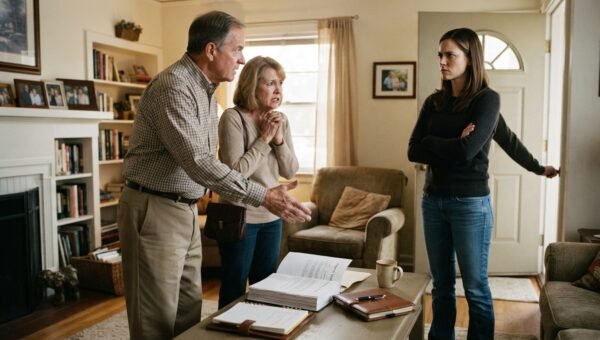
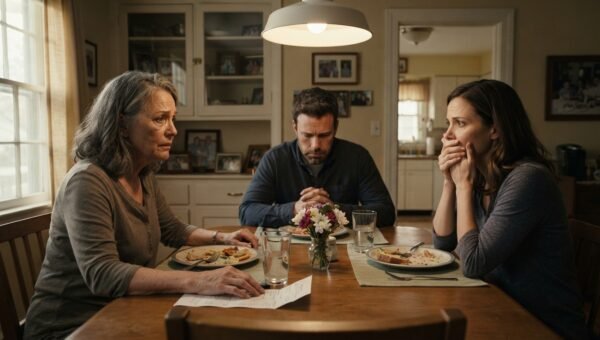
It started over dinner. Arthur had brought home a glossy stack of real estate brochures from a firm over in the county seat. He laid them right across the cherry-wood table, right on top of the placemat I had crocheted for our fortieth anniversary. He told me he had already spoken with an agent. He wanted to list our house, clear out forty years of memories, and move us into a sterile, overpriced independent living community near our daughter in Ohio.
I sat there with my fork frozen halfway to my mouth. We had discussed moving vaguely, years ago, when our knees first started giving us trouble on the basement stairs.
But we had always agreed we would stay put until the ground beneath us forced us out. This wasn’t a discussion. This was an executive decision he had made behind my back, complete with a valuation estimate and a suggested timeline.
The argument was fierce. It tore through the quiet evening like a chainsaw. I told him he was uprooting me from the only place I felt connected to my history. He told me I was being stubborn, that the maintenance was crushing him, and that I was living in the past. The words grew sharp and jagged, the kind of things you only say to someone when you know exactly where their soft spots are.
For the first time in forty-two years, we broke the rule.
At eleven o’clock, Arthur slammed his napkin down, pushed his chair back hard enough to gouge the baseboard, and walked out of the kitchen.
He didn’t go to our bedroom. He went straight down the hall to the cold guest room and clicked the lock shut from the inside.
I stayed at the table until midnight, staring at the glossy pictures of those tiny, identical apartments with their gray carpets and fake granite countertops. My chest felt tight, a dull, heavy ache that wouldn’t shift. I wanted to knock on that guest room door and finish it. I wanted to tell him that he couldn’t just erase our life because he was tired of cleaning the gutters. But my pride kept me glued to my chair.
At 2:14 a.m., I woke up in the dark. The house was dead silent, but something in the air had shifted.
The heavy thud of the front door latching shut echoed softly down the hall.
I threw off the quilt, pulled my flannel robe over my pajamas, and padded barefoot into the living room.
Arthur’s heavy canvas jacket was gone from the peg by the door. His car keys were missing from the ceramic bowl. I walked to the front window and pulled the lace curtain back just in time to see the red tailights of his Ford pickup sweeping across the gravel driveway and disappearing into the pitch-black country lane.
I told myself he had just gone for a drive to cool off. Men of Arthur’s generation do not know how to process panic or defeat, so they drive. I sat on the sofa in the dark, watching the digital clock flip silently from 2:30 to 3:00, then 4:00.
By sunrise, the gray light began creeping through the windows, and the truck still wasn’t in the driveway.
Panic, cold and sharp, replaced the anger in my chest. Arthur was a creature of absolute habit. He never left the property without telling me, let alone vanished into the night without his wallet or his blood pressure medication, which sat neatly in its orange bottle on the bathroom counter.
My hands shook so badly I dropped the landline receiver twice before I managed to punch in our daughter Lisa’s number. Lisa lived forty-five minutes away in a modest split-level with her husband and two teenagers.
She picked up on the second ring, her voice thick with sleep. “Mom? Do you know what time it is?”
“Lisa, is your dad there?” I blurted out, my voice cracking.
There was a pause. Not a confused pause, but a heavy, hesitant silence that made my stomach drop into my shoes.
“Mom,” Lisa said slowly, and her voice sounded unnervingly small. “Dad came here last week.”
“Last week?” I repeated, the words making no sense. “What are you talking about? He was here with me all week.”
“He came by on Tuesday afternoon while you were at the dentist,” Lisa said, and I could hear the rustle of bedsheets as she sat up. “He made me promise not to tell you unless something happened. He brought a small manila envelope and left it in my desk safe. He told me… he told me that if he ever disappeared overnight, I was to give it to you immediately.”
A cold sweat broke out across the back of my neck. I looked around our quiet, familiar kitchen, suddenly feeling like a stranger in my own home.
“Lisa,” I whispered, the floor seeming to tilt beneath my feet. “What is in that envelope?”
“I don’t know, Mom. He locked it. But you need to get in your car and drive down here right now. I’ll have it waiting on the kitchen table.”
PART 2
The drive down Route 9 felt like moving through a dream. The morning mist hung low over the cornfields, blurring the fence posts into gray smears. My foot pressed down harder on the accelerator than it should have, my mind racing through a dozen terrifying scenarios. Had Arthur received a medical diagnosis he was hiding from me? Was he losing his mind? Had he found someone else after all these years? Each possibility felt heavier than the last, but none of them explained why he had prepared an envelope for Lisa a full week before our argument.
When I pulled into Lisa’s driveway, her car was there, but Arthur’s truck was nowhere in sight. Lisa was waiting on the front porch, wrapped in a fleece bathrobe, her arms crossed tight against the morning chill. She didn’t wait for me to cut the engine. She pulled the car door open before I could even unbuckle my seatbelt.
“Did you hear from him? Is he at a hospital?” I asked, my voice trembling as I stepped out onto the gravel.
“No, Mom. Nothing. I tried calling his cell phone straight through to voicemail three times,” Lisa said, taking my elbow and guiding me toward the front door. “Come inside. I made coffee.”
The kitchen smelled of burnt toast and old coffee grounds, the usual chaotic backdrop of Lisa’s busy household, but today it felt frozen. Right in the center of the Formica table sat a thick, yellow manila envelope. My name was written across the front in Arthur’s neat, deliberate carpenter’s handwriting, using a black felt-tip pen.
I sat down heavily in one of the mismatched wooden chairs, my fingers hovering over the paper. It felt heavy, stuffed with something rigid.
“Do you know what’s in here, Lis?” I asked, looking up at my daughter.
“No, I swear to God, Mom,” she said, pulling out the chair next to mine and sitting down. “Dad looked… I don’t know. He looked scared. He told me he was trying to protect something, and that if things ever blew up between us, the truth had to come out. He made me swear on my kids’ lives I wouldn’t open it.”
I took a deep, shaky breath, slid my finger under the metal clasp, and unwound it.
Inside was a single, heavy brass house key with a jagged-cut edge and a small green luggage tag looped through the ring. There was also a folded piece of lined notebook paper. I pulled the paper out first, unfolding it carefully as if it might detonate.
Arthur’s handwriting stared back at me.
*Before you think the worst of me, go here first. The key opens the back deadbolt of the old Miller property on Maple Street. Check the workbench in the basement. I am sorry it had to come to this, but you needed to see what I’ve been covering up.*
I dropped the paper onto the table, staring at it blankly.
“The Miller property?” Lisa echoed, leaning in. “Mom, the old Miller place has been abandoned for six years. Old man Miller died back when I was in high school, and the bank put it into foreclosure. Nobody lives there. Why would Dad have a key to that house?”
“I don’t know,” I whispered, a cold knot tightening in my stomach. “I didn’t even know he talked to anyone about that place.”
“We’re going,” Lisa said firmly, standing up and grabbing her car keys from the counter. “Get back in your car, Mom. Follow me. We’re going to Maple Street right now.”
PART 3
Maple Street was a quiet, forgotten stretch of gravel road on the edge of the old mill district, lined with overgrown oak trees and sagging fences. The Miller property sat back from the road behind a thick wall of neglected boxwood shrubs. The white paint on the two-story farmhouse was peeling away in long, gray strips like sunburned skin, and the front porch sagged heavily toward the overgrown lawn.
Lisa pulled her car off the shoulder and parked right behind the rotting wooden fence. I pulled in right behind her, leaving my engine running for a moment as I stared at the gloomy, silent house. It looked dead. It looked like the kind of place kids broke into on Halloween weekends.
We walked up the weed-choked concrete path together, our sneakers crunching on dry twigs.
“Are you sure you want to do this, Mom?” Lisa asked, her hand resting on my arm. “We could call the sheriff. If Dad is mixed up in something illegal…”
“No,” I said, finding a sudden, hard core of resolve beneath my fear. “Arthur is my husband. If he left me a key to this godforsaken place, I am going to walk through that door and find out why he made me a liar in my own life.”
I walked around to the back of the house, where a weathered screen door hung loosely off its single bottom hinge. Behind it was a heavy wooden door fitted with a modern brass deadbolt that looked entirely too clean and new for a rotting abandoned house.
My hands shook as I fished the heavy brass key out of my pocket and slid it into the lock. It turned with a smooth, oiled click that seemed terribly loud in the quiet morning air. I pushed the door open, and a wave of damp, dusty air rushed out to meet us, carrying the faint, unmistakable scent of fresh cedar wood and motor oil.
We stepped inside into a small mudroom. The floorboards creaked loudly under our weight. A narrow wooden staircase led down into the dark basement, illuminated only by a single bare bulb hanging from a cord on the ceiling.
Arthur had left the light on.
“Stay here,” I whispered to Lisa, though I knew she wouldn’t. We crept down the steps together, holding onto the splintered wooden handrail.
When we reached the bottom, the breath caught in my throat.
This wasn’t a damp, forgotten cellar full of old junk. It was a fully functional, meticulously organized woodworking shop. Expensive power tools—a Delta table saw, a heavy-duty planer, a drill press—stood along the concrete walls, clean and free of dust. Bins of sorted screws, bolts, and hardware lined sturdy plywood shelves.
And right in the center of the room stood Arthur’s workbench.
Spread out across the wooden surface were not woodworking projects, but piles of heavy manila folders, bank statements, legal deeds, and checkbooks.
I walked over to the bench, my legs feeling like lead. I picked up the top document, my eyes scanning the header. It was a property deed transfer, dated four months ago, moving the title of the Miller house—and twenty-three acres of surrounding timberland—into a single name.
Not Arthur’s name.
Not my name.
The name of a woman I had never heard of, living three counties over.
Beneath the deed was a stack of cashier’s receipt stubs. Thousands of dollars. Ten thousand here, fifteen thousand there, spanning back nearly three years. The total number at the bottom of the ledger column made my vision blur. It was nearly two hundred thousand dollars—every dime of the inheritance my mother had left me when she passed away, money we had supposedly put into a safe municipal bond fund for our retirement.
I picked up a personal letter resting near the ledger. It was handwritten on cheap stationery, addressed to Arthur.
*Artie, thank you for keeping your promise. The boys needed this trade school tuition more than you know. I know it’s hard keeping this from Martha, but once the property sells, we can finally put the past behind us. Love, Sarah.*
The room seemed to tilt sideways. The smell of sawdust turned suddenly to ash in my mouth.
Sarah. Two grown boys. Trade school tuition. A secret family tucked away in the shadows of a rotting farmhouse, funded entirely by the life my mother had given me, and kept alive by a man I had slept next to for forty-two years.
“Mom?” Lisa’s voice sounded like it was coming from the end of a long tunnel. She was staring at a framed photograph sitting quietly on the corner of the workbench.
It was a picture of Arthur, looking ten years younger, standing proudly beside a smiling woman with tired eyes and two teenage boys holding fishing poles. On the back, in Arthur’s familiar handwriting, it said: *Family reunion, Lake Lanier, July 2018.*
ENDING
I didn’t scream. I didn’t cry. The shock was so complete, so absolute, that it hollowed me out completely, leaving a cold, clear space where my heart used to be.
Arthur hadn’t wanted to sell our house because he was tired of the maintenance. He wanted to sell our house because he had run out of my mother’s money, and he needed a final, massive injection of cash to clear the debts of a second life he had built behind my back while I was busy tending our garden and believing in our forty-two years of quiet routines.
“Mom, what are we going to do?” Lisa asked, her eyes shining with sudden, hot tears of rage. “Do we call the police? Do we call a lawyer?”
I looked down at the ledger, then at the brass key still clutched tightly in my right hand. The metal was cold against my palm.
“No, Lisa,” I said, and my voice sounded steady, terrifyingly calm, like the surface of a frozen pond. “We don’t call the police yet.”
I picked up the stack of bank statements, the forged deed, and the family photograph, sliding them methodically back into the heavy manila envelope. I tucked the envelope securely under my arm.
“Put the lights out, Lisa,” I said, turning toward the basement stairs. “Your father wanted to play a very expensive game of hide-and-seek. But games end when the sun comes up, and it’s time to go home.”
We drove back to our house in absolute silence. When we pulled into the gravel driveway, Arthur’s Ford pickup was parked right where it always sat, gleaming dully in the morning sun. He was sitting on the front porch swing, his head in his hands, looking like an old, defeated man waiting for his sentence to be read.
As I stepped out of my car, he stood up, his face pale and haggard, opening his mouth to speak.
I held up my hand, stopping him dead in his tracks. I didn’t raise my voice. I didn’t throw the keys at him. I simply walked past him, opened the front door, and locked it firmly from the inside.
He could stay on the porch as long as he liked. For the first time in forty-two years, I was going to bed without him, and I wasn’t angry anymore. I was just finished.