PART 1
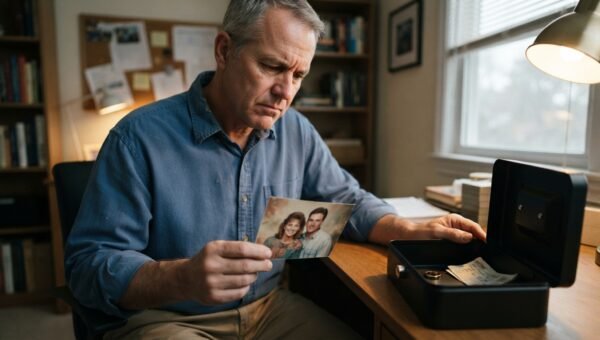
The phone was wrapped in brown paper towels and shoved all the way into the back of the bottom freezer drawer, tucked right inside a half-empty bag of frozen sweet peas.
Around the paper towel was a faded pink grocery receipt from a small discount market in Oakhaven, two towns north of where we live.
I stood there by the open refrigerator door with the cold air spilling across my bare feet.
It was a cheap prepaid smartphone, the kind you buy off a wire rack near the registers at a pharmacy. When I pressed the side button, the screen lit up with a prompt asking for a four-digit PIN. Below the numbers, the small text hint read: “Wedding month, her day.”
My birthday is October 14. October was also the month we married.
I heard Greg’s boots on the back porch steps, kicking off gravel. I set the phone on the island counter right next to the cutting board, the bag of peas still sweating onto the granite.
When he walked into the kitchen, he was carrying his work clipboard. He stopped, glanced down at the counter, and took off his jacket.
“Found that, did you?” he asked. His voice was completely steady.
“Why is there a phone in the frozen peas, Greg?”
He let out a short chuckle, reached into the fridge for a glass of tap water, and shook his head. “Artie from the warehouse lost his glove box key last month, and he asked me to hold on to it so his ex-wife wouldn’t go digging through his truck.
I tossed it in my work cooler, and when I unpacked the groceries on Sunday I must have set it in the freezer by accident.”
“The password hint is my birthday,” I said. “And the month we got married.”
“Artie asked me to set up the lock code for him when he bought it,” Greg said, setting the glass in the sink. “I couldn’t think of four numbers on the spot, so I used yours. You think I’m going to remember a stranger’s numbers?”
He patted my shoulder as he passed, like I was being silly, and went upstairs to shower.
We had been married for twenty-three years. Our daughter, Chloe, was getting married in six weeks at the community church where my parents were buried. We had deposits down on the flowers, the catering, and the hall. We had fifty chairs ordered for the lawn reception. You do not tear a house apart six weeks before your only child’s wedding over a frozen phone and an explanation that sounds ridiculous only because you want to believe your life is solid.
So I put the phone back on the counter and watched.
He did not hide it again. He left it right on the microwave, next to the mail tray.
The following Tuesday, Greg left his shift at the machine plant an hour early. I know because his supervisor’s wife mentioned seeing his truck pull out at three. I took my car and waited near the town line. He drove straight to the bakery by the old grain elevator, bought a single boxed lemon meringue pie, and drove south to the abandoned Cinema 6 lot behind the bypass.
He parked next to the rusted loading dock, cut his engine, and sat there in the cab of his truck for forty minutes. Nobody pulled up next to him. Nobody got out.
The strangest part was what happened when he came home.
The prepaid phone was still sitting on our kitchen counter. He had never taken it with him.
He had intentionally unlocked it before leaving that morning, leaving the screen awake on the settings menu.
Last night, after Chloe stopped by to drop off the final guest list, I sat down at the counter while Greg was out in the garage cleaning his weed trimmer. I tapped the screen.
There was only one photo album saved in the gallery. Everything else was wiped clean. The folder was labeled with a name I had never heard in twenty-three years of marriage, and it wasn’t a woman’s name at all.
It said: “Julian – 1999.”
PART 2
Inside that single folder were twelve pictures.
They were not clear digital photos. Someone had used the cheap camera on that phone to take pictures of old glossy prints resting on what looked like a wooden workbench.
The first was a picture of Greg when he was twenty-four, leaning against the blue Chevy pickup he sold the summer Chloe was born. Standing next to him was a boy with thick dark hair, wearing a high school baseball jersey that read “Oak Creek #7.” He couldn’t have been older than sixteen. He had Greg’s square jaw and the exact same slight bend in his left eyebrow.
The rest of the images were documents.
One was a hospital bill from 1999 from Mercer County Memorial, stamped in red ink across the front: PAID IN FULL. Another was a court filing for legal guardianship, but the name on the petitioner line was blacked out with heavy grease pencil.
The last image was a recent photo taken from a distance. It showed a small brick house with a green mailbox, a yellow porch light, and an older man in a wheelchair sitting near the front screen door with a navy blanket over his knees.
I looked up through the kitchen window. The garage light was still on, casting Greg’s shadow against the workbench as he replaced the trimmer line.
For twenty-three years, our budget had been simple. Greg worked the line at the stamping plant; I handled the books at the local hardware store. Every single dime was accounted for, or so I had always believed. But my mind went back to the spring before we got married, when Greg suddenly took a second job working overnight security at the lumber yard, claiming he wanted to build up our down payment. He had worked eighty hours a week for eighteen months, exhausted, quiet, and thin. When we bought our house, the down payment had been $14,000 less than what he had earned. He told me back then that the lumber company had shorted his tax withholding and he had to pay the state. I never questioned it.
I did not scream. I did not march out to the garage.
The next morning, after Greg left for his regular shift, I drove two towns north to Oakhaven, to the discount market listed on that grocery receipt.
It was an old independent grocery with wooden aisles that smelled like floor wax and ripe bananas. I walked up to the register with a bottle of seltzer. The woman at the counter was in her sixties, wearing an apron with her name pinned to the collar: Martha.
I pulled out the photograph of the brick house with the green mailbox that I had transferred to my own phone.
“I’m trying to find an old family address,” I said, keeping my voice mild. “Does this house look familiar around here?”
Martha adjusted her glasses and squinted at the screen.
“That’s over on Mill Street,” she said immediately. “Number 412. Old man Miller’s place. Though it’s not his anymore. His nephew lives there now, taking care of him.”
“His nephew?” I asked.
“Julian,” she nodded, bagging my drink. “Nice boy. Works the night stocking crew over at the dairy plant. He comes in every Wednesday morning for his groceries. He was just in yesterday afternoon, actually, picking up a pie.”
I paid for the water with cash. My hands didn’t shake until I got back into the front seat of my car.
Greg had bought the pie in our town. But Julian was buying pies too. Or Greg had dropped it off before sitting at that empty theater, waiting for something else entirely.
I didn’t drive back home. I drove straight to 412 Mill Street.
The house was small, with peeling white paint along the eaves and overgrown boxwoods flanking the front steps. The blue pickup truck in the driveway was twenty years old, its hood mottled with primer.
I got out of my car, walked up the three wooden porch steps, and knocked on the door.
Inside, I heard heavy footsteps, followed by the sound of a deadbolt sliding back.
The man who opened the door was about forty years old. He had dark hair cut short, tired gray eyes, and the exact physical posture of my husband when he stood by our kitchen sink.
He looked at me for three seconds. He didn’t look alarmed. He just looked deeply, terribly tired.
“You’re Ruth,” he said.
PART 3
“Yes,” I said. “I’m Ruth.”
He didn’t invite me in right away. He stood behind the screen door, looking past my shoulder toward the empty street, as if he expected another car to be parked behind mine.
“He told me you’d come eventually,” Julian said. “He said if you found the phone, it would take you about three days.”
“Why did he leave it?” I asked. “He left it unlocked on my counter.”
Julian pushed open the screen door. The living room smelled like menthol ointment and lemon pastry. A boxed lemon pie from our town’s bakery was sitting on the small kitchen table, untouched. Through the back hallway, I could see an older man asleep in a hospital bed with a television playing low with no sound.
“Because he couldn’t bring himself to tell you before Chloe’s wedding,” Julian said quietly, pulling out a vinyl chair for me. “And he couldn’t keep lying to you for another six weeks without choking on it.”
Julian sat down across from me. He didn’t offer me tea or water. He just folded his hands on the table.
“I’m his brother’s boy,” Julian said. “My father was Tommy.”
I stopped breathing.
When Greg and I started dating, he told me his older brother Tommy had died in a motorcycle wreck on Highway 9 in the summer of 1998. He had never kept pictures of Tommy in the house. He said it was too painful, that Tommy had lived reckless and died young, leaving nothing behind.
“Tommy didn’t die on a motorcycle,” Julian said. His voice was completely flat, drained of any old anger. “Tommy walked out on my mother and me when I was nine. In 1999, Tommy got picked up in Texas for a warehouse theft that went wrong. He got eight years. My mother had died of cancer six months before that. I was fourteen, sitting in county intake, about to be put into state foster care.”
Julian looked at the closed bakery box on the table.
“Greg was twenty-four. You two had just started talking about getting married. Greg came to the county office, took custody of me, and paid off Tommy’s back child support and medical bills so the state would release me to him. It was $14,000. He worked double shifts at the lumber yard to pay it.”
The missing down payment. The exhaustion. The silence.
“Where were you?” I asked. My throat felt thick. “We were together almost every night back then.”
“He couldn’t bring me home to your town,” Julian said. “He didn’t want you to take on an angry fourteen-year-old kid with a dead mother and a father in prison. He was terrified you’d walk away from him. So he paid my great-uncle Miller up here in Oakhaven room and board to take me in, and Greg drove up every Tuesday with groceries, money, and dinner. Every single Tuesday for three years until I finished high school.”
“And after high school?”
“I joined the Navy,” Julian said. “I did eight years. I came back, got a job, and moved in with Uncle Miller when his stroke hit. Greg kept coming. He never stopped coming up here every Tuesday. Not once in twenty-four years.”
“Why the second phone?” I asked. “Why hide it in the peas?”
Julian reached into his pocket and pulled out a key ring with two brass keys on it. He set them next to the bakery box.
“Because Uncle Miller’s house is in foreclosure,” Julian said. “The tax deed is going to auction on Friday morning. The back taxes are $9,200. Greg went to the bank last month to take out a personal loan to pay it off so I wouldn’t lose the only roof over my head. The bank told him they needed your signature because of the wedding loan you both took out for Chloe’s reception hall.”
Julian looked straight at me.
“Greg bought that cheap phone so I could send him the county tax notices without them showing up on your family plan. He put it in the freezer because he lost his nerve. Then he left it out on your counter because he knew he couldn’t sign the bank papers without telling you the truth. He’s been sitting in his truck behind that movie theater every Tuesday because he’s too ashamed to come in here and tell me he can’t save this house, and he’s too terrified to go home and tell you who he really spent his life protecting.”
ENDING
I drove home along the state route, the afternoon sun cutting low through the windshield.
When I pulled into our driveway, Greg’s work truck was already there.
I walked through the back door into the kitchen. The prepaid phone was still sitting on the counter by the microwave. Next to it was the brown paper towel he had pulled from the freezer, folded neatly into a square.
Greg was standing by the stove, heating soup in an old enamel pot. He didn’t turn around when the latch clicked.
“You went to Mill Street,” he said. It wasn’t a question.
“I did,” I said.
He stirred the soup once, then turned off the burner. He looked smaller than he usually did, his shoulders slumped inside his flannel shirt. He had the same tired expression his nephew had worn at that kitchen table two hours earlier.
“I didn’t steal from Chloe’s wedding,” he said, his voice barely above a whisper. “I swear to you, Ruth. I haven’t touched a dollar of the wedding fund. I was going to let the house go. I just couldn’t bear for you to look at me and think I spent twenty-three years keeping a second family from you.”
“You didn’t keep a second family,” I said. “You kept an orphan boy.”
He leaned his hands against the edge of the stove and looked down at the floor. His chin trembled, just once, before he forced it still.
“I thought if you knew what Tommy was, and what I had to do to pull Julian out of that system, you wouldn’t want a life with me,” he said. “You were twenty-two. Your parents had that neat brick house and your father had his pension. I had a brother in prison and a kid who hated my guts for making him do his homework in a rented back bedroom.”
“He doesn’t hate you,” I said. “He kept every single receipt from the groceries you bought him.”
I set my purse on the island counter, took out the checkbook we used for our household savings, and laid it next to the prepaid phone.
“The back taxes are $9,200,” I told him. “We have $11,000 in the emergency reserve that we haven’t touched since the roof repair three years ago.”
Greg looked up at me, his eyes wet. “Ruth, Chloe’s caterer is due next Friday.”
“The caterer is coming out of the checking account, like we planned,” I said. “And the flowers are paid for.”
I walked over to the stove, took the ladle from his hand, and set it on the spoon rest.
“We are going to the county office tomorrow morning at eight,” I said. “We’re going to pay the courthouse window in person. And on Friday, you’re going to call your daughter and tell her she has a cousin who needs an invitation to her wedding.”
He didn’t answer with words. He just reached out, took my hand, and held it against his chest.
The wedding went forward six weeks later, right on the lawn by the church.
Julian came in a dark gray suit that was a little tight across his broad shoulders. He sat quietly in the fourth row, on the groom’s side, holding the order of service in his lap. Nobody asked who he was, and nobody made a scene.
The prepaid phone is still in our kitchen. It isn’t in the freezer anymore, and it isn’t hidden. It sits in the wicker basket by the front door where we keep our keys and our spare change, right out in the open where anyone can see it.