PART 1
The brown fiberglass hull sat under a gray plastic tarp behind my garage for three years, six months, and two days.
My younger brother, Mark, towed it into my gravel driveway on a humid Sunday afternoon in the middle of his divorce. He told me his ex-wife had hired a vicious lawyer who was taking inventory of every tool, bank account, and fishing rod he owned. He said he needed somewhere safe to keep the nineteen-foot runabout until the property division was finalized.
“Just until the judge signs off on the decree, Sarah,” he said, wiping sweat off his forehead with an oily shop rag. “A couple months at most. Don’t let anybody poke around it.”
I gave him the space beside my utility shed. I never moved it. In the winter, I shoveled snow off the weathered tarp so the weight would not crack the fiberglass. In the summer, I ran the weed trimmer close against the rusted trailer tires so my neighbors would not complain to the township board.
When Mark finally called last Tuesday, his voice sounded rushed.
“I sold the boat to a guy from Grand Rapids,” he said into the phone. “He’s coming with cash tomorrow morning. I need the title and the registration slip. They’re in the locked glove compartment on the passenger console. The key is tucked inside the battery compartment.”
I took a flathead screwdriver and a flashlight out to the yard after dinner.
The evening air smelled like cut clover and damp earth. I pulled back the snapped edges of the canvas cover, climbed over the transom, and opened the small plastic battery box tucked near the fuel tank. The brass key was right where he said it was, resting on top of the black plastic battery casing.
I walked to the console, turned the key in the lock, and swung open the small compartment door.
It was empty.
No plastic registration sleeve. No folded title certificate from the secretary of state. No warranty papers for the outboard motor. There was only a layer of fine grit and a dried dead wasp.
I figured Mark had shoved the papers under one of the vinyl bench seats to keep them dry during a storm. I lifted the rear bench cushion on the port side. Underneath lay two orange life jackets stiffened by years of moisture.
When I picked up the second life jacket, a piece of heavy black duct tape on the underside caught my thumb.
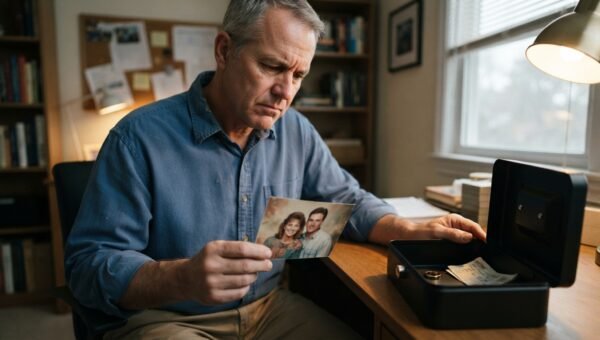
Taped flat against the foam core was an old metal motel key on a faded red plastic diamond tag.
I pulled the tape away. The plastic tag had gold lettering stamped into the red surface: PINE RIDGE MOTOR LODGE, ROOM 14.
Scratched crudely into the plastic right beside the room number were three initials: E.M.R.
Those were our mother’s initials. Eleanor Mae Reynolds.
Our mother had passed away seven years ago after four hard months in hospice care. Mark and I had cleared out her two-bedroom ranch house on Maple Street together. We had divided her quilts, sorted through her yellowed recipe cards, and split the small proceeds from her savings bond. I knew every box she had packed. I knew every piece of costume jewelry she owned. She had never stayed in a motel thirty miles down the highway in her entire life.
I walked back into my kitchen, set the key on the laminate counter, and looked up the Pine Ridge Motor Lodge on my phone.
It was an old twelve-unit brick strip out on Route 9, past the county fairgrounds.
The phone rang four times before a man answered.
“Front desk,” he said, sounding like he had been interrupted in the middle of a ballgame.
“Hello,” I said, holding the plastic tag under the kitchen light. “I found an old room key among my family’s storage things. It’s for room fourteen. I’m trying to figure out how old it is.”
“Room fourteen?” The man paused. I heard the clacking of keys on an old mechanical keyboard. “That room isn’t old business. That room is active. It’s been rented on the first of every month for nearly four years.”
My mouth went dry. “Rented by who?”
“Mark Reynolds,” the clerk said without hesitating. “Paid six months in advance by certified cashier’s check every spring and fall. The guest on the card is listed as Mrs. Reynolds.”
My mind immediately jumped to his divorce. I thought Mark had lied to me from the start. I thought he had been running around with someone while pretending to be broke, hiding money and hiding a woman while his ex-wife took their house.
“What does she look like?” I asked, gripping the edge of the counter.
The clerk gave a short, dry laugh. “Lady, I don’t get in people’s business, but she’s around your brother’s age. Maybe late fifties. Short gray hair, silver wire glasses, walks with a slight hitch on her left side. Wears those faded denim barn coats. I thought you were her calling about the water heater.”
I stood frozen in the middle of my kitchen.
Short gray hair. Silver wire glasses. A slight hitch in the left hip from an old fall off a porch step in 1984.
The clerk had not described a secret girlfriend.
He had just described me.
PART 2
I didn’t sleep that night.
I sat at the kitchen table with the red plastic motel tag resting beside my cold cup of tea. Every time I looked at the three letters scratched into the plastic—E.M.R.—my stomach twisted.
My mother had worked thirty-two years at the county clerk’s records office. She kept three ledgers on her nightstand: one for grocery bills, one for utility expenses, and one for our school clothes. She never threw away a receipt, never took out a personal loan, and never spent an extra dollar on herself. When she got sick, she made Mark the executor of her estate because he lived five minutes from her house, while I was an hour away working twelve-hour shifts at the hospital.
“Mark will handle the papers,” she had told me from her hospice bed, her fingers weak and paper-thin around mine. “He knows where everything goes. You just be my daughter.”
I had trusted him completely.
At seven in the morning, I took my car keys off the hook by the door, walked out to the garage, and drove straight down Route 9 toward the fairgrounds.
The morning fog hung low over the ditch grass. The Pine Ridge Motor Lodge looked even more tired in the daylight than I remembered. The faded neon sign by the highway had missing glass tubes, and the gravel parking lot had deep potholes filled with brownish rainwater.
Room 14 was at the far end of the single-story building, tucked behind a screen of overgrown cedar trees. A rusted blue Chevrolet sedan from the late nineties was parked in front of the door. The front bumper was held on with plastic zip ties.
I pulled my car into an empty stall near the dumpster and sat with the motor idling.
At seven-forty, the painted wooden door to Room 14 opened.
A woman walked out onto the concrete stoop carrying a white plastic bag full of trash. She had short, blunt-cut gray hair. She wore round silver-framed reading glasses and a heavy navy-blue canvas jacket with corduroy trim at the collar. When she stepped down toward the gravel, she favored her right leg, putting almost no weight on her left hip.
She didn’t just look like me.
She looked like my reflection in an old, warped mirror.
She had our mother’s sharp jawline, our mother’s narrow blue eyes, and the small chickenpox scar right below the left side of her lower lip that I had looked at in the bathroom mirror every morning of my life.
I turned the engine off. My hands were shaking so hard the keys rattled against the steering column.
I stepped out onto the gravel. The crunch of my work boots made her stop. She turned around slowly, holding the trash bag against her hip.
She saw my face, and the bag slipped from her fingers. It hit the wet gravel with a dull thud.
“Sarah?” she whispered.
Her voice had the same low, raspy pitch as mine when I caught a cold in November.
“Who are you?” I asked. My throat felt raw. “Why are you using my name? Why is my brother paying for this room?”
The woman didn’t run. She didn’t look angry. She just pulled her canvas coat tighter against the morning chill, her knuckles red from the cold air.
“I don’t use your name,” she said quietly. “My name is Evelyn. Evelyn Mae Reynolds.”
She stepped aside and pointed toward the open door of the room.
“You’d better come inside before Mark gets here,” she said. “He comes by every Wednesday at eight to bring my medication.”
PART 3
The room was clean, but it smelled of damp carpet, rubbing alcohol, and cheap peppermint hard candy.
There was a single queen bed neatly made with a faded yellow quilt from our childhood home on Maple Street. On the small laminate nightstand sat an old framed photograph of our mother standing on the front porch in 1968, holding a bundle wrapped in a pink receiving blanket.
I sat down on the hard vinyl armchair by the window. Evelyn sat on the edge of the mattress, her hands folded tightly in her lap.
“We were born forty minutes apart at St. Jude’s Hospital,” Evelyn said, looking at the floorboards. “July 14, 1961. You were born healthy. Five pounds, eight ounces. I came out blue with the cord wrapped around my neck. The doctors told our mother I had severe oxygen deprivation. They said I would never walk, never speak, and never live past my tenth birthday.”
I couldn’t breathe. “Mother never had twins. I saw the family Bible. My name is the only one written on that page.”
“Because our father made her hide me,” Evelyn said. Her voice was flat, without tears, like someone reciting an address they had memorized forty years ago. “He was a supervisor at the rail yard. He told Mother that having a damaged child would ruin his reputation and drain his pension. He forced her to put me into the state developmental home over in Coldwater when we were six months old.”
“Coldwater closed down thirty years ago,” I said.
“It did,” Evelyn nodded. “In 1992. When the state shut the facility down, Mother came and got me. Father was already dead by then. She didn’t have enough money to buy another house, and she was terrified of what people in town would say after lying for thirty years. So she rented a small trailer for me two counties over. She paid for it out of her clerk’s salary every single month. When she got sick in 2017, she knew she was dying. She knew I had nowhere to go.”
“She didn’t tell me,” I said, the pain pressing hard against my chest. “Why didn’t she tell me?”
“Because she was ashamed,” Evelyn said softly. “She told Mark on her deathbed. She made him swear on her Bible that he would take care of me. Mother had forty-two thousand dollars left in an old private insurance annuity. She didn’t put it in the will because she didn’t want the state to take it for Medicaid recovery. She signed the annuity over to Mark directly. She told him that money belonged to me, to keep a roof over my head and pay for my heart pills until it ran out.”
The door to Room 14 suddenly swung open.
Mark walked in carrying a brown paper grocery bag and a plastic pharmacy sack. He froze three feet inside the doorway, his eyes darting between me and Evelyn.
The grocery bag slipped from his arm. A carton of eggs cracked against the threshold.
“Sarah,” he stammered. “What are you doing here?”
“I found the key, Mark,” I said, standing up from the chair. “I looked under the life jacket in your boat.”
Mark’s face went red, then gray. He closed the door behind him and leaned back against it, his breathing shallow.
“It wasn’t supposed to happen like this,” he muttered, staring at the floor. “I was going to tell you after the divorce settled.”
“After the divorce settled?” I walked over to him, pointing at the plastic motel tag on the table. “You parked that boat in my yard so your ex-wife wouldn’t see it. But that wasn’t the only thing you were hiding, was it? You put Evelyn in a motel room thirty miles from home. How much of Mother’s annuity is left?”
Mark didn’t answer. He looked away, his jaw tight.
“Answer me, Mark,” I said. “How much?”
“Six thousand dollars,” he whispered.
“Mother left forty-two thousand seven years ago,” I said. “This motel costs six hundred a month. That’s less than twenty-five thousand dollars total for her rent and pills over four years. Where is the rest of her money?”
“My business went under during the lockdown, Sarah!” he snapped, his voice cracking with panic and shame. “I had payroll taxes due! If I didn’t pay the IRS, they were going to seize my truck and my shop! I borrowed twelve thousand from her account. I intended to put it back when the boat sold. That’s why I had to sell the boat today! The buyer from Grand Rapids is paying nine thousand cash. I was going to deposit every dime right back into Evelyn’s medical fund this afternoon.”
He wasn’t an evil man. He was just weak, selfish, and desperate, drowning in his own bad choices while keeping our sister hidden like an embarrassing secret in a roadside motel.
“You’re not depositing anything,” I said, my voice steady. “And you’re not selling that boat.”
ENDING
We stood in that small, stale motel room for an hour while Mark cried against the doorframe.
I made him drive his truck to the First National Bank branch in town. I stood over his shoulder at the counter while he withdrew the remaining $6,140 from the private account. I watched the teller count the bills and hand them directly to me.
Then I made him sign the title of the nineteen-foot fishing boat over to my name right there in the bank lobby, with the branch manager acting as notary.
We drove back to my house before noon. The buyer from Grand Rapids called Mark’s phone twice while we were on the highway. Mark looked over at me from the passenger seat, his eyes red and swollen.
“Tell him the boat is no longer for sale,” I said.
He answered the call, spoke two quiet sentences, and hung up.
By three o’clock that afternoon, Evelyn’s two cardboard boxes, her three bags of clothes, and our mother’s yellow quilt were sitting in my guest bedroom upstairs. The room had two south-facing windows that looked out over my garden, where the black-eyed Susans were starting to bloom.
Mark stood on my front porch, holding his truck keys in his hand. He looked small, stripped of the cocky confidence he had carried all his life.
“Are you going to tell the family?” he asked, unable to meet my eyes.
“Evelyn has been hidden for sixty-five years,” I said. “I’m not hiding her for one more minute. You can tell Aunt Clara and the cousins yourself, or I will do it at Sunday dinner.”
He nodded once, walked down the wooden steps, and drove away.
That evening, I cooked beef stew and buttered egg noodles on the stove. Evelyn sat at the kitchen table, watching me stir the pot with our mother’s old wooden spoon. She kept touching the edge of the laminate counter, as if she couldn’t quite believe the room was solid.
“You don’t have to keep me here, Sarah,” she said quietly, her silver glasses catching the warm light of the stove hood. “I’m used to being on my own.”
I set two white ceramic bowls on the table, pulled out the chair across from her, and sat down.
“You’re not on your own anymore,” I told her.
Tomorrow morning, we are going to the county clerk’s office on Maple Street to add her name to the family registry, right beside mine where it belonged from the start.