PART 1
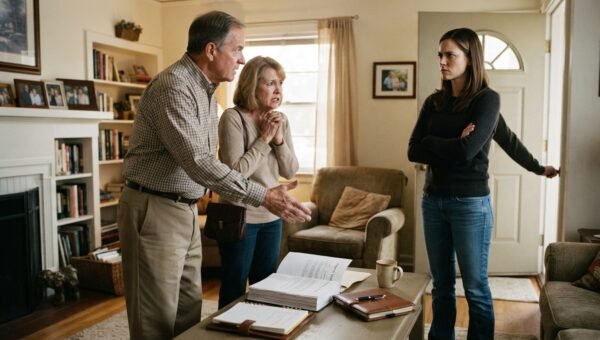
The day I came home from the hospital after my hip replacement, my son Todd carried my luggage into the back bedroom and set it down like he was unpacking a trunk in an attic. He told me the stairs were out of the question. He told me the hardwood floors in the front parlor were too slick. He told me that my small ranch-style house in Elmira, the home where I had raised him after his father passed, was now full of traps.
“You need to stay put, Mom,” Todd told me. He was forty-two, tall, and worked as an independent subcontractor on home remodels, though work had been thin for over a year. “The surgeon told me your bone density is paper-thin. One wrong shift, and you shatter the socket. If you fall, you are looking at permanent bed rest or a county nursing home. And you know what those places cost. Your monthly check wouldn’t even cover the laundry fees.”
My monthly Social Security check was exactly $2,180. It had been deposited reliably into my local credit union account on the third of every month since I turned sixty-six. Before the surgery, that check covered my property taxes, my heating oil, my groceries, and left me a little cushion for Sunday dinners. But Todd had convinced me to add his name as an authorized signer on the account during the week of my pre-op consultations.
He told me it was standard procedure so he could pay the hospital copays and utility bills while I was under anesthesia.
In the first two weeks, I believed every word. My hip ached, a deep, hot soreness that felt like an iron bolt driven into my pelvis. Whenever I reached for the aluminum walker the hospital had sent home with me, Todd hovered.
“Don’t do it alone, Mom,” he would say, stepping between me and the frame. “Wait for me.”
By the fourth week, the walker was gone from beside my nightstand. When I asked him where it was, he was rinsing a mug at the sink.
“I moved it down to the basement,” he said calmly, not turning around. “You keep trying to get up when my back is turned. You’re stubborn, and stubbornness is going to break your pelvis. I talked to the doctor’s office. They agreed you need strict immobility until the bone fuses.”
“What about the outpatient physical therapy clinic on Water Street?” I asked. “Dr. Vance said I had three sessions a week booked starting the second week.”
Todd sighed, turning with a towel in his hands. He looked exhausted, like a man carrying an impossible burden for an ungrateful mother. “I had to cancel them, Mom. I drove down there to talk to the billing coordinator. Your Medicare plan maxed out the rehabilitation rider. If we go back, it is two hundred and forty dollars out of pocket every single visit. Do you have seven hundred dollars a week to throw away? Your check barely covers the oil tank and your groceries.”
He brought me meals on a wooden tray. Oatmeal in the morning, canned soup at noon, and whatever takeout he picked up on his way over in the evening. He moved his duffel bag into the guest bedroom, claiming he had to live there full-time to keep me safe.
Whenever my sister Evelyn called from Syracuse, Todd answered the landline. I could hear his low, solemn voice echoing down the hall.
“She’s having a very rough day, Aunt Evie,” he would say. “Her legs are giving out. She can barely sit upright without getting dizzy. The doctor says we have to prepare for the reality that she may never walk again without full assistance. It’s heartbreaking, but I’m handling everything. Don’t worry about driving down, she sleeps eighteen hours a day anyway.”
He isolated me so quietly that I thought I was simply decaying. For three months, ninety-two days, I stayed in that back room. The outside world became the rectangle of sky visible through the side window and the sound of Todd’s pickup truck pulling into the gravel driveway. I began to doubt my own legs. When I swung them over the edge of the mattress, my knees trembled, not because the bone was broken, but because my muscles were wasting away from disuse.
Then, on a rainy Tuesday in early November, the mail carrier didn’t drop the letters in the outside box. The wind was whipping rain against the siding, and the front door had an old brass mail slot that fed straight into the front hall.
Todd had gone out to run what he called “business errands.” Around two in the afternoon, someone knocked sharply on the front door, twice. I called out, but nobody answered. A moment later, I heard the faint rustle of paper sliding through the draft sweep beneath my closed bedroom door.
It wasn’t mail. It was a single manila folder, folded in half, that had been pushed all the way across the hall runner by a sudden gust or someone who had stepped inside the enclosed porch.
I stared at it from my bed. My heart beat against my ribs like a trapped sparrow. To reach that door, I had to stand.
PART 2
I swung my feet to the floor. My bare soles touched the cold linoleum. I waited for the sudden, searing agony Todd had warned me about, the sound of bone giving way. Nothing happened. My quadriceps felt weak and stringy, but my hip felt solid. There was no grinding. There was no collapse.
I gripped the wooden bedpost, pulled myself upright, and stood. My balance swayed for a few seconds. I took a shallow breath, held on to the dresser, slid my hand along the edge of the wall, and reached the doorknob.
I knelt down, bracing my good knee against the floorboard, and pulled the paper into the room.
It was an official printout from the River Valley Physical Therapy Clinic. Across the top was my name, Clara Mercer, my patient ID number, and the name of a therapist named Megan Cole. Clipped to the front was a handwritten sticky note:
“Clara, we have tried calling your home number six times to reschedule after your son canceled your appointments, but your voicemail has been full. One of our drivers dropped off your home exercise progression chart since your insurance fully covers home-health transition. You were doing wonderfully on these before the sudden drop-off. Please call us.”
My hands shook so hard the paper rattled.
I looked down at the chart. It listed three distinct visits, dated during my second week post-surgery, visits Todd had driven me to before he claimed the insurance ran out. Right next to each exercise, Megan had scribbled notes in blue ink:
“Patient achieved 90-degree flexion without assistance.”
“Patient walked 60 feet on parallel bars with excellent stability.”
“Patient cleared for unassisted walker use at home on Day 14. Strong hip stability. Minimal risk of dislocation.”
Six weeks of progress. Documented, approved, and stamped by a licensed therapist. Todd had taken me to three sessions, seen me stand on my own two feet, and then told the clinic I had suffered a major setback while telling me the clinic was bankrupting us.
I held that paper against my chest. The betrayal did not hit me as sorrow; it hit me as cold, clear fury.
Ten minutes later, I heard his truck tires crunch on the driveway gravel.
I scrambled back onto the mattress, sliding the papers underneath my pillow. When Todd walked into the room carrying a plastic grocery bag, he was whistling. He had a brand-new silver watch on his wrist, something heavy and expensive that caught the bedside lamp light.
“How are we doing, Mom?” he asked, setting a carton of chocolate milk on the nightstand. “I checked your account balances while I was out. Everything is paid up, but we’re running thin. Might need to think about listing the house in the spring so we have cash reserves.”
I looked at him, looking straight into his eyes. “Todd, did the physical therapy clinic call here?”
His face did not change. He reached over, picked up my empty coffee mug from the morning, and poured fresh coffee from the thermos he had brought in.
“They called a while back trying to sell us private home-visit packages,” he said smoothly. He handed me the mug. “I told them we couldn’t afford it. Don’t worry about them, Mom. You’ll fall if you try to do what those twenty-something therapists want. They don’t care about elderly hips. They just want billing hours.”
“I think I could walk to the bathroom,” I said quietly.
Todd stopped. His smile vanished, replaced by an irritated, patronizing frown. “We’ve been over this. You fall, you die on the floor, or you go to a county ward. Now drink your coffee and rest.”
He walked out and clicked the door shut.
That night, after I heard his television turn off in the living room and his heavy snoring fill the hallway, I pushed the covers back. I did not reach for a walker, because I didn’t have one. Instead, I stood up on my own two feet. I walked to the bedroom doorway. I opened the door without a sound.
Using the kitchen counter as a railing, sliding my palms along the cold laminate, I crossed the entire length of the hallway. My ankles were stiff. My calves burned. But my hip held my weight completely. I walked past the hall closet, past the basement door where he had locked away my mobility, and stepped right up to the kitchen table.
Sitting on the counter was Todd’s leather organizer, unzipped. Inside lay the bank statements he had kept hidden from my room.
PART 3
I opened the folder under the faint yellow glow of the microwave clock.
My monthly $2,180 Social Security check had cleared on August third, September third, October third, and November third. But the money had not gone to property taxes or home heating oil.
On August sixth, there was an electronic withdrawal of $1,400 to a local auto parts supplier. On September tenth, $1,800 had been transferred directly into a personal checking account listed under Todd’s name. In October, there were three cash ATM withdrawals of $500 each from a casino forty miles west of Elmira. The balance in my credit union account, which had sat at $14,000 before my surgery, was down to $412.
On the floor beside the kitchen counter sat an open manila envelope from an estate liquidator. Inside was a draft contract for the private sale of my home, with a power-of-attorney clause marked with a yellow sticky tab where my signature was supposed to go.
He wasn’t protecting me from falling. He was keeping me in bed long enough to declare me legally incompetent, liquidate my property, and pocket every dime of my late husband’s legacy before anyone noticed.
I didn’t yell. I didn’t wake him up. I took the clinic progress report, the bank statements, and the estate liquidator’s draft, folded them together, and tucked them into the pocket of my housecoat. Then, holding the counter with one hand, I walked quietly back to my bedroom, shut the door, and locked it from the inside for the first time in three months.
The next morning, I used the landline extension in my room to call my sister Evelyn.
“Evie,” I said, keeping my voice level and low. “Don’t ask questions. Call Marcus and tell him to drive you down here. Be at my house by noon. Tell Todd you are coming to discuss my long-term care options.”
Marcus was my nephew, Evelyn’s son, and an investigator with the county sheriff’s department.
When Todd knocked on my bedroom door at eight in the morning with a bowl of oatmeal, he found the door locked.
“Mom?” he rattled the knob. “Why is this locked? Unlock the door.”
“I’m resting, Todd,” I answered from the bed. “Leave the tray in the hall.”
He cursed under his breath, banged on the wood once, and walked away.
By eleven-thirty, I heard two cars pull up the gravel drive. Todd answered the front door, his voice ringing out with forced cheerfulness.
“Aunt Evie! Marcus! What are you two doing here? If you called ahead, I could have told you she’s really not up for visitors today. Her hip is deteriorating. She’s mostly unresponsive.”
“We’re here anyway, Todd,” Evelyn’s sharp voice cut through his act. “We’re going to sit down as a family and figure out where Clara goes from here.”
“Fine,” Todd said, his voice tightening. “Let’s sit at the dining table. I’ve already done the research on facilities.”
I heard the dining chairs scrape across the floorboards. I took a deep breath, slipped my feet into my leather house slippers, and stood up. I didn’t use the wall for balance this time. I walked straight to my bedroom door, unlocked it, and pulled it open.
I walked down the hallway. My stride was slow, but it was steady, upright, and unassisted.
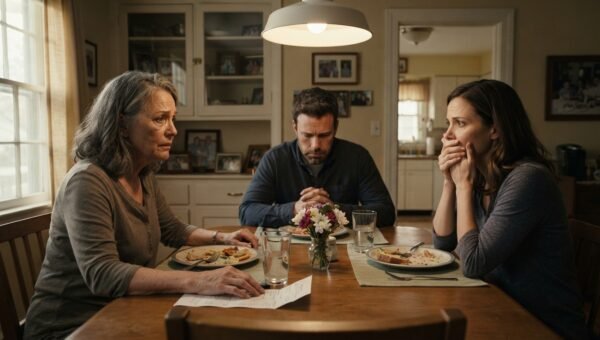
When I rounded the corner into the dining room, Todd was standing at the head of the table with a stack of brochures in his hands, explaining to Evelyn how expensive skilled nursing care was going to be.
Marcus saw me first. His eyes widened, and he immediately stood up from his chair. Evelyn gasped, putting her hand over her mouth.
Todd turned around, annoyed that they weren’t listening to him.
When his eyes landed on me, standing tall on my own two feet in the middle of the dining room entryway, the color drained out of his face so fast he looked like a corpse. His mouth opened, but no sound came out. The brochures in his left hand slid through his fingers and scattered across the floor.
ENDING
I did not wait for him to speak. I walked directly to the table, pulled out the chair opposite him, and sat down.
I reached into the deep pocket of my housecoat. I took out the therapy progression sheet, the four months of bank statements showing his cash withdrawals, and the liquidator contract for my house. I laid them flat on the polished mahogany table, right in the center, directly under the chandelier.
“You told everyone I was crippled, Todd,” I said. My voice did not shake. It was quiet, clear, and cold enough to freeze water. “You told your aunt I was dying in a back room. You told me the clinic was too expensive, while you were taking my checks to the casino and spending my savings on your truck.”
Evelyn leaned forward, picking up the therapy sheet. Her eyes scanned the doctor’s sign-off from September. “Todd… what is this? Clara was cleared to walk two months ago?”
Todd’s face turned from pale to an ugly, mottled red. He lunged his hand out toward the papers, but Marcus caught his wrist mid-air. Marcus didn’t raise his voice; he simply applied enough pressure to force Todd’s hand back down to the wood.
“Don’t touch the table, Todd,” Marcus said. His officer voice was calm, dangerous, and completely immovable.
“Mom, you don’t understand,” Todd stammered, looking frantically between me and Marcus. “I was managing your expenses! You’re eighty-one years old, you get confused! I had to protect you from yourself! The house is too big for you anyway!”
“I am seventy-four years old,” I said, looking him dead in the eyes. “And I am not confused about simple arithmetic. You stole over seven thousand dollars from my credit union, you hid my walker in the cellar to keep me prisoner, and you were planning to forge my name to sell my home out from under me.”
I turned to Marcus. “Marcus, take the key to the basement off the hook by the pantry. Go down there and bring my walker up. Then call the local precinct and file an official complaint for vulnerable adult exploitation and grand larceny.”
Todd stepped backward, his knees knocking against the sideboard. “Mom, you can’t do that. I’m your son! I gave up three months of my life to take care of you!”
“You didn’t take care of me,” I said, standing up from the chair on my own. “You warehoused me so you could loot my life.”
Marcus didn’t hesitate. He took out his department phone and dialed the local desk. Todd tried to argue, then he tried to plead, and finally, when he realized nobody in the room was buying his performance, he grabbed his jacket and bolted out the front door into the rain.
He didn’t get far. Two Elmira patrol units met his truck at the end of the road. Because Marcus had already transmitted photographs of the forged liquidator agreement and the altered financial withdrawals, they brought Todd in for questioning that same afternoon.
It took four months of legal filings, but the county prosecutor charged him with felony financial exploitation of an elder. To avoid state prison, Todd signed an agreement surrendering his rights to any portion of my estate, agreed to a full restraining order, and was placed on five years of strict probation with a court-ordered restitution garnishment against his remodeling wages. I have not spoken to him since the day he ran out my front door.
Evelyn stayed with me for three weeks while I got back into a routine. I hired Megan Cole from the clinic to come to the house twice a week for private strength conditioning, paying her directly from my restored account. Within a month, I didn’t even need the walker Marcus brought up from the basement. I gave it to a local church charity.
Yesterday morning, I walked two blocks down to the corner bakery, bought a loaf of sourdough bread, and walked back up my own front steps without holding the rail. My home is mine. My legs belong to me. And nobody will ever make me a prisoner in my own life again.