PART 1
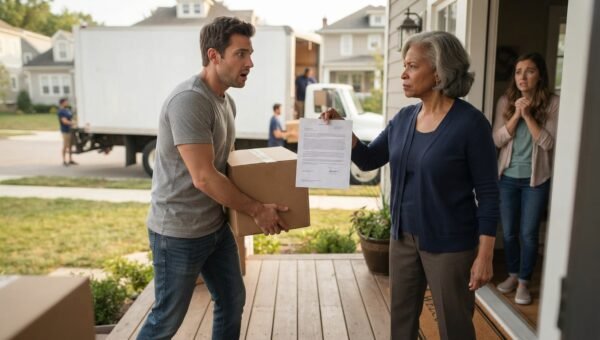
The heavy black wreath on our front door was barely dry when Brenda had the deadbolts changed. It was two days after my father’s funeral, a service where Brenda had wept into a black lace handkerchief while standing as far from me as polite grief allowed. I drove up the gravel driveway expecting to pick up the photo albums Dad and I had spent hours sorting through last winter, only to find my key spinning uselessly in the top lock.
When I pounded on the oak door, Brenda slid the side window open an inch, her face tight behind the screen. She wore one of Dad’s old cashmere cardigans that hung off her slight shoulders, though it belonged in the donation pile we had discussed only a week prior.
“The house goes to family, Brenda said, her voice flat and devoid of any warmth. Your father left everything to me in his revised will. You have no legal claim here, and quite frankly, your presence is upsetting my nerves.”
I pointed down to the driveway where three large black contractor trash bags sat right beside the rural mailbox, baking in the midday July heat. One of them had tipped over, spilling a pile of my winter sweaters and a framed portrait of my mother across the dirt.
“Those are my things, Brenda,” I said, my chest tightening with a mix of shock and rising fury. “That was my mother’s portrait. You didn’t even give me twenty-four hours.”
“You can take your garbage and leave,” she snapped, and slid the window shut with a sharp click, locking the latch.
I stood by the mailbox for a long moment, my hands shaking as I gathered my mother’s picture from the gravel. The glass was cracked right across her smile. Dad had built this house with his own hands back in nineteen eighty-four, hammering every plank of cedar while I sat in the dirt playing with wood scraps. He had promised me repeatedly over coffee at the kitchen table that the homestead would stay in the bloodline, that when he passed, the roof over my head would be secure. Instead, I was standing in the dust with three bags of clothes, locked out by a woman he had married three years ago after a whirlwind courtship at a local garden club.
Driving into town, my phone buzzed in the cup holder with notifications from the probate lawyer I had briefly consulted before the funeral, warning me that second spouses often held survivorship rights unless a specific prior trust protected the children.
But I didn’t care about the legal paperwork just yet; my anger was entirely focused on the sheer cruelty of dumping my personal belongings by the mailbox like trash.
I pulled into Miller’s Lock and Key on Main Street. Old man Miller had retired the year before, but his nephew Tom was running the shop now. Tom had known my father since we were kids; he used to let us sit on the counter and chew bubblegum while Dad picked out replacement tumblers for the farm gates.
When I walked in, carrying the broken frame, Tom looked up from a brass cylinder he was re-pinning.
“I heard about your dad, Sarah,” he said, setting his tools down. “I’m real sorry. I know you two were close.”
“Brenda changed the locks on the house today,” I told him, my voice shaking. “Two days after the service. She threw my clothes out by the mailbox.”
Tom scowled, wiping his grease-stained hands on a rag. “That don’t sit right. Your dad called me just last month complaining about the back latch sticking. He made me put a heavy-duty deadbolt on the front door, but he insisted on keeping the old mortise lock underneath it just in case of power failures, he said. He liked the old iron skeleton keys.”
“She won’t let me back in to get my mother’s cedar chest or my childhood photo albums,” I said.
Tom reached under the counter and grabbed a heavy canvas tool roll. “Come on. I installed those locks. If your name is still on the deed or if you have a right to retrieve personal property, I’ll go out there with you and make sure you get your things without a shouting match.”
Twenty minutes later, Tom’s service truck was parked behind my sedan in my father’s driveway. The house was quiet, the curtains drawn tight against the afternoon sun. Brenda’s gray sedan sat in the garage, but there was no sign of her at the front window as Tom walked up the porch steps with his pick set.
“This is ridiculous,” Tom muttered, sliding a tension wrench into the top keyway. “Your dad loved this place. He talked about you every time I came out to fix a door. Said you were the only one who understood how he wanted the workshop organized.”
He worked the pick with practiced patience, the small metallic clicks echoing off the porch timber. Within thirty seconds, the new brass deadbolt gave a dull thud and slid open.
“There,” Tom said, stepping back to let me push the door. “Now let’s get your photo albums and get out before she calls the sheriff.”
As I pushed the heavy oak door inward, the familiar scent of old pine and lemon oil hit me, bringing a fresh wave of grief. But as I stepped over the threshold, Tom reached down and tapped his boot against the bottom of the doorframe.
“Hold on a second, Sarah,” he frowned, leaning down close to the wood. “Look at this.”
I looked down. The new deadbolt sat high up, but right below it, nestled in the woodwork where the old mortise lock had been, the faceplate looked slightly askew.
“She didn’t just change the top lock,” Tom said, pulling a screwdriver from his belt. “She put a brand new faceplate over the old keyhole. Why would she cover a working lower lock unless…”
With a sharp twist of his wrist, Tom unscrewed the brass plate. As the metal peeled away from the wood, something small and heavy dropped out of the cavity, hitting the hardwood floor with a sharp clatter and rolling across the entryway rug.
I knelt down and picked it up. It was a narrow, heavy brass key, blackened with age at the grip and stamped with a small, uneven numeral: ATTIC 3.
PART 2
I turned the cold brass key over in my palm, feeling the sharp edges of the stamping.
“Attic three?” I whispered, looking up at Tom. “There are only two rooms up in the attic. Dad showed them to me when we insulated the rafters back in ninety-eight. One was his old storage room for farm ledgers, and the other was just empty eaves.”
Tom picked up his flashlight from the tool roll and clicked it on, shining the beam up the open stairwell that led from the kitchen corridor. “People build hidden spaces all the time in old houses like this,” he said quietly. “Especially men from your father’s generation. They like secrets.”
We walked down the hall past the kitchen, where a half-empty mug of coffee sat on the counter with a skin formed over the top. The house felt entirely different now, stripped of its usual warmth and smelling faintly of the heavy floral room spray Brenda favored.
The pull-string for the attic stairs hung from the ceiling near the pantry. I pulled it down, the wooden ladder folding out with a familiar groaning sound that had punctuated my entire childhood.
“Wait here a minute,” Tom whispered, stepping ahead of me and climbing up into the dim space above.
I followed him up into the dusty heat of the upper floor. The afternoon sun beat down through the small gable window, illuminating floating motes of dust. To our left was the ledger room, boxes of old tax forms and spare tractor parts stacked neatly against the brick chimney. To our right was the spare eaves room, its door wide open to show empty rafters and a few old trunks.
“There’s nothing here except junk,” Tom called out from the far corner, sweeping his flashlight beam along the paneled wall.
“Look at the key again,” I said, holding it up in the dim light. “It says attic three. If there are only two rooms, why is this number three?”
Tom walked back to the center of the floor, shining his light along the baseboards. He ran his hand along the vertical oak paneling that separated the main storage area from the chimney chase.
“Listen,” he said, tapping his knuckles against the wood.
The sound wasn’t the dull thud of a hollow wall. It was a solid, muffled echo, as if something heavy was pressed against the other side.
“There’s a void behind here,” Tom said, his voice dropping to a low murmur. “Help me push this bookcase.”
It was a heavy oak shelving unit filled with old hardware catalogs and seed corn manuals. Together, we shoved it sideways across the wide pine floorboards. As the bookcase slid out of the corner, it scraped over a hidden latch set low in the baseboard, revealing a narrow vertical seam in the wood paneling that had been disguised to look like regular wall siding.
There was no visible handle, just a small keyhole set at eye level.
I stepped forward and slid the heavy brass key into the slot. It fit with a deep, satisfying click. When I turned it, a heavy internal bolt slid back with a pneumatic hiss, and the panel swung open toward us, releasing a gust of cold, perfectly stale air that smelled faintly of lavender and old paper.
PART 3
I reached out and flicked a small toggle switch just inside the hidden doorframe. A single overhead bulb flickered to life, casting a harsh yellow glow over a space no larger than a walk-in closet, tucked completely inside the dead space between the roof gables and the second-floor ceiling.
Tom stepped in first, his boots crunching softly on the floor. I followed him, my breath catching in my throat as my eyes adjusted to the light.
It wasn’t an attic storage room. It was a nursery.
In the center of the small room sat a white wicker crib, draped with yellowing lace and piled high with tiny knitted blankets. A mobile of wooden stars hung from the ceiling beam, motionless in the dead air. On a small pine dresser beside the crib sat a row of silver-wrapped birthday gifts, each one bearing a small white gift tag with neat, familiar handwriting.
I stepped closer, my fingers trembling as I reached out to touch the tag on the nearest package.
*To our granddaughter, Maya. On your fifth birthday. Love, Grandpa and Grandma.*
“My God,” Tom breathed, staring at the wall beside the dresser. “Sarah… look at the calendar.”
Nailed to the wood paneling was a large wall calendar opened to the month of October, twenty-four years ago. Every single date from the middle of the month onward had been crossed out with a heavy black marker, and across the bottom margin, in my father’s handwriting, were the words: *She is safe. Brenda agreed to tell her the truth when she turns eighteen.*
I stared at the crib, the small stuffed rabbit sitting against the pillow, and the framed hospital birth certificate resting on the dresser top. The name on the document was mine, but the date of birth and the mother’s name listed underneath were not mine at all—they belonged to a young woman from the neighboring county whom my father had quietly taken in during a bitter winter storm before he married Brenda.
“Your dad didn’t just hide things from Brenda,” Tom said quietly, his hand resting on my shoulder. “He hid a whole life up here.”
Before I could answer, heavy footsteps creaked on the pull-down stairs below us.
“Who is up there?” Brenda’s voice rang out through the floorboards, shrill and sharp. “Tom Miller, you get out of my house this instant or I am calling the state troopers!”
The sound of her heels clicking across the kitchen floor grew louder as she marched toward the stairs. A second later, her face appeared at the top of the ladder, flushed with anger and clutching a heavy brass fireplace poker in her right hand.
She stopped dead on the top rung. Her eyes swept past Tom and locked directly on the open panel, the wicker crib, and the rows of wrapped birthday gifts lining the shelves.
The color drained entirely from Brenda’s face, leaving her skin the gray-white of old parchment. The fireplace poker slipped from her fingers, clattering loudly against the wooden steps before rolling down into the darkness below.
ENDING
Brenda didn’t scream. She just gripped the edges of the ladder with both hands, her knuckles turning white as she stared into the small room where my father had preserved a family she had spent three years trying to erase.
“He promised me,” Brenda whispered, her voice cracking into a dry, ragged wheeze. “He swore on his mother’s grave that child was never coming home, that he had put the past in a box and buried it where no one would ever find it.”
“You locked me out of my own home two days after he died,” I said, stepping out of the hidden room and standing at the edge of the attic landing, looking down at her with a coldness I didn’t know I possessed. “You threw my mother’s picture in the dirt. But you didn’t even know what was hiding in the walls he built.”
Brenda shook her head, backing down a step on the ladder as if the sight of the crib was physical pain. “He left the house to me. The lawyer said the deed was clear. You can’t change that.”
“The deed might be in your name, Brenda,” Tom said from inside the room, holding up the hospital birth certificate and the stack of gift tags. “But fraud has a funny way of opening doors that deadbolts can’t lock. Especially when there’s a second family waiting to hear what happened to the inheritance your husband set aside before you ever moved in here.”
Brenda stared at us for one long, silent moment, realizing the full weight of what her haste had uncovered. Without another word, she turned around on the ladder, stumbled down the stairs, and fled out the back door, leaving the screen swinging in the summer wind.
I stayed in the attic for a long time after she left, turning the heavy brass key over in my hand while Tom called the local authorities to secure the house. The locks Brenda had installed that morning were still intact, but the house no longer belonged to her secrets. Through the gable window, the sun dipped below the tree line, casting a golden light across the tiny wooden crib that waited twenty-four years for a child who was finally home.