PART 1
For six years, my mother found a reason to miss every single thing my son ever did on a stage.
It started back in second grade with his winter holiday pageant. Toby had four lines dressed as a snowy pine tree, and he practiced them until he could say them in his sleep. Mom called at four in the afternoon on the day of the show, claiming her hip was stiff from the rain.
But three days later, my sister Brenda posted a video on Facebook of Mom standing on a chilly aluminum bleacher in the biting wind, waving a homemade banner at Brenda’s eight-year-old twins during their pee-wee soccer tournament.
In fourth grade, Toby played the recorder in the spring band showcase. Mom said her evening driving glasses were lost somewhere in the cushions of her sofa. That same night, Brenda checked in at an ice cream parlor across town, tagging Mom with a photo of a giant chocolate sundae to celebrate Brenda’s daughter making the travel cheer squad.
I stopped asking after fifth grade. I told myself I was protecting Toby, but really I was protecting my own pride. I hated the small, hopeful look on my twelve-year-old boy’s face when he asked if Grandma Clara was going to make it, and I hated the flat knot in my stomach every time I had to invent an excuse for a woman who lived just twenty minutes away.
Brenda had always been the golden child, the daughter who married an orthodontist, lived in a gated subdivision, and gave Mom the social standing she craved at church coffee hour. I worked as a bookkeeper for a local lumber yard, raised Toby on my own after his father walked out when Toby was three, and lived in a small, weathered brick ranch house that smelled like floor wax and laundry detergent.
Then eighth grade arrived, and Toby did something none of us saw coming. He tried out for the middle school spring musical, The Music Man, and won the lead role of Harold Hill.
He worked on those songs until his voice cracked. He practiced his marching steps in the kitchen while I browned ground beef for dinner. When the formal tickets were printed on heavy cardstock, the drama teacher gave each cast member five tickets to distribute to their families.
Toby took one ticket, laid it flat on our kitchen counter, and carefully wrote “Row C, Seat 8 — Please come this time, Grandma” along the top margin in blue felt-tip marker. He slipped it into a stamped envelope and walked it down to our mailbox himself.
Two days before opening night, Mom sent me a short text message: “My bursitis has flared up terrible. I am simply too tired for loud kid stuff. Tell Toby good luck and give him a hug from me.”
I stared at the screen while the kitchen clock ticked on the wall. Loud kid stuff. That was what she called my son’s months of sweat and courage. I didn’t yell. I didn’t text back an angry paragraph. I simply wrote: “Understood. Hope you feel better.”
Opening night was a Friday in late April. At five-thirty, Toby was already in the middle school green room getting his stage makeup applied.
I was standing in my bedroom, smoothing the wrinkles out of my navy dress pants, when my phone chimed on the dresser. It was a Facebook notification. Brenda had posted a photo album.
The first picture was my mother. She was wearing a brand-new lavender cardigan, sitting under bright fluorescent lights in an auditorium sixty miles away in Greenville, smiling broadly next to Brenda. The caption read: “Grandma drove two whole towns over to support her favorite little dancer! First place in solo jazz! Family first, always!”
My hands shook so hard I nearly dropped the phone. Mom had not been too tired. Her hip hadn’t flared up. She had deliberately chosen Brenda’s child over mine, just like she had done for six straight years, fully aware that Toby’s biggest night was happening at the very same hour.
I swallowed the lump in my throat, turned off my phone, and drove to the school. I bought a bouquet of grocery-store carnations, walked into the auditorium, and took my seat in Row C. Seat 8, the seat Toby had reserved for his grandmother, sat empty beside me. I placed my coat on it so nobody else would slide into the space. Toby had checked the curtain peephole five minutes earlier; I had seen his head pop out and then quickly pull back. I knew he was looking for her.
The house lights were dimming. The overture was about to start when someone tapped my shoulder.
It was Mr. Henderson, Toby’s middle school principal. He was leaning over my row, his brow furrowed in genuine confusion.
“Rachel?” he whispered. “Excuse me. Do you have a minute? There’s an elderly woman sitting on the bench by the front doors. She is crying uncontrollably, and she keeps clutching a wrinkled ticket with Toby’s handwriting on it. She says she isn’t allowed to walk inside.”
PART 2
I stared at Mr. Henderson for a second, my mind refusing to fit the pieces together. Greenville was an hour and a half away. Brenda had posted that photograph barely two hours earlier.
“She’s outside?” I asked, my voice barely louder than the cello tuning up in the orchestra pit.
“She’s out on the brick steps right by the glass vestibule,” Mr. Henderson said quietly. “The ticket monitors didn’t want to turn her away, but she won’t even step through the doors. She says she doesn’t deserve to sit down. You might want to come out before the overture starts.”
I grabbed my purse, stood up, and slipped out the side aisle.
The spring night air hit my face with a sudden chill. Standing in the yellow glow of the school entrance lights was my mother.
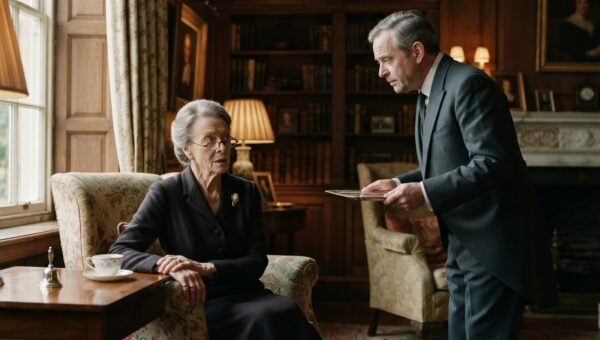
She looked completely dismantled. The lavender cardigan Brenda had photographed her in was unbuttoned at the neck. Her hair, usually sprayed into a neat silver helmet for public outings, was whipped sideways by the highway wind. She was sitting on the cold concrete edge of the flower planter, her hands trembling around the stiff yellow paper of Toby’s ticket. Her eyes were red, swollen, and wet.
When she heard the heavy crash bar of the exterior door slam shut behind me, she looked up.
“Rachel,” she whispered.
I didn’t step down the stairs toward her. I stood under the brick archway with my arms folded across my chest. The anger that had been simmering inside me for six years felt like cold iron.
“What are you doing here, Mom?” I asked. “Brenda said you were in Greenville watching the jazz solo. You were too tired for Toby’s show. That’s what you told me.”
Mom tried to push herself up from the planter, but her knees seemed weak, and she ended up catching herself against the brick wall.
“The picture was from last Saturday,” she said, her voice shaking so hard the words sounded brittle. “It was from the regional qualifiers. Brenda saved it to post today. She knew Toby had his play tonight.”
“And you let her?” I snapped. “You texted me two days ago saying your bursitis was flaring up and you couldn’t handle loud kid stuff.”
Mom closed her eyes, tears leaking down the deep creases beside her mouth. She reached into her handbag with trembling fingers and pulled out a small stack of folded envelopes.
“Brenda wrote that text, Rachel,” she whispered. “She took my phone on Wednesday when she was over helping me clean my pantry. She told me you had called her and said Toby’s musical was sold out, that the school had restricted tickets to parents only because of fire codes. She told me you gave the spare seat to your neighbor.”
I stepped down the concrete steps, my heart thumping against my ribs. “What are you talking about? Toby sent you the ticket in the mail three weeks ago. He mailed it himself.”
Mom held up Toby’s ticket. It was dog-eared and creased down the middle, the blue marker smeared where her damp thumb had pressed into it.
“I never got the envelope Toby mailed,” Mom said, choking on a sob. “I found this three hours ago. Brenda left her laundry basket in my utility room to wash before the Greenville finals tomorrow. I went to sort the towels, and I found four opened letters from this school jammed at the bottom of her tote bag. Along with Toby’s ticket. Along with the choir program from two years ago that you swore he didn’t want me at.”
PART 3
The parking lot was silent except for the faint, muffled thump of the orchestra’s bass drum through the thick school walls.
I stood there in the chilly spring dusk, the reality crashing down on me in waves.
Brenda had a key to Mom’s house. She lived two streets over from Mom, while I lived on the opposite side of town near the rail yard. Brenda checked Mom’s mail every day at noon while Mom was at her senior bridge club. Brenda had been filtering Mom’s life for six years, controlling every narrative, making sure Mom felt entirely dependent on Brenda’s family while believing that Toby and I were distant, embarrassed of her, or too busy to include her.
“Brenda told me you never wanted me around because Toby’s father left,” Mom wept, wiping her nose with a wadded tissue. “She said you were ashamed of being on your own, and that seeing me around the school made you feel like people were pitying you. Every time I asked about his band concerts, Brenda told me you had already taken your friends and asked her not to tell me so my feelings wouldn’t get hurt.”
“And you believed that?” My voice cracked. The pain of six wasted years burned in my throat. “You believed I would hide my own child’s life from you? Did you ever pick up the phone and ask me? Did you ever call your own grandson and ask him how his music was going?”
Mom lowered her head. She looked smaller than she ever had, stripped of the tidy, respectable veneer she always kept up for the neighborhood.
“I was a coward, Rachel,” she whispered, the tears spilling down onto the collar of her sweater. “Brenda made everything so easy. She drove me to the doctor. She brought me dinners. She made me feel needed by asking me to watch her kids at their games. Whenever I questioned her, she threatened to stop bringing the grandchildren over. And whenever I asked about you, she sighed and told me you were bitter, that you needed space, that pushing you would only drive you further away. I took the easy way out. I let her poison me against my own daughter because I was terrified of ending up alone in that house.”
She reached out, holding the wrinkled cardstock toward me.
“I drove here like a madwoman,” she said. “I found this ticket in her bag at four o’clock. I confronted her on the phone. She laughed at me, Rachel. She actually laughed and said, ‘Mom, Toby isn’t talented anyway, you’d be bored to death.’ That was when I realized what she was. That was when I realized what I had allowed myself to become.”
The muffled sound of laughter and applause drifted out through the school vents. Toby was on stage. The overture had finished.
“I got in my car and sped the whole way here,” Mom sobbed, looking down at her scuffed walking shoes. “But when I saw the families walking through the doors, with their flowers and their programs, I couldn’t move my feet. I sat on this planter and realized I had missed his entire childhood because I was too weak to ask you a single honest question. I have no right to walk in there. I have no right to look that boy in the eye.”
ENDING
I looked at the wrinkled ticket in her shaking hand. I looked at the blue marker, Toby’s careful eighth-grade lettering asking his grandmother to please come this time.
I felt the urge to leave her there on the concrete. Part of me wanted her to sit in the cold and feel every ounce of the isolation Toby and I had felt for six years while watching Brenda’s endless parade of trophies and celebrations online.
Then I pictured my son standing behind the curtain in his ridiculous checked suit, waiting for his big solo in act two, hoping against hope that the empty chair in Row C had filled up.
I reached out and took my mother by the elbow.
“You don’t get to sit out here and feel sorry for yourself,” I said, my voice firm and low. “That’s just another easy way out. You’re going to stand up, you’re going to wipe your face, and you’re going to walk into that auditorium.”
Mom looked up, startled. “Rachel, I can’t. Look at me. I’m a mess.”
“Nobody is looking at you,” I told her. “They’re looking at Toby. And Toby deserves to look out into that crowd and see the person he saved that seat for.”
She swallowed hard, straightened her lavender sweater, and let me guide her through the heavy glass doors. Mr. Henderson saw us coming, quietly opened the back door to the auditorium, and gave me a gentle nod.
We slipped into Row C just as the stage lights swelled for “Seventy-Six Trombones.” Toby was right in the center, arms raised, his voice filling the room with a clear, booming brightness I hadn’t known he possessed.
As he turned toward the left side of the house, his eyes scanned our row. He saw me, and then his gaze locked onto the woman sitting beside me, clapping with both hands pressed high against her chest, tears streaming unchecked down her cheeks. The briefest flash of surprise crossed Toby’s face, followed by the widest, most radiant grin he had worn all year. He sang the rest of that number straight toward Row C.
Brenda called Mom’s cell phone twelve times during the show. In the lobby afterward, while Toby was surrounded by classmates signing programs, Mom took her phone out of her purse, stepped over to the trash can by the water fountain, and turned the device completely off.
“Let her call,” Mom said quietly, her voice steadier than I had heard it in years. “Tomorrow morning, the locks on my front door are being changed. And Brenda can explain to the family why she’s no longer the one handling my affairs.”
We didn’t fix six years of neglect in one evening. Forgiveness doesn’t work like a switch you flip; the scar of being sidelined doesn’t disappear just because the truth finally came out. But that night, we took Toby to the twenty-four-hour diner down on Route 4. Mom sat across from him in the vinyl booth, still wearing her crumpled sweater, and listened to him talk about stage lighting and missed cues until one in the morning. For the first time in his life, my son had her undivided attention, and for the first time in mine, I didn’t have to make up an excuse for why she wasn’t there.