PART 1
My father was seventy-nine when Mom died, and about three months after her funeral, he started clearing out the house like a man who knew his lease was up.
It started with small things that felt harmless enough. His vintage fly rods, the ones he kept in green canvas sleeves behind the water heater, went to the high school boy across the road who cut our lawn. His old turntable and three wooden crates of gospel records went to the church rummage sale on a Saturday morning.
When I went by his place on Tuesdays to bring him groceries and do his laundry, I would find another corner scraped clean. An empty shelf where his carved wooden duck used to sit. A blank patch on the wood-paneled hallway wall where his Korean War service plaque had hung for forty years.
Every time I asked him about it, he just wiped the kitchen table with a damp cloth and gave me that flat, quiet shrug of his. “Just getting rid of the clutter, Sarah. When a man gets to be my age, stuff just turns into dust you have to sweep anyway.”
Then came the phone call about the cabin.
The cabin was forty acres up near the river outside of Pine Creek. My grandfather built the original one-room cedar shack back in the fifties, and over the years, Dad and my uncles had added a screened porch, a second bedroom, and a wood stove.
It wasn’t fancy, but it was where we spent every Fourth of July of my childhood. When Mom got sick with cancer four years ago, my younger brother, Greg, stopped visiting the river altogether. He said seeing the woods just made him depressed about her illness.
Greg was thirty-eight, ten years younger than me, and he had spent his entire adult life bouncing from one great idea to the next. He had tried selling imported kitchen knives, flipping leased sports cars, and running an independent logistics firm out of his spare bedroom that folded after nine months and left him sixty thousand dollars in credit card debt. Whenever the bottom fell out, Mom had always been the one to write the check. She called Greg her “sensitive boy.” After she passed, Greg didn’t call Dad much, except when his truck broke down or when he needed help covering the quarterly tax penalty on his failed business.
On a Thursday night in late October, Dad called my house while I was washing dinner plates.
“Sarah,” he said, his voice slow and heavy over the line. “I’ve been thinking about the river place. I’m going to deed the cabin over to your brother. He needs it more than you do. You and David have your retirement set, and your mortgage is almost paid off. Greg needs something solid under his feet.”
A bitter, familiar ache flared up in my chest. For two straight years, I had taken Mom to every single round of chemotherapy while Greg claimed his car had transmission trouble. I was the one who drove over to clean Dad’s refrigerator and make sure his blood pressure pills were organized in his plastic Sunday-through-Saturday organizer. Greg hadn’t even stayed for the reception after Mom’s burial because he said he had a business dinner in the city.
And now, Greg was getting the family cabin because he couldn’t hold down a regular job.
I leaned against my kitchen counter, looking out the window at the rain tapping against the glass. I was tired. I was fifty-four years old, working forty hours a week managing a dental clinic, and I simply didn’t have the stomach to fight over real estate.
“If that’s what you want to do, Dad, it’s your property,” I said quietly. “You do what makes you comfortable.”
“All right then,” he muttered. He sounded almost relieved, though his voice was dry as bone. “I’ll handle the paperwork.”
Two weeks went by without another word about it. Greg didn’t call to thank me, and Dad didn’t bring it up when I dropped off his groceries that weekend.
Then, on a cold Tuesday morning, Dad called and asked if I could take half a day off work to drive him down to the county clerk’s office in town. He told me he needed a ride because his cataracts were bothering him in the morning glare. I told him I would pick him up at nine.
When he climbed into the passenger seat of my Subaru, he was wearing his Sunday church suit. The fabric was shiny at the elbows, and it hung loose on his frame because he had lost nearly twenty pounds since Mom died, but his white collar was stiff and pressed. He carried a battered leather portfolio tucked tight under his right arm.
We had driven about five miles down the state highway when he pointed a crooked, arthritic finger toward the Dairy Freeze on the edge of town.
“Pull in there, Sarah,” he said.
I looked at him, puzzled. “The Dairy Freeze? Dad, it’s nine-fifteen in the morning, and it’s barely forty degrees outside.”
“I want a vanilla milkshake,” he said simply.
I stared at him for a second. In all my fifty-four years on this earth, I had never once seen Arthur Miller order ice cream, let alone a vanilla milkshake. He hated sweets. Whenever Mom baked her famous peach cobbler, he would take two bites of the crust and leave the rest on his plate. He called soft ice cream “cold lard.”
“Since when do you drink milkshakes?” I asked, slowing the car down.
“Since today,” he replied, looking straight out the windshield. “Go through the drive-through. Get one for yourself if you want, but buy me a small vanilla.”
I pulled into the lane, placed the order with a teenage girl who looked half-asleep, and handed Dad the white paper cup with the red plastic straw. He took three long, deliberate sips, his eyes fixed on the glove compartment, then set the cup into the center console holder. He didn’t say another word about it.
We drove the rest of the way to the county courthouse in complete silence.
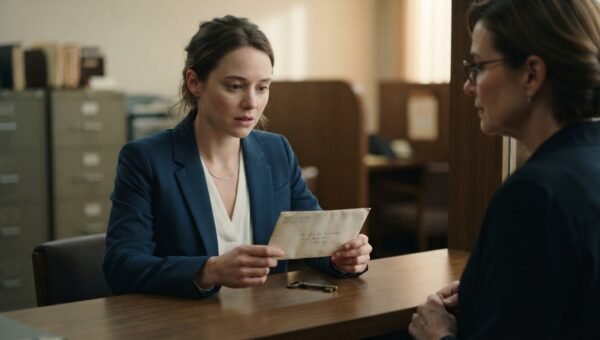
The clerk’s office was on the second floor, down a long hallway that smelled like old paper, industrial wax, and radiator steam. An older woman named Clara, who had worked land records in the county since I was in middle school, looked up from behind the wide laminate counter.
“Morning, Arthur,” Clara said warmly, adjusting her reading glasses. “I have those transfer packets you called about last week.”
“Morning, Clara,” Dad said. He stepped up to the counter, unzipped his leather portfolio, and slid a manila folder across the counter. “I’m ready to file the change.”
I stood two paces behind him, keeping my arms crossed over my coat. I had already made peace with Greg getting the cabin. I had told myself in the mirror that morning that a piece of river dirt wasn’t worth breaking whatever peace Dad had left in his final years.
Clara opened the folder, turned the first page toward Dad, and laid a black ballpoint pen on top of it. She pointed to a flagged line. “Your signature here as the grantor, Arthur. And Sarah, you’ll need to sign as the grantee right below him.”
I froze. My breath caught in my throat.
“Wait,” I stepped forward, looking down at the legal description stamped on the parchment. It was the parcel number for the Pine Creek cabin. “Clara, you made a mistake. My brother Greg is taking the cabin. Dad told me two weeks ago.”
Clara didn’t flinch. She just looked at Dad.
Dad didn’t look at Clara. Instead, he reached out, took my wrist in his dry, weathered hand, and squeezed it with surprising strength. His blue eyes, usually clouded and tired these days, were dead sharp.
“Dad, what are you doing?” I whispered, my voice trembling in the quiet room. “You told me Greg was getting the cabin. You said he needed it more.”
“I told you Greg needed something under his feet,” Dad said, his voice dropped low, meant only for me. “The cabin isn’t the part I’m worried about, Sarah.”
Before I could process what he was saying, Clara opened a second drawer beneath the counter. She pulled out a heavy legal document bound with blue cardboard backing and set it right on top of the cabin deed.
It was a certified deed for two hundred and ten acres of timberland in the northern ridge of the county. Land our family had never once mentioned in fifty years.
PART 2
I looked from the blue-backed document to my father, feeling the air completely leave my lungs.
“Dad,” I whispered, glancing nervously at Clara, who politely pretended to examine a ledger on her computer screen. “What is this? You don’t own two hundred acres in the north county. Grandpa only had the farm on Miller Road and the forty acres at the cabin.”
“Your grandfather didn’t buy it,” Dad said, his voice flat and steady. “I bought it. Back in 1974, before your brother was even a thought in anyone’s head. Paid four thousand dollars cash for the tax lien on it when the old pulp mill went belly up.”
“Why didn’t you or Mom ever say anything?”
“Because your mother made me swear to God Almighty I’d never touch it, never talk about it, and never sell it,” he said. He picked up Clara’s pen and tapped the wood counter. “Sign the cabin deed first, Sarah. Then we’ll deal with this one.”
My hands were shaking as I picked up the pen. The signature line for the Pine Creek cabin had my full legal name already typed out in crisp black ink: Sarah Miller Evans.
“Dad, Greg thinks you’re giving him the cabin today,” I said, hesitating over the paper. “He called me last Sunday asking if the riding mower was staying in the shed. If he finds out you gave the river place to me, he will tear our family apart. You know how he gets.”
“Greg isn’t getting the cabin because Greg can’t own a five-dollar hammer without pawning it for three dollars,” Dad said, not a flicker of hesitation in his voice. “I let him believe he was getting it so he’d quit sniffing around the house. For the last six months, every time he came by, he went through the file drawers in the spare bedroom while I was in the bathroom. He thinks there’s insurance money. He thinks Mom had a private savings account.”
Dad tapped the paper again. “Sign it.”
I signed my name on the line. Clara notarized the signature with a heavy metal press that thumped against the laminate, took Dad’s fifty-dollar recording fee, and filed the cabin transfer into the county records.
Then Dad turned his attention to the second document.
The paperwork listed parcel number 44-098, encompassing two hundred and ten acres of dense hardwoods bordering the state forest line. But attached to the back of the deed was a bright yellow notice stamped in red ink from the County Board of Commissioners, dated three weeks prior.
I leaned closer, reading the formal print. It was a formal notification of a public easement purchase and an adjacent commercial access appraisal. The county was extending the southern highway bypass straight through the lower third of that property, and a regional utility consortium had already filed an offer for mineral and transit rights on the remaining acreage.
The assessed county purchase offer listed at the bottom of the page was seven hundred and forty thousand dollars.
My knees felt weak. I had to plant my palm on the edge of the clerk’s counter to steady myself. Seven hundred and forty thousand dollars. To a retired school-district custodian and a mother of three who drove a ten-year-old car, that wasn’t just money. It was an impossible sum.
“Dad…” My voice broke. “Did you know about this?”
“I’ve known the state was surveying that ridge for five years,” he said. He didn’t sound happy. He sounded bone-weary. “Your mother knew, too. That’s why she made me keep my mouth shut. She knew if Greg ever got wind of that parcel, he’d find a way to mortgage it to the hilt for one of his schemes before the county even broke ground. She knew he’d bleed it dry, and when it was gone, he’d be right back on our front porch with his hand out.”
“Then why didn’t you sell it when Mom got sick?” I asked, anger suddenly cutting through my shock. “Dad, we were drowning in medical bills! You took out a second mortgage on the house in town to pay for her experimental immunotherapy treatments in St. Louis! I watched you eat canned soup for lunch every day for a year while you worried about keeping the heat on!”
Dad looked down at his shoes. His knuckles were white against the counter edge.
“Because the land wasn’t mine to sell,” he whispered.
“What are you talking about? Your name is on the deed!”
“Look at the bottom line, Sarah,” Dad said quietly. “Look at who bought that lien with me in 1974.”
I turned the page over. Underneath my father’s signature from fifty-two years ago was a second name, written in neat, deliberate cursive that I recognized instantly.
It was my aunt Evelyn, Mom’s older sister. Evelyn had died thirty years ago in a car crash on Route 9, leaving behind no husband and only one surviving child: my cousin Mark, who had moved to Oregon in the nineties and barely kept in touch.
“Evelyn put up half the money,” Dad said. “When she died, her share was supposed to go into a trust for Mark, but the paperwork was a mess, and Mark was off in the Navy. Your mother and I never settled the estate. We just paid the annual property taxes out of our joint account every November and let the trees grow. If I had sold that land while Mom was dying, half that money would have belonged to Mark, and the other half would have gone straight into probate court. It would have triggered a legal war between Greg, Mark, and me while your mother was fighting for her breath.”
He looked up at me, his eyes rimmed with red.
“Your mother made me promise on her deathbed that I would fix Evelyn’s share for Mark, and that whatever was left would go to you. Not to Greg. She told me, ‘Arthur, if you give Greg money, you are buying his funeral. Give him a roof, but don’t give him cash.’ That was her exact words, Sarah.”
“So what does this document do?” I asked, staring at the blue cover.
“It transfers my half of the parcel into an irrevocable land trust,” Dad said. “With you as the sole trustee. Not Greg. You. You’ll have the legal authority to sign off on the county’s bypass buyout, pay off Mark’s fifty percent share fair and square, and keep whatever is left to take care of yourself.”
“And what about Greg?”
Dad reached into his suit jacket and pulled out a clean, folded envelope. He laid it gently on top of the blue deed.
“Greg gets the house in town,” Dad said softly. “The one with the twelve-thousand-dollar mortgage balance left on it. I signed the transfer on death deed yesterday. He gets a roof over his head, fully paid off once he clears that last twelve thousand. If he sells it, he has to find his own place to live. But he won’t be able to touch the land, and he won’t be able to touch the river cabin.”
He looked at me with a tired, sad smile.
“That’s why I wanted the vanilla milkshake, Sarah,” he murmured. “Because your mother always bought me one from that Dairy Freeze every time we had to make a hard choice we didn’t want to make. Said it kept a person from tasting their own bitter thoughts.”
I felt a tear slip down my cheek, hot and fast. I picked up the pen and signed the trust documents.
We walked out of the courthouse together into the gray October chill. I helped Dad into the passenger seat, buckled his belt, and drove him back to his quiet, empty house.
Three days later, on a Friday afternoon, Greg showed up at Dad’s front door with a notary he had hired from the local bank and a printout of a quitclaim deed for the Pine Creek cabin.
PART 3
I was in Dad’s kitchen putting away a pot of chicken noodle soup I had made for him when the front screen door banged open.
Greg didn’t bother knocking. He walked right into the living room, wearing a sharp navy blazer that looked brand new and smelling of expensive cologne. Behind him was a middle-aged woman carrying a brown leather briefcase and a notary stamp.
“Dad!” Greg called out, his voice booming with forced cheerfulness. “Rise and shine, old man! I took the afternoon off work. Brought Brenda here from the credit union. We’re going to get this cabin thing signed, sealed, and delivered so you don’t have to worry about the maintenance anymore.”
Dad was sitting in his worn recliner by the window, reading the morning newspaper. He didn’t jump. He didn’t even drop his paper. He just lowered the top edge by two inches and looked over his spectacles at Greg.
“Hello, Gregory,” Dad said evenly.
Greg finally noticed me standing by the refrigerator with a wooden spoon in my hand. His smile tightened at the edges, his eyes narrowing slightly.
“Sarah. Didn’t know you’d be here,” he said, adjusting his collar. “Look, this won’t take long. Just need Dad to sign the quitclaim for the river place, Brenda will stamp it, and I’ll run it down to the clerk’s office before five.”
“You don’t need to trouble Brenda, Greg,” I said, stepping into the living room and wiping my hands on a dish towel.
“It’s not trouble, it’s business,” Greg snapped, his usual impatient edge surfacing. “Dad said two weeks ago he was deeding it over. I’ve already got a contractor lined up to look at the roof on Monday. A guy I know from the gym wants to partner up and list the whole forty acres as an off-grid vacation rental. We could pull four grand a month easy during hunting season.”
There it was. The real plan. He wasn’t looking for a quiet retreat or a family legacy. He had already mentally leveraged the cabin for another speculative venture before the ink was even on the page.
Dad folded his newspaper slowly, placed it on the side table, and gripped the armrests of his chair to push himself up. He stood on shaky legs, his shoulders stooped, but his gaze was level.
“You’re too late, Gregory,” Dad said.
Greg blinked, looking around the room as if searching for a joke. “What do you mean, too late? The clerk’s office is open till four-thirty.”
“I went down there on Tuesday,” Dad said. “The cabin deed is already recorded.”
A broad, smug grin broke across Greg’s face. He let out a loud laugh and slapped his knee. “Well, damn, Dad! You could have told me! You went ahead and filed it in my name without me having to drag Brenda out here? That’s great! That saves me an hour in line.”
“I didn’t file it in your name,” Dad said.
The silence that hit that room was absolute. Even the woman from the credit union seemed to realize she was in the middle of a disaster; she took a half-step backward toward the front door.
Greg’s smile vanished. “What did you say?”
“I deeded the cabin to your sister,” Dad said, his voice dropping into that low, granite tone he used when Greg had gone too far as a boy. “The deed is registered in Sarah’s name. She owns the forty acres and the cabin, free and clear.”
Greg’s face went from pale to a dark, furious crimson. The veins along his neck stood out like cords. He turned on me, his hands balling into fists at his sides.
“You,” he hissed, his voice shaking with pure rage. “You did this. You snake. You sat there on the phone two weeks ago and pretended you were fine with it, and then you went behind my back and poisoned his head! You couldn’t stand the thought of me having one damn thing, could you?”
“Greg, watch your mouth in this house,” Dad barked, stepping forward.
“No, Dad! To hell with that!” Greg yelled, turning on Dad now. “You promised me that land! You told me it was mine! I already put down a two-thousand-dollar deposit on a survey team! I owe people money on this deal!”
“That’s your business, Gregory,” Dad said coldly. “I told you that you needed something solid under your feet. And you have it. When I pass on, this house is yours. The mortgage has twelve thousand left on it. You pay that off, and you have a home for the rest of your life. But you are not getting the river place to gamble away on some rental scheme.”
“This house?” Greg gestured wildly at the wood paneling, the water-stained acoustic ceiling tiles, and the drafty front window. “This sixty-year-old dump? What am I supposed to do with this? I can’t borrow against a house that has a lien on it! The cabin was forty acres of prime timber! It was worth at least three hundred thousand!”
“The cabin is staying in the family,” Dad said. “Sarah will keep it. Her children will use it. It will not be sold.”
Greg took a deep, shuddering breath. He looked at Brenda, who was staring fixedly at the floorboards, clearly mortified.
“Get out of here, Brenda,” Greg muttered.
The woman didn’t need to be told twice. She turned, pushed open the screen door, and practically jogged down the front walkway to her car.
Once the door clicked shut, Greg turned back to us. The fury in his face had curdled into something cold, mean, and spiteful.
“You think you’re so smart, both of you,” Greg said, his voice dropping to a harsh whisper. “You think you won. But I know what’s in this town. I know Dad’s been meeting with an attorney. You think I don’t talk to people? Tommy at the hardware store said Dad was asking about estate tax exemptions last month. There’s money somewhere. Where is Mom’s money? Where did the life insurance payout go?”
“There was no insurance payout, Greg,” I said tiredly. “Mom’s policy lapsed three years before she died because she couldn’t afford the premiums when the clinic closed. I told you that at the funeral.”
“You’re lying!” he yelled, taking a step toward me.
Dad didn’t hesitate. For an old man with failing hips, he moved faster than I thought possible. He stepped squarely between Greg and me, his finger planted right against Greg’s chest.
“Do not raise your voice to your sister,” Dad ordered, his voice trembling with an authority that shook the room. “And do not speak of your mother in this house like she was an ATM machine. Your mother gave you every spare nickel she ever had, Gregory. She gave you forty thousand dollars for that knife business that you drank away in hotels. She paid off your leased car so the repo men wouldn’t come to your apartment. She protected you from the real world until the day she couldn’t breathe on her own anymore.”
Greg scoffed, crossing his arms, but he stepped back. “She loved me.”
“She loved you enough to worry herself into an early grave over what would happen to you when we were gone,” Dad said, his eyes welling with tears. “And her final wish to me was to make sure you had a roof over your head, and not a single dime of cash you could use to ruin yourself. If you want this house, you can have it when the good Lord calls me home. But if you take one step toward contesting your sister’s deed on that cabin, I will call the county clerk tomorrow morning and deed this house to the church.”
Greg stared at Dad for a long, agonizing moment. He looked at the old man’s trembling hands, then at me.
“You’re both dead to me,” Greg said.
He turned on his heel, walked out the front door, and slammed it so hard the glass pane rattled in the frame. A few seconds later, his truck engine roared to life in the driveway, tires spitting gravel as he tore off down the street.
Dad stood there in the quiet living room for nearly a full minute, listening to the sound of the truck fade into the distance.
Then his knees gave out.
ENDING
I caught Dad under his arms before he hit the carpet, easing him down into his recliner. His skin was gray, his breathing shallow and rapid. I hurried to the kitchen, poured a glass of tap water, and brought it back, kneeling beside his chair while he took slow, trembling sips.
“I’m all right, Sarah,” he whispered after a few minutes, leaning his head back against the worn fabric. “Just… took the wind out of me, is all.”
“He was just angry, Dad,” I said, though the venom in Greg’s words was still ringing in my ears.
“No,” Dad said softly, closing his eyes. “He was honest. That’s who he is when there’s no money on the table. Your mother always hoped he’d grow out of it. She kept thinking thirty-five would be the year, then thirty-eight. A mother doesn’t want to admit when her boy’s heart is hollow.”
He reached out and patted my hand where it rested on the armrest. “I’m sorry I put this weight on you, Sarah. But I couldn’t leave this world knowing Evelyn’s boy was cheated, and knowing you’d be left picking up the pieces after Greg burned through whatever was left.”
Over the next four months, I handled the business Dad had carried in secret for fifty years.
I hired a real estate attorney in town to review the trust and the northern acreage. The county’s bypass project was legitimate; the state transportation department had already finalized the route. Working through the trust, we negotiated the final easement and sale of the highway parcel for seven hundred and sixty-five thousand dollars.
Tracking down my cousin Mark took two weeks. He was living outside of Eugene, Oregon, working as a shop foreman for a commercial cabinet maker, raising two teenage daughters. When I finally reached him on the phone and explained what Dad had done, there was a long silence on the other end of the line. Mark had assumed his mother’s family had simply forgotten him after the funeral thirty years ago.
When the escrow closed six months later, a cashier’s check for three hundred and eighty-two thousand dollars was wired directly to Mark’s account, representing his mother’s half of that 1974 tax lien purchase, adjusted for the decades of property taxes Dad had quietly covered. Mark flew in for a weekend that spring just to sit on Dad’s porch, drink black coffee, and say thank you.
The remaining balance stayed in the family trust. Under the terms Dad laid out, the money was used to immediately pay off the twelve-thousand-dollar mortgage balance on Dad’s house, clear the remaining funeral debts from Mom’s illness, and establish a maintenance fund for the Pine Creek cabin.
Greg never called Dad again.
He didn’t call on Thanksgiving, and he didn’t show up on Christmas Eve, even though Mom had spent forty years making sure the entire family sat around the same dining table. A mutual acquaintance told me Greg had moved two counties over, working as a lot manager for a used car dealership and renting a duplex with a new girlfriend.
Dad lived another fourteen months after that cold morning at the county clerk’s office.
He passed away quietly in his sleep on a Sunday night in early April, just as the dogwood trees in the front yard were beginning to bloom. When the attorney notified Greg of Dad’s passing and explained the transfer on death deed, Greg signed the paperwork to take possession of the town house within seventy-two hours. He listed it for sale two weeks later, took whatever equity was left after the transfer taxes, and disappeared south toward Florida. He didn’t attend the burial.
The day after Dad’s service, I drove up to the Pine Creek cabin alone.
The river was running high and clear from the spring melt, tumbling over the gray stones behind the cedar porch. The old wooden rocking chairs Dad had built with his own hands were still sitting right where he left them, weathered by twenty winters but solid as iron.
I walked inside, opened the wooden shutters to let in the clean pine air, and set a cardboard box on the kitchen table. Inside were Dad’s old green canvas fly-rod sleeves, which the neighbor boy had brought back to me after the funeral, saying he thought the family ought to have them back.
On my way up the mountain that morning, I had stopped at the Dairy Freeze on the edge of town.
I carried the small white paper cup out to the porch, sat down in Dad’s rocker, and took a slow sip of the vanilla shake. It was thick, sweet, and entirely too cold for an April morning. But as I sat there listening to the water rush through the trees our grandfather had cleared with a crosscut saw, the bitter taste finally washed away.